
Ethos Invest launches world’s largest sharia-compliant fund

The fund is a milestone in promoting Sharia-compliant and ethical investments in the Western world

Ethos Invest, based in the UK, has launched its Financial Services & Technologies Fund, which will seek to raise £1bn in funds for private equity investments in sharia-compliant and ethical SMEs.

The fund will be the first of its kind and will invest in disruptive financial services companies.

While most of its capital will be deployed in the UK, there will be additional investments across Europe, Asia and North America.

“The uniqueness of the Fund is that it bridges the gap for private equity funds between the UK and other Islamic countries such as Saudi Arabia,” said Abdullah Medallah at Abdullah Medallah & Co. LLP who acted as a Legal Counsel.

The fast-growing Sharia-compliant investment industry is available across 80 countries but remains in relative nascence in Western markets.

This fund is a milestone in promoting Sharia-compliant and ethical investments in the Western world.

Shariah-compliant funds are investment funds that follow by the rules of Shariah law and the principles of the Islamic religion more generally.

“The fund brings together a team of experienced investment professionals, the Al Inma Investment Company, BMO Global Asset Management’s private equity team and Vistra, who serve as the Fund’s administrator,” Ethos Invest said in a statement.

Dr Quintan Wiktorowicz, partner at Ethos Invest, expressed delight at the launch of the fund:

“The Ethos team is excited to launch this Fund which represents a real milestone for Islamic and ethical finance in the UK and around the world. SMEs with strong ethical credentials are vital as we look towards a brighter future for the global economy and ensuring that these companies have access to capital is key. The Fund will ensure that this is taking place, especially in the Financial Services and wider technology spaces, and we look forward to partnering with many exciting businesses.”

US dollar strengthens ahead of this week’s US non-farm payroll report

‘A number significantly above the 700,000 mark could really get the dollar freight train running’

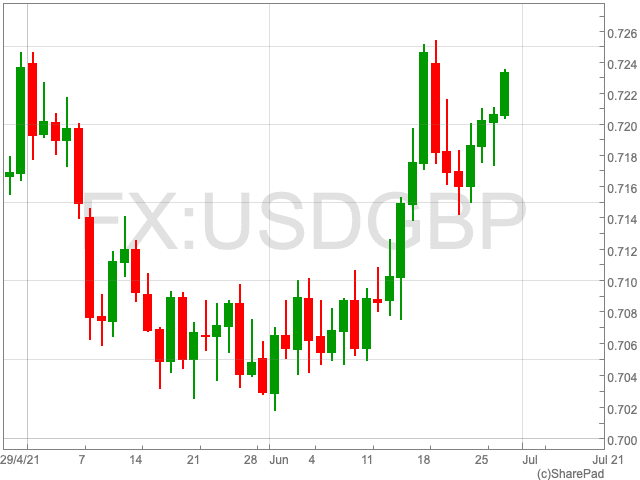
The US dollar is up by 0.38% on Tuesday against the pound as investors await this week’s non-farm payroll report. At the time of writing, the dollar is valued at £0.723076.

“Dollar strength continues to weigh on the euro and sterling, giving a modest boost to indices this side of the pond, while in the US despite some weakness in the futures markets remain in strong form,” said Chris Beauchamp, chief market analyst at IG.

“Money continues to flow into the US dollar, as the greenback continues its recovery from the lows of last week. The rosier US outlook is driving a renewed appreciation of US assets, even if the Fed has managed to muddy the waters on policy thanks to the recent FOMC meeting and the speeches following it.”

According to economists polled by Reuters, the US Labor Department will report a gain of 690,000 jobs for June, which would be up from 559,000 in May. Unemployment is expect to fall by 0.1% to 5.7%.

“This rise in the greenback is taking its toll on commodity prices, with gold under renewed pressure while oil becomes increasingly nervous ahead of this week’s OPEC get-together,” Beauchamp added.

Since the Federal Reserve’s policy meeting earlier in June, the dollar has been moving up, as the Fed said that the first interest rate rise could come in 2023.

“The potential for an upside surprise (in the U.S. jobs data) that pulls monetary tapering and tightening expectations forward is looming ever bigger for investors,” Karl Schamotta, chief market strategist at Cambridge Global Payments in Toronto, told CNBC.

“A number significantly above the 700,000 mark could really get the dollar freight train running, and no one wants to be tied to the tracks if that happens.”

Consumer credit figures suggest a return to normal

0

Many households have built up a pot of savings throughout the pandemic

Consumers borrowed more than they paid off for the first time since August 2020, according to May figures released by the Bank of England.

Personal loans, overdrafts and credit cards, often referred to as net consumer borrowing, amounted to £280 during May.

It represents a shift in a prior trend as more people were paying off more than the amount they borrowed using consumer credit.

The amount of money allocated by households into deposits fell to £7bn in May, down from an average of £16.5bn during the six month period to April 2021.

Net mortgage borrowing meanwhile recovered to £6.6bn in May and appears to be stabilising.

Weeks of volatility came before, the Bank of England said, as households anticipated the conclusion of the stamp duty holiday.

Laith Khalaf, financial analyst at AJ Bell, believes that old habits die hard when it comes to consumer spending, “unless there is a lockdown in force”.

“Borrowing is on the rise, and savings are falling back, as the lifting of social restrictions has prompted consumers to reach for their wallets. The data is from last month, and so straddles a significant lockdown easing date. Since 17th May, hospitality and leisure businesses have been in fuller swing, so we can expect spending trends to have accelerated since then,” Khalaf said.

Many households have built up a pot of savings throughout the pandemic.

“Unfortunately those savings are earning next to nothing in the bank, and now inflation is on the rise, they’re actually losing their buying power more quickly. Indeed, the Bank of England now expects inflation to rise above 3% later this year, and that may yet prove to be a conservative estimate,” Khalaf said.

“For money that’s going to be spent in the short term, cash is still the only option, though a high street current account is likely to be offering a particularly dismal rate of interest so it’s worth shopping around for a bit more. For money that‘s not going to be used for the long term, five to ten years or more, the stock market might offer better protection from inflation for those who can tolerate the ups and downs.”

Supply@ME pens agreement with Italian Banking Group to start monetisation programme

0

Supply@ME will acquire 10% of a fintech bank owned by the unnamed Italian banking group

Supply@ME (LON:SYME), the fintech platform which provides the ‘Inventory Monetisation’ service to manufacturing and trading companies, confirmed on Tuesday that it has reached an agreement with an Italian banking group.

The agreement has two specific conditions. Firstly, a commercial agreement to manage both the origination of new client companies and a multi-annual inventory funding plan. And second, the execution of a first inventory monetisation transaction involving a portfolio of Italian client companies.

Upon completion of the above arrangements, Supply@ME will acquire 10% of a fintech bank owned by the Italian banking group. This will allow Supply@ME to avoid the need for regulatory approval and will have the option to acquire an additional 10% of the fintech bank within the next two years.

The name of the fintech bank, which was valued at €34m – €50.6m, cannot be disclosed “due to the strategic nature of the transaction”, the company revealed today.

Alessandro Zamboni, SYME CEO, made further comment on the agreement:

“I am delighted to announce this agreement as a cornerstone of our inventory funding strategy. We can now begin to structure the monetisation of the first group of Italian client companies. This is a key initiative for Supply@ME and we expect that it will serve as the basis for an ongoing and scalable inventory funding programme for Client companies, starting in Italy. We believe that this will also provide further confidence to investors who have been awaiting the news of our first monetisation,” said Zamboni.

“We expect the agreement will create additional value for the Company, given the opportunity to invest directly in a Fintech Bank whose portfolio will grow as Supply@ME completes further rounds of monetisation. This transaction reinforces the positioning of SYME as an innovative fintech business, via non-credit transactions, aimed at assisting with the working capital needs of SMEs and large corporates.”

The Supply@ME share price is up by 6.69% on Tuesday to 0.38p.

UK house prices rise at fastest rate in 17 years on stamp duty frenzy

0

Yearly rate of house price growth now at 13.4%

UK house prices are rising at the fastest yearly rate since 2004, according to figures released by Nationwide.

Month-on-month, the average price of a UK home increased in June, up by 0.7% compared to May. This means that the yearly rate of growth is now at 13.4%, the highest rate of annual growth in nearly 17 years.

Nationwide chief economist Robert Gardner said prices were closing in on a record high relative to average incomes, which he said makes it more difficult for first-time buyers.

“Another month, another rise in house prices. Not a surprise as many home buyers rush to complete before the end of the stamp duty holiday,” said Danni Hewson, AJ Bell financial analyst commenting on Nationwide’s House Price Index.

“There are many factors at play here. Cheap interest rates and the availability of low deposit deals have undoubtedly fuelled price hikes despite the country being slap bang in the middle of a pandemic which has impacted people’s economic health.”

“But that pandemic has also spurred the market on, changing our preferences. What was top of people’s wish list two years ago is a distant memory with the potential to spin out working from home indefinitely, or at least on a part time basis, expanding the geographical map for many and adding home office to the list of demands,” Hewson said.

Hewson does not feel the shift is likely to revert back and expects the market to remain “toasty” over the coming months. “The X factor will be unemployment. How many people will still be in a job once the furlough scheme ends? How many mortgage holidays will result in quick sales? There’s no getting away from the fact that the next few months will be difficult for many people once support is withdrawn,” Hewson said.

Last summer, Rishi Sunak cut the stamp duty tax on property purchases to reverse a slowdown in property sales at the beginning of the pandemic. In March, Sunak extended the tax cut to the end of June.

FTSE 100 off to a better start on Tuesday with homebuilders among the top risers

0

Following Monday’s disappointing turn, UK stocks have picked up on Tuesday with the FTSE 100 rising 0.5% to 7,106.

“Investors bid up shares in tobacco sellers, banks and telecoms, while there was mixed appetite for miners with Rio Tinto and Glencore among the biggest contributors to the index in points terms, while Anglo American was the biggest detractor,” said Russ Mould, investment director at AJ Bell.

Housebuilders were also in demand after new figures from Nationwide revealed that UK house prices grew at their fastest annual pace for more than 17 years in June, up 13.4%.

“Taylor Wimpey, Persimmon and Barratt Developments were among the top risers as investors hoped the frantic activity in the UK property market would benefit their earnings,” said Mould.

“The key issue is whether we’re at the peak of the activity as buyers rush to take advantage of the stamp duty holiday which starts to taper from the start of July.”

“However, with so many properties being snapped up fast, there could be many potential buyers waiting in the wings for the market to calm down a bit – suggesting that we may not see a massive crash once the stamp duty holiday comes to an end on 30 September.”

FTSE 100 Top Movers

Barclays (2.13%), Persimmon (1.62%) and Legal and General (1.61%) headed up the FTSE 100 during the morning session on Tuesday.

At the other end of the UK index, United Utilities Group (-1.8%), Polymetal International (-1.72%) and Anglo American (-1.52%) have lost the most ground so far today.

Facebook’s stock value goes past $1trn as antitrust lawsuit dismissed by US judge

0

Facebook joins Microsoft, Amazon and Apple in being valued over $1trn

Facebook won a battle versus an American regulator yesterday causing the tech company’s stock value to surge past $1trn.

The ruling by the US judge will be welcomed news for tech giants as the Federal Trade Commission (FTC), along with a group of state attorney generals, launched the antitrust lawsuit in an effort to wrestle power from major tech firms.

However, the antitrust lawsuit that was aimed at compelling Facebook to sell Instagram and WhatsApp was dismissed by the judge.

The ruling both failed to limit the power of Facebook and preceded the company’s share price reaching a record high.

Shares in Facebook saw out the day up by over 4%, at $355.64, bringing the total value of the company to $1trn.

The judge ruled that the FTC did not give enough evidence to demonstrate that the social network was a monopoly. Having said that, the regulator is able to file another complaint as the case was not dismissed.

Facebook walks in the footsteps of fellow FAANG stocks, Amazon, Microsoft and Apple, all of which are valued above $1trn.

Private equity company Bridgepoint set for London IPO

Bridgepoint is one of the leading pan-European investment groups

Bridgepoint Advisers, the private equity firm, confirmed it plans to go public as part of a deal that could see the UK company valued at £2bn.

The company said it wants two raise in the region of £300m via the IPO to maintain its growth levels, while seeking to expand into property and infrastructure-type investments.

Bridgepoint’s float would represent an uncommon move into public markets from a private equity company. Other companies to do the same, as reported by the Financial Times, are FTSE 100-listed 3i Group, Partners Group of Switzerland, France-based Eurazeo and EQT of Sweden.

The move comes as a number of private equity groups look towards companies that have been struggling throughout the pandemic.

“Over the last 30 years we’ve built the global leader in middle market growth investing, with strength and depth across two very complementary strategies in private equity and private credit,” said executive chairman William Jackson.

“Bridgepoint operates across the middle market at scale, providing access for some of the world’s most experienced investors to attractive growth businesses through its unique local insight and expertise and its well-resourced platform. We have delivered strong and consistent returns for investors and shareholders through different economic cycles.”

Bridgepoint is one of the leading pan-European investment groups focussing on the middle market.

The private equity company has raised a total of over €39bn of committed capital from a global investor base that includes public and private pension funds, asset managers, family offices, sovereign authorities and insurance companies.

Just over a week ago, it confirmed a deal to take a position in Itsu, the fast-food chain, which it should would help bring about 5,000 new jobs over the next fiver year period.

It was reported by Sky News that Bridgepoint would value Itsu at £100m.

New AIM admission: Silver Bullet Data Services

Silver Bullet Data Services Group has developed technology that can take over from cookies as the basis of targeting digital marketing. Cookies are falling foul of tighter regulation around the world, such as GDPR, and the company’s 4D technology offers an alternative that is within current regulations.
Global digital advertising spending, excluding search, was $199bn in 2019 and could reach $340bn in 2024. This is a big market and there is competition. Even if the 4D technology can take a small chunk of that market Silver Bullet will be highly profitable.
The share price ended the first day a...

New AIM admission: itim Group

SaaS-based retail software provider itim believes that it can take advantage of the changes that are being brought about in retail following the Covid-19 pandemic. High street retailers can make the most of their physical presence while also maximising online business and competing with pure online retailers.
There is certainly a large market for itim to go for and it already has a solid customer base. Management says that it has a pipeline of potential new customers that will help to build on the momentum in 2020.
Even allowing for Covid-19, the momentum does not appear that impressive. Progr...