Iron ore price falls as China intervenes over concerns of excessive speculation

Iron ore still up by over 20% over past three months

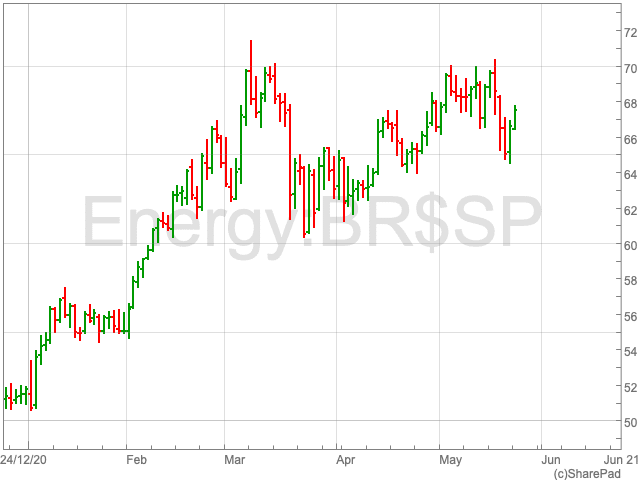
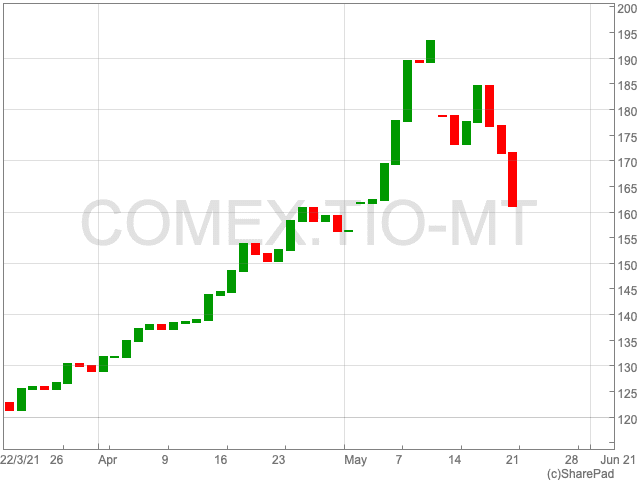
The price of iron ore, the ingredient used to make steel, dived on Monday as China suggested that it would aim to calm rising prices amid concerns over inflation.

On Monday China’s economic planning agency said it would come down on monopolies in commodities markets, as well as the spread of false information.

Following a recent surge, the iron ore composite fell by 6.03% to $161.09 as the announcement by the Chinese government made its way through markets. Although the commodity remains up by 20.1% over the past three months.
Despite rising commodity prices boosting China’s recovery from the pandemic, it remains concerned.

“I think there is increasing evidence of speculative excess,” Robert Rennie, head of market strategy at Westpac, told the Financial Times. Rennie also anticipates further intervention by the Chinese state.

China is easily the world’s largest consumer of commodities and higher raw material prices will affect production costs.

Two weeks ago iron ore reached its highest ever point thanks to strong demand for steel in China.

The FTSE 100 traded higher despite miners’ share prices being pulled down by falling iron ore prices as Chinese authorities warn of excessive speculation.

Fresnillo, Antofagasta and BHP have all lost ground on Monday.

Oil price up as doubt cast over revival of Iran deal

Goldman Sachs restates optimistic outlook for oil

The price of oil rose on Monday as the revival of the Iran nuclear deal appears to be at risk.

The West Texas Intermediate composite is up 1.25% to $64.6796 at lunchtime in the UK, while the Brent crude oil composite is up by 1.34% to $67.492.

Despite the possibility that the hiccup could increase oil supply through Iranian exports, Goldman Sachs believes prices will continue to rise.

Just a week ago, the price of oil dropped by nearly 3% following statements by Iran president Hassan Rouhani that the US was ready to lift sanctions on his nation’s oil, banking and shipping sectors.

However, the speaker of Iran’s parliament confirmed that a monitoring deal between Iran and the UN nuclear watchdog had expired and that it would stop having access to images from a number of Iranian nuclear sites.

Diplomats from Europe said that failure to agree an extension of the deal would bring the possibility of future talks between Washington and Tehran into crisis.

“All in all, it seems to be only a matter of time before the sides involved put pen to paper on a new nuclear accord,” Stephen Brennock of oil broker PVM told Reuters.

“Investors are bracing for a fresh wave of what will surely be heavily discounted Iranian crude … yet for all this alarmism, an aggressive ramp up in Iranian production and exports is unlikely to stall the drawdown in global oil stocks”.

Analysts at Goldman Sachs believe the case for the oil price rising in the future remains solid as it will be driven by increased demand as the vaccine roll-out continues.

“Even aggressively assuming a restart in July, we estimate that Brent prices would still reach $80 per barrel in fourth quarter, 2021, with our new base case for an October restart still supporting our $80 per barrel forecast for this summer,” Goldman said.

FTSE 100 makes ‘sedate progress’ on Monday following wild week

0

The FTSE 100 is up by 0.19% to 7,031.29 on Monday morning in a positive start to the week for the index.

“The FTSE 100 made sedate progress on Monday morning although you would imagine investors would take that after something of a wild ride last week driven by inflation fears and a bitcoin crash,” says AJ Bell investment director Russ Mould.

The cryptocurrency added further losses over the weekend, before a modest recovery, as China continued its crackdown.

“The cryptocurrency remains more up and down than a yo-yo, enduring further heavy losses over the weekend before staging a modest recovery amid a crackdown in China.

The UK’s flagship index traded higher despite miners’ share prices being pulled down by falling iron ore prices as Chinese authorities warn of excessive speculation.

“Observers will be asking if this is the week the FTSE 100 finally pushes ahead of the 7,000 mark after a period of going backwards and forwards around this level,” Mould added.

“A second estimate of US GDP on Wednesday may provide some direction, in addition to consumer confidence and price data which should help show whether the world’s largest economy is simmering nicely or is in danger of bubbling over.”

“After recent evidence of rapidly rising prices in the UK, there is likely to be considerable attention on Bank of England Governor Andrew Bailey and his colleagues when they appear before MPs to testify later.”

FTSE 100 Top Movers

Flutter Entertainment (2.01%), Compass Group (1.61%) and Vodafone Group (1.38%) are the top risers midway through the morning session on Monday.

At the other end, Fresnillo (-2.93%), Antofagasta (-1.59%) and Barratt Developments (-1.44%) have lost the most ground.

Cineworld

Cineworld praised a “strong” opening weekend across the country and anticipates a continued recovery after cinemas were forced to close down for months due to the pandemic

The cinema group said that Peter Rabbit 2: The Runaway was to thank for its opening weekend success as families flocked to cinemas in droves. 

Cineworld said that its performance over the weekend surpassed its own expectations as “customers were eager to return to the movies and enjoy the full movie experience”.

Research finds first-time investors are more diligent than their reputation suggests

0

2.5% of investors use social media as their sole research tool according to Freetrade

Freetrade, the investment platform, released research on Monday that challenges some of the misconceptions around first-time retail investors.

There has been an explosion in retail activity over the past year, as retail investors have been portrayed as “young, naive, impatient and highly susceptible to misleading discussions about “hot stocks” pushed via social media”, according to Freedtrade.

However, research suggests that the contrary is true. Freetrade reckons that many first-time retail investors set “realistic” long-term goals, while “developing constructive, life-long habits”.

Two-thirds of investors are under 35, half of whom live with a partner/spouse, while 68% live in a property they own.

81% of investors are approaching investment as a long-term habit, while 91% say they lack confidence when they first invest.

Younger people, 18-25 year-olds, are generally more cautious according to Freetrade, and are also more goal-oriented, with the desire to boost their income being the most common motivator.

The role of social media can be overstated too, as a mere 2.5% of investors saying they use it as their sole research tool.

Adam Dodds, CEO of Freetrade, said: “These findings suggest that the buzz around investing is not a fad. Millions of people are getting into investing for the right reasons and picking up an important, life-long habit which should be nurtured and celebrated.”

“While we have seen a number of stereotypes about new and inexperienced investors taking hold in the last twelve months, our research shows, by contrast, that their behaviour is much more conservative.”

“What we do need to worry about is the behaviour of platforms. We’ve seen genuine, positive momentum build in the DIY investing space this year. It would be a shame if retail investors ended up getting shouldered with heavy losses because they were encouraged to dabble with complex, leveraged derivatives. Firms that offer CFDs and spread betting are simply duping their customers into speculating to line their own pockets, and they threaten to undo the progress made by damaging the reputation of responsible investing.”

Shell’s climate plans not enough according to major UK investor

0

Shell loses vote over climate plans at AGM

Legal & General Investment Management (LGIM), one of the UK’s largest fund managers, has come out as being critical of Shell’s (LON:RDSB) efforts to tackle climate change.

At Shell’s AGM last week, LGIM voted against the FTSE 100 oil giant’s energy transition strategy.

The fund manager told the Guardian that it was standing alongside activists as it does not buy the credibility of Shell’s plan.

Although LGIM did say that some progress was being made. “We remain concerned that the strength of interim targets (up to 2035) and disclosed plans for oil and gas production fall short of the level of ambition required for the company to credibly claim alignment with a 1.5C pathway,” the company said.

At the recent AGM, a resolution put forward by shareholders called the oil company to do more to address climate concerns by setting binding emissions targets received 30% of the vote. Among the voters in favour was LGIM.

The result builds further pressure on Shell and now means the oil giant will be required to consult shareholders and report on their views within six months.

The resolution was put forward by Follow This, a campaign group that uses activist investment that pressures oil companies to reduce their emissions in line with the limits set by the 2015 Paris climate agreement.

“This is really a very strong signal to the board of Shell that their current targets are not sufficient to reach the [aims of the] Paris climate agreement. That is what investors one by one are realising,” said Mark van Baal, the founder of Follow This.

Cineworld hails successful opening weekend as cinema goers return

0

Cineworld anticipates its recovery will gain momentum amid the releases of Cruella and A Quiet Place 2

Cineworld praised a “strong” opening weekend across the country and anticipates a continued recovery after cinemas were forced to close down for months due to the pandemic.

The cinema group said that Peter Rabbit 2: The Runaway was to thank for its opening weekend success as families flocked to cinemas in droves.

Cineworld said that its performance over the weekend surpassed its own expectations as “customers were eager to return to the movies and enjoy the full movie experience”.

One week ago, on Monday, cinemas were officially allowed to welcome customers back after being closed due to lockdowns for over four months during the third lockdown.

Mooky Greidinger, chief executive of Cineworld, said the business anticipates its recovery will gain momentum amid the releases of Cruella and A Quiet Place 2.

“We are thrilled to have our cinemas back in business in the US and UK and to welcome movie fans back to the big screen for an exciting and full slate of films. We are especially pleased with the warm welcome our employees have received, and the positive feedback from returning guests,” Greidinger said.

“With the releases next week of Cruella, and A Quiet Place 2, we expect next weekend’s results to be strong. When combined with improving consumer confidence and the success of the vaccination rollout, we expect a good recovery in attendance over the coming months, noting the record breaking success of F9 in the Asian market.”

“We are excited for our customers to experience the magic of big screen entertainment again, all made possible by the hard work of our colleagues around the world, and remain committed to be the best place to watch a movie.”

The Cineworld share price is up by 2.96% to 89.39p per share during the morning session on Monday.

Ofgem to invest £300m into electric vehicle infrastructure

0

Ofgem will install 1,800 new ultra-rapid charge points for EVs

Ofgem, the UK energy market regulator, outlined on Monday its plan to invest £300m in over 200m infrastructure projects to ready the UK for the future of electric transport.

The plans will come into action over the next two years and is part of a wider £40bn project to move the UK to a system that uses low-carbon transport and heating.

Boris Johnson has previously confirmed plans to forbid the sale of petrol and diesel cars from 2030 in order to reduce its emissions to net-zero by 2050. However, the country may well need to upgrade its infrastructure significantly to support the future influx of electric vehicles.

Ofgem has confirmed that it will install 1,800 new ultra-rapid charge points for EVs, thereby tripling the current network, on motorway service areas and trunk road locations across the UK.

Electric Car Owners to be Rewarded for Charging at Off-Peak Times

Financial rewards will be given to up to 25,000 drivers of electric vehicles as an incentive to charge their cars at off-peak times as part of a wider plan to reduce pressure on the power grid.

UK Power Networks, which runs electricity networks across London and surrounding regions, is anticipating up to 4.5m electric vehicles charging on the network by 2030, up from current levels at 150,000.

Sotiris Georgiopoulos, head of smart grid development at UK Power Networks, said that people usually charge their vehicles from 5:30pm to 9pm.

Sotiris Georgiopoulos, its head of smart grid development, said that people tended to put their cars on charge from about 5.30pm until around 9pm. He added that it would be necessary to take action to avoid overrunning the network.

“The network may need some additional capacity,” Georgiopoulos said. “Our traditional solution would be to say, ‘OK, let’s upgrade the local infrastructure’.”

Avon Rubber waits on contract news

Interim figures from Avon Rubber (LON:AVON) will be reported on Tuesday (25 May). Those figures will not be as important as the indications about the timing of contracts.
There were delays to product approvals for the company’s body armour and this means that revenues have moved into next year. There could be more news about the timing of these revenues, although it may be too soon for this to be finalised.  
This contract will be important for the coming years. Even so, profit can improve this year with a bigger boost the following year.
Interims
Interim revenues are expected to grow to ...

Zotefoams is fleet of foot

Zotefoams (LON: ZTF) is holding its AGM on Wednesday 26 May and there should be a further update on trading, which appeared to be going well at the time of the full year figures. Profit should bounce back this year, but there are still short-term uncertainties.
The 2020 figures held up relatively well with a small drop in underlying pre-tax profit to £8.6m. That was after a record second half. The high performance products (HPP) business continues to benefit from demand from footwear manufacturers, while PPE demand held up sales of polyolefin foams.
If the losses can be stemmed at MuCell, whic...

Revolting shareholders: Pendragon remuneration policies questioned

Motor dealer Pendragon (LSE: PDG) continues to have significant votes against its remuneration report and certain directors. It paid significant bonuses despite the large loss in 2020.
Three votes at the AGM had significant minorities against them. This includes the approval of the remuneration report, where 42.2% of votes were against the motion. This was similar to the 41.3% votes against the remuneration policy and the long-term incentive plan the year before (the vote against the 2020 remuneration report was 21.5%).
Pendragon reported a £25.5m pre-tax loss on continuing operations for 2020...