What does the bitcoin crash mean for the Argo Blockchain share price?

0

Argo Blockchain Share Price

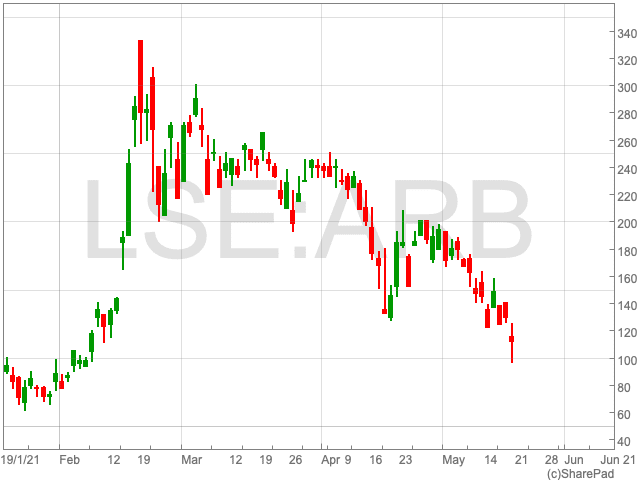
The Argo Blockchain share price (LON:ARB) has fallen by over 13% to 112.70p per share on Wednesday. Having closed at 149p per share last Friday, the bitcoin mining company is down by over 30%. As bitcoin continues to plummet, shareholders in Argo will be concerned about its immediate prospects.
Bitcoin Crash

As a bitcoin miner, the performance of the Argo Blockchain share price is closely correlated to the performance of bitcoin. If the price of bitcoin falls, then Argo’s share price is likely to do the same.

Having reported earlier today that bitcoin crashed to below £28,000, the cryptocurrency is now at £25,000. At one point today it got below £23,000 as its recent bull-run came to a devastating end. Wednesday’s decline means bitcoin’s loss over the past week now stands at over 40%.

Outlook

The question now is what does the dip mean for the future of bitcoin. According to Laith Khalaf, financial analyst at AJ Bell, today has highlighted the extreme risk in buying bitcoin.

The price of Bitcoin has tumbled by a third over the last month, which highlights the extreme risk inherent in cryptocurrency. Risk cuts both ways however, and Bitcoin is still trading above where it started the year, so many investors will remain in profit, albeit trimmed back by the recent fall.”

Khalaf also suggested that in recent weeks there have been significant developments which undermine bitcoin’s long term prospects.

“The tide has turned on Bitcoin because environmental concerns and regulatory risks have materialised, which have raised doubt over the long term adoption of cryptocurrency by businesses and consumers,” Khalaf said.

Consumers and investors may also start to shun cryptocurrency, particularly younger Bitcoin fans, who are also likely to be sensitive to climate issues.

“Bitcoin mining uses up a phenomenal amount of energy, and unlike traditional metal mining, doesn’t actually produce anything which is useful in the economy. Even celebrity endorsements may dry up as public figures become wary of being associated with an environmentally unfriendly product,” Khalaf says.

If nothing else, today’s crash will serve as a reminder of the risks of investing in cryptocurrencies and related companies. The future looks will be a testing time for both the Argo Blockchain share price and the world of crypto.


Anti-Glazer fan campaign could cost Manchester United sponsors ‘millions’

0

#NotAPennyMore movement started following failed European Super League project

Digital analysis of Manchester United fans’ #NotAPennyMore campaign suggests online targeting of sponsors’ Google Ads could cause millions of pounds worth of overspending.

New research by Mediaworks, a digital marketing agency based in the north of England, is showing that sponsors of Manchester United, including Adidas, Chevrolet and Tag Heuer, are being affected by the #NotAPennyMore campaign, a protest against Manchester United’s owners.

The movement was founded on the back of the Glazer family’s failed efforts to form a European Super League along with 11 other European football teams.

Organisers of the protest movement are appealing to fans to click multiple times on any of Manchester United’s listed sponsors’ Google Ads. This could serve to pile up high bills for the companies, which could potentially run into “millions of pounds”, Mediaworks says.

Mediaworks has been analysing the digital impact of the movement on the club’s commercial partners.

CEO and founder of Mediaworks, Brett Jacobson said: “When looking at the digital evidence, it’s very easy to see how this could very quickly start costing Manchester United’s sponsors a lot of money. This could easily run into sums comfortably into the millions.”

“We’ve already seen one major sponsor pull back from a new deal this week and this move by the fans to light the match on some digital dynamite as a means to remove the Glazer family as owners of the club has every possibility of having the desired effect. There could be some very awkward boardroom conversations between United and their sponsors if this plays out as the fans hope.”

Using freely available Google Ads data to calculate what that could mean to advertising costs for these brands, Mediaworks says the outlook is bleak for the marketing budgets of the targeted companies.

Brett Jacobson explained: “We’ve looked at the top end cost per click data for just those five brands, a price they could reasonably expect to be charged by Google for this type of fan activity. Generously assuming that only one quarter of those choosing to look up these sponsors in the last 48 hours decide to click just once on their Google Ads, that could be an eye-watering bill in excess of £1.2m they could be collectively facing this month alone. And that figure could easily skyrocket.”

“Manchester United has 50 listed key partners and sponsors that the #NotAPennyMore activists claim they’ll target. As Glazer’s Stateside accountants might be nervously whispering right now, ‘you do the math’.”

“With The Hut Group withdrawing from a rumoured £200m, ten year deal to join the list of sponsors for the club for fear of the negative associations, you do fear that this is just the tip of the iceberg for the Glazer’s fan troubles.”

The Manchester United share price (NYSE:MANU) is down by 0.35% on Wednesday to $15.88.

Eurasia Mining Share Price: investors encouraged by potential sale of assets

0

Eurasia Mining Share Price

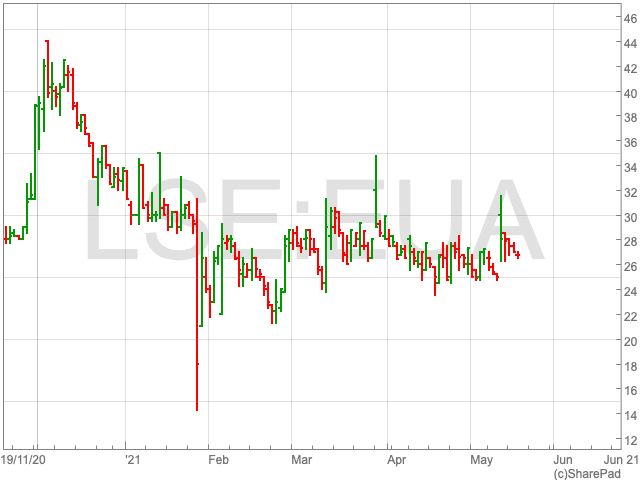
Last Thursday the Eurasia Mining share price (LON:EUA) climbed as high as 20% in one day before retreating. Despite trading sideways from February onwards, year-to-date the stock is down by over 20%. Going further back to July, the Eurasia Mining share price is up by over 100%. Investors will be curious about the recent surge and what it could mean for the company’s longer-term outlook.

Potential Sale

The cause of the surge of the Eurasia Mining share price last Thursday was an announcement by the company that it could be selling all of its assets. The platinum group metals and gold producer also said that it had finalised its strategic review and formal sale process.

In a trading statement Eurasia Mining said it “has more recently focused its attention, including providing due diligence access, on a limited number of potential bidders who had shown consistent interest in Eurasia and its high-quality asset base”.

While the board will now focus on the potential sale, it said it could mean a significant dividend payment for investors. “A proposal from a credible party that could allow us to pay a significant dividend to all shareholders,” said Eurasia’s executive chairman Christian Schaffalitzky.

While the statements coming from Eurasia Mining looks promising for shareholders, the deal has not yet been confirmed, and there is no guarantee it will go through.

Performance

Aside from a potential sale, the AIM-listed company gave an update on its West Kytlim operations in the Urals.

Russian authorities have officially approved a new Technical Project. This means three plants will be in operation in 2021, compared to one the year before. All three points will have begun production this quarter, the company confirmed.

This means the outlook for the Eurasia Mining share price is strong, as its mining operations now appear secure. This will be the case even if the sale of the company does not go ahead.

Precious Metals

Another thing to consider for investors is the price of precious metals. The Eurasia Mining share price is closely tied to the price of platinum group metals (PGMs) and gold. If the price of Eurasia Mining’s produce goes down in the future then it will count for less that there mining operations are solid. This is worth consideration for those looking to invest in Eurasia Mining.

Rolls Royce, Argo Blockchain and CVS Group with Alan Green

This week’s Podcast with Alan Green looks at Rolls Royce (LON:RR), Argo Blockchain (LON:ARB) and CVS group (LON:CVSG).

Inflation is at the forefront of investors minds again with European equities, including the FTSE 100, sinking over fears of an increase in interest rates. Although central banks have made no indiction this will the case in the short term, it hasn’t stop markets sending bond yields higher. UK 10-year Gilts now yield 0.9% having only yielded 0.2% at the beginning of 2021.

Rolls Royce have recently announced a move into Nuclear Power with a series of projects that could provide power for a million homes. The mini power stations will provide diversification in a business model dogged by COVID.

Rolls Royce have been positive about the recovery in their aviation business as economies reopen, however, analysts have released a note this week which suggest Rolls Royce may have been over confident with their assumptions for the recovery. With the Rolls Royce share price up 46% YTD, we exam the merits of the company and whether now could be an entry point for investors looking at Rolls Royce shares.

With Bitcoin falling through the floor, there is attention paid to Argo Blockchain shares. The Bitcoin miner provides a proxy for the Bitcoin price and Argo’s shares have duly sunk in line with Crypto assets.

We also revisit veterinary company CVS Group who are enjoying the fruits of reoccurring revenue and growing demand.

Amigo Holdings Share Price: risk on the menu amid dispute with FCA

0

Amigo Holdings Share Price

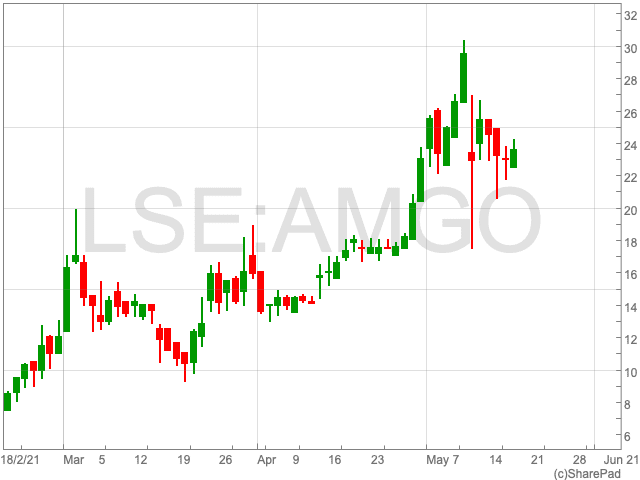
Over the past few months the Amigo Holdings share price has surged, regularly featuring as one of Hargreaves and Lansdown’s most viewed shares. Since the beginning of the year, the guarantor loan lender’s share price is up by 179%. However, at 23.58p per share, it has more than halved in value from its pre-pandemic level. Over the past few days it has experienced some dips as the company continues its dispute over its rescue plan with the Financial Conduct Authority (FCA). Therefore, now is a useful time for investors to take a look at Amigo Holdings to assess its prospects moving forward.

Rescue Plan

During the final few months of 2020, Amigo Holdings received more than 10,000 complaints about guarantor loans. In response, Amigo outlined a rescue plan, or a “Scheme of Arrangment”, a court-approved agreement between Amigo and its investors, which would cap any potential compensation.

However, it was revealed yesterday that the FCA said it would object to a deal in court. The news caused the company’s share price to tumble, as seen above. It follows the regulator saying in March that despite its reservations over Amigo’s “Scheme of Arrangement”, it would not oppose the plans.

Amigo confirmed it received correspondence from the FCA stating that it believed the rescue plan was unfair and that its intention is to oppose it at a final court hearing at the end of this month. Amigo remains hopeful that the FCA will set aside its objections at the final court hearing and back the deal. This would allow for the rescue plan to go ahead.

At the least, the issue adds risk to investing in Amigo Holdings. Conversely, if Amigo was to go under as a result of the ruling, the consequences could be bad for claimants. Therefore the FCA may not want to overplay its hand. This may work in favour of the Amigo share price looking forward.

Primary Bid launches Artisanal Spirits offer

Edinburgh-based Artisanal Spirits Company has launched an offer via Primary Bid ahead of its planned flotation on AIM. Artisanal owns the Scotch Malt Whisky Society, which has 28,300 members around the world.

The offer will be priced between 112p a share and 121p a share. Existing members of the Scotch Malt Whisky Society are likely to take priority in this offer. The offer closes on 21 May and the expected admission date is 4 June.

Artisanal hopes to raise around £16m of new money, while existing shareholders are selling a similar amount of shares.

There is still potential to increase membership numbers around the world given the tiny market share the company has. Currently the focus is single malt whiskies, although other spirits, such as cognac, gin and rum, are also sold. The product range will be expanded in the next few months to include blended whiskies under the JG Thomson brand. Reopening the venues should also help sales.

The Scotch Malt Whisky Society business was bought out of LVMH in 2015. It purchases casks from distillers, matures the whisky and then chooses the correct time to bottle the whisky and sell it.

The whisky is sold at £35/70cl or more. There are 250 70cl bottles in a cask and the whisky from each cask is given a name and cask identifier number. Artisanal has plenty of maturing whisky stock. It is estimated to be 26 times the volume sold in 2020.  

Figures

Edison has published a research note on Artisanal. In 2020, Artisanal’s revenues increased by 3% to £15m and the operating loss, before an exceptional charge of £392,000 relating to investment in IT and the initial costs of the flotation, fell from £572,000 to £311,000. The company received £169,000 from the coronavirus job retention scheme.

The cash outflow from operating activities was £1.38m. There were capitalised website development costs of £366,000. Net debt was £13.7m at the end of 2020.

Artisanal had to close its venues and cancel events during last year due to Covid-19 lockdowns – the new Glasgow site opened at the beginning of March and was closed in a matter of days. Management estimates that the venue closures knocked £2.1m from revenues, so the growth in overall revenues was a decent achievement. Online sales increased by £2.4m, making up for the shortfall from venues.  Membership income increased from £1.27m to £1.52m.

There was an extra cost due to the 25% US tariff on single malt imports and that was absorbed by the company, which decided not to put up prices. The tariffs were suspended in March 2021, although it was described as temporary, so that should help to improve margins this year. The tariff reduced profit by around £700,000 last year.

Prospects

Customer loyalty is an attraction. Once Artisanal gains a customer then the long-term income generation is much higher than the cost of acquiring the customer.

Competition is fierce in the spirits market, though. The overall market for upmarket whisky is $5.5bn. Artisanal is a very small participant in the sector, which brings plenty of opportunities but also means that its marketing fire power is limited. Distil, which has been quoted on AIM in one form or another for two decades, has shown that it is difficult to build up spirits brands.

Cash continues to flow out of the business and the cash raised in the AIM float is needed to further build up stocks and continue to the marketing activities to add to the membership list. UK membership is relatively flat with the fastest growth coming in Europe and Asia.

Investment in ecommerce is also important. There are plans to launch additional brands: JG Thomson (blended whiskies) and The American Whiskey Society, which will help to broaden the appeal.

According to Edison the new shareholders from the flotation should own around 39% of Artisanal, which suggests that the market capitalisation could be around £80m.

That valuation seems to be optimistic, but if the membership can be increased then long-term revenues will grow substantially. There are also the valuable whisky stocks. This appears to be one for whisky fans.

FTSE 100 sinks below 7,000 as UK inflation more than doubles month-on-month

0

The FTSE 100 is down 1.28%, or nearly 90 points, after the bell, knocking back under 7,000 in the process. The move comes “as markets returned to last week’s inflation-fearing panic on Wednesday following a commodity-bloated CPI reading out of the UK,” said Connor Campbell, Financial Analyst at Spreadex.

“Already investors were preparing themselves for the UK’s inflation data for April to double month-on-month, from 0.7% to 1.4%. Instead, it came in just higher than forecast at 1.5%, dragging questions over inflationary pressures and what that means for interest rates kicking and screaming back into the spotlight,” Campbell added.

“There were reasons not to be quite as alarmed. The core reading, which strips out volatile elements, most pertinently commodities, saw a much milder rise, from 1.1% to 1.3%.”

“Still, that was cold comfort for the markets, which reacted exactly as you’d expect given their recent skittishness around inflation data.”

The FTSE 100 wasn’t Europe’s worst performer. Both the DAX and CAC were down 1.1% apiece, leaving the German and French bourses at 15,230 and 6,300 respectively.

“It didn’t help that the European markets were already on the backfoot thanks to the Dow’s decline last night, one that left the index only 60 points above 34,000,” said Campbell.

The Dow is set to drop below that keep level this afternoon, with the futures pointing to a 0.4%, or 120-point, slump when trading starts Stateside.”

FTSE 100 Top Movers

At the time of writing, Ferguson (3.07%), Imperial Brands (0.64%) and DCC (0.18%) are the only three companies on the FTSE 100 to have made gains on Wednesday.

Antofagasta (-3.33%), Anglo American (-3.29%) and Scottish Mortgage Investment Trust (-3.45%) are the biggest fallers on the index.

Bitcoin plummets again as China moves against crypto

Bitcoin at lowest level since February

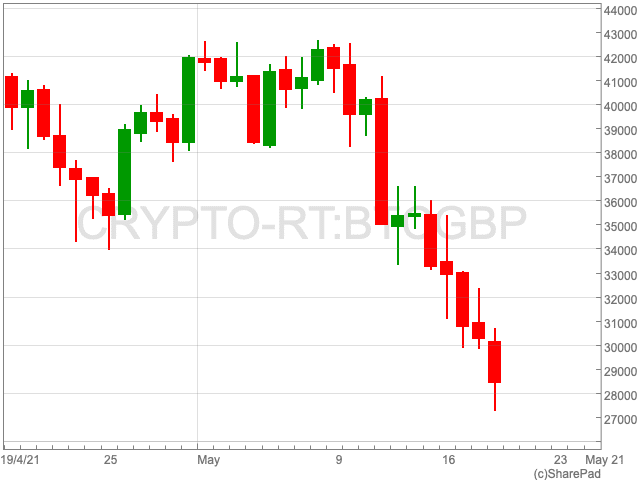
The price of bitcoin plummeted again overnight to its lowest level since February after regulators in China came down on the use of cryptocurrencies by financial institutions.

The crash took the price of bitcoin to below £28,000, and occurred alongside a slump in the wider crypto market.

This image has an empty alt attribute; its file name is CRYPTO-RT_BTCGBP.png

According to a statement by the People’s Bank of China, cryptocurrencies should not be used in financial markets or the wider economy because they are not “real” currencies.

“This is the latest chapter of China tightening the noose around crypto,” Antoni Trenchev, managing partner and co-founder of Nexo in London, a crypto lender, told Bloomberg.

China’s attempts to limit the rise of crypto comes as it prepares the launch its own digital currency.

“Part of it is they have their own digital renminbi, part is the lack of control in terms of cash outflows and part of it is trying to make sure people don’t get scammed,” said Paul Haswell, a partner at law firm Pinsent Masons in Hong Kong, of China’s crackdown.

The news comes soon after the price of bitcoin plummeted over the weekend as Elon Musk ramped up his criticism of the cryptocurrency, before confirming Tesla has not recently sold any of its holding.

Neil Wilson of Markets.com told The Guardian that crytpocurrency’s latest price volatility proves that it is a bubble. 

“A nice pop, but this is small versus the Musk-induced selling that has been taking place lately. In addition to Tesla saying it would stop accepting Bitcoin as payment, Musk indicated in a reply to a tweet that the company was dumping or had already dumped all its Bitcoin. Prices fell sharply over the weekend and at $44k the crypto asset is still down by around a third from the all-time high near $66k set in April,” said Wilson.

UK inflation more than doubles to 1.5%

0

The price of oil may continue to exert upward pressure on inflation

The rate of inflation in the UK has more than doubled in April, amid higher energy prices and an increase in the cost of clothing.

The rise to 1.5% in April from 0.7% in March, confirms that prices are at their highest level since March 2020, the beginning of the coronavirus pandemic.

According to the Office for National Statistics (ONS), a rise in the oil price has caused an increase in the price of petrol.

Petrol prices are now at their highest point since January 2020.

“At current levels, inflation is nothing to fret about, but there is rising concern that the fiscal and monetary response to the pandemic has sown the seeds of an inflationary scare further down the road.”

“For the moment, the Bank of England is dismissing consumer price increases as a natural bounce back from the depths of the pandemic last spring. But the economic recovery could be a Trojan horse, smuggling inflation into the UK, right under the nose of central bankers,” says Laith Khalaf, financial analyst at AJ Bell.

The price of oil may continue to exert upward pressure on inflation, according to Khalaf.

“Much of the inflation of the last year can be explained away by an oil price rising from an exceptionally low $20 a barrel last spring to around $70 today. This effect will moderate as we start lapping the summer months of 2020, but even if oil prices remain where they are, they will continue to exert upward pressure on the headline rate of inflation number for the remainder of the year.”

“What’s more, as the global economy opens up, there is potential for further price rises as demand picks up again,” Khalaf added.

The UK is still well behind the US, where the latest inflation reading came in at 4.2%, and CPI inflation is still below the Bank of England’s 2% target.

“The Bank has made it clear that it will tolerate inflation rising modestly above target, without pulling the trigger on interest rate rises. However, if inflation looks like it’s going to get a significant foothold, markets will take matters into their own hands and raise borrowing costs across the economy. Inflationary fears have already started to trickle into markets, with the ten-year gilt now yielding 0.9%, up from 0.2% at the beginning of the year,” Khalaf commented.

A fortnight ago the Bank of England said that UK inflation is heading above its 2% target and it expected it to hit 2.5% at the end of 2021.

Tips update: Hargreaves Services

Hargreaves Services (LON: HSP) has published another positive trading statement following my buy recommendation four weeks ago. A stronger than expected performance by the German joint venture HRMS means that the profit for the year to May 2021 will be much better than expected.
AIM-quoted Hargreaves Services provides transport, industrial and earthworks services, as well as developing land from legacy operations. HRMS su0plies coal and operates waste recycling facilities. Commodity prices have been strong because of demand from steelmakers and HRMS should make a materially larger profit contr...