Record highs in sight as FTSE 100 makes positive start to the week

0

FTSE 100 is up by 0.26% to 7,037.60 on Monday morning trading, a 14-month high.

“Though there’s still some ways left before it gets there, a return to the 7,900-approaching records highs of May 2018 all of a sudden don’t feel as far off as they once did,” said Connor Campbell, financial analyst at Spreadex.

Beating its blue-chip brother to the chase, the FTSE 250 hit another record peak after the bell, rising a further 0.3% to touch 22,650.

“Sunny weather should have given retailers and hospitality businesses in England a boost over the weekend and this helps explain why the more domestic-facing FTSE 250 outperformed its large-cap counterpart and is marking new record levels,” said Russ Mould, investment director at AJ Bell.

All eyes will now be on whether the FTSE 100 itself can push yet higher and challenge its own all-time high of nearly 7,900 as the economy continues its recovery from the pandemic.

After a lacklustre fortnight the DAX burst into action last Friday, breaking away from 15,250 to reach a fresh all-time high. A quiet start meant the German bourse couldn’t really build on that feat, lurking around 30 points shy of 15,500.

“The Dow Jones is still expected to start the session above 34,100. It’s been a steady climb for the Dow this month, opening at 33,030, with a good chunk of April left if it wants to strike 35,000,” according to Campbell.

“There isn’t too much going on this Monday, which might inhibit the market’s ability to really push forward and break records. Then again, said calm may be the kind of environment the Western indices want if they are to stretch their legs,” Campbell added.

FTSE 100 Top Movers

Ocado (3.05%), Fresnillo (2.46%) and London Stock Exchange Group (2.18%) made the most gains on the FTSE 100 on Monday morning.

Evraz (-1.84%), Phoenix Group Holdings (-1.11%) and Smith and Nephew (-1.02%) were the bottom thee companies on the FTSE 100 a couple of hours in on Monday.

Oil falls as rising Covid cases set to slow demand

India’s coronavirus death toll now stands at nearly 180,000

Oil prices slipped on Monday as rising cases of Covid-19 emerged across the world, leading to measures to tackle the pandemic being reinstated.

The strong measures to curb the spread will have knock on effects on economic activity, including demand for oil.

Having risen by 6% over last week, Brent crude oil was down by 0.3% early this morning to $66.60 per barrel. While West Texas Intermediate (WTI), having gained 6.4% last week, was down by 0.2% to $63.03 a barrel.

“The progress of vaccination drives in the developed markets can be seen in road traffic levels, but resurging case numbers have reversed the recovery in the emerging countries,” such as India and Brazil, ANZ Research said in a report on Monday.

India confirmed a record increase in cases of Covid-19 on Monday of 273,810, bringing the total number of cases to over 15m. India is now the second worst affected country behind the US, which has in excess of 31m infections. India’s coronavirus death toll now stands at nearly 180,000.

Hong Kong is supending flights from India, Pakistan and the Philippines from April 20, authorities have said.

In early March oil prices climbed to a 14-month high as Brent crude oil reached $67.85 per barrel today, its highest level since January 2020.

Starling receives £50m cash injection from Goldman Sachs

0

Starling now has over 2m customers and made a profit last year

Starling, the UK-based digital bank, confirmed on Monday that Goldman Sachs has invested £50m into the company.

Starling said that the Goldman’s investment is part of an already oversubscribed funding round of £272m, which valued the company above £1.1bn.

The bank said it would allocate the funding towards its “continued rapid and now profitable growth”.

Since it was launched in 2017 Starling has earned over 2m customers and even made a profit during the past year, one of the only challengers to the major banks to do so.

Starling performed well despite the pandemic thanks to its efforts in business banking which included its participation in the government’s Covid-19 lending scheme.

The bank now has in excess of £5.4bn in deposits while its gross lending has reached above £2bn.

Starling Bank has already gained attention from Lloyds and JP Morgan. Last autumn it was reported JP Morgan had talked about buying Starling while Lloyds was interested in its technology.

“Starling is one of the leading and most innovative digital banks in the UK, with an ambitious technology-first leadership team and addressing a deep market opportunity,” James Hayward, managing director at Goldman Sachs, said.

“Securing the support of another global financial heavyweight demonstrates the strength of demand from investors and represents yet another vote of confidence in Starling,” founder and chief executive Anne Boden. 

“Goldman Sachs will bring valuable insight as we continue with the expansion of lending in the UK, as well as our European expansion and anticipated M&A.”

Starling is the fastest-growing bank for small and medium-sized enterprises in Europe and now holds a 6% share of the UK’s SME banking market. It is on course to report its first full year in profit by the end of its next financial year-end.

Greatland Gold begins Paterson drilling programme by confirming prospectivity at Scallywag

0

Greatland Gold has identified a number of new targets that merit further exploration

Greatland Gold (AIM:GGP), the precious and base metals company, announced on Monday that results from its drilling campaign at its Scallywag licence have provided further evidence of the potential for intrusion-related mineralised systems, as well as confirming the area’s prospectivity.

Initial targets have again intersected pathfinder elements associated with systems seen close by at Havieron and Telfer, and regionally at Winu.

The AIM-listed company has also identified a number of new targets that merit further exploration and will be conducting further drill testing.

The Scallywag drill programme is the first stage of an extended drilling programme across Greatland’s 100% licences and the Juri Joint Venture in the Paterson province of Western Australia, which is expected to commence in the coming weeks.

During 2020 drill results provide further evidence of pathfinder element anomalism potentially distal to intrusion-related mineralised systems, and potentially along strike of the current drilling

At the Kraken target, assay and logging confirm the intersection of prospective target lithologies and pathfinder element anomalisms including silver, copper, bismuth and lead.

Shaun Day, Chief Executive Officer of Greatland Gold plc, commented:

“We may only be in the first stages of an extensive drilling programme, yet these results provide further evidence that the Scallywag licence is prospective for intrusion-related mineralised systems. In particular, it is very pleasing that initial targets have once more intersected pathfinder elements associated with systems seen nearby at Havieron and Telfer, and regionally at Winu,” said Day.

“Greatland has established a proven approach to exploration that brought it much success at Havieron: drill selective targets, analyse the information and refine targets to unlock value from our projects.

Ongoing geological interpretation, assisted by drill information and regional aeromagnetics, has identified multiple new targets within the Scallywag licence.

New targets include “Architeuthis”, a 600m long magnetic anomaly located 1km north of Kraken and 9km north-west along strike of Havieron, and which may represent primary mineralisation along the Scallywag Synform.

New Aquis admission: NFT Investments

NFT Investments offers investors the chance to gain exposure to a portfolio of non-fungible tokens (NFTs). These are a digital files with a unique and verified identity, that exist on a digital ledger or blockchain. They can be traded.
NFT Investments is effectively a shell with net assets of 3.7p a share. There is no history and no investments have been made. Former directors of Argo Blockchain are on the NFT Investments board, although it should not be assumed that the success of that company will be repeated.
It appears that there may be further new admissions from this group of directors. ...

Helium One Global set for drilling

A £10m placing by Helium One Global (LON: HE1) proved highly popular with investors. More than double the cash could have been raised at the 10p placing price, which was more than treble the previous placing price.
The company’s focus is the 100%-owned Rukwa helium project in Tanzania. There was already enough cash in the bank to drill the three anticipated exploration wells in the next few months. The additional funds will enable the drilling rig to be retained for additional appraisal and more 3D seismic can be acquired. There could have been at least four months delay without the additional...

Shell to stop using declining oil and gas reserves by 2040

0

Shell’s reserve dropped by 1.972bn barrels of oil equivalent

Royal Dutch Shell (LON:RDSA) anticipates that it will have produced 75% of its current oil and gas reserves by 2030, and approximately 3% after 2040.

The oil giant also said in its Energy Transition Strategy that it will put forward a non-binding shareholder vote next month.

The FTSE 100 company’s proved oil and gas reserves have dropped in the past few years, meaning the reserve’s life is now below eight years of production.

Taking production into account, Shell’s reserve dropped by 1.972bn barrels of oil equivalent (boe), during 2020, to 9.124bn boe by December 31.

The new level amounts to seven years worth of production, which is lower than many of its rivals.

Other major oil companies have seen their crude oil reserves plummet by 25% over the last few years. This will provide a challenge to the earning potential of Big Oil in the next few years, according to Citi.

A number of oil giants disclosed reduced reserves in their recent reports, also due to the 2020 oil price and oil demand collapse, which forced all of them to write off billions of dollars off the value of assets.

In Shell’s case, the declining reserves life is not in contradiction to its assessment from earlier this year that its oil production peaked in 2019 and is set for a continual decline over the next three decades.

Morgan Stanley profit far exceeds estimates

0

Morgan Stanley net revenue jumped 61% to $15.72bn

Morgan Stanley (NYSE:MS) confirmed a 150% increase in its Q1 profit on Friday that blew past expectations.

The announcement came as high trading activity supported its international securities division and a global dealmaking surge lifted investment banking.

However, the Wall Street giant also confirmed a one-time loss in excess of $900m that it said came following a credit event and resulting losses from a “single prime brokerage client”.

Morgan Stanley was one of a group of banks exposed to Archegos Capital Management, a family office that defaulted on margin calls at the end of March causing a firesafe of stocks across Wall Street.

However, despite the setback, the investment bank surpassed its expectations with ease, conceding a strong quarter for New York’s major banks that benefited from reserve releases and record capital markets activity.

The jump in the volume of trades during Q1 of this year, powered largely by the Reddit-inspired trading surge of GameStop, among other stocks, driving a 66% spike in revenue of Morgan Stanley’s securities operation.

Morgan Stanley said net income applicable to shareholders rose to $3.98bn, or $2.19 per share, in the quarter ended March 31, from $1.59bn, or $1.01 per share, a year ago.

Analysts were looking for a profit of $1.70 per share, according to IBES data from Refinitiv.

Net revenue jumped 61% to $15.72bn.

Morgan Stanley prospered as a result of unprecedented levels in dealmaking through special purpose acquisition companies (SPACs).

Lloyds Share Price: analysts are backing the UK bank

0

Lloyds Share Price

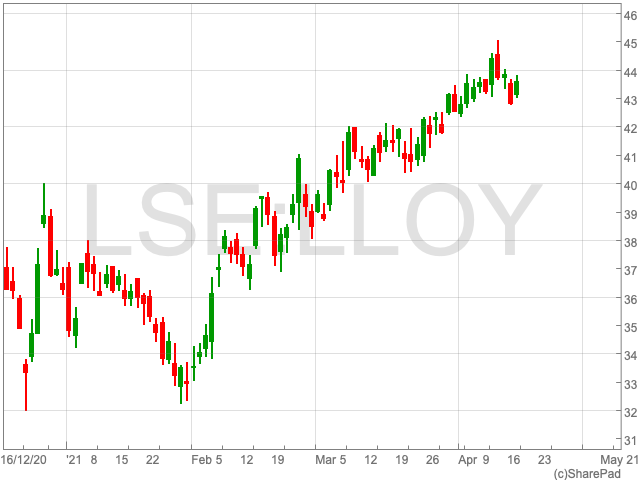
The Lloyds share price (LON:LLOY) has risen sharply since the turn of the year as pent-up demand and the vaccine roll-out is creating a positive mood around the UK economy. Having begun 2021 at under 35p, Lloyds shares are now valued at 43.56p per share, an increase of nearly 20%.

With the outlook for the UK economy improving as the so far successful vaccine roll-out has led the governor of the Bank of England to hint at stronger than anticipated growth in the coming months, the FTSE 100 bank looks set to capitalise.

Price Target

The UK bank has been given some positive targets by analysts that will be welcomed by investors. Barclays’ investment banking arm recently upgraded its “overweight” share price target for Lloyds to 47p from 46p. Barclays based its estimate on favourable outlook for the UK banking sector. “There are also nascent signs of stabilisation in unsecured personal lending (albeit at subdued levels) while asset pricing remains stable, with March mortgage pricing down marginally following softening in February,” the bank said.

While Deutsche Bank analysts also upgraded the stock from “hold” status to a “buy”. Despite the upgrade, the bank maintains its 50p target price, which is more than 6p above the current Lloyds share price.

Savings

Brits are set to have saved an additional £180bn in their bank accounts, or around 10% of UK GDP. While this figure might seem favourable to a bank such as Lloyds, this may not be the case as Banks will struggle to find a way to lend this money profitably as UK consumers are cutting their borrowing at a record pace. Consumer borrowing dropped 9.9% year-on-year compared with February last year – just before the pandemic struck the West – the biggest fall since the series began in 1998, the BoE said.

However, business loans could continue to rise in 2021, creating an avenue for Lloyds to return to profit. “Banks lent firms a total of £35.5bn in net terms last year – £34.7bn of which was lent since the start of the pandemic in March – with a further £26bn forecast by the end of 2021, and many firms unlikely to start repayments until 2024,” a report by financial services company EY stated.

FTSE 250 ‘on a roll’ rising by 26% in the past six months

0

Minutes before lunchtime on Friday, the FTSE 250 is up by 0.38% to 22,556.40, continuing its strong form since the beginning of the pandemic.

“The FTSE 250 is on a roll, having risen by 26% in value over the past six months. This has silenced critics who said there is little to like about the UK stock market,” said Russ Mould, investment director at AJ Bell.

“Value-style stocks offering jam today rather than jam tomorrow have been in demand, as well as lots of companies well placed to benefit from the reopening of the economy thanks to the rollout of the Covid vaccines,” Mould added.

Friday’s session was dominated by industrials, financials and utilities, helping to push the FTSE 250 up another 0.3% to 22,539. Key movers included Mitie, whose shares have more than doubled in price in the past six months.

“Mitie was previously seen as a pandemic loser. Many people thought the working from home trend could result in reduced commercial property demand, affecting one of its key services in cleaning offices. Investors now appear to be taking the view that this threat has been overplayed,” said Mould.

FTSE 250 Top Movers

Petropavlosk (3.87%), WH Smith (3.5%) and Syncona (3.11%) are the top risers on the index heading into lunchtime on Friday.

At the other end, TI Fluid Systems (-5.68%), Kainos Group (-3.24%) and AO World (-2.69%), have seen the biggest falls in the value of their shares.