Consumer spending boosts UK as Brits get ready for summer

0

Consumer spending rose 7.6% in May compared to the same period in 2019

The possibility of the UK economy being buoyed by consumer spending received a boost on Tuesday as it was revealed that spending rose by 7.6% in May compared to the same month in 2019.

Brits spent their money on food, drink and clothing as they began socialising more as lockdowns eased further. This is according to a survey released by Barclaycard earlier today.

The increase in spending is the most substantial since the beginning of the coronavirus pandemic in early 2020.

Spending on essential goods was supported by an increase in supermarket shopping, up 17.7%, and shopping at local specialist food and drink retailers, including butchers and off-licenses, up by 69.3%.

The patchy weather at the beginning of May did little to deter consumers from going back to the shops, as total spending on non-essential goods jumped by 5.8% compared to the same month two years ago, before the pandemic.

Brits sought to refresh their wardrobes to continue socialising, as there was a rise in clothing sales of 8.5%, in addition to sales at department stores which jumped by 8.6%.

Raheel Ahmed, head of consumer products, said: “May was a positive month for a range of categories, with the nation clearly determined to show support for retailers and local businesses. As friends and families reunited after months apart, it is reassuring to see signs of recovery for the entertainment and hospitality industries, both of which have faced significant challenges over the past year.”

“While international holidays continue to be hampered by restrictions, staycations in the UK are providing a welcome boost to the travel sector, as May saw more holidaymakers, particularly in the older age groups, book or embark on trips. With summer – and hopefully more of this warmer weather – on the way, we hope to see these positive trends continue as Brits make the most of their newfound freedoms.”

Pandemic has had massive impact on financial planning across UK

0

Pandemic sees one third of millennials move house to find a better quality of life

The coronavirus pandemic and resulting lockdowns across the UK led to more than one third of 18-34 year-olds moving home, according to research by Close Brothers, an asset management firm.

The 36% of those who moved did so to secure a better standard of life, the findings suggested.

To compare, the figure for those aged 55 and above is 9%, while the average across Britain came in at 21%.

The report highlights the way in which workers across the UK have altered their financial plans due to the events of the past 12 months.

Close Brother’s findings also show a shift towards remote working as 39% are going fully remote, while 30% intend to do so on a part-time basis.

Facebook recently said its employees will be allowed to continue working from home as it thinks remote work “is the future”.

The last 18 months, in addition to impacting the way people approach their mental and physical health, has encouraged many to keep a closer eye on their day-to-day spending, as outlined below.

Top Changes Made to Improve Financial Wellness

OverallMenWomen
Keeping a closer eye on day to day spending63%52%73%
Saving more into an emergency savings fund61%57%65%
Writing a will/ updating an existing will20%19%21%
Saving more into my personal pension19%24%15%
Increasing my contribution to my workplace pension16%19%13%

Jeanette Makings, Head of Financial Education at Close Brothers commented: “For years, we’ve been keeping a close eye on the financial wellbeing of UK employees and in the last few years, there are some signs of trending in the right direction.”

“But the impact of the pandemic and the experience through multiple lockdowns have been a catalyst for some significant lifestyle changes and in employees taking steps to improve their mental, physical, and financial health.”

“At this moment in time employees are more focused than ever about the importance of better managing their finances. It is therefore the perfect time for employers to push harder on their financial wellbeing strategies and better support their employees’ financial health. More employees need it and more employees are ready, willing and able to listen.”

World’s major websites struck by internet outage

0

UK government, Amazon, Financial Times included in those brought down temporarily

A vast internet outage took down some of the world’s most prominent websites, including those of the UK government, the Guardian and Amazon.

The failure was traced back to an error at the American cloud computing services company Fastly, who identified and amended the disruption.

In an error message posted at 10.58 in the UK, Fastly said: “We’re currently investigating potential impact to performance with our CDN services.”

Error messages first started to appear on people’s screens, including “Error 503 service unavailable” and “connection failure”, as early as 11am this morning.

Almost an hour later, Fastly declared the incident over. “The issue has been identified and a fix has been applied. Customers may experience increased origin load as global services return,” the company said in a status update.

Over 20,000 Reddit users confirmed issues with the platform, while in excess of 2,000 users of Amazon raised issues with the online retailer’s website.

Other websites impacted were news organisations CNN, the New York Times and the Financial Times.

The outage didn’t seem to apply to everywhere in the world. While failures were reported in New Zealand, London and Texas, others, including Berlin, reported no issues at all.

“This global outage that affects many high-profile companies does highlight the dependency we have on cloud services and their availability,” said Sergio Loureiro, Cloud Security Director at Outpost24.

“This directly impacts many businesses, including for example Reddit whose entire business is based around their website.”

Bank of England outlines climate stress test for banks and insurance companies

0

Test will analyse the ability of the UK’s major banks and insurers to adapt to the shift towards a net-zero emissions economy

The Bank of England outlined its stress test of the ability of the UK’s financial system to deal with the threat of climate change on Tuesday.

It added that the findings will not yet be used to determine capital requirements.

The central bank’s test will analyse the ability of the UK’s major banks and insurance companies, including HSBC, Barclays and Aviva, to adapt to the shift towards a net-zero emissions economy over the coming years, in addition to the impact of extreme weather conditions.

As the test is relatively new it will not compile results on individual firms at this stage and is set to publish its findings in May 2022. Although this date could be sooner.

The test involves three specific scenarios that cover 30 years. Firstly it will look at early action by governments across the world to reduce emissions, then action that is late, and finally the prospect of taking no additional action.

These scenarios will be judged using two criteria. Firstly, physical impacts, including fires and floods, and financial risks, such as a dramatic change in asset values or the price of carbon.

Responding to the publication of the Bank of England’s climate stress test scenarios this morning, Positive Money senior economist David Barmes said:

“The Bank’s climate scenario analysis may be a useful exploratory exercise, but it’s time to move from exploring to acting. Scenario analysis is incapable of accurately measuring highly complex climate-related financial risks, and we already know enough about the dangers of the climate crisis to justify regulatory action now,” Barmes said.

“It is concerning that the Bank of England appears to be ruling out using climate stress tests to help inform changes to capital requirements. Climate capital rules that reflect the high risk of fossil fuel investments are a necessary inevitability to ensure financial stability and alignment with the government’s climate plans, and the Bank needs to be introducing such policies without delay.”

“By delaying the implementation of climate capital rules, the Bank is undermining its duty to protect financial stability and support net-zero.”

FTSE 100 benefits from sterling’s retreat despite summer slowdown

0

Adding at best 0.27%, the FTSE 100 was sat just below 7,100 after the bell, kept from that level by the 0.6% and 1.2% losses for BP and Shell respectively.

“The summer slowdown felt in effect this Tuesday, with Europe barely able to raise its head from the pillow,” said Connor Campbell, financial analyst at Spreadex.

The index benefited from sterling’s retreat. Cable was down 0.3%, and back below $1.414, while against the euro the pound dipped 0.1% to €1.1619.

The Eurozone was even more lethargic, with the DAX down 0.1% and the CAC up the same amount.

“There’s still a flurry of data from the region that could case a shift. The Eurozone-wide ZEW economic sentiment reading is set to rise from 84.0 to 85.5, while the German-specific equivalent is eyeing a jump from 84.4 to 86.0. The revised Q1 GDP reading, however, is set to remain at -0.6%,” said Campbell.

“At present the Dow Jones doesn’t look interested in upping the ante this afternoon. The futures have the index down 0.1%, and hovering around 34,600. That leaves the Dow within reach of its 35,000 all-time highs, but perhaps reticent to near that level until it gets a gander at Thursday’s inflation data.”

FTSE 100 Top Movers

Intermediate Capital Group (5.64%), Aviva (3.55%) and Flutter Entertainment (3.01%) are the top risers on the FTSE 100 during the morning session.

While Smith and Nephew (-1.33%), Shell (-1.17%) and Evraz (-0.85%) make up the bottom three.

British American Tobacco

British American Tobacco has upgraded its revenue forecasts for the current year on better than expected sales of its non-tobacco products.

The FTSE 100 cigarette company is now anticipating its revenues will grow by 5% on a constant currency basis during 2021, as it saw record growth in the amount of customers for its non-tobacco products. Exchange rates will skim off some of BAT’s gains as it expects an “8% currency headwind” during H1 and the full year.

Aviva

Cevian Capital, an activist investor, confirmed on Tuesday it had acquired a 4.95% stake in Aviva, and that the UK insurer should now be able to return £5bn of excess capital next year.

As an alternative to ousting chief executive Amanda Blanc, Cevian is encouraging the FTSE 100 company’s boss to work on a number of disposals she announced when she took over the company nearly 12 months ago.

British American Tobacco upgrades revenue forecast as non-tobacco products see record growth

0

BAT now anticipating its revenues will grow by 5% on a constant currency basis during 2021

British American Tobacco (LON:BATS) has upgraded its revenue forecasts for the current year on better than expected sales of its non-tobacco products.

The FTSE 100 cigarette company is now anticipating its revenues will grow by 5% on a constant currency basis during 2021, as it saw record growth in the amount of customers for its non-tobacco products.

Exchange rates will skim off some of BAT’s gains as it expects an “8% currency headwind” during H1 and the full year.

Commenting on the statement, Steve Clayton, Hargreaves and Lansdown select fund manager said:

“Currencies threaten to undo BATS’ efforts when the group reports this year, but the underlying progress is encouraging. Traditional tobacco products continue to see volumes shrinking, but BATS’ portfolio is outperforming the trend,” Clayton said.

“Growth in the NGP division is picking up though, with the numbers of consumers choosing to use BATS’ vaping and tobacco heating products growing by over 10% in the last six months. Their Vype and glo brands are both building share in these new, reduced risk categories.”

“Tobacco firms are traditionally very strong cash generators and BATS is very much from that mould. The company is rapidly paying down the debts it took on when it acquired the rest of Reynolds American a few years ago, seeing leverage down to 3x by year end.”

BAT has set its sights on acquiring 50m consumers of non-burning products by 2025, in addition to making its own operations carbon neutral by 2030.

Regarding tobacco, BAT was aided by a strong recovery in the US, as Vuse, its vapour brand, is now close to market leadership with a share of 31%.

Jack Bowles, chief executive, said: “We added +1.4mln non-combustible product consumers in Q1, to reach a total of 14.9mln.”

“We are growing New Categories at pace, encouraging more smokers to switch to scientifically substantiated reduced-risk alternatives.”

Bowles is also confident of his company’s net-zero emissions targets.

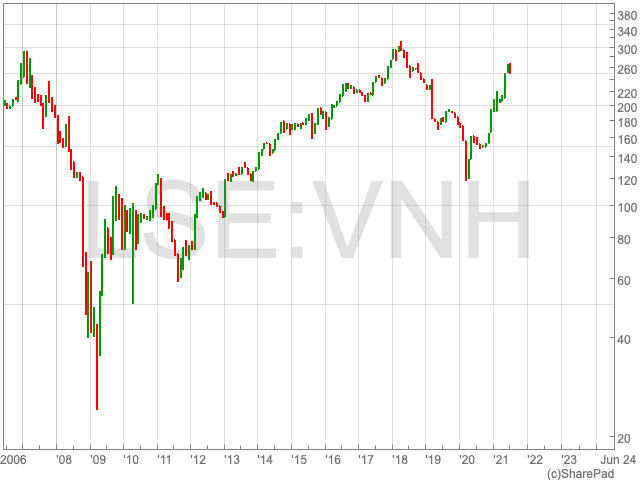
The British American Tobacco share price is up by 1.35% early on Tuesday to 2,811.58p.

German industrial output down 1% in April as supply bottlenecks hold back recovery

0

German factories remain 5.6% below pre-pandemic levels

Germany saw its industrial output fall in April due to a lack of semiconductors, timber and other intermediate goods.

It is additional evidence that supply bottlenecks are holding back a recovery in the largest economy in Europe.

The Federal Statistics Office confirmed industrial output fell by 1% on the month following a downwardly revised increase of 2.2% in March.

The dip in the industrial output figure was driven by a 3% fall in consumer goods production and a sharper fall of 4% in construction activity.

The figures mean that the German economy will be more reliant on household spending to support its economy which is still reeling in the aftermath of the coronavirus crisis.

German factories remain 5.6% below pre-pandemic levels, despite the global economy beginning to pick up this year.

Factory bosses have been drawing attention to shortages in plastics, rubber and metals and semiconductors, as suppliers have raised prices in response.

“Such a combination is unparalleled: Order books in industry are well filled and production is falling,” VP Bank economist Thomas Gitzel said, adding that the supply problems with semiconductors were causing a fall in output in the car industry.

Gritzel said that manufacturing would only be able to make a minimal contribution to the overall picture in the coming quarter, despite order books being full.

Bosch board member Harald Krüger told the Financial Times: “The only way to get out of [the recent crisis] is to have a different level of commitment”.

In an effort to ensure production of chips for its power tools in July, Bosch opened a €1bn semiconductor plant in Dresden yesterday.

“Money needs to be put on the table and actually parts have to be bought. The commitment needs to be rock solid that those parts will be bought. It can’t be: ‘Maybe I [will] buy them, prepare for it, and maybe not.’ This doesn’t work.”

Aviva must return capital says activist investor Cevian

0

Cevian Capital has acquired a 4.95% stake in Aviva

Cevian Capital, an activist investor, confirmed on Tuesday it had acquired a 4.95% stake in Aviva (LON:AV), and that the UK insurer should now be able to return £5bn of excess capital next year.

As an alternative to ousting chief executive Amanda Blanc, Cevian is encouraging the FTSE 100 company’s boss to work on a number of disposals she announced when she took over the company nearly 12 months ago.

Over the past year, Aviva has agreed to sell eight non-core businesses, raising nearly £8bn, in an effort to prioritise the UK, Ireland and Canada. The pursuits of previous leadership teams were seen by some analysts as overly ambitious, leaving Aviva with an overly big cost base.

“Aviva has been poorly managed for many years, and its high-quality core businesses have been held back by high costs and a series of bad strategic decisions,” Christer Gardell, managing partner and co-founder of Cevian said in a statement.

The insurer “has the potential to become a focused and well-capitalised market leader that produces profitable growth, generates significant cash, and is highly appreciated in the equity markets,” he added.

At the end of last month, Aviva said it had raised £7.5bn from disposals, while its intention was to return the money to shareholders. However, Aviva did not put a number on the amount.

Analysts, according to Reuters, expect the insurer to have between £3.7bn and £6.6bn in excess capital after the asset sales were completed.

“Aviva has made significant strategic progress over the past eleven months and we remain sharply focused on further improving our performance,” an Aviva spokesperson said in an emailed statement.

“We regularly engage with investors and welcome any thoughts which move us towards our goal of delivering long term shareholder value”.

Cevian manages in excess of $16bn on behalf of 350 pension funds, endowments and other investors. According to the Financial Times, it began building it stake in Aviva early this year. With its holding at 4.95%, Cevian is now Aviva’s second-largest holding behind BlackRock.

The Aviva share price is up by 2.53% during the morning session to 421.10p per share.

New standard listing: Thungela Resources

Anglo American (LON: AAL) has successfully spun off South African coal mining business Thungela Resources Ltd (LON:TGA) and the shares have started trading on the standard list in London and the Johannesburg Stock Exchange. Anglo American shareholders received one Thungela share for every ten Anglo American shares they own.
Thungela generates four-fifths of sales from exports. The major destination is India. The realised export price can sometimes be more than treble the domestic price.
There are reserves of 137Mt and resources of 756Mt. Thungela operates four open cast mines and three undergr...

Aquis to Main Market: ImperialX / CloudBreak Discovery

Aquis shell company ImperialX has finally secured some mining assets to provide a base for its business and it says that it has a pipeline of other potential deals. This includes grassroots mineral assets.
The share price has settled down at 4.5p. Management is setting its store by a rising share price and the increasing attraction of the shares to the vendors of assets that it wants to purchase.
This company seems to be a ragbag of assets. It really requires someone with some knowledge to trawl through the different investments and net smelter returns to assess just what valuation the company...