Oil rally lifts FTSE 100 above 7,100 for first time since May 10

Though it didn’t quite match yesterday’s growth, the FTSE 100’s early gains still lifted it to a recent high.

Up 0.3%, the UK index is now above 7,100 for the first time since May 10 and is around 70 points from matching the then-14-month peak struck on that date.

“The FTSE 100 built on yesterday’s strong performance to trade solidly higher on Wednesday morning, lifted by rising oil prices which boosted the big energy firms on the index, BP and Shell,” says Danni Hewson, financial analyst at AJ Bell.

“An upbeat assessment of demand from producers’ cartel OPEC and the waning prospect of a big increase in Iranian supply have helped support a rally in crude prices. Something which could make the market a little nervous if it is sustained given investors’ current preoccupation with inflation risks.”

Connor Campbell, financial analyst at Spreadex added: “Looking at the trading landscape this Wednesday, however, and a low energy open may make it difficult for the FTSE to significantly make strides towards those levels.”

“The DAX and CAC, for example, both started the session flat following a far worse than forecast German retail sales reading, while the Dow Jones is heading for a similarly sluggish performance this afternoon,” Campbell said.

Wednesday could be a day where the markets tread water, saving their energies for the US jobs focused sessions on Thursday and Friday, which bring the unemployment claims and latest non-farm payroll data respectively.

FTSE 100 Top Movers

Burberry (3.44%), British Land Company (2.16%) and Land Securities (1.82%) were the top risers on the FTSE 100 during the morning session.

At the bottom end, Kingfisher (-2.32%), Aviva Group (-1.72%) and Antofagasta (-1.63%) each lost ground on Wednesday morning.

Oil

Brent crude oil surged past $70 per barrel for the first time since March on Tuesday.

The news comes as OPEC+ stayed true to their plan of releasing more barrels of oil into an improving market.

The benchmark for oil used across the world now stands at $70.78, as OPEC+ producers, headed up by Russia and Saudi Arabia, said they were restricting output as there are a number of uncertainties at play. This is despite there being an increase in demand globally.

Brent crude oil surpasses $70 a barrel for the first time since March

OPEC+ representatives agreed to move ahead with plans to release more oil to the market next month

Brent crude oil surged past $70 per barrel for the first time since March on Tuesday.

The news comes as OPEC+ stayed true to their plan of releasing more barrels of oil into an improving market.

The benchmark for oil used across the world now stands at $70.78, as OPEC+ producers, headed up by Russia and Saudi Arabia, said they were restricting output as there are a number of uncertainties at play. This is despite there being an increase in demand globally.

According to a poll by Reuters, US crude stockpiles were expected to fall by 2.1m barrels last week. In addition, oil prices were pushed up by Chinese data that showed manufacturing rose at its fastest rate this year in May.

Prices were also boosted by Chinese data showing that the country’s factory activity grew at its fastest pace this year in May.

Following a virtual meeting OPEC+ representatives agreed to move ahead with plans to release more oil to the market next month.

A number of traders, as reported by the Financial Times, have suggested that the vaccine roll-out, along with stimulus packages, have pushed demand for oil. The resultant deficit is what caused the price of crude oil to surge by over 30% since the end of last year.

“Unless widespread cheating develops or a renewed uptick in global coronavirus cases evolves, OPEC’s current recipe for success would appear to represent a viable plan,” said Jim Ritterbusch, president of Ritterbusch and Associates in Galena, Illinois.

Wizz Air reports massive loss as pandemic takes its toll

0

For the 12 months to 2020, Wizz posted a net loss of €482m

Wizz Air (LON:WIZZ) said it will lose money next year as the effects of the pandemic on the airline industry could be prolonged as travel restrictions remain across the continent.

The budget airline said on Wednesday that restrictions had remained longer than expected. Between April and June, Wizz expects to fly around 30% of its normal schedule.

Wizz Air chief executive Jozsef Varadi said the company is cautiously optimistic about the businesses’ recovery, adding that it has “started later than what we would have liked”.

Varadi expects to record a net loss for the 12 months to March 2022, unless restrictions are lifted in a “permanent” and “accelerated” way.

For the 12 months to 2020, Wizz posted a net loss of €482m, as flyer numbers fell by 75% to 10m.

Liquidity stands at €1.617bn as of March 31. The Hungarian airline went through €84m during the last quarter.

Susannah Streeter, senior investment and markets analyst at Hargreaves and Lansdown, commented on the outlook of the travel sector and Wizz’s prospects.

“High hopes that brighter skies were in sight for the airlines have been clouded by fresh strains of Covid emerging in parts of the world. It has meant that the lights have been stuck on amber for many travel destinations for longer than expected, throwing holiday plans into disarray.”

“The Hungarian carrier flies routes mainly to and from Eastern European countries, which have been far from speedy in vaccine roll outs, although lighter travel restrictions compared to the UK do put it in a slightly more resilient position. It’s also been flexible in its reaction to ever changing rules, by nimbly ramping up to 80% capacity last summer before reducing back down to 20% only weeks later.”

Down to its low-cost base and expansion into different areas during the pandemic, Wizz could yet emerge as a winner from the pandemic.

During the morning session, the Wizz Air share price is down by 1.56% to 4,800p per share.

Zoom faces challenge of adapting beyond lockdowns

0

Zoom saw revenues rise 191% in the first quarter of this financial year

Zoom (NASDAQ:ZM) last night said it expects its revenue for the current quarter will surpass estimates due to the increased provision of hybrid models of working.

Over the past year, Zoom’s brand has been popularised across the world as companies and schools increasingly used its service to cope with being locked down.

James Andrews, Personal Finance Expert at money.co.uk, commented:

“Zoom has been one of the biggest success stories of the past 15 months, seeing revenues surge 326% over its 2021 fiscal year as ever more companies and individuals signed up during various lockdowns. In short, it’s gone from a relatively unknown US tech firm to a household name across the globe.”

With the vaccine roll-out proving to be a success, the question now is if Zoom can stand firm in the face new challenges.

“The key question investors have been asking is if the firm can continue to grow as people return to work and virtual meetings are replaced by face to face ones. So far, at least, the answer appears to be ‘yes’, with the video conferencing platform seeing revenues rise 191% in the first quarter of this financial year,” said Andrews.

“With Zoom now established as the leading specialist video conferencing tool, the other big question is whether it can continue to hold its position as the likes of Facebook, Microsoft, Google and more seek to muscle into the market leveraging their existing users, platforms and bank balances to take revenue from Zoom.”

The company based in San Jose, California, addressed those concerns by forecasting revenue for the current quarter to reach between $985m and $990m. According to data from IBES Refinitiv, this is above Wall Street estimates of $931.8m.

Zoom shares closed down by 1.15% yesterday, as the company has seen a steady decline since October.

Tekmar Group: strategic growth emerging

Tekmar Group (AIM:TGP) - Today’s 2nd interims (as the year-end is changing to September) contained a part of a business strategic review from the recently appointed CEO, Alistair Macdonald. The Covid impacted results showed a 29% revenue decline to £29.1m with an Operating loss of £2.4m to March 2021, which compares to a previous profit of £2m.
It is estimated that there will be €50bn of global spend on subsea cable procurement and installation in the next decade with over 60,000km of subsea cable to be installed by 2030, creating substantial opportunity for Tekmar’s technology and services. ...

CFA Institute members say equities correction likely in next one to three years

0

Plurality argue equities have been out of sync with the real economy since the start of the pandemic

The CFA Institute, the global association of investment professionals, surveyed its membership to analyse the impact of the coronavirus pandemic, and found that many respondents are expecting market corrections within the next one to three years.

The results showed that 45% of those surveyed thought this to be true, believing that equities in their respective markets have recovered too quickly.

The proportion of respondents who believe that equities are fairly valued was low across the board.

50% of respondents in North America are concerned about a correction, compared to 40% of Europeans, while respondents in emerging markets appear more optimistic that equities in their own market.

Double-digit declines have occurred in the S&P 500 every 1.87 years since 1950, therefore stock market crashes are more common than it may seem.

While the US stock market has been showing some signs of weakness with the Nasdaq trading lower for three weeks in a row last month. This is also raising concerns on Wall Street that a crash could be on the way.

Big tech companies reached new highs since the pandemic and many analysts argue that the markets are due for a correction as the economy recovers thanks to a fall in Covid-19 cases.

However, with a somewhat contrary view, a majority of analysts polled by Reuters believe that a near-term correction is unlikely.

Reuters polls of nearly 300 equity strategists taken across May showed all 17 stock indexes surveyed on were forecast to rise, with yearly gains in nearly all of them predicted to be in double digits in 2021.

“When it comes to assessing the market environment we prefer to choose ‘half full’. We will remain vigilant for rebalancing opportunities … as we expect rates and equities to drift higher,” noted Ehiwario Efeyini, senior market strategy analyst at Bank of America.

“In terms of the broader economic environment, we are closer to mid-cycle than late cycle and that growth is currently flashing bright green and surprising more than expected.”

“It is interesting to see the survey results telling us that respondents believe that equities have recovered too quickly, as it could show that CFA Institute members believe there is a disconnect between economic growth fundamentals and capital markets caused in part by monetary stimulus, which could be corrected in a not-too-distant future of less than three years,” said Paul Andrews, Managing Director of Research, Advocacy and Standards at CFA Institute. 

 “To me, it also indicates to authorities that monetary stimulus is not a simple or linear lever to pull given the complexity of the economic and financial ecosystem; there will be unintended consequences to consider in the future.”

Analysts see this UK housebuilder’s profit rising 20% in 2021

The latest release from Nationwide recorded a 10.9% increase in property prices in the year to March, the fastest rate in around seven years.
The boom in the UK housing market was helped by tax incentives offered by the UK government, as well as a broad 'race for space' observed in buyers scrambling to upsize to rural properties "with people reassessing their needs in the wake of the pandemic," outlined by Nationwide's chief economist Robert Gardner in the report.
Given the jump in activity, it's likely interest in housebuilding shares increases and analysts have highlighted one UK housebuilde...

The commodities supercycle and mining royalties with Trident Royalties

Trident Royalties presented at the May UK Investor Magazine Virtual Conference and delivered a truly fascinated Q&A session covering the commodities supercycle and the composition of their mining royalty portfolio.

CEO Adam Davidson gave his views on the possibilities of a commodities supercycle and outlines the market pressures driving commodity prices.

Adam Davidson also discusses why Trident Royalties wanted to make Lithium a central part of their portfolio of royalties, given the increasing demand for electric batteries.

The full video presentation is available in the video section of the UK Investor Magazine website.

Gold retreats after reaching five-month high

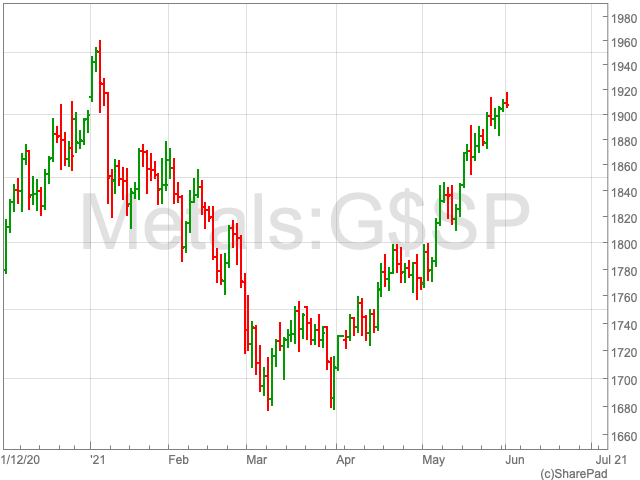
Spot gold may rise into $1,932-$1,953/oz range according to technical analysis

Gold is toying with a five-month high ahead of European and US data set to be revealed this week that could provide insight into the health of the world economy.

Gold retreated from its five-month high of $1,917 to just below $1,910.

The recent move down comes as the decline in the US dollar halted and a rally in the Treasury yields made up some ground.

While inflationary pressures remain on the horizon it appears the sentiment around the precious metal is still bullish.

US consumer prices jumped in April, easily surpassing the Fed’s 2% target, recording its largest annual gain since 1992.

“Gold prices are riding a very strong upward trend … this is against the backdrop of a falling U.S. dollar and also inflation concerns,” said Margaret Yang, a strategist at DailyFX.

“Perhaps another fundamental factor behind gold is the return of Chinese and Indian buyers. In the near-term, if gold can breach the $1,922 per ounce mark, it can open the room for further upside potential.”

Investors will be focusing on key US economic figures, including non-farm payrolls data due on Friday.

The Fed continues to reassert its view that the figures show a short-term trend, including the stimulus packages and supply-chain bottlenecks.

Spot gold may rise into $1,932-$1,953/oz range according to technical analysis by Margaret Yang.

Oakley Capital unveils investment in ICP Education

Oakley Capital Investments’ liquid resources available for deployment estimated to be £180m

Oakley Capital announced on Tuesday that the Oakley Capital IV has agreed to invest in ICP Education Holding, a leading independent group of UK nurseries.

Oakley Capital Investment (OCI) is a listed investment trust that invests in the funds managed by Oakley Capital. Its indirect contribution via Fund IV will be £27m, while its liquid resources available for future deployment (including this transaction) are estimated to be £180m.

ICP Education is one of the largest nursery operators in the UK, serving nearly 6,000 children at 44 nurseries across England, predominantly in London and the South East.

“The group is one of the highest quality large nursery operators in England, with a third of nurseries rated Ofsted Outstanding and 98% rated Outstanding or Good,” Oakley Capital said in a statement.

In addition, last year ICP was ranked as the 14th Best Place to Work in the UK by Glassdoor, across all categories.

ICP Education has achieved a strong track record of growth since its foundation. Enrolments were negatively impacted through UK COVID-19 lockdowns, however the business has quickly recovered to pre-COVID occupancy levels in recent months.

Stephen Booty, Executive Chair of ICP Education, commented: “We are very much looking forward to our partnership with Oakley, given their depth of experience as investors in Education. The team has a real appreciation of how important it is to be focused on providing the highest standards of quality care and early years education, and we are looking forward to working with them to realise our growth ambitions in the UK and internationally.”

Oakley is one of the most active investors in the European education sector. To date, platform investments in the sector have included Inspired Education, a leading global schools group; Schülerhilfe, Europe’s largest tutoring group; IU Group (formerly Career Partner Group), the largest and fastest growing university in Germany; ACE Education, a leading French university group; and Ocean Technologies Group, the leading provider of e-learning to the maritime industry. 

Peter Dubens, Managing Partner of Oakley Capital, commented: “Our experience investing in high-quality businesses within the Education sector has led us to identify the nursery sector as an attractive area which is enjoying sustained growth. We look forward to partnering with Stephen, Dominic and Clare, as they continue to grow one of the leading premium nursery groups in Europe.”