The government will guarantee mortgages up to 95% of a home’s value
Property industry experts have reacted positively to Rishi Sunak’s budget announcement on Wednesday, while outlining the need for more sustainable reforms.
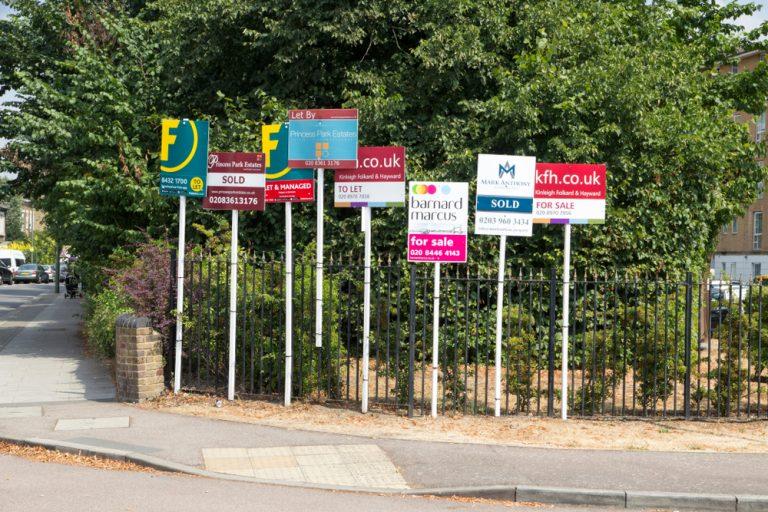
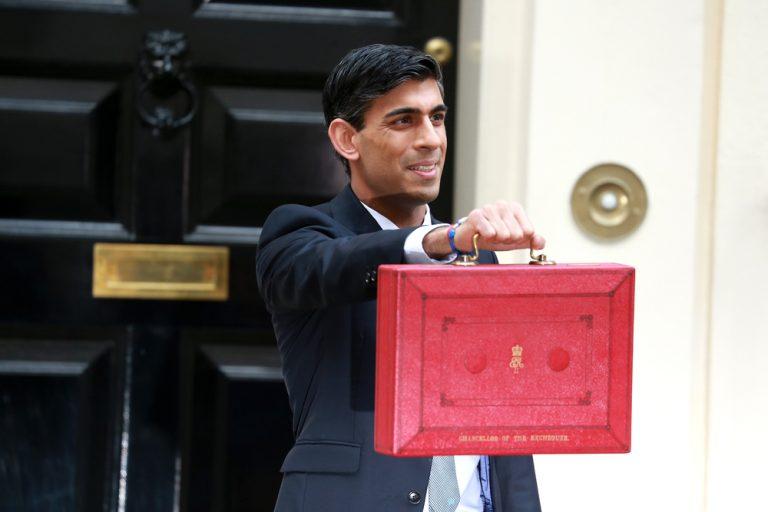
The Chancellor pledged to “stand behind home buyers”, extending the stamp duty holiday to June. The point at which stamp duty will be paid will remain at £250,000, double its standard level, until the end of September. The budget also included assurance that the government will guarantee mortgages up to 95% of a home’s value.
House builders, Persimmon (5.96%), Barratt Developments (5.7%) and Taylor Wimpey (5.41%) made up three of the top four risers on the FTSE 100 following Chancellor Rishi Sunak’s budget announcement on Wednesday afternoon. Today follows a recent surge by UK house builders as they continue to prop up the index of the UK’s top companies.
Commenting on the Budget and its implications, David Ross, managing director at Hometrack, said:
“Our analysis shows that the 95% mortgage scheme for first-time buyers would support borrowers predominantly in lower value markets, particularly in the northern regions of England and across Scotland, parts of Wales and Northern Ireland, which lenders should factor into their considerations. The high cost of homes in southern England makes using a 95% mortgage much harder, and mortgage regulations compound this with limits on maximum loan to income levels.
While Richard Donnell, research director at Zoopla, praised the combined impact of Sunak’s policy on the housing market, he said it would do little to address the sector’s longer-term structural issues
“Taken together, the stamp duty holiday extension and the 95% mortgage guarantee scheme provide continued support for the housing market as we help the economy respond to the pandemic – they address barriers to movement and access to home ownership but will have limited impact on shifting the longer term fundamentals of the housing market,” Donnell said.
Rishi Sunak warned during his budget announcement that “it will take a long time to recover from this extraordinary situation”. The Chancellor on Wednesday afternoon confirmed an increase in corporation tax to help restore the nation’s finances in the aftermath of the pandemic. In addition, Sunak announced a continuation of the furlough scheme and the stamp duty holiday, among other policies.
Sunak began by outlining forecasts by the Office for Budget Responsibility (OBR) for the economy to return to its pre-pandemic level quicker than anticipated. The OBR expects the economy to return to its pre-Covid level at the middle of next year, six months quicker than previously thought, Sunak confirmed. The Chancellor also said that the OBR has forecast the UK economy will grow by 4% in 2021, 7.3% in 2022 and 1.7% in 2023.
Tax Hike
Sunak announced that government debt would rise to 97% of GDP, comparing the figure to levels seen during World War Two.
The Chancellor announced a hike in corporation tax up to 25% from 2023, up from its present level at 19%. “It’s a tax rise on company profits, but only the larger most profitable companies and only in two years time,” Sunak said.
The lowest income tax threshold will rise to £12,570, while the higher rate threshold will go up to £50,270. Both will then be frozen until 2026.
Covid-19 Support
The UK Government’s furlough scheme will be extended to the end of September. Employees will continue to receive 80% of their salary, while businesses will be asked to contribute as well. The self-employment scheme will also be continued.
The government will continue to raise universal credit by 20% for the next six months, beyond the proposed conclusion of the national lockdown. While grants will be provided to businesses across the UK. Retail and hospitality businesses will receive a special “restart” grant to help them reopen in April.
Sunak said the government’s fiscal support for the UK economy would total £407bn.
Property
The Chancellor pledged to “stand behind home buyers”, extending the stamp duty holiday to June. The point at which stamp duty will be paid will remain at £250,000, double its standard level, until the end of September. The budget also included assurance that the government will guarantee mortgages up to 95% of a home’s value.
Commenting on the extension to the stamp duty holiday and introduction of a government-backed 5% mortgage in today’s Budget, Tom Brown, managing director of real estate at Ingenious, said: “The Chancellor’s decision to extend the Stamp Duty Land Tax (SDLT) holiday and provide a Government-backed guarantee to mortgages with deposits of just five per cent reflect the importance of maintaining optimism in the UK housing market.”
“The support provided by the SDLT relief extension, saving up to £15,000 on property purchases of £600,000 is positive news for our strategy as an alternative lender focused on the affordable end of the market,” Brown added.
Green bonds
The budget included a number of “green” policies aimed at rebalancing the UK economy after the pandemic.
Sunak announced new port infrastructure enabling offshore wind on Teesside and the Humber, in addition to a new “green” retail savings bond. The UK’s new infrastructure bank, located in Leeds, will be armed with an initial £12bn fund to support projects aimed at zeroing out net carbon emissions by 2050.
Chris Holmes, co-lead investment adviser at JLEN Environmental Assets Group, commented on today’s budget:
“We are particularly pleased to see confirmation of a cash boost for the new UK Infrastructure Bank. It is vital for the UK’s post-pandemic and post-Brexit recovery to invest in the sustainable infrastructure and nascent green technologies that will take our country forward, honouring the government’s promise to ‘Build Back Better’ and creating the jobs needed to power the green economy.”
“Environmental infrastructure assets such as wind and solar plants, have on the whole proved to be very robust during the coronavirus pandemic – proving their resilience and reinforcing the investment case for building a sustainable future.”
Pensions
Finally, Sunak announced that the government would be freezing the pension lifetime allowance. The allowance is the amount people can save in their pension before they are liable to pay tax.
Simon Harrington, senior public policy adviser at PIMFA, commented on the policy.
“We are dumbfounded that the Chancellor has frozen the Pension Lifetime Allowance until 2026. Doing so penalises pension savers looking to secure their future and in the most extreme cases sees people left with no choice but to give up work. Freezing the lifetime allowance could see a number of people inadvertently exceed their allowance and, as we have seen previously with NHS workers, incur a 55% tax hit which they otherwise would not have to pay,” Harrington said.
DS Smith improves ESG rating, retaining ‘Prime status’
DS Smith (LON:SMDS) confirmed on Wednesday that its trading volumes are in line with the company’s expectations.
The FTSE 100 firm, which supplies packaging products to Amazon, Nestle and Unilever, noted “strong box volumes” driven by its differentiated offering, while input costs costs also increased.
Corrugated box volume growth has soared compared to Q2 of DS Smith’s financial year, as the e-commerce and FMCG (Fast-moving consumer goods) operations proved to be strong over the Christmas period and into 2021.
DS Smith’s North European and North American regions have continued its “strong growth with our largest customers and increasing utilisation of our plant in Indiana”.
DS Smith’s share price was up by 0.68% before lunchtime to 405.74p per share.
Since the beginning of the calendar year, DS Smith’s rating within the MSCI ACWI Index has increased from A to AA and the company’s ISS ESG rating had increased, retaining its prime status.
Mike Roberts, chief executive of DS Smith, commented on the results:
“The Group has delivered a robust performance during the period against a challenging macro-economic environment, and I remain immensely grateful and proud of our colleagues for their commitment to keeping our plants safe and operational and continued support from our customers.”
“We are seeing excellent demand from FMCG and e-commerce customers for our sustainable packaging products and solutions and we continue to invest for growth in these areas. COVID-19 is accelerating a number of the structural growth drivers and with our leading position in recycling and fibre-based packaging we are well positioned to capitalise and drive further market share gains.”
“While the economic environment remains uncertain due to Covid-19, we are experiencing good momentum across the business in both Europe and North America. We are confident in delivering results in line with our expectations for the year and showing further good progress and momentum as we move into the next financial year.”
JLEN will invest around £21.2m over the next 12-15 months
JLEN (LON:JLEN), the environmental infrastructure fund, confirmed on Wednesday that it has acquired a 100% stake in Gigabox South Road Limited (GSRL).
JLEN, the FTSE 250 company, has said it will invest around £21.2m over the next 12-15 months as a part of the acquisition of GSRL.
GSRL holds the development rights to construct the West Gourdie project, a 50MW lithium-ion battery energy storage plant based in Dundee, UK. It is anticipated the project will reach energisation and begin commercial operations in March 2022.
JLEN said that storage projects provide vital support to the National Grid, by reducing imbalances and improving its ability to harness a greater level of intermittent renewables on the system.
The West Gourdie project will connect to the Scottish Hydro Electric Power Distribution plc’s network and has a 49.9MW import and export connection.
This acquisition represents JLEN’s third investment into battery storage systems, adding to the two co-located batteries that the company owns as part of its run-of-river hydro portfolio.
JLEN’s share price is up by 0.43% on early Monday morning trading to 114.5p per share, recovering to its level at the beginning go 2021.
Richard Morse, Chairman of JLEN, committed on his company’s acquisition:
“We are pleased to announce the further expansion of our interests in the energy storage market with our first grid-scale battery project. We believe that plants such as this one, will play an important role in the decarbonisation agenda by providing balancing support to the local network and allowing for greater levels of renewable generation on the network.”
“This investment should offer additional returns over time as it is structured to take advantage of increased market volatility as intermittent renewable generation facilities play a greater part in supplying green electricity to the nation.”
The FTSE 100 looks set to extend its gains on budget day as the index pushed up again by 1.28% on early morning trading. This is despite the possibility of tax rises as Rishi Sunak vows “to be responsible” with British people’s money.
Naeem Alam, chief market trader at AvaTrade, speculated on how the UK Government will continue to provide support, while aiming to secure the nation’s finances in the long-term.
“It is widely expected that the Chancellor will be using the budget to extend a vast package of covid-19 support, which is likely to last until the end of September. Of course, the Chancellor is betting on a hope that the economy will return from its coronavirus crisis by that time,” said Aslam
“The furlough scheme was due to end in April, but now, it will run in its current form until the end of June. After that, it is expected to phase out slowly. The key idea over here is to avoid any cliff-edge by withdrawing the furlough support rapidly.”
“Obviously, all of this means a higher bill for the Treasury. The Chancellor will maintain the need to balance the budget once the economy is back on the recovery track. Traders expect to see a future tax rise path that could help repair the damage that has occurred to public financing.”
FTSE 100 Top Movers
Whitbread (4.68%), Informalities (4.01%) and Persimmon (3.84%) lead the pack at the top of the index.
Out of a handful of companies to have lost ground on the FTSE 100 on Wednesday morning, Avast (-1.96%), Kingfisher (-0.39%) and Admiral Group (-0.33%) are the biggest fallers.
Persimmon
Persimmon, the FTSE 100 homebuilder, confirmed its profit fell during 2020, while the company saw an increase in the value of its forward order book to £2.3bn. Profit before tax fell to £783m from £1bn, as revenues also dropped by £0.1bn to £3.3bn.
The company confirmed its dividend for the year at 110p a share, down from 235p per share at the end of 2019.
Avast
Avast (LON:AVST), the internet security application, confirmed an increase in its full-year profit and revenue as more people worked from home during the pandemic. During 2020, the FTSE 100 company’s tax before profit rose to $436.7m, up from $400.1m the year before. Avast’s adjusted revenue increased by 2% to $892.9m.
At early morning trading, the FTSE 100 company’s share price fell by 1.77% to 456p per share. It is a continuation of the performance of the Avast’s share price year-to-date, which is down from 532.5p per share.
Avast (LON:AVST), the internet security application, confirmed an increase in its full-year profit and revenue as more people worked from home during the pandemic.
During 2020, the company’s tax before profit rose to $436.7m, up from $400.1m the year before. Avast’s adjusted revenue increased by 2% to $892.9m.
Adjusted revenues jumped by 10.6% to $699.7m in the consumer direct desktop segment. This came after a spike in installations as lockdowns came into effect.
Avast confirmed a final dividend for the year at 16 US cents per share, up 8.8% from the year before, while proposing a final dividend to be paid in June 2021 of 11.2 US cents per share.
At early morning trading, Avast’s share price fell by 1.77% to 456p per share. It is a continuation of the performance of the company’s share price year-to-date, which is down from 532.5p per share.
Ondrej Vlcek, chief executive of Avast, commented on the results:
“The Group delivered another strong year of top line organic growth, high levels of profitability and cash flow generation. Group Adjusted Revenue was $892.9m, with organic growth of 7.9%, driven by double-digit growth in our Consumer Direct Desktop business.”
“In a year when more people and businesses turned to technology to keep their lives and their work enabled, Avast has played a vital role in safeguarding our customers’ digital data and privacy. I am proud of the way the Company has met the challenge of the pandemic head on, putting our duty to act as a responsible business at the heart of our approach”
“The core of the Avast business and our fundamental strengths remain unchanged as we continue to effectively leverage the scale and sophistication of our platform in consumer and SMB markets. We are confident in our ability to unlock new growth opportunities, with a commitment to continued product and technological innovation, and a stronger-than-ever customer experience.”
“Underpinned by a strong prior year billings performance, we expect to deliver FY 2021 organic revenue growth in the range of 6 percent to 8 percent.”
Persimmon, the FTSE 100 homebuilder, confirmed its profit fell during 2020, while the company saw an increase in the value of its forward order book to £2.3bn.
Profit before tax fell to £783m from £1bn, as revenues also dropped by £0.1bn to £3.3bn.
The company confirmed its dividend for the year at 110p a share, down from 235p per share at the end of 2019.
At early morning trading, Persimmon’s share price is up by 0.89% to 2,734p. This follows a strong performance by homebuilders on the FTSE 100 yesterday in anticipation of Rishi Sunak’s budget announcement.
As the firm benefitted from the stamp duty holiday throughout the pandemic, as well as low interest rates, it will now look to further announcements by the UK Government.
Ben Nuttall, senior analyst at Third Bridge, singled out Wednesday’s budget announcement as a policy area of significance to Persimmon.
“All eyes will be on the budget later today as stamp duty plans come through. Many are expecting a stamp duty holiday extension so if the chancellor takes a different path housebuilders such as Persimmon will feel the repercussions.”
While the government’s Help To Buy scheme I unlikely to impact Persimmon as it will other construction companies, the homebuilder could be affected by environmental regulations, according to Ben Nuttall.
“Something that Persimmon won’t escape dealing with will be new environmental building regulations, which are expected to add around £5k to each house build. However, our experts say it is unlikely to impact Persimmon’s profitability as the cost is more likely to be shared by house buyers and land values,” Nuttall said.
Dean Finch, chief executive of Persimmon, outlined the company’s ambitions for the future.
“We must build on this important progress and further enhance our build quality and customer care so we are known for both outstanding service as well as outstanding value. To achieve this we will further strengthen our build quality and independent inspection regime within the Persimmon Way. This will both drive efficiencies that will pay for these improvements and enhance our capabilities, enabling us to build a greater volume of homes at five-star. We have also set new environmental targets in line with the Paris Agreement and will seek to further develop the Persimmon Way to embed the specific measures that will deliver on these targets in the future.”
Rolls-Royce’s share price (LON:RR) is coming under increased scrutiny ahead of the company announcing its financial results on 11 March. In addition, with the continued success around the vaccine roll-out, the airline industry could soon provide the FTSE 100 company with some positive news.
Rolls-Royce Share Price
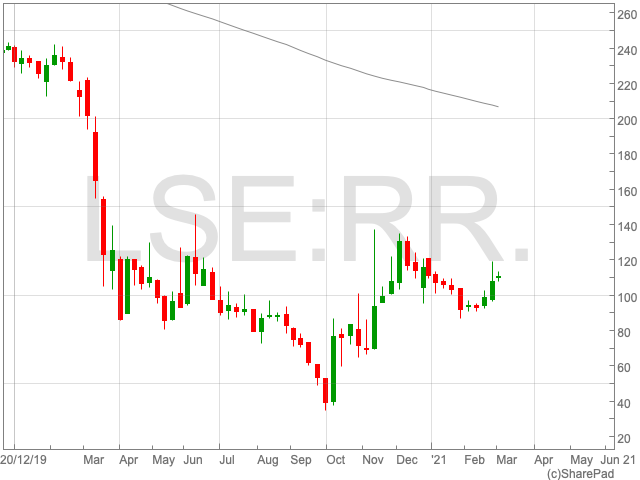
Rolls-Royce shares were badly impacted by the pandemic, falling by 63% between February and April 2020, from 232.39p per share to 86.34p. Since then the company’s share price has mostly staggered along as demand for aircraft dried up. However, in February the company’s stock value rose by 20% as positive news emerged around vaccine roll-outs.
Outlook
As one of the largest aircraft manufacturers in the world, Rolls-Royce has been significantly impacted by the ongoing pandemic. Not only did many airlines rescind their orders but fewer planes are currently being serviced due to a lack of flights. The company does not expect orders to recover to pre-Covid levels until 2025.
In the meantime, much will depend on the success of the continued vaccine roll-outs, and the resumption of international flights. Airlines reported an influx of holiday bookings following the Prime Minister announcing a roadmap out of lockdown. However, the sector will need more than demand from consumers to secure its future. A question mark remains over the long-term effects of Covid-19, even once most people have received a vaccine jab. If the disease lingers then intonational travel could be restricted further.
In addition, the aerospace company recently announced it has made progress towards developing the world’s fastest electric plane. Rob Watson, director of Rolls-Royce Electrical, said: “Electrification of flight is an important part of our sustainability strategy as we aim for net zero carbon by 2050. For the first time, the plane propelled itself forward using the power from an advanced battery and propulsion system that is ground-breaking in terms of electrical technology.”
Experts have said that it will be decades before electric planes are able to displace kerosene models. However, it is an emerging sector which could interest investors with a long-term perspective.
Rolls-Royce will hold announce its annual results on March 11 when the company is expected to record a significant loss.
Boohoo shares (LON:BOO) are stirring interest among investors again as the fast fashion brand emerges from the pandemic in tact. However, the next few weeks could be telling for investors interested in the online retail giant as the company faces up to the prospect of a tax hike from the UK government and an outright ban from the US authorities.
Boohoo share price
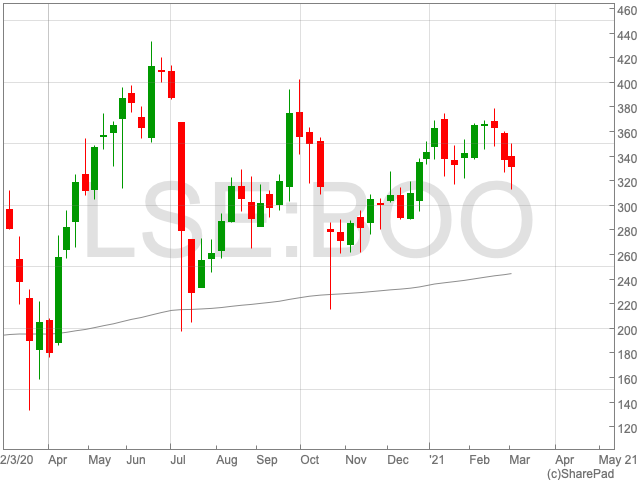
Boohoo’s share price tumbled in July by over 20% to 210p per share as news emerged of poor factory conditions and low pay at some of the company’s suppliers. However, the fast fashion brand showed resilience and recovered well in the following weeks by convincing investors that they planned to turn the situation around. At the end of January, when Boohoo announced its acquisition of Debenhams, the company’s shares jumped up but have since retreated.
Over the past 12 months, taking into account the pandemic and the factory scandal, Boohoo’s share price has risen by over 10% to 333.42p per share. Asos, one of the online retailer’s main competitors, saw a dramatic rise in its share price during 2020, from 2,945p per share to 5,646, an increase of over 90%. However, over a period of five years, Boohoo’s share price, up 669%, has far outperformed Asos, which is up 84%.
Boohoo’s outlook
Boohoo’s revenue growth over the past year has been strong across all regions. In January the retailer released a trading update. Four the final four months of 2020, Boohoo saw its revenue grow by 40%, up to £660.8m. More specifically, in the UK, the US, the rest of Europe and the rest of the world, revenues were up by 40%, 51%, 32% and 34% respectively. The fashion brand anticipates revenue growth between 36% and 38% for the financial year to 28 February 2021. Boohoo also expects to deliver an adjusted EBITDA margin for 2021 at around 2021.
Risks
Boohoo’s price-to-earnings (PE) ratio is at 58.4. This is a high PE ratio, which appears expensive, however it could also reflect the company’s potential for high earnings growth.
While Boohoo recovered well from the factory controversy in 2020, the issue may not have been put to rest. The company could be facing a ban on importing into the US as an investigation has been launched into the its handling of claims of “modern-day slavery”.
Online retailers, including Boohoo, could also face the prospect of a tax policy aimed at the companies that have profited from the unique nature of lockdowns.
The BlackRock Circular Economy Fund report has outlined how the coronavirus pandemic threatened to stall the world’s transition towards ‘circular’ solutions to economic issues. However, as consumer preferences have changed, corporations have increased awareness, and governments have implemented regulations, the sector looks set to get back on track in 2021. The fund’s managers have identified four key sectors where they are expecting growth over the coming months.
The fund invests at least 80% of its total assets in companies that contribute to the advancement of the Circular Economy. The Circular Economy involves unravelling business activity from the consumption of finite resources. Its core principles include: designing out waste and pollution, keeping products and materials in use, and regenerating natural systems.
The BlackRock Circular Economy fund was established in partnership with the Ellen MacArthur Foundation, which is providing the investment firm with expert insights and guidance on circular economic principles and practices.
The widespread use of masks during the pandemic saw a reverse in the decline of single use plastic, although more sustainable options have made an impact.
Plastic usage is often touted as being problematic when discussing sustainability. However, within the circular economy, plastics could very much be a part of the future, according to BlackRock. This can be done, as an example, by replacing recyclable plastic with compostable plastic, which would avoid the prospect of recyclable plastic ending up in a landfill or the sea.
Evy Hambro, co-manager of the BlackRock Circular Economy Fund, argues that getting rid of plastic use is not the solution to the take-make-waste model of consumption.
“We believe that the pandemic will shift the focus to building the right infrastructure to deal with plastic disposal — waste management, collection, sorting and chemical recycling. That makes us more bullish on the supply chain opportunities compared to the pre-COVID era when the debate mostly focused on demonising plastic.”
Technology
BlackRock sees tech companies as embodying the principles of the circular economy. The investment management company expects the theme of sustainability to grow specifically within electronics.
Olivia Markham, co-manager of the BlackRock Circular Economy Fund, believes there needs to be a sustainable solution to manage the economics of decommissioning equipment, and says the company will allocate its holdings accordingly.
“For our portfolio, we seek companies that are aiding lower waste by reducing, reusing, or recycling materials. This applies to the components going into tech hardware produced by technology companies, as well as enabling consumers to do the same with disposable goods. As such, we see growth in the sharing economy, online flea market apps, second hand and rental platforms, e-waste solutions, device leasing and take back schemes.”
Healthcare
BlackRock has drawn attention to the pressing need for a more reliable healthcare infrastructure. While it is clear the sector needs the best equipment possible, product cycles are short-lived.
Olivia Markham outlined the sector’s various schemes to improve reuse and recycle rates.
“Healthcare is an important part of the circular economy with increasing relevance to circularity, especially considering medical devices and single-use health solutions. COVID-19 has been instrumental in shining the spotlight on this area, as hygiene and disposability – for example PPE and testing material – have taken precedence in almost every household in the world. We believe this accelerates the need to better understand medical waste and develop more permanent solutions for recycling and re-usability.”
Fast fashion
Fast fashion has boomed over the last two to three decades as barriers to trade have broken down across the world. While this has allowed for the democratisation of fashion, more affordable clothing has come at a cost to the planet.
BlackRock has argued that the industry will increasingly come under pressure, which will accelerate its transition towards circular practices. The investment management company will seek supply chain innovators which innovate along these lines.