


The gap between material innovation and market adoption
The construction industry is under increasing pressure to reconsider the materials it uses, driven by regulation, procurement standards and rising scrutiny of performance across the full lifecycle. With the buildings and construction sector accounting for approximately 35 to 40 per cent of global carbon emissions, the need for practical and scalable material innovation is becoming increasingly urgent.
Recent industry analysis, including work by KPMG, highlights a clear direction of travel. Demand for lower-impact building materials is growing as policy, cost structures and procurement requirements evolve. However, the central challenge is no longer awareness. It is adoption at scale. Despite increasing interest in alternative materials, very few successfully make the transition from innovation into mainstream construction use.
The barriers are rarely about concept. They are about integration, including cost competitiveness, supply chain readiness, regulatory alignment and the ability to perform within established building practices without adding complexity.
This is where many material innovations stall.
What it takes to bring new building materials to market
Moving from development to deployment requires coordination across the value chain, from manufacturers and developers through to regulators and investors who can support the transition from pilot stage to scaled production.
It also depends on education and industry engagement to build confidence across supply chains that are often risk-averse and heavily standardised.
This challenge is particularly clear in materials derived from secondary industrial waste streams. While these materials already exist at scale, bringing them into mainstream construction requires investment in production infrastructure, validation and commercial rollout.
Innovation alone is not enough for adoption. New building materials must also be commercially viable, cost-competitive and capable of integrating into existing construction practices if they are to succeed at scale.
This is where companies such as EnviraBoard are working to address a key bottleneck, by developing construction materials from secondary industrial waste streams designed to integrate into existing building systems while meeting the practical demands of the market.
The broader opportunity is not only in developing new materials, but in enabling their adoption within a construction industry that is structurally evolving but operationally constrained.
Real progress depends on solutions that are commercially viable, operationally compatible, and ready for large scale deployment, supported by investment and collaboration across the value chain.
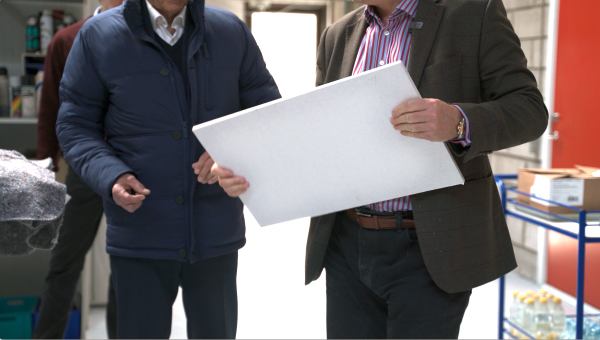
Learn more about EnviraBoard
The transition to lower-impact construction materials will depend not only on innovation, but on the ability to scale commercially viable solutions.
EnviraBoard is developing building boards from secondary industrial streams designed for integration into existing construction practices.
To learn more about our progress and growth plans, visit www.enviraboard.com or register your interest here