Shell to stop using declining oil and gas reserves by 2040

0

Shell’s reserve dropped by 1.972bn barrels of oil equivalent

Royal Dutch Shell (LON:RDSA) anticipates that it will have produced 75% of its current oil and gas reserves by 2030, and approximately 3% after 2040.

The oil giant also said in its Energy Transition Strategy that it will put forward a non-binding shareholder vote next month.

The FTSE 100 company’s proved oil and gas reserves have dropped in the past few years, meaning the reserve’s life is now below eight years of production.

Taking production into account, Shell’s reserve dropped by 1.972bn barrels of oil equivalent (boe), during 2020, to 9.124bn boe by December 31.

The new level amounts to seven years worth of production, which is lower than many of its rivals.

Other major oil companies have seen their crude oil reserves plummet by 25% over the last few years. This will provide a challenge to the earning potential of Big Oil in the next few years, according to Citi.

A number of oil giants disclosed reduced reserves in their recent reports, also due to the 2020 oil price and oil demand collapse, which forced all of them to write off billions of dollars off the value of assets.

In Shell’s case, the declining reserves life is not in contradiction to its assessment from earlier this year that its oil production peaked in 2019 and is set for a continual decline over the next three decades.

Morgan Stanley profit far exceeds estimates

0

Morgan Stanley net revenue jumped 61% to $15.72bn

Morgan Stanley (NYSE:MS) confirmed a 150% increase in its Q1 profit on Friday that blew past expectations.

The announcement came as high trading activity supported its international securities division and a global dealmaking surge lifted investment banking.

However, the Wall Street giant also confirmed a one-time loss in excess of $900m that it said came following a credit event and resulting losses from a “single prime brokerage client”.

Morgan Stanley was one of a group of banks exposed to Archegos Capital Management, a family office that defaulted on margin calls at the end of March causing a firesafe of stocks across Wall Street.

However, despite the setback, the investment bank surpassed its expectations with ease, conceding a strong quarter for New York’s major banks that benefited from reserve releases and record capital markets activity.

The jump in the volume of trades during Q1 of this year, powered largely by the Reddit-inspired trading surge of GameStop, among other stocks, driving a 66% spike in revenue of Morgan Stanley’s securities operation.

Morgan Stanley said net income applicable to shareholders rose to $3.98bn, or $2.19 per share, in the quarter ended March 31, from $1.59bn, or $1.01 per share, a year ago.

Analysts were looking for a profit of $1.70 per share, according to IBES data from Refinitiv.

Net revenue jumped 61% to $15.72bn.

Morgan Stanley prospered as a result of unprecedented levels in dealmaking through special purpose acquisition companies (SPACs).

Lloyds Share Price: analysts are backing the UK bank

0

Lloyds Share Price

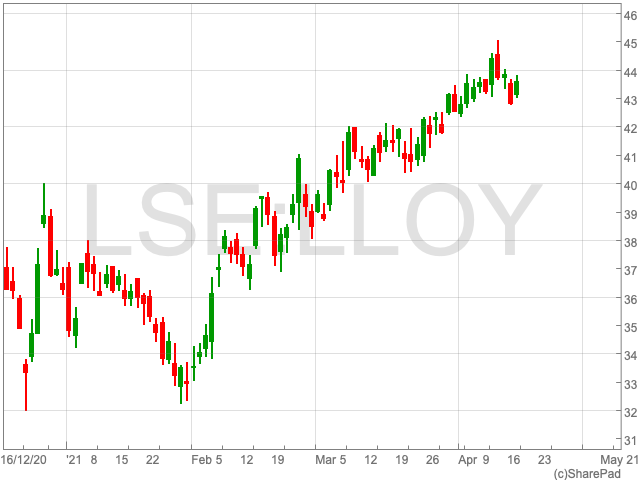
The Lloyds share price (LON:LLOY) has risen sharply since the turn of the year as pent-up demand and the vaccine roll-out is creating a positive mood around the UK economy. Having begun 2021 at under 35p, Lloyds shares are now valued at 43.56p per share, an increase of nearly 20%.

With the outlook for the UK economy improving as the so far successful vaccine roll-out has led the governor of the Bank of England to hint at stronger than anticipated growth in the coming months, the FTSE 100 bank looks set to capitalise.

Price Target

The UK bank has been given some positive targets by analysts that will be welcomed by investors. Barclays’ investment banking arm recently upgraded its “overweight” share price target for Lloyds to 47p from 46p. Barclays based its estimate on favourable outlook for the UK banking sector. “There are also nascent signs of stabilisation in unsecured personal lending (albeit at subdued levels) while asset pricing remains stable, with March mortgage pricing down marginally following softening in February,” the bank said.

While Deutsche Bank analysts also upgraded the stock from “hold” status to a “buy”. Despite the upgrade, the bank maintains its 50p target price, which is more than 6p above the current Lloyds share price.

Savings

Brits are set to have saved an additional £180bn in their bank accounts, or around 10% of UK GDP. While this figure might seem favourable to a bank such as Lloyds, this may not be the case as Banks will struggle to find a way to lend this money profitably as UK consumers are cutting their borrowing at a record pace. Consumer borrowing dropped 9.9% year-on-year compared with February last year – just before the pandemic struck the West – the biggest fall since the series began in 1998, the BoE said.

However, business loans could continue to rise in 2021, creating an avenue for Lloyds to return to profit. “Banks lent firms a total of £35.5bn in net terms last year – £34.7bn of which was lent since the start of the pandemic in March – with a further £26bn forecast by the end of 2021, and many firms unlikely to start repayments until 2024,” a report by financial services company EY stated.

FTSE 250 ‘on a roll’ rising by 26% in the past six months

0

Minutes before lunchtime on Friday, the FTSE 250 is up by 0.38% to 22,556.40, continuing its strong form since the beginning of the pandemic.

“The FTSE 250 is on a roll, having risen by 26% in value over the past six months. This has silenced critics who said there is little to like about the UK stock market,” said Russ Mould, investment director at AJ Bell.

“Value-style stocks offering jam today rather than jam tomorrow have been in demand, as well as lots of companies well placed to benefit from the reopening of the economy thanks to the rollout of the Covid vaccines,” Mould added.

Friday’s session was dominated by industrials, financials and utilities, helping to push the FTSE 250 up another 0.3% to 22,539. Key movers included Mitie, whose shares have more than doubled in price in the past six months.

“Mitie was previously seen as a pandemic loser. Many people thought the working from home trend could result in reduced commercial property demand, affecting one of its key services in cleaning offices. Investors now appear to be taking the view that this threat has been overplayed,” said Mould.

FTSE 250 Top Movers

Petropavlosk (3.87%), WH Smith (3.5%) and Syncona (3.11%) are the top risers on the index heading into lunchtime on Friday.

At the other end, TI Fluid Systems (-5.68%), Kainos Group (-3.24%) and AO World (-2.69%), have seen the biggest falls in the value of their shares.

Reasons to be cheerful: UK leisure ready and waiting

0

As the third lockdown comes to an end, hopefully for the last time, the UK’s leisure industry is all set for a substantial recovery. This is on the assumption that the the government eases out of lockdown restrictions in a proper way. According to research conducted by Edison Group, the confidence is driven by lessons learned during the pandemic, from pent-up demand on 2020 reopening and the benefits of technology. Another driver has been the prospect of a new post-Covid structural environment, in addition to a positive change consumer behaviour patterns, which has followed delivery uptake as a growth channel for hospitality. While the continuation of curbs on international travel is bad for the airline industry, it will be a positive for the domestic’s leisure sector.

The pandemic’s silver lining

There is a grim irony that COVID-19’s exacerbation of longstanding structural difficulties in UK hospitality has thrown up undeniable growth opportunity for well-funded businesses. There has been an increasing availability of prime sites at ever cheaper prices, in addition to being on more flexible terms. This has come about as businesses have been forced to close down which has led to an increase in the supply of high-quality staff. The outlook is starkly contrasted to chronic capacity before the pandemic, which caused intense cost pressures and narrow margins, compounded by Brexit-led economic uncertainty.

To this end, surviving companies have strengthened finances and accelerated implementation of initiatives, such as the use of technology in managing labour costs and driving customer loyalty. Delivery has predictably excelled, offering scope for operators with the right scale and brands.

Pushing at an open door

In addition to the boost to domestic leisure from persisting uncertainty about foreign holidays in 2021, there is welcome industry consensus ahead of reopening about pent-up consumer demand. Since the start of the pandemic, household savings have increased and household debt remains mostly unchanged, largely owing to a fall in spending on non-essential items over lockdown (the Q220 household savings ratio was the highest ever).

For those who have suffered financially, low-ticket domestic leisure may well be an attractive option. Potential beneficiaries cover a mix of activities from family entertainment centres and escape rooms to gyms and hospitality.

The value of vaccination

The UK has pushed ahead with a world-leading vaccination programme and looks set to emerge at the head of the pack from the pandemic. As social distancing and lockdowns give way to social spending, the leisure entertainment and travel sectors may be set for an earnings-based recovery. Valuations may have recovered but this relative earnings momentum may point to further outperformance in the months ahead.

While the negative impact of the pandemic are well documented, there are reasons for optimism for Brits looking ahead. The UK leisure industry is primed for recovery with huge opportunities for the fittest businesses.

FTSE 100 breaks through 7,000 for first time since pre-pandemic

0

The FTSE 100 jumped through the 7,000 level for the first time since February 2020, rising 0.51% to 7,019.

“This represents a massive milestone in recovering from the terrible pandemic and shows how investors’ confidence has completely changed since just over a year ago,” says Russ Mould, investment director at AJ Bell.

While the market experienced a shock as the coronavirus pandemic gripped the world, it has now turned its attention on the future in anticipation that corporate earnings will recover, “in true market style”, Mould said.

FTSE 100 miners and oil producers were in demand on Friday following new data that showed China’s economy jumped by 18.3% in Q1 of 2021. “The key issue from the market’s perspective is how quickly stimulus measures will be withdrawn in the country. Officials say it will be a gradual process but not everyone trusts China’s authorities to be true to their word,” Mould commented.

FTSE 100 Top Movers

Making the most gains on the FTSE 100 at mid-morning trading is BT (2.49%), Ocado (2.34%) and Evraz (2.31%).

At the other end, Aveva (-2.27%), Barrratt Developments (-1.50%) and Intermediate Capital Group (-1.29%), are the day’s biggest fallers so far.

Ocado

Ocado, the British online supermarket, confirmed on Friday that it is taking a £10 million stake in Oxbotica, a UK startup that develops autonomous driving systems.

The FTSE 100 company is making a strategic investment to develop AI-powered, self-driving vehicles that will operate its operations, including inside its warehouses. The aim for the new technology is to reduce Ocado’s delivery costs in order to boost its customer’s value proposition through a shift to electrically powered cars.

NFT Investments fares well on London stock market debut

35

NFT Investments issued a total of 1bn shares giving a market capitalisation of £50m

NFT Investments (LON:NFT), an investment company specialising in the non-fungible token (NFT), got off to a strong start as its shares began trading on Aquis Exchange’s AQSE Growth Market on Friday morning.

The investment company, which is the first focused solely on NFTs to launch on a stock market in a major worldwide jurisdiction, said it has been admitted to the Access segment of the market following a “substantially oversubscribed” share placing which raised £35m according to Proactive Investors. This was more than three times the amount initially planned, with an order book of demand that exceeded £100m.

The funds raised by the company set a new record on the Aquis Exchange and was raised from its original £10m target on account of what NFT said was “unprecedented investor demand”.

The company said the money made from its IPO will now be allocated to “identify and carry out due diligence on potential investments” and to provide further capital to support its acquisition and investment strategy.

The company issued a total of 1bn shares which gave NFT Investments a market capitalisation of £50m.

“NFT Investments’ admission to the AQSE Growth Market marks a significant milestone for the non-fungible sector. Our record-breaking raise on AQSE provides a strong foundation on which the company can execute its long-term growth strategy and capitalise on its first-mover advantage,” executive chairman Jonathan Bixby said in a statement.

“We are delighted with the strong support we have received from a wide range of investors and our oversubscribed placing is a real endorsement of our investment plans in a promising market set for growth,” he added.

NFT Investments has been launched by the co-founders of Argo Blockchain, a leading crypto miner valued at more than $1 billion.

The firm had originally expected its market capitalization to be around £25 million ($34 million) and claims to be the first investment company focused solely on the NFT market to launch on a stock market in a major jurisdiction.

UK online job adverts climb back to pre-pandemic level

0

Catering and hospitality jobs increased by 10% to 58% of the average in February 2020

The number of new job postings is rapidly rising as the UK is finding its way out of the pandemic.

The Office for National Statistics (ONS) said on Thursday that job listings have now reached the level they were at in February 2020, before the beginning of the pandemic and when lockdown restrictions were first introduced.

Some of the biggest increases came from the legal and hospitality industries while vacancies increased across 16 out of the 28 industries counted. The report by the ONS used data collected by search engine for jobs ads Adzuna.

Catering and hospitality jobs increased by 10% to 58% of the average in February 2020 as the industry went on a hiring spree ahead of reopening.

Since 12 April “non-essential” retail outlets have been reopening, as well as outdoor operations for hospitality venues, including pubs, restaurants and cafes.

The report by the oNS estimated that UK dinner reservations at the beginning of this week were at around 79% of levels seen two years prior.

“We have seen a marked shift in the number of companies seeking to book and organise events in recent weeks,” said Jo Ferreday, managing director of hospitality and events company Sheer Edge. 

“The economy is starting to open up and many hospitality businesses are beginning to hire staff so that they can hit the ground running when things hopefully return to normal in the not-too-distant future.”

Data released on Thursday by Morgan McKinley, and conducted separately, showed that finance vacancies in London had jumped up by 70% as confidence increased.

However, while some sectors saw rises in job openings, many saw declines. Listings in travel and tourism fell by 16% to 84% of February 2020 levels.

The international travel and indoor hospitality sectors are waiting patiently until 17 May to see if the relevant restrictions will be lifted.

China posts record GDP growth on road to recovery from pandemic

0

China grew by 18.3% in Q1 of 2021

China has reported its strongest economic growth since records began nearly 30 years ago.

The world’s second biggest economy, behind the US, grew by 18.3% in Q1 of 2021 compared to the year before when lockdowns and travel restrictions shut the world down.

Up from 6.5% in Q4 2020, it is China’s best year-on-year growth since 1992 when the country began recording such figures.

China‘s recovery has been pushed in part by a surge in consumer spending. Retail sales surged in march by 34.2%, surpassing the forecast by 6%.

National Bureau of Statistics spokesperson, Liu Aihua, told the media that the national economy’s strong start to the year was in part down to a low base effect.

The sharp spike was partly due to “incomparable factors such as the low base figure of last year and increase of working days due to staff staying put during the lunar new year” holiday, said Liu.

But she added that quarter-on-quarter growth has “demonstrated a steady recovery”.

Julian Evans-Pritchard, senior china economist at Capital Economics, warned that China’s recovery could level off this year.

“The upshot is that with the economy already above its pre-virus trend and policy support being withdrawn, China’s post-COVID rebound is levelling off,” Evans-Pritchard said.

“We expect quarter-on-quarter growth to remain modest during the rest of this year as the recent boom in construction and exports unwinds, pulling activity back towards trend.”

Kyle Rodda of IG says the economic data is a little mixed — and suggests the surge in retail sales in March [34.2% year-on-year] could concern the People’s bank of China:

“GDP growth year-over-year expanded by the 18.3% forecasters had tipped, but indu”strial production and fixed asset investment missed estimates,” Rodda said

“Retail Sales shot the lights out, although that might not be seen as a totally good thing from the market’s perspective – with very hot consumer sentiment perhaps a reason for the PBOC to tighten financial conditions further and remove support for the markets.”

China’s economic growth rate for this year has been raised by the International Monetary Fund (IMF) as the organisation says the route out of the pandemic-induced economic crisis is “increasingly visible”.

The IMF, based in Washington DC, increased its forecast for economic growth for China in 2021 to 8.4%, 0.3% higher than its prediction earlier in the year.

Ocado invests in autonomous vehicle software company Oxbotica

0

Ocado news comes one day after rival buys stake in autonomous vehicle company

Ocado (LON:OCDO), the British online supermarket, confirmed on Friday that it is taking a £10 million stake in Oxbotica, a UK startup that develops autonomous driving systems.

The FTSE 100 company is making a strategic investment to develop AI-powered, self-driving vehicles that will operate its operations, including inside its warehouses.

The aim for the new technology is to reduce Ocado’s delivery costs in order to boost its customer’s value proposition through a shift to electrically powered cars.

Alex Harvey, Chief of Advanced Technology at Ocado, commented: 

“We are excited about the opportunity to work with Oxbotica to develop a wide range of autonomous solutions that truly have the potential to transform both our and our partners’ CFC and service delivery operations, while also giving all end customers the widest range of options and flexibility.”

In similar news, Walmart, the American supermarket giant took a stake in Cruise, another autonomous tech company, as part of a recent $2.75bn monster round. Walmart also owns Asda, one of Ocado’s major competitors in the UK.

Paul Newman, Co-Founder & CTO of Oxbotica, shared his excitement at the prospect of the partnership.

“This is an excellent opportunity for Oxbotica and Ocado to strengthen our partnership, sharing our vision for the future of autonomy. By combining both companies’ cutting-edge knowledge and resources, we hope to bring our Universal Autonomy vision to life and continue to solve some of the world’s most complex autonomy challenges.”

During the last lockdown there was a surge in demand for online retailers demand for food at home as Ocado confirmed in March that its sales surged by 39% in Q4 of the past financial year.

The size of an average order was recorded at £147 as families that remained in their homes purchased more goods. As a result, sales went up by two-fifths from the quarter the year before which was unaffected by the pandemic.