Supermarket clothing sales double to £313m

0

Total supermarket sales were down by 2.9% from the year before

Clothing sales at supermarkets surged in March as shoppers took advantage of the opportunity to buy garments in-person while other non-essential outlets remained closed.

The figures come as a signal of pent up demand as shops get ready to reopen across the UK.

In the four weeks ended 27 March sales at supermarkets doubled to £313m.

Additionally, home and garden sales also boomed to £175m in anticipation of outdoor socialising ahead of spring and into summer.

Total supermarket sales were down by 2.9% from the year before, according to Nielsen research. In March 2020 many people were stockpiling and panic buying, fearing the worst ahead of the oncoming lockdowns.

UK shoppers spent £1bn more on goods compared to the same period in 2019, which was before the coronavirus pandemic.

The fastest grown supermarket over the past three months was Lidl, followed by Iceland and Aldi.

Out of the big four supermarkets, Asda and Morrisons grew the fastest.

Mike Watkins, NielsenIQ’s UK head of retailer and business insight, commented: “It’s clear that as we draw ever closer to the end of lockdown, consumers have been looking ahead to spring and indulging in some retail therapy, ranging from Easter chocolate to some new clothing or accessories for the home and garden.”

finnCap reveals better than expected results following strong March

0

finnCap total income up 83% from year before

finnCap Group (LON:FCAP), provider of strategic advisory and capital raising services to growth companies, today confirmed its results for the year ended on 31 March 2021.

The company said its unaudited total income for the year is around £47.3m, up 83% from the year before.

finnCap said its performance had been stronger than expected in March across the company, thanks to successful completion of further equity fundraisings, private M&A transactions and the company’s fourth IPO of the year.

Among projects the AIM-listed firm advised on in March was ready meals group Parsley Box’s London float.

Sam Smith, CEO of finnCap, commented on the company’s recent performance.

“The Group continued to perform strongly in March, surpassing our expectations. We acted on secondary equity issues raising a total of £66m, completed the £83.8m IPO of Parsley Box PLC, advised on several private M&A transactions including the sale of David Rubin & Partners, and secured £52m of debt funding for Rockpool Investments’ acquisition of Cambridge Maintenance Services,” Smith.

“This performance is testament to the platform that we have built to service the strategic and financial needs of ambitious growing companies and their management teams. Our pipeline for Q1 is healthy and I look forward to announcing our full year results in July.”

finnCap provides financial services to growth companies both public and private. It provides advisory, broking and research services to companies on AIM and on the London Stock Exchange Main Market and also advises on M&A, with a specialism in sell-side M&A through Cavendish, as well as arranging corporate debt and private company fundraisings.

Texas freeze cost Shell $200m in Q1

0

Shell average output to be between 2,400,000 and 2,475,000 barrels per day

Royal Dutch Shell (LON:RDSB) today confirmed that the impact of the Texas winter storm will see the company lose out on $200m in the first quarter of 2021.

This is despite the crude oil price rising over the same period.

Shell’s production of oil was reduced by between 10,000 to 20,000 barrels per day, however the company is still anticipating average output to come in between 2,400,000 and 2,475,000 barrels per day. This would result in a swing to a profit following a prior Q4 loss.

Crude oil prices rose to $59.5 per barrel from $48, with every extra $10 adding $3bn to the company’s revenue.

Shell says its integrated gas production will be between 920,000 and 960,000 barrels per day, which is up on previous estimates, however LNG volumes will be lower at 7.8m-8.4m tonnes.

This division was relatively unimpacted by the weather in the Lone Star State although Shell did confirm that its results had come in below average.

Refinery utilisation was lower than expected in the last update at 71-75%, as was oil product sales and chemical plant throughput.

Director dealings: Ebiquity

Ebiquity (LON: EBQ) non-executive chairman Rob Woodward is the latest director to buy shares in the media consultancy following the publication of its 2020 results at the end of March. He has invested nearly £15,000 in 41,759 shares at 35.9p each. That takes his stake to 147,280 shares. Woodward is a former boss of STV.
Chief executive Nick Waters, who joined last July from Dentsu Aegis, bought 50,000 shares at 32p each, which was his first purchase, while non-executive director Richard Nichols doubled the number of shares owned by him by buying 100,000 shares at 30.729p each.
Business
Ebiquit...

FTSE 250 recovers to pre-pandemic levels

0

The FTSE 250 has now recovered to its level prior to the coronavirus pandemic as the index jumped up today following the Easter break.

The index, which includes Royal Mail and Domino’s Pizza Group, is up 1.2%, or 261.81 points, to 21,994.48 on market closing.

Prior to when the stock market crashed in February 2020, the FTSE 250 peaked at just below 21,900.

The FTSE 100 also crept upwards, by 1.36%, getting above 6,800 on early Tuesday trading to 6,829.09, marking a four-month high.

Markets across the continent put in strong performances, albeit not as strong. The DAX was back above 14,500 following a 0.4% increase, while the CAC is nearing 6,050 once again after adding 10 or so points.

Optimism around a worldwide recover is ever-growing as employment numbers in the US, still the world’s largest economy, far exceeded expectations.

Closer to home, confidence is on the rise as prime minister Boris Johnson confirmed that the reopening of non-essential shops and pub gardens on schedule. Johnson added that there was no reason to to think that there would be any reason to delay the UK’s current roadmap out of lockdown.

UK to record fastest growth since 1988 according to IMF

0

UK recovery set to surpass expectations

The UK’s recovery is set to be quicker than anticipated over the next two years as the global economy rebounds from its worst recession since World War 2.

The International Monetary Fund (IMF) is forecasting that the UK economy would grow by 5.3% in 2021 and 5.1% the following year, which would be its fastest rate of growth since 1988. A year ago the UK economy shrank by 9.8%, the most severe recession since 1709.

The revised growth target means places the UK as the third fastest growing economy in the G7 behind the US and France, after it performed the worst in 2020. The global growth forecast has been raised to 6% this year and 4.4% in 2022, increases of 0.8% and 0.5% respectively.

The IMF said that its updated forecasts were a result of “additional fiscal support in a few large economies and the anticipated vaccine-powered recovery in the second half of the year”.

The world economy contracted by 3.3% in 2020, the deepest recession since the Second World War. This figure was minimised thanks to government support which amounted to $16trn across the world, in addition to interest rate cuts, quantitative easing and loans, the report by the IMF said.

The IMF said that the collapse during 2020 could have been three times worse without the aforementioned support by governments.

Out of the develop world, America will see the fastest recovery primarily as a result of the $1.9trn stimulus package by President Biden. The US is the only nation expected to surpass its pre-pandemic levels of GDP.

Other advanced economies will recover more slowly, with the eurozone and Britain expected to return to pre-crisis levels of GDP next year but remaining short of where they would have been under pre-crisis projections.

Unemployment is expected to increase to 6.1%, up from 5%, meaning 400,000 Brits would be out of work this year.

Nonfarm payroll figures far exceed expectations in March

0

Nonfarm payrolls rose by 916,000 last month

Job numbers soared in March at the fastest rate since last summer, as the vaccine roll-out continued apace along with robust economic growth.

The US Labor Department reported a surge in new jobs in hospitality and construction on Friday.

During March nonfarm payrolls rose by 916,000 while the unemployment rate fell to 6%.

A Dow Jones survey of economists anticipated a rise of 675,000 along with an unemployment rate of 6%. The figure for March was the highest since the 1.58m added in August 2020.

“It shows that the economy is healing, that those who lost their jobs are coming back into the workforce as the recovery continues and restrictions are lifted,” Quincy Krosby, chief market strategist at Prudential Financial told CNBC. “The only concern here is if we have another wave of Covid that leads to another round of closures.”

While the jobs added were spread across the US economy, they were particularly strong in areas impacted the most by the pandemic.

Nearly 7.9m fewer Americans are counted as employed in February 2021 compared to the year before, and the labour market is down by 3.9m people.

Leisure and hospitality, a sector critical to restoring the jobs market to its former strength, showed the strongest gains for the month with 280,000 new hires. Bars and restaurants added 176,000, while arts, entertainment and recreation contributed 64,000 to the total.

Despite its continued gains, the leisure and hospitality sector remains 3.1m below its total before the pandemic in February 2020.

Economists have outlined what the data could mean for monetary policy in the USA if the results show consistency.

“While the gaudy hiring numbers for March won’t lead to an immediate policy shift, if the economy puts together a string of months like what we’ve seen in March, it will only be a matter of time before expectations on the start of Fed tapering will move up to late 2021, also pulling forward market expectations for the first interest-rate hike into the latter part of 2023,” wrote Joseph Brusuelas, chief economist at RSM.

Deliveroo Share Price: what now after poor London debut?

0

Deliveroo Share Price

The Deliveroo (LON:ROO) IPO turned out to be a huge disappointment as shares plunged 26% in the company’s debut on the final day of March. It has since recovered somewhat although investors who got in early are still well down. The question now is whether the fall represents an opportunity for investors to get value by buying shares in the food delivery company.

Deliveroo Share Price

Why did the Deliveroo share price perform poorly on its London debut?

There was a number of factors at play according to analyst Neil Wilson of Markets.com.

“In addition to the failure to bring several large funds on board, the dual-class share structure, regulatory uncertainty, general profitability concerns and a miscalculation by the bankers on the pricing in relation to wider demand in the market, it also looks like some hedge funds shorted the stock aggressively from day one.”

The dual-class structure, whereby founders could retain control via enhanced voting rights, particularly appears to have put investors off.

Sacha Sadan, director of investment stewardship at Legal & General Investment Management (LGIM), said that while the ruling is appealing to founders, it alienates investors. “If a client puts £1 in, why should they not get a £1 economic interest? Seems fair.

“It is important to protect minority and end-investors against potential poor management behaviour that could lead to value destruction and avoidable investor loss.”

Looking ahead

Deliveroo is not the first company to experience a rocky start. “Uber stocks fell more than 7% on its debut but, if you’d kept your nerve, you’d be up 20% today,” said Danni Hewson, financial analyst at AJ Bell.

“Facebook had a torrid year or so as a listed business but if you’d hung on from those initial lows your investment would be up by more than 10-fold today,” Hewson added.

Investors saw an opportunity in Deliveroo and the company hasn’t disappeared. It is still a rapidly growing company with ambitions to be a market leader. Now it has a point to prove. Will Shu, who founded the company in 2013 and remains as CEO, needs to show the country’s credentials quickly and publicly.

No decision made to restrict AstraZeneca vaccine

0

AstraZeneca share price down as Holland halts jab

Following reports that the UK’s medicines regulatory body is considering restricting use of the vaccine in younger people, it has now said no decision has been made on a regulatory action relating to the Oxford/AstraZeneca vaccine.

Channel 4 News said yesterday that the Medicines and Healthcare products Regulatory Agency (MHRA) was weighing up the possibility of imposing restrictions following concerns around blood clots.

“Two senior sources have told this programme that while the data is still unclear, there are growing arguments to justify offering younger people – below the age of 30 at the very least – a different vaccine,” the report said.

The two sources did however put their support behind the Oxford jab and said that restricting the roll-out could harm public confidence in it.

The MHRA’s chief executive Dr June Raine yesterday said that no decision had been reached and urged people to keep getting vaccinated.

“Our thorough and detailed review is ongoing into reports of very rare and specific types of blood clots with low platelets following the Covid-19 vaccine AstraZeneca. No decision has yet been made on any regulatory action.”

Professor Neil Ferguson of Imperial College London told BBC Radio 4’s Today programme on Monday that the clots raised questions over whether young people should get the jab.

“There is increasing evidence that there is a rare risk associated particularly with the AstraZeneca vaccine, but it may be associated at a lower level with other vaccines, of these unusual blood clots with low platelet counts,” he said.

“And so the older you are, the less the risk is and also the higher the risk is of Covid, so the risk-benefit equation really points very much towards being vaccinated. I think it becomes slightly more complicated when you get to younger age groups, where the risk-benefit equation is more complicated.”

The AstraZeneca share price is down 0.57% since market opening on Tuesday as the Netherlands became the latest country to stop rolling out the vaccine.

FTSE 100 catches up to US and China after Easter break

0

The FTSE 100 crept above 6,800 on early Tuesday trading to 6,829.09, up 1.36%.

“The FTSE 100 was playing catch up after the Easter break, enjoying strong gains after global stocks rallied hard on Monday, supported by strong US and Chinese economic data,” says AJ Bell financial analyst Danni Hewson.

Also helping the index was news from index heavyweight BP that it expects to hit its net debt target ahead of schedule – raising the prospect of more generous returns to shareholders.

“Travel stocks moved higher despite tourism chiefs voicing some disappointment with the plans announced for international travel from the UK yesterday,” Hewson added.

The rest of the week could see markets struggle for direction with relatively few big corporate announcements on the horizon.

FTSE 100 Top Movers

SSE (4.02%), Rolls-Royce (3.69%) and mining giant, Glencore (3.61%), led up the FTSE 100 at the beginning of the week.

At the bottom of the index, Ocado (-1.63%), Just Eat (-1.35%) and Rentoki (-0.98%) are the day’s biggest fallers so far.

BP

BP (LON:BP) announced on Tuesday that it expects to reach its $35bn net debt target in Q1 of 2021. The estimate is a result of earlier-than-expected proceeds from disposals and a “very strong quarter”, the oil company said today. 

At the end of 2020, BP had a debt pile of $39bn. The FTSE 100 company previously expected to reduce its debt to $35bn by as late as 2022. The company plans to begin buying back shares once it reaches its debt target, and will provide an additional update upon releasing its Q1 results on 27 April.

Tesla

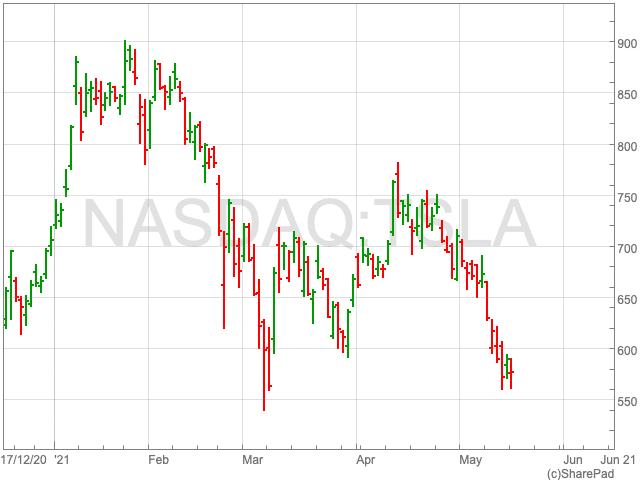
Away from the FTSE 100, Tesla shares (NASDAQ:TSLA) opened 7% higher on Monday as news emerged that the electric vehicle manufacturer exceeded expectations of its production and delivery figures.

At the end of last week Tesla confirmed it had delivered and produced 184,800 and 180,338 cars respectively in the first quarter of 2021. Analysts expectations were at around 168,00 vehicles for the period, according to data collected by FactSet. It was a record-setting quarter, exceeding the 180,570 deliveries completed in Q1 of 2020.