Dollar rising sends gold down

Spot gold fell by 1.18% to $1,712.90

The price of gold fell on Monday as the US dollar strengthened and hopes of a speedy economic recovery dampened demand for the precious metal.

The commodity fell by 1.18%% to $1,712.90 in the afternoon, while gold futures dipped 1.18% to $1,711.80.

There are three reasons driving this drop, according to Giles Coghlan, chief currency analyst, HYCM.

“Firstly, it has to with the performance of the USD. There is a clear correlation between gold and the greenback. When the dollar is weak, the price of gold tends to rise, and vice versa. With the passing of the recent stimulus bill and the US slowly transitioning out of lockdown, the market seems confident about the future prospects of the US economy, leading to a recovering USD and a drop in gold prices. Should the easing of lockdown measures continue, I would anticipate further declines in the price.”

Coghlan continued: “Secondly, rising real yields. This is like a poison for gold prices: when real yields rise, this pressures gold. Thirdly, gold ETFs have been falling for over 25+ days. The fall in gold ETFs heavily influences gold prices and funds have plenty more to sell. The outlook for gold looks to be a clear sell on rallies in the current environment.”

The dollar index held steady just below four-month highs against its rivals, while gold’s safe-haven status came under threat as investors turned towards riskier assets.

Speculators will now look ahead to Joe Biden’s infrastructure spending package, set for Wednesday, and rumoured to be between $3trn and $4trn.

While many see the precious metal as a hedge against inflation that could come in the wake of Biden’s stimulus, a recent rise in US Treasury yields has dented its attractiveness.

“We see virtually no scope for noticeably higher prices until mid-year, though gold should be able to make significant gains in the second half of the year,” Commerzbank analysts wrote in a note.

“Gold is currently lacking the support of financial investors, as buying interest is low.”
BP Share Price: a balanced strategy required

0

BP Share Price

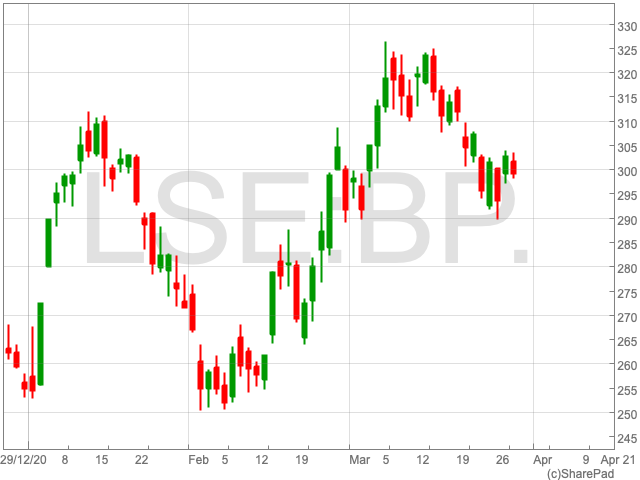
The BP share price (LON:BP) is up 17.5% year-to-date after a challenging 2020. Over the same period the FTSE 100 index is up by 2%. While the major oil player could be set to capitalise on an economic recovery across the world, and rising oil prices, a number of factors remain at play that make its outlook difficult to evaluate.

Oil Prices

Oil prices dropped on Monday as the Ever Given ship was refloated in positive news for global supply chains. Brent crude oil fell by 2% before pushing back to 0.6% lower on early Monday trading. However, this will only have a short-term impact. Looking further ahead, BP looks set to profit from an oil price which will outperform in 2021 compared to the year before.

Barclays upped its forecast for oil prices for 2021 on account of a weak supply response from US producers to higher prices following the cold storm in Texas in February. The UK bank increased its forecast for Brent crude oil from $55 to $62 per barrel and West Texas Intermediate (WTI) from $52 to $58 per barrel.

Bank of America (BofA) Global Research and Goldman Sachs Equity Research also raised their oil price forecasts for 2021.

Of course, these bullish predictions are on the assumption vaccinations go according to plan, and economies are able to regain a sense of normality.

BP Dividend

While companies across the board, including BP, decided to slash dividends throughout 2020 due to precarious balance sheets, investors will now look to towards stocks that can generate income going forward.

Despite slashing its dividend payment, BP’s yield remains high, which could bode well for shareholders once its earnings return to normal levels.

Clean Energy

The BP share price’s future prospects will come down to a balance between profiting from oil and moving to clean energy. The company will have to judge when oil production peaks, as well as making smart investments in green technology to secure its future.

BP has committed to spending billions of dollars in renewable energy over this decade. If the company is successful, it could become a major player in the supply of renewable energy. If BP is able to successfully make this move, and investors are tuned in, then there could be money to be made. A recent forecast by the company estimated that demand for oil will fall by over 10% before 2030 and 50% by 2040.

BP confirmed in January that it completed the formation of its strategic US offshore wind partnership with Equinor. The oil company intends to develop a “green” hydrogen project at its Lingen refinery in Germany as part of plans to move towards sustainable forms of energy.

The BP board appears to be under no illusions that it must actively readjust to the future world economy. Investors will be keeping a close eye on its ability to capitalise on oil prices in the near-term as well as the effectiveness of its investing in green energy into the future.

Deliveroo narrows flotation price range as fund managers express concerns

0

Deliveroo lowers price range to between £3.90 and £4.10 per share

Deliveroo, the online food delivery service, confirmed on Monday that it will list its shares towards the bottom of the initially outlined range.

The original valuation price range, which suggested that Deliveroo could have been valued at up to £8.8bn, has now been revised to between £7.6bn and £7.85bn.

The company put the decision down to “volatile” market conditions.

In a statement, the company said: “Deliveroo has received very significant demand from institutions across the globe.”

However, following a price range of between £3.90 and £4.60 per share a week ago, Deliveroo narrowed its price range to between £3.90 and £4.10 per share.

A number of fund managers have expressed doubts over the listing and said they will reject it outright.

James Anderson, manager of Scottish Mortgage Investment Trust, considers the company to be too reliant on London and too focused on slower-growing markets, he told The Times.

This is despite Anderson gaining significant holdings in other home delivery platforms, such as Meituan in China, Delivery Hero, a key player in other Asian markets, and Grubhub in the US.

Anderson told The Times that replicating the success of the aforementioned companies would be difficult for Deliveroo. “I think their model is successful in the unusual economics of London and it’s much more difficult to spread elsewhere,” he said.

A number of other leading fund managers have expressed similar concerns, particularly to do with workers’ rights, the company’s business model and regulatory concerns.

Rupert Krefting, head of corporate finance and stewardship at M&G, said the company’s reliance on gig-economy workers made it a risk for investors.

While, David Cumming, chief investment officer at Aviva, warned of the risk that drivers will have to be reclassified as workers, which would entitle them to rights such as sick and holiday pay. “It’s an investment risk if the legislation changes,” he said.

The cheapest and most expensive areas to buy new build properties in the UK

0

Housing developments are being constructed across the UK every month in an effort to match rising demand.

New builds in the UK do however come with a premium price tag of £306,997 on average, 26.7% more than the average price paid for an existing property.

Across the UK, there is a variation in the price of a new build property, with some regions being more affordable than others.

Top 10 cheapest area to buy a new build

The most affordable areas to purchase new build properties are either in the North of England or Scotland, with Hyndburn, in Lancashire, being the only authority where the average new build costs less than £100,000.

This is followed by North Ayrshire in Scotland at £126,036 and Burnley (also in Lancashire) at £128,613.

RankLocal authorityRegionNew build average price
1HyndburnNorth West£99,034
2North AyrshireScotland£126,036
3BurnleyNorth West£128,613
4InverclydeScotland£149,608
5HartlepoolNorth East£153,681
6Stockton-on-TeesNorth East£154,181
7East AyrshireScotland£158,600
8County DurhamNorth East£159,751
9Argyll and ButeScotland£160,179
10BlackpoolNorth West£160,502

Top 10 most expensive areas to buy a new build

On the other hand, and unsurprisingly, the most expensive places to purchase new build properties are in the South of England. The most pricey being found in prime central London locations such as Kensington and Chelsea (£1,167,805), Westminster (£1,006,564) and the City of London (£930,033).

RankLocal authorityRegionNew build average price
1Kensington and ChelseaLondon£1,167,805
2WestminsterLondon£1,006,564
3City of LondonLondon£930,033
4CamdenLondon£820,735
5ElmbridgeSouth East£752,483
6Hammersmith and FulhamLondon£671,776
7RochfordEast£643,833
8IslingtonLondon£636,980
9HackneyLondon£635,482
10MertonLondon£629,850

Dave Sayce, Managing Director at Compare My Move, the company which conducted the report, commented on the findings:

“Alongside price, there are many other aspects to consider when choosing whether to purchase a new build or an existing property,” Sayce said.

“If you are wanting a property which is immediately livable and ready to move into, a new build may be the best option for you. Most new builds allow you to customise the property to be as bespoke as you like, from choosing the fittings to paint colours. The purchasing process can also be easier, as once you reserve the property it is taken off the market. However, the process from reservation to the completion of construction can be lengthy, so it might not be the best option if you are looking to move in the near future.”

“Although new builds typically offer lower repair and maintenance costs, as well as being more environmentally friendly than existing properties, historical homes do have their benefits. Older properties usually provide lots of character, with features unique to their period, as well as more space and potential to add your own stamp.”

FTSE 100 slow out of the blocks on Monday

0

Despite a strong close from the US last Friday, European investors hesitated after the bell on Monday. The FTSE 100 failed to celebrate the first step of the UK’s spring awakening, trickling lower and dropping to 6,715.62, while the pound was equally unenthused, flat against dollar and euro alike.

“An easing of restrictions in England failed to act as a catalyst for the FTSE 100 on Monday with the index trading modestly lower,” says AJ Bell investment director Russ Mould.

That same timidity had a green tinge to it in the Eurozone, where the CAC and DAX were both up 0.2%, leaving the latter short of its 14,800-plus all-time highs.

“A third wave of Covid-19 in Europe and the emergence of new strains of the disease is threatening to deflate the optimistic mood which had built up off the back of vaccine success,” Mould added.

This early reticence may be tied to the Archegos Capital situation. Friday saw significant losses for ViacomCBS, Discovery, and a selection of Chinese tech stocks, without immediate explanation.

Over the weekend it was then revealed that a margin call-hit Archegos was behind the selling, leading to warnings of ‘significant’ losses from Credit Suisse and Nomura on Monday morning.

“With both Credit Suisse and Nomura warning of a hit in the fallout from the saga, investors have been reminded of the interconnectedness of the global financial system and how this creates a risk of contagion when something goes wrong,” said Mould.

FTSE 100 Top Movers

Renishaw (2.63%), BT Group (1.54%) and Severn Trent (1.44%) led up the FTSE 100 on early Monday morning trading.

The biggest fallers on the UK index so far are Glencore (-2.68%), Smiths Group (-2.47%) and Flutter Entertainment (-2.37%).

Entain

Entain, owner of Ladbrokes and Party Poker, made a profit in 2020 as online gambling rose during the pandemic. The group confirmed an operating profit of £530m, up by 2% from 2019, with 89% of EBITDA coming from online business. The revenue generated from online gaming came in at £2.7bn, as 75% of the FTSE 100 company’s revenue is now online.

UK online car retailer Cazoo to float in New York for $7bn

0

Cazoo SPAC to be headed up by Dan Och

UK online car seller Cazoo is set to debut on the New York stock market via a special-purpose acquisition company (SPAC), having agreed a merger deal that values the firm at $7bn (£5bn).

In the latest of string of SPAC deals, Cazoo will be merge with Ajax I, headed up by billionaire investor Dan Och.

The news represents a loss for the City and the London Stock Exchange, which was hoping to secure the car seller’s listing, having updated its rules in order to make the capital an attractive proposition to high-growth companies.

The deal will give Cazoo up to $1.6bn of funds to aid its growth and expand its operations. The car retailer employs over 1,800 people across Europe and expects to earn revenue up $1bn in 2021, which would be a 300% increase from the year before.

Och will join the board of the company which was founded in 2018 by its current chief executive Alex Chesterman.

Cazoo buys and inspects cars before they are put up for sale online, while aiming to deliver or collect vehicles in as little as 72 hours.

Alex Chesterman OBE, Founder & CEO of Cazoo, commented: “This announcement is another major milestone in our continued drive to transform the way people buy cars across Europe. We have created the most comprehensive and fully integrated offering in the largest retail sector which currently has very low digital penetration.”

Dan Och, Founder of AJAX, struck a similarly optimistic tone:

“We are incredibly excited to have the opportunity to partner with Alex and the exceptional team at Cazoo. Alex has proven to be one of Europe’s most successful serial entrepreneurs and we are proud to be supporting the growth of this world-class team, brand and platform. With their constant focus on innovation, data and customer satisfaction, I have no doubt that Cazoo is going to continue to lead the way in this massive, untapped market opportunity and am looking forward to joining the Board of Cazoo and working with Alex and his team.”

AJ Bell expecting to surpass revenue expectations

0

AJ Bell says revenue for H2 will be £136m

AJ Bell (LON:AJB), the investment platform, said on Monday that it expects its revenue for the current year to be at least £6m ahead of current market expectations.

The FTSE 250 company confirmed the increase in a trading update for H1 of the current financial year, concluding 30 September 2021.

Market consensus at present states that AJ Bell’s revenue for the period will be £136m.

The company released a statment with its trading update which went into further detail:

“In its 2020 annual results announced on 3 December 2020, the company highlighted the high levels of new customers and record levels of dealing activity by D2C customers in the year ended 30 September 2020.”

“The company has continued to see strong customer acquisition in the first half of the current financial year and dealing activity by D2C customers has remained at elevated levels throughout.”

“Although dealing activity is expected to moderate from current levels in the second half, management currently expects revenue for the year ending 30 September 2021 to be at least £6m above current market consensus.”

On early morning trading AJ Bell shares are up by 1.47% 414.5p per share.

Gfinity looks ahead after sharply reducing losses

0

Gfinity Digital Media continues momentum into 2021

Gfinity (LON:GFIN) confirmed it narrowed its losses in H1 as the esports media company reported the conclusion of its strategic review.

The AIM-listed firm announced an adjusted operating loss of £0.9m for the six months to 31 December 2020, down from £2.4m compared to the year before. Gfinity posted revenues of £3m, down from £3.5m.

The company drew attention to its continued momentum into the current year, specifically the continued growth of Gfinity Digital Media (GDM).

Gfinity chief executive John Clarke outlined in a statement the company’s areas of focus for the coming year.

“Our relentless focus on delivering against our new strategy has continued to bring positive results. We have ended the period with an impressive set of numbers, including a reduction in operating loss, a significantly reduced cost base and an improved cash position.”

“Throughout the first half, we have continued to leverage the significant demand for our expertise and capability in creating unique solutions for our partners, whilst also expanding and investing in our community of gamers through our GDM platform. Despite the uncertainty caused by the COVID-19 pandemic, our business model has proved resilient. Our leading tournament platform, virtual production capabilities and proprietary technology IP means that we are uniquely placed to help brands engage with the rapidly growing gaming community.”

“We have also announced today the conclusion of the strategic review and Formal Sale Process that commenced in October last year. We have been encouraged by the discussions held with a range of parties, one of which resulted in signing a significant multiyear commercial contract with the new sports fan engagement site IQONIQ and further deals are expected throughout 2021. Now it is time to accelerate the growth of the business by being focused on the growth areas identified under each of our strategic pillars.”

Earlier this month Gfinity Digital Media (GDM) unveiled a new partnership with Magic Lamp Technologies, the owner of interactive video game map creator MapGenie.

Entain records profit as online gaming jumps during pandemic

1

Entain committed to paying out dividend once uncertainty clears

Entain (LON:ENT), owner of Ladbrokes and Party Poker, made a profit in 2020 as online gambling rose during the pandemic.

The group confirmed an operating profit of £530m, up by 2% from 2019, with 89% of EBITDA coming from online business.

The revenue generated from online gaming came in at £2.7bn, as 75% of the company’s revenue is now online.

Entain’s EBITDA increased by 11% during 2020 to £843.1m, while the company stated its commitment to paying out dividends once there is more clarity over the future impact of the pandemic.

The company’s share price is down by 1.77% on early morning trading.

Entain non-executive chairman Barry Gibson commented on the company’s results for the year-gone:

“It is a great testament to the quality of our people and the strength of our business model that the group’s growth continued during 2020, despite the Covid-19-related sporting cancellations and retail closures that were necessary at times during the year.”

“We have long talked about the importance of having a truly diversified business model and of not being overly reliant on any one product, brand, territory, or channel, and it was this approach that mitigated the impacts of the pandemic on our business so effectively.”

Earlier this month, Arena Racing Company and Entain confirmed a new long-term horseracing media rights deal as well as the creation of a greyhound racing joint venture.

The horseracing media rights element of the deal covers races from Arc’s 16 UK racecourses, which include Doncaster, Newcastle, Chepstow and Lingfield, along with content from South Africa and Australia and is based on turnover for both online and retail.

Look out for XF-73 Destiny

Destiny Pharma (LON: DEST) expects to report on the study results of the phase 2b clinical study on the use of XF-73 nasal gel for the prevention of post-surgical infections by the end of March. finnCap believes that positive news would increase the broker’s valuation of Destiny by 80p a share.
Destiny is a developer of antimicrobial drugs. The main focus has been on XF-73, which is used to treat post-surgical infections, such as MRSA. There are also other potential uses of the XF platform, including a collaboration with SporeGen for the prevention of Covid-19 and other respiratory viral infec...