Cineworld Share Price: enormous debt pile poses risk to recovery

0

Cineworld Share Price

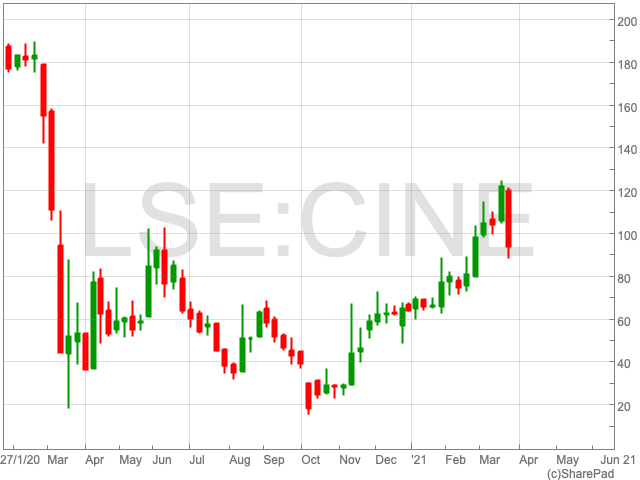
Cineworld (LON:CINE) shares fell by 9.32% on Thursday to 92.68p per share, a way off its recent high of 122p. However, the company is up by 57% over the past 12 months, after making a solid recovery since its inevitable crash when lockdowns begun. With its earnings release being announced and economies gradually opening up, now could be a pivotal time for investors looking at the leisure group.
Cineworld Reopening

The good news is that Cineworld has set firm dates for its reopening. The FTSE 250 company has said it will open a number of sites in its biggest market, the US, in early April, ahead of the Godzilla vs Kong opening. While it plans to open in the UK, its next biggest market, in early May.

The company confirmed that capacity restrictions will allow occupancy of 50% or more in most US states. CEO Mooky Greidinger says that this means “we will be able to operate profitably in our biggest markets.”

Of course a emergence of Covid-19 in Europe or America could threaten the company’s reopening.

Performance

Cineworld confirmed a $3bn loss for the financial year gone as the devastating impact of lockdowns on the cinema chain became clear. The FTSE 250 company’s revenues plummeted by over 80% to $852m, down from $4.3bn the year before. The chain also posted a pre-tax loss in 2020 of $3bn, a swing from a profit off $212m if 2019. Cineworld’s board confirmed it had raised an additional $213m to see it through to when cinemas are able to reopen in April, so now the company’s net debt stands at $8.3bn.

Risks

While news that Cineworld is opening up its venues across the world is positive, there are reasons to suspect that consumers may not flock to cinemas in their droves. The group penned a deal with Warner Bros to secure the release of its films in its cinemas for 45 days before the studio can load them on to its streaming platform HBO Max. Put simply, this shortens the cinema’s exclusivity window, and creates an incentive for film lovers to wait until their favourite movies are on streaming platforms. Morgan Stanley said that it “cements an industry-wide shortening of the window, a negative for exhibitors and reflecting of increased premium video on demand/streaming risk”. However, it is better than Warner Bros films going straight to streaming service and people well have a strong appetite for going to the movies after being locked down for so long.

Suez Canal could be blocked for weeks as ship owner apologises

0

Over 150 ships are said to be waiting to pass through the Suez Canal

The owner of the cargo ship that has been blocking the Suez Canal since Tuesday has apologised for disrupting global trade, while rescuers confirmed the container ship could block the canal for “weeks”.

Japanese company, Shoei Kisen Kaisha, said it was striving to resolve the situation, but it was proving to be very difficult.

Dredgers arrived on Thursday to assist in digging out the 220,000-tonne Ever Given after it became unstuck in the canal, blocking the passage for other ships.

The boat became wedged in across the canal following a sandstorm, which lead Boskalis, a company partaking in the rescue, to compare the mission to trying to free a beached whale.

Over 150 ships are said to be waiting to pass through the vital maritime route.

The Suez Canal connects the Mediterranean Sea to the Red Sea, providing the shortest sea route from Asia to Europe, with around 12% of global trade passing through the canal.

“The more secure the ship is, the longer an operation will take,” Boskalis chief executive Peter Berdowski told the Dutch media. “It can take days to weeks. Bringing in all the equipment we need, that’s not around the corner.”

One alternative route, is to go around the Cape of Good Hope on the southern tip of Africa, however, it can add 14 days on to the journey time.

Toshiaki Fujiwara, an official at Shoei Kisen Kaisha, informed Reuters that the ship had an insurance policy, but that he was not totally sure of the details or any costs involved at this stage. “It’s just the beginning,” he said.

“Every port in Western Europe is going to feel this,” Leon Willems, a spokesman for Rotterdam Port, Europe’s largest, said. “We hope for both companies and consumers that it will be resolved soon. When these ships do arrive in Europe, there will inevitably be longer waiting times.”

Nationwide to allow staff to ‘work from anywhere’ following lockdown

0

Nationwide confirms there will be space for staff who wish to at the office

Nationwide (LON:NBS) is going to allow the majority of its 13,000 office-based staff to work from home after the end of the coronavirus pandemic if they wish to do so.

The UK’s second largest mortgage provider confirmed its plan to introduce a”work from anywhere” policy as over 4,500 employees responded to an internal survey saying they wish to work from home full-time.

Nationwide chief executive Joe Garner vowed to lead the way promising in an interview that he would work away from the office between one and two days a week. His goal is to make Nationwide’s staff more comfortable in the fact that they would not damage their career prospects by working away from the office.

“Whatever leaderships of organisations say they want to happen, people will follow behaviour more than words,” said Garner.

“The evidence so far is showing you can have better outcomes, productivity, and wellbeing by being more flexible. But if organisations want that to happen, the leadership needs to behave the same way,” he added.

The Nationwide chief did confirm that there would be space for staff who wished to work from, as 6% out of 8,500 respondents to the survey wanted to work in an office for five days per week.

Firms across sectors are deciding on plans on how to resume work once the pandemic eases and offices become accessible again.

A number of companies have said they are looking at hybrid models whereby staff would spend some time working in an office and some at home.

Nationwide’s decision will enable the building society to close down three of its offices near its headquarters in Swindon, while allowing the company to advertise jobs without a set location. “We can recruit talented individuals where they are, not where the office is,” the company said.

Finally, the Nationwide chief said cost-cutting was not the reason for the decision. “If indeed we’re more productive and making better decisions [working from home], the benefits can be multiples of the hard cost saved,” Garner said.

FTSE 100 errs on side of caution ahead of EU summit

0

The FTSE 100 fell by 0.2% just minutes after opening, before climbing back to 6,713.14. Today marks a big day for the UK and Europe as EU leaders discuss whether to ban vaccine exports, which could have further ramifications for the UK’s relationship with the bloc. The DAX, meanwhile, fell by the same amount, as did the CAC, knocking the German and French indices below 14,600 and 5,930 respectively.

“Since the summit is set to continue into Friday, and may produce no firm answer given the reservations officials reportedly have over decision-making done via virtual meetings, the markets could be left wanting,” said financial analyst at AJ Bell, Connor Campbell.

“However, any hint as to which direction the EU will swing could have an outsized impact on the UK markets especially.”

“In anticipation of the summit, the markets were erring on the side of caution, reluctant to move too much after the bell,” Campbell concluded.

FTSE 100 Top Movers

Intertek (3.65%), Experian (2.32%) and Halma (2.29%) are the top movers on the FTSE 100 at early morning trading.

At the other end, the day’s top fallers at the time of writing are Burberry (-2.63%), British American Tobacco (-2.42%) and Glencore (-2.28%).

Cineworld

Away from the FTSE 100, Cineworld confirmed a $3bn loss for the financial year gone as the devastating impact of lockdowns on the cinema chain became clear.

The FTSE 250 company’s revenues plummeted by over 80% to $852m, down from $4.3bn the year before. The chain also posted a pre-tax loss in 2020 of $3bn, a swing from a profit off $212m if 2019.

Cineworld swings to a $3bn loss

0

Cineworld to reopen cinemas in April

Cineworld (LON:CINE) confirmed a $3bn loss for the financial year gone as the devastating impact of lockdowns on the cinema chain became clear.

The FTSE 250 company’s revenues plummeted by over 80% to $852m, down from $4.3bn the year before. The chain also posted a pre-tax loss in 2020 of $3bn, a swing from a profit off $212m if 2019.

Cineworld’s board confirmed it had raised an additional $213m to see it through to when cinemas are able to reopen in April.

Thee group operates 660 cinemas, which including the Odeon chain in the UK, confirmed that its sites had mostly remained shut since March last year.

Commenting on these results, Mooky Greidinger, chief executive of Cineworld Group plc, said:

“For all of us across the world, this has been an incredibly challenging year. COVID-19 has created a huge amount of stress and uncertainty, both in business and in our personal lives. At Cineworld, I never imagined a time that we would see the closure of our entire cinema estate, nor that varying restrictions would remain in place for so long as we continue to navigate our way through this crisis.”

“I am immensely proud and inspired by the response of our people to these very difficult circumstances. We have worked hard to strengthen the long-term prospects of the business and, looking forward, Cineworld enters 2021 confident about the next chapter in our development; not least the intention to reopen our cinemas starting April 2nd.”

Cineworld is aiming to reopen cinemas in the US, its largest market, from the beginning of April in time for the release of Godzilla vs Kong.

The group penned a deal with Warner Bros to secure the release of its films in its cinemas for 45 days before the studio can load them on to its streaming platform HBO Max.

CMC Markets to exceed earnings forecast as client retention remains high

0

CMC to deliver operating income above £330m in 2022

CMC Markets (LON:CMC) said on Thursday that its net operating income for the year ending in March is expected to exceed its initial forecast.

The online trading platform confirmed in a market update that its net operating income will be above its initial expectation of £399.6m following a strong performance during the current financial year.

The company also changed its expectations for 2022 by saying that it will now deliver operating income above £330m for the next financial year.

CMC Markets said its client retention remained well above 80% in Q4. Increased spending on marketing allowed the company to retain a high percentage of its clients.

Peter Cruddas, chief executive of CMC Markets, commented:

“I am delighted by the strong performance of the business so far during the last quarter of our financial year. Our relentless focus on supporting clients with market leading technology and service has fuelled record growth and puts us in a great position as we start the next financial year,” said Cruddas.

“Over the last 12 months, market volatility has driven up client activity across the industry. I am particularly pleased that our new clients are demonstrating similar behaviours to existing long-term, high value clients, which supports our longstanding strategy. Our client acquisition rates are very encouraging and reflect the advancements we have made in our technology, pricing and execution of trades.”

“Robust risk management continues to be fundamental to the ongoing success of the business and, together with ongoing refinement of our analytics and learnings from client behaviour, is a key competitive advantage.”

“The resilience of our platform continues to be evident through very high uptime. Our ability to support increased trading activity, unobstructed through recent periods of heightened market volatility, has built trust with clients and embedded CMC as a key partner in fulfilling their trading ambitions,” Cruddas concluded.

Strix set to heat up

A stronger second half made up the first half profit shortfall for kettle components manufacturer Strix Group (LON: KETL) and the new Chinese factory is on course to be fully up and running in August. New products outside of the kettle sector are increasing the potential market for AIM-quoted Strix.
In 2020, revenues were 2% lower at £95.3m, while underlying pre-tax profit was 2% ahead at £30.9m. That profit does include a small contribution from last autumn’s acquisition of Laica.
Strix has edged up its share of the kettle controls market to 55% and it has three-quarters of the regulated segm...

UK inflation slows to 0.4% in February

0

Expected rise offset by downward pressure in other areas

UK inflation unexpectedly fell in February as the prices of clothes and second-hand cars dropped sharply, the Office for National Statistics (ONS) announced today.

The ONS confirmed the rate fell by 0.4% in February, down from 0.7% the month before.

Economists had previously anticipated an increase in inflation on account of rising fuel and energy prices. However, the expected rise was offset by downward pressure in other areas, including second-hand cars and clothing.

Clothing and footwear prices fell between January and February for the first time since 2007 and are 5.7% lower than a year before, the biggest annual decline since November 2009.

Danni Hewson, financial analyst at AJ Bell, suggested the figures should be analysed in the context of the pandemic.

“Looking at today’s figures you’d be forgiven for wondering why there has been such concern about rising inflation. Lockdown three has dented seasonal clothing sales at a time we traditionally see prices rise. The cost of toys and computer games have fallen as have second-hand cars and public transport,” said Hewson.

“But these falls must be put into context. Shops are still shut, children had yet to return to school and many workers continue to do their jobs from home. It’s impossible to compare with what’s normally expected. The economy has been distorted and many of the measures the ONS usually looks at have been missing.”

Hewson also looked ahead, warning of the possibility of UK inflation on the horizon.

“Trying to quantify what will happen when lockdown ends is rather like trying to read tea leaves. But February’s figures do raise some red flags and suggest inflationary pressures may be brewing. Creeping commodity prices are beginning to be felt by the consumer. Motor fuels saw a 0.11% hike and housing costs like water and electricity were up 0.1%,” Hewson said.

“Add to that strong wage growth figures, pent up demand and savings for those lucky enough to have missed out on the worst effects of the pandemic and these figures are likely to be the low point. Few doubt the Bank of England’s belief that rising inflation is inescapable in the short term and investors and savers should be prepared.”

FTSE 100 slips as ONS confirms UK inflation falls to 0.4%

0

The FTSE 100 slipped by 0.4% on Wednesday, lurking at a 19-day low of 6,679. The news came as the Office for National Statistics (ONS) confirmed the UK inflation rate fell to 0.4% last month, down from 0.7% in January.

“Given the extent to which inflation fears have impacted the markets in recent week, one would think a UK CPI reading of 0.4%, half of the 0.8% forecast, would be a boost to the FTSE,” said Connor Campbell, financial analyst at Spreadex.

“A dulling of recovery hopes as Europe tackles a third wave of coronavirus are a bit of a double-edged sword for the market as they also seem to have cooled the inflation fears which have had investors in a tizz,” added AJ Bell investment director Russ Mould.

“What markets would really like is a Goldilocks situation where the recovery is neither too hot to avoid causing prices to rise uncontrollably, nor so cold that it prompts another downturn,” Mould continued.

FTSE 100 Top Movers

IAG (3.3%), Kingfisher (2.43%) and Whitbread (1.99%) were the top risers on the FTSE 100 post-lunchtime.

Taylor Wimpey (-2.71%), Polymetal International (-1.62%) and BT Group (-1.59%) were the top fallers on the UK index.

Musk confirms Tesla cars can be bought using bitcoin

1

Non-US customers able to use bitcoin to buy Tesla later this year

Tesla (NASDAQ:TSLA) chief Elon Musk announced on Wednesday that their cars can now be bought using bitcoin.

Musk, who confirmed in February that the company has purchased $1.5bn worth of bitcoin, made the announcement via a tweet on Wednesday.

With the continued volatility of the cryptocurrency, this means the price of a car could vary each day.

Elon Musk made an additional tweet outlining the company’s plan to organise its own internal software to handle bitcoin payments, which “operates Bitcoin nodes directly”. Nodes refer to computers that process bitcoin transactions.

Musk also confirmed that rather than convert payments into fiat currency, Tesla will retain them in bitcoin.

At present, only American customers will be able to buy Tesla using bitcoin, although Musk said his company would accept payments from outside the US later in the year.

The price of bitcoin, which has nearly doubled in 2021, rose on Musk’s announcement to above $55,000 having retreated over the past week.

“Tesla’s decision to both accept payment for its cars in bitcoin and hold that bitcoin on its balance sheet rather than convert it to dollars will likely build more momentum for the cryptoasset,” Simon Peters, cryptoasset analyst at brokerage eToro, said in emailed comments. 

“Tesla and other companies are showing that crypto is here to stay, and its mainstream adoption is only going to increase. In terms of market dynamics, as more companies hold bitcoin on their balance sheet, so the finite supply is depleted even more, and this is likely to cause a supply-side squeeze and boost prices over the longer-term.”

Last week, Deutsche Bank analyst and Harvard economist Marion Laboure predicted “the next two or three years should be a turning point for bitcoin.”

“Bitcoin’s current valuation is pricing in a shift toward cross-border digital currencies; the hypothesis is that bitcoin, as the leader, will benefit from network effects and become an important means of payment in the future,” Laboure wrote in a report on the future of payments.