Biden unveils $1.9tn stimulus plan

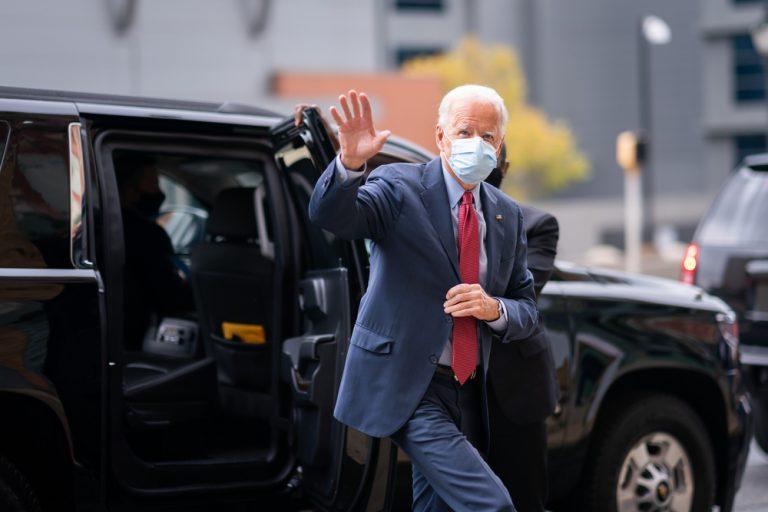
US President-elect Joe Biden has announced a $1.9tn economic relief package to boost the bruised American economy ahead of his inauguration next week.

Although the plan still needs to be approved by Congress before it is implemented, with the Democrats holding slim majorities in both the House of Representatives and the Senate – the first time the party has had control of both houses of Congress for a decade – it is expected that Biden’s proposal will pass, if with a little tussle from Republican senators who oppose its outlandish cost.

The package will include $415bn to pump into efforts to tackle the coronavirus pandemic, as well as a $440bn boost for small businesses, and direct cash payments of $1,400 – on top of the $600 already approved last month – to every “eligible” US adult to help mitigate the financial burden of Covid-19.

On top of this, Biden has pledged $20bn into making sure Americans get vaccinated against the virus, with the money being used to help set up mass vaccination centres and mobile units that can be used to reach remote parts of the country. The package also calls for an additional $50bn to expand testing and $130bn to help most schools reopen by the spring, as well as funds set aside to aid the hiring of 100,000 public health workers for contact tracing.

There are currently nearly 11 million people unemployed across the country, but Biden’s proposed package would see supplemental jobless benefits increase to $400 a week from $300 a week and also be extended until September. Evictions and home repossessions are also expected to be paused.

Among the more popular of Biden’s pledges is the plan to introduce a bill to Congress that could see the federal minimum wage doubled to $15 per hour – a Democrat commitment which predates the pandemic – although this one is probably going to face a lot of obstruction from the Republican party.

The Dow Jones was on the subdued side on Friday morning despite Biden’s stimulus plan announcement, actually slipping a bit, although this can most likely be attributed to yesterday’s news that US jobless claims have surged to their highest level since August 2020.

Commenting on the market’s week-end performance, Spreadex‘s financial analyst Connor Campbell weighed in:

“It seems the market’s view is that it is all well and good promising such stimulus – now Biden needs to get it through a precariously balanced, and distracted, Senate. If the incoming President can achieve that, then investors might be in the mood to celebrate.

“At the moment the Dow Jones doesn’t seem ready to applaud Biden’s stimulus plans, especially in light of Thursday’s jobless claims reading, which neared 1 million for the first time since the end of August. 

“Instead the Dow is facing a 100 point decline after the bell rings stateside, a loss that would leave it a fraction above 30,900. 

“One thing that could change the complexion of this afternoon’s trading is the US retail sales numbers for December.  The standard reading is set to rise from -1.1% to 0.0% month-on-month, with the core figure up from -0.9% to -0.1%. Beats for either of those could put a smile on the Dow’s face”.

The Gym Group revenue falls 48% amid restrictions

0

The Gym Group shares opened higher on Friday after the group shared a trading update for the year ended 31 December 2020.

The company, which owns 184 low cost gyms, revealed total revenue to fall from £153.1m in 2019 to £80.5m as it lost 45% of the trading days in the year amid government restrictions.

The Gym Group has started talks with lenders. It said in the update: “Given the ongoing impact from the latest lockdown and its implications for the operational reopening of our gyms, we have started discussions with our lending banks, who continue to be supportive, to review the future covenant tests relating to this facility.”

The company’s memberships fell from 794,000 to 578,000. All memberships have been frozen so that members do not pay whilst the gym is closed.

Richard Darwin, the chief executive, commented: “2020 has been a challenging year for our business, our members and our colleagues. Through the outstanding work of our team we provided a COVID-secure exercise environment for our members and demonstrated the resilience of our business model by trading profitably when gyms have been open.

“Our cash management during the pandemic has ensured we ended 2020 with manageable levels of debt and significant liquidity. At a time when health and fitness has never been more important to the nation, we are ready to emerge from the pandemic and take advantage of the many opportunities available us.”

Despite the difficult year, the Gym Group opened eight new sites last year and is onsite with a further three sites in York, Sydenham and Cambridge.

The group said that it “continues to see an opportunity to access excellent new sites at attractive rents; we are building a strong pipeline for 2021 and beyond and we will continue to progress new leases during this current period of lockdown. We will determine the timing of the rollout programme once there is greater visibility about a reopening date for gyms.”

The Gym Group shares are trading +1.66% at 221,61 (1007GMT).

Boohoo sales surge 40% ahead of Christmas

0

Boohoo sales surged 40% to £661m in the four months to 31 December.

The group is seeing strong sales over the pandemic and more people turn to online shopping as high street stores close.

The surge in sales is despite the poor working conditions for employees in the UK and abroad. An investigation by the Guardian found that Boohoo factories in Leicester were not paying workers the minimum wage.

The online retailer has hired Leveson to “bring transparency and independence” to their “agenda for change”. In today’s comments on the Agenda for Change, Leveson said: “It is clear that there is a long way to go.”

Following the strong peak trading performance, Boohoo revenue growth for the financial year to 28 February 2021 is expected to be 36% to 38%, ahead of our previous guidance of 28% to 32%.

John Lyttle, Boohoo chief executive, commented: “I’m delighted with the Group’s performance over the peak trading period. Our team worked exceptionally hard in 2020 as we navigated the many challenges, including the COVID-19 pandemic and the successful acquisitionand integration of Oasis and Warehouse.

“Growth has been strong across our multi-brand platform and we have continued to grow our market share across all geographies. I’m pleased to be able to provide a further update on our Agenda for Change programme today, which demonstrates our ongoing commitment to transparency as we invest in our approach to sustainability and our supply chain for the benefit of all of the Group’s stakeholders. The Group is in an excellent position entering 2021, which we expect to be another year of progress towards our goal
of leading the fashion e-commerce market globally.”

Boohoo shares (LON: BOO) are trading -3.47% at 339,00 (0937GMT).

GDP fell 2.6% during November lockdown

0

The UK GDP fell 2.6% in November’s second national lockdown.

In what could be the first step towards a double-dip recession, the economy was halted and the six consecutive months of growth have come to an end.

Whilst the economy may have shrunk, it is not by as much as the 5.7% that economists had expected.

“Following six consecutive monthly increases, including an upwardly revised 0.6% increase in October, real gross domestic product (GDP) fell by 2.6% in November 2020,” said the ONS.

“Restrictions were in place to varying degrees across all four nations of the UK during November.”

The new statistic show that the economy was 8.5% smaller in November than it was in the month before the pandemic.

The biggest fall was in the service sector. As pubs and restaurants closed, the sector shrank by 3.4%. Production was down 0.1% whilst construction grew by 1.9%.

The ONS commented: “There were falls in output in all 14 services sub-sectors between October and November 2020. The largest contributor to this fall was accommodation and food service activities, followed by wholesale and retail trade, other service activities and arts, entertainment and recreation, because of the reintroduction of restrictions in some parts of the UK. These four sectors accounted for nearly 80% of the fall in services.”

Rishi Sunak commented on what the new GDP figures meant for the country: “It’s clear things will get harder before they get better and today’s figures highlight the scale of the challenge we face.

“But there are reasons to be hopeful- our vaccine roll-out is well underway and through our Plan for Jobs we’re creating new opportunities for those most in need. With this support, and the resilience and enterprise of the British people, we will get through this,” he added.

Douglas Grant, is the Director of Conister, part of AIM listed Manx Financial Group. He commented on the new GDP figures: “While the economic contraction in November was expected as most of the UK entered a second lockdown, the drop in output is still a cause for concern for many businesses and reflects the dire situation that they are now facing. We must now ensure that the financial security of those businesses that are sustainable can flourish in the future.

“Up until now, the BBLS and CBILS have performed a fundamental role in keeping many SMEs alive and acted as an important triage system to identify and support qualifying businesses needing credit. However, we believe that we have now passed this phase and we must recognise that many businesses will not survive this pandemic, particularly those with an unsustainable debt burden. It is imperative for the future that we now focus on identifying and protecting our most resilient business sectors.”

Equities bullish ahead of stimulus announcement

0

Equities around the world rose on ‘Super Thursday’ as a slew of major companies posted festive trade updates, and anticipation continues to mount for the announcement of President-elect Joe Biden’s stimulus package.

With inauguration day fast approaching, it is expected that the new administration is ready to implement the multi-trillion dollar package passed by the House of Representatives towards the end of 2020 as well as a pledge of $1,400 stimulus checks to take the $600 payments approved by Trump’s team before Christmas up to a total of $2,000.

Global equities are broadly trekking upwards, as the Dow Jones (INDEXDJX:.DJI) looks to be on track for a record close after climbing 128 points on Thursday – floating near 31,200 – and the DAX (INDEXDB:DAX) and the CAC (INDEXEURO:PX1) both up 0.55% and 0.47% respectively.

The FTSE (INDEXFTSE:UKX) is also up a modest 0.71% to 6793.50 points as of GMT 15:36, buoyed by the news that the pound is set to close at its best price against the euro since early June.

Commenting on how equities are behaving across the pond, Spreadex‘s financial analyst Connor Campbell said:

“Hopefully not setting themselves up for disappointment, the Western markets rose on Thursday in anticipation of Joe Biden’s stimulus package announcement.

“We are now less than a week away from inauguration day. And though Donald Trump continues to eat up airtime despite the clock rapidly running out on his particularly grim chapter of modern American politics, the incoming administration is ready to go on the fiscal offensive from Day 1.

“Most relevant to the markets is size and scope of the relief plan the Democrats put together. It is likely Biden and co. will return to the multi-trillion dollar package passed by the House of Representatives in the latter portion of last year – if not the full $2.2 trillion sum – as well as an additional commitment to a round of $1,400 stimulus checks to compliment the paltry $600 payments approved pre-Christmas.

“The Democrats have the Senate and the House. But their control of the former is mighty slim, so this, more so than the impeachment process, will be the first real test of their ability to get things done over the new few years. That slight hesitance explains why the Dow Jones is warm rather than red hot. Flirting with 31,200, the Dow climbed 125 points, and could well be on track for another record close if Biden delivers”.

In terms of UK markets, stocks generally look rosy on the back of optimistic trade updates from some major British companies, such as Halfords (LON:HFD) and Taylor Wimpey (LON:TW).

“It is a rare sight to see the FTSE rising 0.6%,” Campbell adds, “as sterling takes 0.5% off its single currency rival and 0.2% off the greenback. As the UK index approaches 6,800 – a better reaction to Tesco’s latest figures could’ve given it the extra oomph it needs to hit that level – the pound is preparing to close at its best price since early June against the euro”.

Silver set to outperform gold in 2021

Swiss investment bank UBS has announced that it expects silver to outperform gold in 2021, following a year which saw “safe haven” precious metals hit record highs and reap the benefits of global stock market volatility.

2020 was a remarkable year for gold, which surged to a record high of $2,075 in August after one of its longest price rallies in history. With pessimism weighing down equities around the world as a result of the Covid-19 pandemic, investors increasingly looked to gold – which usually, but not always, appreciates in value during periods of economic turbulence – to balance their books.

Now, as gold extends a month-long dip in value, strategists at UBS’s Global Wealth Management team have warned that they do not expect the precious metal to repeat its 2020 arc, but that silver is ripe for its chance to shine – and may well outperform gold entirely.

As the economy gradually improves in 2021, UBS predicts that increased industrial demand will support silver prices, especially considering a greater focus from policymakers on renewable energy and decarbonisation efforts in 2021. According to UBS, more than 50% of silver used in industrial applications is linked to solar panels and electronics, both of which are crucial for the trend towards green technology.

The UBS strategists expect silver prices to reach $30 per ounce by the end of the first quarter and eventually level off to $27 per ounce by the end of 2021. It is is currently trading at around $25 per ounce.

Meanwhile, UBS expects that gold will struggle to attract “sufficient” ETF inflows to sustain prices above $1,900, with the firm estimating the asset will finish 2021 2.5% lower than current levels, at $1,800 per ounce.

UBS added that ongoing dollar weakness and low real interest rates will keep all precious metals prices elevated in the first quarter of 2021, but that gold will weaken in the second quarter as the macroeconomic backdrop improves and the Federal Reserve – as well as the Bank of England – begin to taper their quantitative easing programmes.

Mortgage repayment rates reveal North-South divide

New research by estate agents Coulters Property has collated the average house price and salary in every major town and city in the UK to reveal the places where you will need to work the most – or least – to pay off your mortgage if you put down a 15% deposit.

A mortgage is one of, if not the most, important investments most people ever make in their lifetime, and it can sometimes take an entire lifetime to pay it back. Of course, this depends on the value of the property, which is why the most expensive places to buy a home in the UK are also the places it takes the average person the longest to pay their mortgage back.

Coulters took the top 50 towns and cities in the UK by population and used data from the Office for National Statistics (ONS) to determine the average gross hourly rate of pay for all employee jobs in that area, then took the average house prices from each town and city as of August 2020 according to the Land Registry UK House Price index.

With the global pandemic of 2020, more lenders are asking for at least 15% deposit, so Coulters used this figure to calculate the deposit amount an “average house” in each town, city and region would require. An average number was then calculated for the number of hours and working days (based off an average eight hour working day) it would take for each town, city and region to pay off the average mortgage amount.

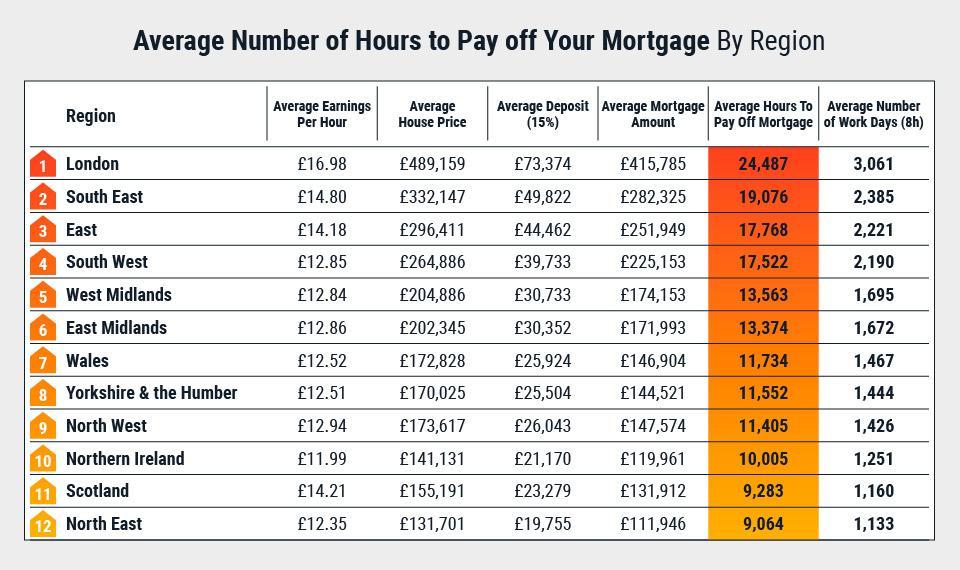
Data courtesy of Coulters Property.

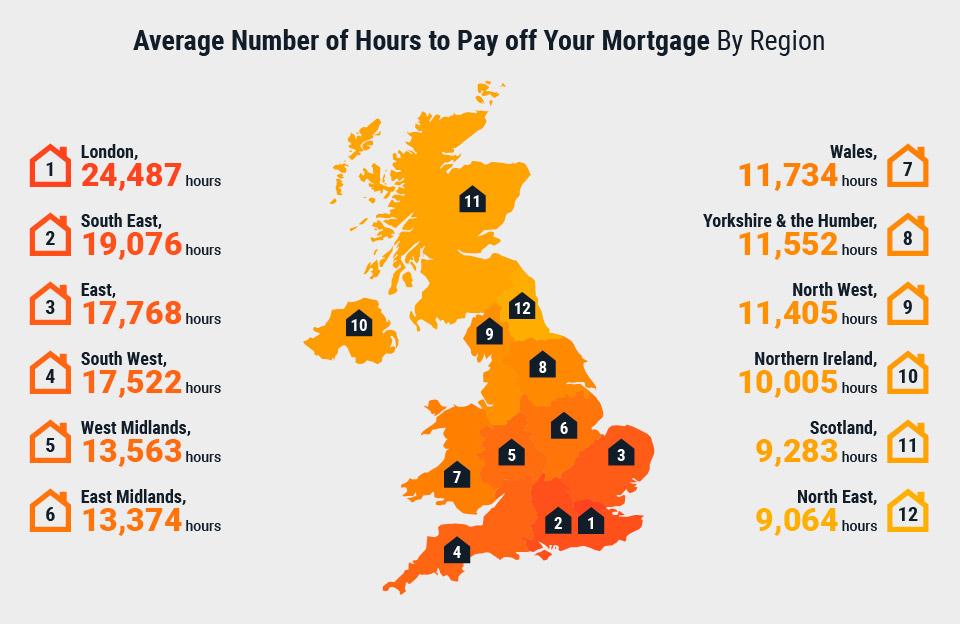
Coulters’ research has revealed that those that live in the South East, South West or East of the UK are likely to need to work twice the number of hours than their Northern counterparts, ranging from as much as 24,487 days in London to 9,064 in the North East.

This means, on average, Londoners need to work three times the total working days of someone living in the North East to be able to afford their average mortgage amount of £415,785.

In other parts of the UK, it would take 11,734 hours to pay off a mortgage in Wales, 10,005 in Northern Ireland and only 9,283 in Scotland, trailing the list with the second lowest time required to pay off the debt in full. Sunderland topped the list as the area where it is easiest to pay back a mortgage, however, needing 7,905 working hours to cover an an average mortgage of £96,678.

Graph courtesy of Coulters Property.

Mike Fitzgerald, Executive Chairman at Coulters Property, commented on the report’s findings:

“Applying for a mortgage to buy a house is a big investment, and it can take a lifetime to pay the lender back. The length of mortgage repayments are determined by the cost of properties, which are dependent on location, and several other socioeconomic factors.

“We have all heard of the ‘north-south divide’ and this is the case for the property market. Mortgages in the south are considerably higher than mortgages in the north as you can see from our research, which shows it takes homeowners in the South East and South West nearly twice as long to pay off their mortgage compared to the North East”.

888 to beat profit and revenue expectations

0

Online gambling firm, 888, has seen a growth in profits and revenues as betting shops remained closed during the pandemic.

The group said today that they will beat profit and revenue expectations for last year thanks to the strong trading through 2019 and into 2020.

In the six months to 30 June, group revenue soared by 37% to $379.1m and pre-tax profits surged by 130% year-on-year to $50.9m.

Chief executive of the group, Itai Pazner, commented: “We are pleased with 888’s trading during the second half of 2020. This performance continues to reflect strong FTD trends in line with the group’s recreational customer focus as well as the structural shift towards online services being seen across several consumer-facing industries. We have continued to prioritise safe gambling and recognise the impact of COVID-19 on the lives of 888’s customers across global markets.

“888 continues to invest in protecting customers and has again increased the volume of interactions with customers initiated by 888’s safer gambling team in order to help prevent gambling related harm. Underpinned by 888’s core strengths as a responsible operator with outstanding technology, the group remains well positioned to deliver further strategic progress.”

Looking forward, the group said they are entering the new year with strong momentum and “remains well-positioned to deliver further progress” but aware of possible headwinds and regulatory uncertainties.

Last year, the group hired Lord Mendelsohn as its new chairman. This was the second Labour Party affiliate to join the a gambling firm in a week. Tom Watson, the former deputy Labour leader, was announced as a senior adviser to Flutter Entertainment, owner of Paddy Power.

888 shares are trading -0.88% at 301,00 (1444GMT).

Trading in a volatile stock market

This year is all set to be a very volatile one for the stock markets. The stock market is trading near record highs but it’s not in sync with the economy. Though vaccines will be rolled out at a large scale in the next few months, macro indicators remain weak and it is safe to say that traders can expect a lot of movement in the markets.

A volatile market means a lot of price fluctuation that gives traders the opportunity to make higher than usual profits. However, as volatility increases, so does the risk of incurring a loss. Here are four steps to keep in mind while trading volatile markets so that you can maximize profits and minimize losses.

The smart choice to make in volatile markets is to only choose stocks that are trending. Often, a lot of stocks move at a steady pace irrespective of market volatility. You want to avoid those stocks. If the stock is upwardly volatile, hunt for stocks that are trending up. If you are a short-seller in a volatile market, hunt for stocks that are declining but haven’t totally collapsed. There are a couple of factors that you can look out for before trading in these stocks.

Volume

Choose stocks that have large trading volumes. The larger the volume, the easier it is for you to enter and exit stocks. The worst error you can make is getting stuck in a stock that no other party wants to buy or sell. For example, you can use a stock filter to narrow your vision to 10 stocks that trade between £10 and £50 and have over a million trades for the last 100 days.

Average Movement

You can use a stock filter to filter stocks that have moved over 2.5% daily between the open and close of the market (in either direction) for the last three months.

Often, indices report daily gainers and losers. An easy way to identify volatile stocks is to manually go through this list and figure out which stocks make regular appearances on this list.

Keep an eye out for ‘breakout’ levels

A lot of expert traders use the ‘breakout’ rule for trading in volatile markets. The rule is very simple: Keep an eye out for stocks that are establishing strong support levels and are trading within an effective range. If the stock continues to trade in that range, no action is taken on that stock. However, if the stock breaks out or crosses the upper/lower range, traders buy the stock because it could zoom up/down and create a new range.

During normal trading days, there is a danger that once a stock breaks out, it can lose momentum and slide back into the previous range. In a volatile market, that usually doesn’t happen. Stocks in a volatile market almost always create a new range and move up or down. One thing you have to make sure of is that your break out range is wider than normal.

However, in a volatile market, if a stock creates a false breakout level, the price decline can be huge, sudden and severe. If that happens, there is a danger of a huge loss. It is important to keep a strict stop-limit order so that you can cut your losses.

Place limit orders, not market orders

Markets don’t move in a normal or traditional sense during volatile days. Traders need to ensure they leverage various stock order types to ensure they are focused and disciplined while executing a trade. 

So, a market order is an order that lets you buy or sell stock at the current price in the market. For example, Lloyd Bank is trading at £36.74. If you place a buy market order, it will execute the trade at £36.74 during normal times. However, during volatile markets, this could change to £34 or £39 because prices fluctuate wildly in these kinds of markets. 

When you place limit orders, your orders only get executed at those prices. For example, if you place a buy order at a limit of £36.74, your broker will execute that order only if the price is £36.74. If the price is over the number, it won’t be executed. However, there is a chance that you might lose out on a good stock because it didn’t hit your limit.

Only deal in short-term strategies

Volatile markets have a great way of lulling you into a comfort zone. This could mean that you might think it is sensible to hold on to a stock for longer than usual. For example, in a regular market, if a stock breaks out, a trader can afford to have a higher price target for the stock before selling it. However, in a volatile market, you have to book your profits quickly.

  1. You have to set a target or a certain percentage when you will sell your stock.
  2. If you don’t want to sell your whole position, sell a large part of your position (maybe recoup your principal) and hold the remaining stock to generate more upside.

In a nutshell, understand that the market can change suddenly and be prepared to react when it happens.

Why it matters that Trump is impeached – again

Twitter was uncharacteristically quiet on Donald Trump‘s end yesterday after it was announced that he is now the first US President in history to be impeached twice, and having been suspended from his social media accounts, this time there was no platform for him to express his disapproval of the charge of “incitement of insurrection”.

Last week marked a historic moment for the US after a violent mob of Trump supporters stormed the Capitol on 6 January, echoing the President’s false claims that the 2020 election was “stolen” from him. Five people were killed in the riots and Congress – which was in the process of confirming the electoral college vote count to formalise President-elect Joe Biden’s victory – was evacuated and the building locked down as armed security fought to protect lawmakers.

Scenes from the attack have gradually emerged across social media in recent days, capturing the vandalism and looting of the rioters, who were able to breach police parameters despite the use of metal barricades, tear gas and paper spray. The “protestors” – whom Joe Biden and many others have argued should instead be labelled “domestic terrorists” – scaled walls and smashed windows to gain access to the House chamber, where the electoral college vote was taking place.

While Trump was not directly involved in the riots, the President has received global condemnation for his inflammatory rhetoric in the aftermath of the 2020 election and in the lead-up to the attack itself, repeating unfounded claims of “voter fraud” resulting in the election being “stolen from him”, despite the fact that Biden won a conclusive victory with more than 7 million public votes and more than 70 electoral college votes.

Trump himself urged spectators at his “Save America” rally on the morning of the 6 January to storm the Capitol, “fight like hell” and “take back our country”, while the President’s lawyer Rudy Giuliani pushed for “trial by combat” and Donald Trump Jr. echoed previous calls for “total war”.

Almost immediately after the January 6 riots, US Democrats announced their intention to launch a second impeachment process – following the first early in 2020, for which he was ultimately acquitted for “abuse of power” and “obstruction of Congress” after a private telephone call was leaked of the President’s suspect conversation with Ukrainian President Volodymyr Zelensky – marking the first time in US history that a President has faced impeachment charges twice.

Although he is due to leave office next week on 20 January, efforts to charge Trump are more than just a knee-jerk reaction to the violence of last week’s attack. Impeachment – if it passes the Senate, where a 100-member body will sit as a jury presided over by the chief justice of the US Supreme Court – would make life very difficult for Trump once he completes his term.

There is a common misconception that being charged with impeachment means that a sitting US President can be removed from office, but this is not true. Impeachment is not a criminal charge, but a political one, and refers only to the House of Representatives (the lower chamber of Congress) concluding that a president engaged in a “high crime or misdemeanour”. It does not actually equate to a criminal offence, which is why an impeached president can continue to stay in power even if he is “charged”.

Trump’s last impeachment charges were ultimately acquitted by the Senate – which the Republican party held a majority in at the time – which meant he did not incur any significant political or criminal consequences for his infamous phone call, but the upcoming trial on Trump’s responsibility for the Capitol riots represents a fresh threat that the charge could actually go through.

During the last impeachment trial, the House of Representatives impeached Trump the first time without a single Republican vote, but this time 10 members of Trump’s own party broke ranks to support the move.

Liz Cheney, the third-ranking Republican in the chamber and the daughter of former Vice-President Dick Cheney, had some notably harsh words for the President:

“There has never been a greater betrayal by a president of the United States of his office and his oath to the Constitution,” she wrote in a statement that was frequently referred back to by Democrats during the impeachment debate on Wednesday.

While the trial will most likely not be completed in time for the culmination of Trump’s term next week, if he is convicted, the charges will likely prevent him from running for office again – a risk that Democrats would rather not take when the next election rolls around in 2024.

Trump has previously flouted his intentions to run again, but a successful impeachment charge would probably spark an additional vote from the Senate to rule this out, and potentially open up the field for alternative Republican candidates to take the opportunity which would otherwise have been nabbed by the President.

Brian Kalt, author of “Unable, The Law, Politics, and Limits of Section 4 of the Twenty-Fifth Amendment,” has pointed out that Trump could attempt to run again on a technicality, but it is exceedingly unlikely that he would get enough backing from his party:

“There are people who have argued that. I think, though, as a practical matter, if they’re going to get two-thirds in the Senate against him, it would be a sign that just as a practical matter, he’s lost enough Republican support, that he’d be facing an uphill battle getting the nomination anyway”.

Besides from preventing him from running again, there are other practical arguments for launching a second impeachment trial. Lawyer James Robenalt, and John Dean, former White House counsel for President Richard Nixon, told PolitiFact that the most important reason to impeach him would be that members of Congress “perceive that Trump intends to continue to incite insurrection, which could become an armed insurrection. That threat, or the threat he might use military force at home or abroad as a pretext to stay in power, could cause them to act”.

Similarly, they warned, is the possibility that “Trump might pardon those who engaged in insurrection, or himself, or both. Those kinds of pardons would be unacceptable to the American people, but difficult to litigate in the courts because the pardon power is so broad and unlimited”.

On top of this, a successful impeachment charge would strip Trump of his post-term benefits – including an over $200,000 pension and an extensive lifetime security detail provided by the Secret Services. Under the Former Presidents Act, ex-US leaders are also entitled to a governmental allowance for office space and staff, plus reimbursed travel expenses of up to $1 million annually, as well as a funeral with full honours.

These benefits, however would not extend to a president removed by impeachment.

Additionally, once he leaves office for good, Trump will probably have to face the string of allegations of tax evasion and sexual misconduct that he has been able to evade while in office.

Assuming the impeachment charges are approved by the Senate, Trump could see his post-presidency plans turned completely upside-down, which is precisely what the Democrats – and an increasingly growing pool of Republicans – are aiming for.