Reflections on current market volatility

At the current time, every market moving event seems to start with a pronouncement from US President, Donald Trump. His desire to bring an end to the war in Ukraine and the associated cessation of US military aid, is likely to re-write the European defence architecture, with European countries having to make significant increases to their defence spending.

In Germany, the incoming government of Friedrich Merz responded by announcing a relaxation of the country’s so called ‘debt brake’, thereby freeing up significant resources for increased defence and infrastructure spending. The total stimulus to the European economy could be in the order of €800 billion and is therefore significant1. European bond yields rose in response to the prospect of higher borrowing, although European stock markets also initially greeted this development positively.

Self-inflicted economic harm

So called Liberation Day has come and gone, with Trump announcing swingeing tariffs on imported goods, ranging initially between 10% and 50%. The overall level of tariffs on goods imported into the US is set to rise to its highest level since the Smoot-Hawley Tariff act of 19302. This is likely to have profound consequences for both the American and global economy and we could therefore be witnessing the greatest act of self-inflicted economic harm in recent times. In the first week of April, stock markets reacted extremely badly to this news, being led down by those companies that are likely to be most exposed to the resulting fall out, such as auto manufacturers and banks.

Since the initial Liberation Day announcements, the situation has continued to evolve rapidly and unpredictably. America’s tariff stance has become significantly more nuanced at a country and product level. Certain consumer goods, such as smartphones and laptops, have been granted temporary exemptions. Meanwhile, there has been a partial pause on the introduction of wider tariffs, particularly for countries that have shown a willingness to engage in negotiations. By contrast, the US has taken a particularly tough stance towards China, with proposed tariffs on some imports rising as high as 145%. This has been met with a firm response from Beijing, including retaliatory measures. Markets have rallied from their lows, but sentiment remains fragile, and the outlook is highly sensitive to further political developments.

The President has invoked the International Emergency Economic Powers Act of 1977 as cover for the introduction of these tariffs. This act was originally established to allow a US president to act quickly in a war like situation and was clearly not designed to be gamed in the way that it is today. Whilst bypassing Congress in this way is certainly unconstitutional, some would argue that it is also illegal. It is maybe not an exaggeration to say therefore that the US faces a constitutional crisis, and it is possible, and maybe even probable, that Congress will step in to re-exert control in the coming weeks.

Even if nothing changes and the currently proposed tariffs are adopted in full, the economic fallout may be so great that the Republican Congressmen could come under pressure from their constituents to rein in the President. Failing that and in the event of an economic slowdown, they would likely suffer terribly at the mid-term elections in eighteen months’ time and possibly lose control of both houses of Congress. Confidence in the current administration was falling even before the tariff announcement – it is now tanking.

At the time of writing, it is impossible to know the extent to which these tariffs will ultimately be enforced or their durability once imposed. Even if we could, the degree to which they may negatively affect the global economy cannot be predicted. All we can say for sure is that the risk of a global recession has markedly increased in recent days. Meanwhile, it is worth noting that even prior to the tariff announcement, inflation measures were remaining some way above target, with the Federal Reserve’s favourite inflation indicator showing a rise of just over 3.5% in the year to February3. US consumer confidence also recently fell to its lowest level since January 20214, raising the potential spectre of stagflation.

Sticking to our knitting

When stock markets are as volatile as they have been so far in April, there is a natural human instinct to protect ourselves and perhaps run for cover until things ‘calm down’. Each uncertain period brings its own challenges, but reacting to this instinct has historically typically resulted in lower returns than had you done nothing.

Volatility can be unsettling but is part and parcel of investing in equity markets and it is the reason why we believe the asset class delivers premium returns over time.  Indeed, the savvy investor can use market volatility to his or her advantage. As Ben Graham said in his book The Intelligent Investor, “The investor who permits himself to be stampeded or unduly worried by unjustified market declines in his holdings is perversely transforming his basic advantage into a basic disadvantage.”

In our view, it is especially true that at times like these that one needs to put emotion to one side, focus on the long term and stay true to one’s investment philosophy. Our approach is and has always been to think long term and buy what we believe to be fundamentally sound businesses at a significant discount to their true economic worth, on the basis that, eventually, this economic worth will be reflected in a higher share price.

There are no guarantees of course, but in our experience, this approach has stood the test of time and, in our investing careers, has so far proved its worth through a technology bust, a global financial crisis, a Eurozone debt crisis and a global pandemic. Indeed, one of the reasons that investors in Temple Bar have enjoyed such strong returns since we began managing the trust in October 2020 is that we were able to take advantage of the market panic in the early days of the pandemic to buy some very lowly valued businesses which subsequently recovered strongly to the benefit of shareholders5.

Even though the short term is extremely uncertain, and things may well get worse before they get better, we are optimistic that this approach will remain an effective counterbalance to uncertainty, which should ultimately prove rewarding to those with the discipline to stay the course.


1 Source: Financial Times, March 2025

2 Source: Bloomberg, April 2025

3 Source: Federal Reserve Economic Data (FRED), 28 February 2025

4 Source: The Conference Board, 25 March 2025

5 In the period from 31 October 2020 to 31 March 2025, Temple Bar Investment Trust is +149.9% in NAV total return terms, compared to +89.2% for the Morningstar IT UK Equity Income sector average (source: AIC / Morningstar). Past performance is not a guide to the future. The price of investments and the income from them may fall as well as rise and investors may not get back the full amount invested. No investment strategy or risk management technique can guarantee returns or eliminate risks in any market environment.


Past performance is not a guide to the future. The price of investments and the income from them may fall as well as rise and investors may not get back the full amount invested. Forecasts and estimates are based upon subjective assumptions about circumstances and events that may not yet have taken place and may never do so.

No investment strategy or risk management technique can guarantee returns or eliminate risks in any market environment. Nothing in this document should be construed as advice and is therefore not a recommendation to buy or sell shares. Information contained in this document should not be viewed as indicative of future results. The value of investments can go down as well as up.

This article is issued by RWC Asset Management LLP (Redwheel), in its capacity as the appointed portfolio manager to the Temple Bar Investment Trust Plc. Redwheel, is authorised and regulated by the UK Financial Conduct Authority and the US Securities and Exchange Commission.

The statements and opinions expressed in this article are those of the author as of the date of publication. 

Redwheel may act as investment manager or adviser, or otherwise provide services, to more than one product pursuing a similar investment strategy or focus to the product detailed in this document. Redwheel seeks to minimise any conflicts of interest, and endeavours to act at all times in accordance with its legal and regulatory obligations as well as its own policies and codes of conduct.

This document is directed only at professional, institutional, wholesale or qualified investors. The services provided by Redwheel are available only to such persons. It is not intended for distribution to and should not be relied on by any person who would qualify as a retail or individual investor in any jurisdiction or for distribution to, or use by, any person or entity in any jurisdiction where such distribution or use would be contrary to local law or regulation.

The information contained herein does not constitute: (i) a binding legal agreement; (ii) legal, regulatory, tax, accounting or other advice; (iii) an offer, recommendation or solicitation to buy or sell shares in any fund, security, commodity, financial instrument or derivative linked to, or otherwise included in a portfolio managed or advised by Redwheel; or (iv) an offer to enter into any other transaction whatsoever (each a Transaction). No representations and/or warranties are made that the information contained herein is either up to date and/or accurate and is not intended to be used or relied upon by any counterparty, investor or any other third party. Redwheel bears no responsibility for your investment research and/or investment decisions and you should consult your own lawyer, accountant, tax adviser or other professional adviser before entering into any Transaction.

AIM movers: Gear4Music acquires stock from former competitor and Sosandar downgraded

0

Musical instruments retailer Gear4Music (LON: G4M) has acquired assets from the administrators of GAK (GAK.co.uk Ltd and The Guitar, Amp & Keyboard Centre Ltd). The stock purchased cost £600,000 but could have a value three times that figure. Gear4Music had been hit by discounting by GAK. There are no plans to use the GAK trading brand. There has been an improvement in trading with sales growth in double digits in recent weeks. The share price recovered 17% to 137.5p.

Mercia Asset Management (LON: MERC) has increased inflows to its assets under management and they have passed £2bn. Increased efficiency means that pre-tax profit has been upgraded to £8.5m. There is £40m in cash and a revaluation of the direct investment portfolio will be published with annual results on 1 July.  Mercia Asset Management wants to realise 70% of the current direct portfolio. The share price increased 15.7% to 29.5p.

The first quarter update from Cirata (LON: CRTA) shows the strongest bookings since the first quarter of 2019. They were $3m, including data integration bookings of $2.4m. The cash burn was down to $1.4m. Annualised cash overheads have been reduced to less than $17m. Cash was $8.3m at the end of March 2025. The share price rose 9.83% to 19p.

IXICO (LON: IXI) says interim revenues were 26% ahead at £3.2m and the medical imaging analytics company is on course to beat guidance. The order book was worth £13.1m at the end of March 2025, while cash was £5m. The loss was reduced to £700,000. The share price rebounded 9.52% to 8.625p.

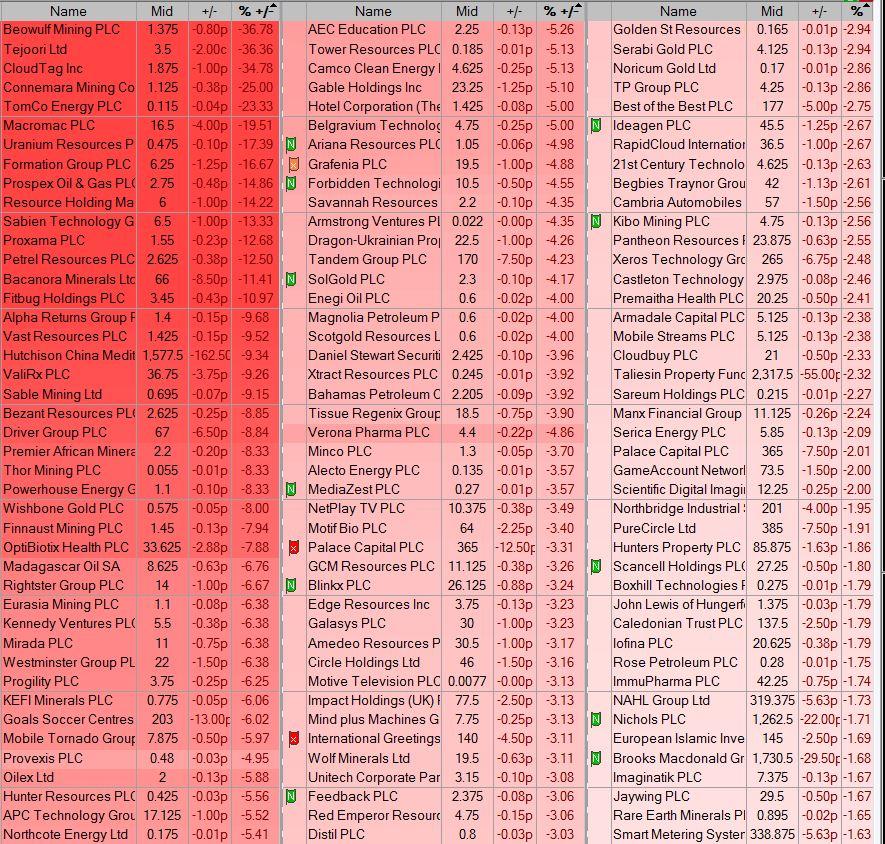
FALLERS

Jarvis Securities (LON: JIM) is selling its execution only broking business to Interactive Investor for £11m and winding down its clearing and settlement operations. Completion will happen when client agreements are transferred and that should happen in early July. The board believes that winding up the remaining operations and returning the remaining cash to investors is the best outcome. It will take 15 months to wind up the business. There are no plans to make an acquisition and shareholder approval will be sought for cancelling the AIM quotation. The share price had already fallen yesterday afternoon and it fell a further 27.8% to 13p.

Strategic Minerals (LON: SML) has raised 31m at 0.3p/share. The proceeds will be used to develop the Redmoor tungsten tin copper project in Cornwall and for working capital. Zeus has been appointed as joint broker. The share price decreased 18.8% to 0.325p.

Sales were weak in February, but online women’s clothing retailer Sosandar (LON: SOS) says fourth quarter sales were in line with expectations. Full year sales have fallen by one-fifth, with a 10% decline in the fourth quarter. Gross margins have improved, though. Six stores have been opened. Net cash is £7.1m. Singer has halved its pre-tax profit estimate for 2024-25 to £500,000. The 2025-26 figure is unchanged at £1.5m. The share price slipped 11.1% to 6p.

In the first quarter of 2025, Angus Energy (LON: ANGS) produced 411 million standard cubic feet of gas and 7,381 barrels of gas condensate from the Saltfleetby field, which was lower than the previous quarter. That is before the new booster compressor was commissioned. The Brockham field produced 2,150 barrels of oil. First quarter revenues of £5.32m are estimated. The share price dipped 7.41% to 0.25p.

FTSE 100 hit by tariff woes as fresh controls on chips sends US tech lower

The FTSE 100 fell on Wednesday after the US announced it would impose controls on the export of chips to China by US tech giant Nvidia.

After a relatively benign start to the week, Donald Trump ignited a fresh wave of concern through equity markets by slapping restrictions on Nvidia that hit a range of US chip makers, sending them sharply lower in the US premarket.

The developments knocked investor sentiment globally, and London’s leading index was 0.3% lower at the time of writing.

“The FTSE 100 was firmly lower early on Wednesday as investors reacted to the latest developments on tariffs and trade,” says AJ Bell investment director Russ Mould.

“A warning from AI chips champion Nvidia that it will face a $5.5 billion hit from tightened US controls on exports to China marks a new chapter in the escalating tit-for-tat between Washington and Beijing, along with Chinese restrictions on ordering Boeing jets.

“The deteriorating relationship between the two countries means China’s better-than-expected GDP figures for the first quarter may not attract too much attention given they cover a period before the Trump administration unleashed its trade policy.”

The selloff of US tech shares also overshadowed an upbeat UK CPI reading that raised the chances of an interest rate cut at the Bank of England’s next meeting.

There was a noticeable bid in UK housebuilders on the back of UK CPI falling to 2.6%, with Persimmon and Barratt Redrow among the top gainers. Barratt Redrow’s steady-as-you-go trading update, which was also released on Wednesday, provided additional support for the sector.

A bumper price target upgrade for Endeavour Mining by Barclays analysts amid rising gold prices sent the miner to the top of the FTSE 100 leaderboard with a 6% gain.

Bunzl was the FTSE 100’s top faller, plunging over 20%, after announcing ‘revenue softness’ across its North American business and a reduction in its profit outlook.

“A profit warning and termination of a share buyback programme, the first such halt by any FTSE 100 firm since the dark days of Covid-19 and lockdowns, are both taking a heavy toll on shares in Bunzl and driving them to a four-year low,” Russ Mould explained.

“March’s full-year results had already got a cool reception owing to worries about a slowdown in the core US operations and a reliance on acquisitions for growth, and those issues have now come home to roost. The company has flagged slower-than-expected sales growth in the US and the UK and Ireland as well as the impact of these trends upon profit margins in 2025.”

Focusing on long-term fundamentals with Vietnam Holding

The UK Investor Magazine was delighted to welcome Craig Martin, Chairman of Dynam Capital, the manager of the Vietnam Holding Investment Trust, back to the podcast to delve into the impact of tariffs on Vietnam and the portfolio.

Explore the Vietnam Holding Investment Trust here.

Vietnam was hit by punitive tariffs in Donald Trump’s ‘Liberation Day’ announcement, sparking a wave of volatility in Vietnamese stocks and the wider global equity universe.

In this podcast, we look through the noise of tariffs and explore the long-term fundamentals driving returns for the VNH portfolio.

Craig outlines their approach to portfolio management and the underlying strengths of the economy that will see it through tariff uncertainty.

We discuss Vietnam Holding’s discount and the innovative measures the board has in place that allowed them to increase the size of the fund earlier this year.

Barratt Redrow shares tick higher as completion guidance reaffirmed

Barratt Redrow shares were steady on Wednesday after the house builder released an update for the early stages of 2025 that showed a minor improvement in trading conditions.

Barratt’s release titled ‘Well-positioned for sustainable growth’ showed signs of improvement from a low base and did little to inspire investors or give them any reason to sell the stock. 

“Much to investors’ relief, Barratt Redrow has shown that everything’s ticking along nicely in 2025,” said Aarin Chiekrie, equity analyst, Hargreaves Lansdown.

Barratt Redrow shares were 1% higher at the time of writing.

The issues with the UK housing market are well documented and largely priced into housebuilding shares. Like a coiled spring, investors are looking for signs of an improvement that will likely spark a rerate in the sector.

We didn’t quite get that in today’s update from Barratts, but an uptick in sales rates in the early months of 2025 shows things aren’t getting any worse for the sector. 

“Being the first UK housebuilder to update markets on performance since the storm of tariff uncertainty and stamp duty changes, Barratt has done well to quell worries for now,” Aarin Chiekrie said.

“Revenue and cost benefits are continuing to build as the integration of Barratt and Redrow is nearing its completion date. And while many peers are seeing moderate levels of build cost inflation, Barratt’s increased scale means it’s been able to keep build costs broadly flat this year.”

The company left its guidance of between 16,800 and 17,200 completions unchanged over the full year. 

Touching on the integration of Redrow into the business, the company said it had closed a number of regional offices and was continuing to achieve head office function synergies.

discoverIE – ten years of growth to continue, broker targets suggest 50% upside for shares

This morning’s Trading Update for its year to end-March from discoverIE Group (LON:DSCV) was extremely positive and it should help to continue the recent share price acceleration.
Extending its growth in underlying operating profits and margins in each of the last ten years, the customised electronics business informed the market that it expects to report, on Wednesday 4th June, that its last year will show record profitability.
The Main Market-listed group, employs some 4,500 people across 20 countries, and has principal operating units based in the UK, Continental Europe, Sri Lanka, India, C...

Interest rate cuts on the horizon after UK CPI falls

The pound pared gains against the dollar on Wednesday after UK CPI fell to 2.6% and piled pressure on the Bank of England to cut interest rates.

March inflation of 2.6% was lower than February’s reading of 2.8% and 3% in January.

“Today’s inflation figures suggest a fragile but promising momentum – a second month of stability that hints we may be turning a corner, though not yet out of the woods,” said Paul Noble, CEO of Chetwood Bank.

While the drop in inflation will be welcomed by first-time buyers and household bill payers, the drop in the rate of inflation is only predicted to be temporary, with economists expecting the rate to tick higher in the coming months.

That said, interest rate futures market quickly priced in a rate cut at the Bank of England’s next meeting.

Inflation was expected to rise later this year, even before Donald Trump unleashed his tariffs on the world. The net impact of the tariff war is inflationary, so the hopes of sustained interest rate cuts are negligible. 

“Like an inattentive driver in rush hour traffic, inflation has hit the brakes again, falling to 2.6% in March. But the rough ride isn’t over. Once the price rises of Awful April kick in, we can expect it to accelerate sharply again,” said Sarah Coles, head of personal finance, Hargreaves Lansdown.

Investors may find solace in Trump’s propensity to U-turn, which may see him roll back on tariffs before they cause long-lasting damage to prices. 

The pound dropped against the dollar in the immediate reaction to the release, but was still higher on the day. 

Jarvis Securities selling broker to Interactive Investor and winding up other operations

0

Jarvis Securities (LON: JIM) is selling its execution only broking business to Interactive Investor for £11m and winding down its clearing and settlement operations. The share price slumped 58.1% to 18p. This is the lowest level since the end of 2006.

The broking business generated £8.55m out of group revenues of £13.1m in 2023. Assets under administration ate £1.27bn. Interactive Investor is paying an initial £9m on completion and a further £1m 12 months later, then the final £1m in a further six months. The additional payments can be reduced if there are warranty or indemnity claims.

Completion will happen when client agreements are transferred and that should happen in early July. Assets under administration and number of customers should remain at 90% of their current level for the completion to take place. Some clients are not covered, and Jarvis Securities will help them to move to an alternative broker.

The board believes that winding up the remaining operations and returning the remaining cash to investors is the best outcome. It will take 15 months to wind up the business. There are no plans to make an acquisition and shareholder approval will be sought for cancelling the AIM quotation.

There was £5.5m in the bank at the end of June 2024, but it is unclear if any of that will go with the broking business. There are likely to be costs of winding up the business. The current market capitalisation is £8.1m.

Buy this UK defence share with geopolitical tensions running high

Donald Trump's second stint as President has turned the world order on its head. Tariffs threaten to damage the world economy, while his approach to foreign policy has emboldened the West's enemies.
Trump's tariffs have diverted attention away from the conflicts in Ukraine and the Middle East. But these conflicts rage on, and the risks of new conflicts emerging remain high.
Defence stocks have done very well over the past year amid heightened geopolitical tension, and governments globally are preparing to ramp up defence spending, providing further support for the sector.
This UK-listed defe...

Investing in UK Build-to-Rent with FTSE 250 Grainger

The UK Investor Magazine was thrilled to be welcomed by Robert Hudson, Chief Financial Officer of Grainger PLC, to explore recent developments at the FTSE 250 build-to-rent specialist.

We start by looking at the group’s transition from a trading company to a REIT and the tax benefits for investors. Taking a broad view of Grainger’s proposition to investors, Rob notes the ability of retail investors to gain exposure to the UK rental market through an ISA by buying Grainger shares.

Grainger’s total rental income is up 15% in the early stage of their financial year. We look at the factors driving growth and the momentum the company is building in the build-to-rent sector.

We explore Grainger’s 5,000 property pipeline and the expected uplift in earnings.

Rob outlines the technological capabilities of the business and how the company’s CONNECT platform is designed to facilitate future growth and improved margins.

We discuss Grainger’s dividend track record and how the dividend will evolve as Grainger transitions to a REIT.

Rob finishes by detailing what excites him the most about the year ahead.