The UK Investor Magazine was pleased to be joined by Damon Rand, the founder of Cepro, to discuss their residential smart grids for new UK homes, which promise to disrupt both the new home and renewable energy markets.
Cepro is an award-winning smart grid developer and operator based in the UK, specialising in developing and operating residential smart grids for new UK homes, combining solar power, battery storage and electric vehicle charging infrastructure.
The firm’s vision centres on decarbonising and decentralising home energy whilst helping housebuilders deliver all-electric, future-proof homes at reduced costs.
Cepro is addressing the challenge of high-carbon, gas-reliant centralised home energy systems at a time when housebuilders face mounting regulatory pressure and costs to deliver low-carbon infrastructure.
We discuss the company’s pipeline of commercial proposals covering over 11,000 homes and how Cepro aims to scale through strategic partnerships with builders in the growing UK new-build market.
The FTSE 100 jumped on Friday as investor confidence received a shot in the arm from the US/UK trade deal, even if it leaves the UK in a worse position than before Trump’s ‘Liberation Day’.
London’s leading index was trading 0.4% higher at the time of writing.
“Yesterday’s UK-US trade deal happened just before the UK market closed which meant quite a few investors won’t have had time to soak it all in and adjust portfolios accordingly,” said Russ Mould, investment director at AJ Bell.
“The FTSE 100 shrugged off the event in the heat of the moment, but advanced 0.4% in early trading on Friday as investors belatedly celebrated the agreement.
“Notably, the FTSE 100 top risers’ list was full of UK-listed stocks that do business in the US, such as retailer JD Sports, rat catcher Rentokil and industrial groups Smiths and Spirax.
“The trade deal was smaller than expected but strategically significant as it puts the UK in the friend zone for the US, a status whose importance shouldn’t be underestimated.”
As alluded to by Russ Mould, those stocks most heavily impacted by the introduction of Donald Trump’s tariffs put in the strongest performances on Friday.
JD Sports shares were ravaged by Trump’s tariffs due to its exposure to the US and a supply chain woven into the economies of the countries slapped with the highest tariffs. JD Sports shares were 2% higher on Friday and have rallied around 30% from their post-tariff lows.
IAG gained 2% after beating Q1 profit expectations on strong performance in North Atlantic services during the period.
The general uptick in investor confidence helped lift cyclical sectors on Friday. Miners Glencore and Anglo American were on the leaderboard, while oil majors Shell and BP added a notable number of points to the index as oil price rose.
“Brent is trading near 64$ pb up from the upper 50s level as cautious optimism kicked in from the demand side with relatively improved market sentiment on the back of high-level trade negotiations, US vs China, and the US-UK agreed trade framework,” explained Ahmad Assiri Research Strategist at Pepperstone.
Airtel Africa was the FTSE 100 top riser as the stock rebounded from a sharp sell-off yesterday.
If you’re anything like me, you probably didn’t start investing with a perfectly thought through plan. You may have looked at fund managers and thought you could do better. Maybe you invested in funds, but were disappointed by the results.
You wanted more control, higher returns, a bit more risk.
So you started picking shares.
And that’s where the trouble begins.
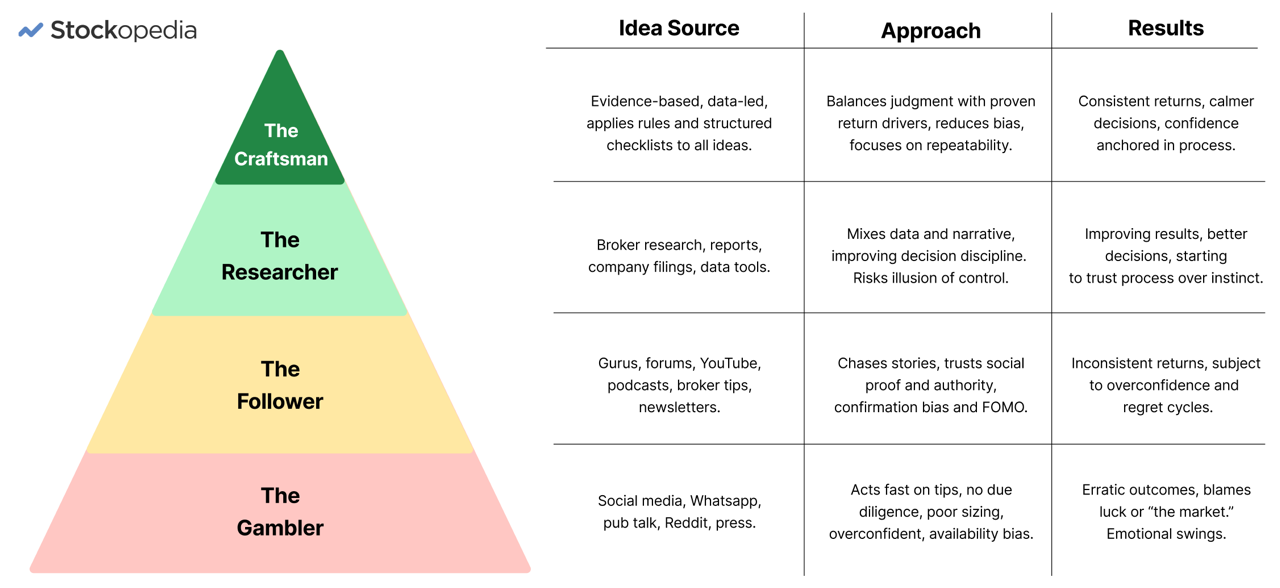
Stage 1: The Gambler – betting on a big idea
This is how many of us start. We come across a share tip, from a broker or a bulletin board, maybe an overconfident YouTuber. We find a convincing idea. We want in.
Sometimes it works, but often the theme has already played out by the time you buy in. You don’t even know you’re late.
This isn’t investing. It’s gambling on hope, which too often ends with a loss – yes of capital, but also of confidence, which can be hard to rebuild.
Stage 2: The Follower – trusting authority
After a few bets fail, you smarten up. You start following people who actually know what they’re doing. People you respect. Premium content. Expert Newsletters. Communities of proven investors.
This is definitely a step up. The very best investing insights are often shared by real investors, investing their own money. But even here, there are traps.
Because following others isn’t the same as doing analysis. You risk just buying the story.
We are all hard-wired to believe in stories. They are how we make sense of the world. We seek story arcs in our investments – a viable turnaround plan, a heroic new CEO, a market that must be disrupted. But Nassim Taleb warned of the “narrative fallacy” in Fooled by Randomness – we see patterns where they really don’t exist, stories where there’s only noise.
So if you find yourself, or the experts you follow, projecting a Hollywood ending onto your favourite share, while ignoring the red flags – buyer beware. It really can pay to be a sceptic.
Story stocks vs the statistics…
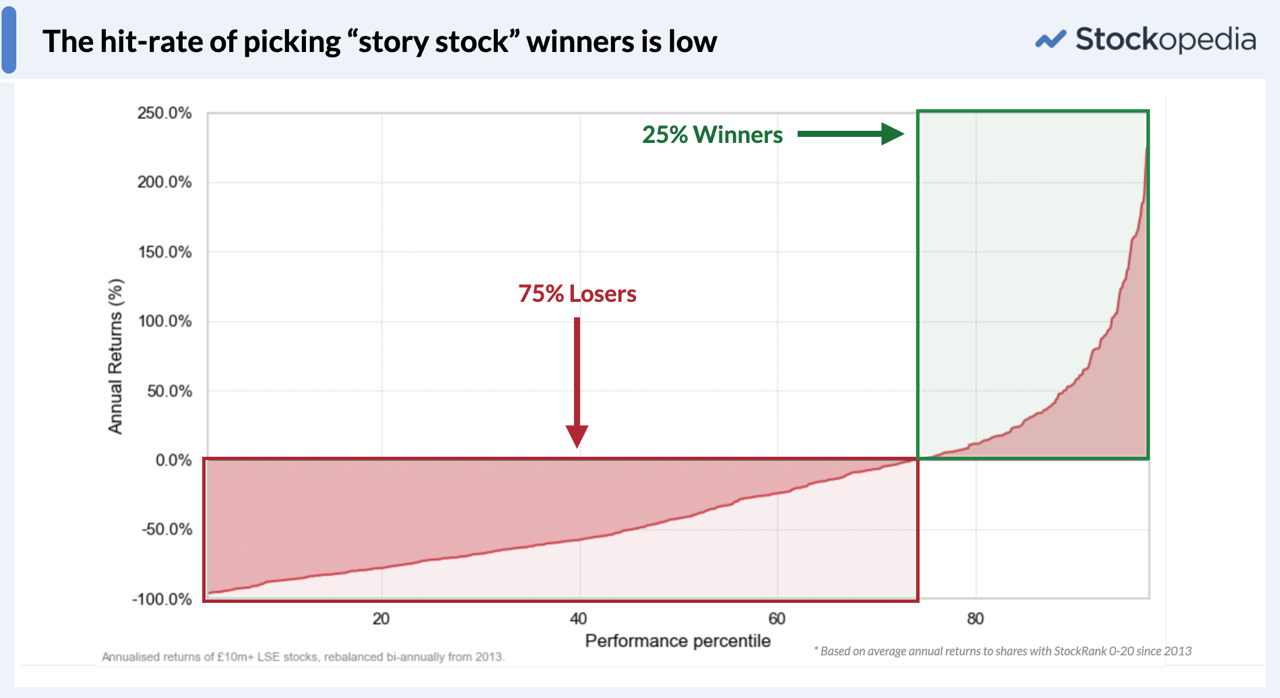
For some reason, companies that are pre-profit, or pre-revenue are even easier to project narratives onto. At Stockopedia, we’ve tracked the performance of blue-sky “story stocks” that so often dominate attention. Stocks like Sirius Minerals – that tens of thousands lost money in.
And we found roughly three-quarters of them lose money in a typical year.
We all want believe our favourite share will be a lottery win, but the stats just don’t back it up. Only 5% of pre-profit story stocks end up doubling or tripling in a year.
Stage 3: The Researcher – digging deeper
So now you take your investing seriously. You learn to read financial statements. You source broker research and annual reports. You study investing books and create spreadsheets.
You are doing the real work now. You feel smarter. But even now there’s a catch – doing more research doesn’t guarantee better results.
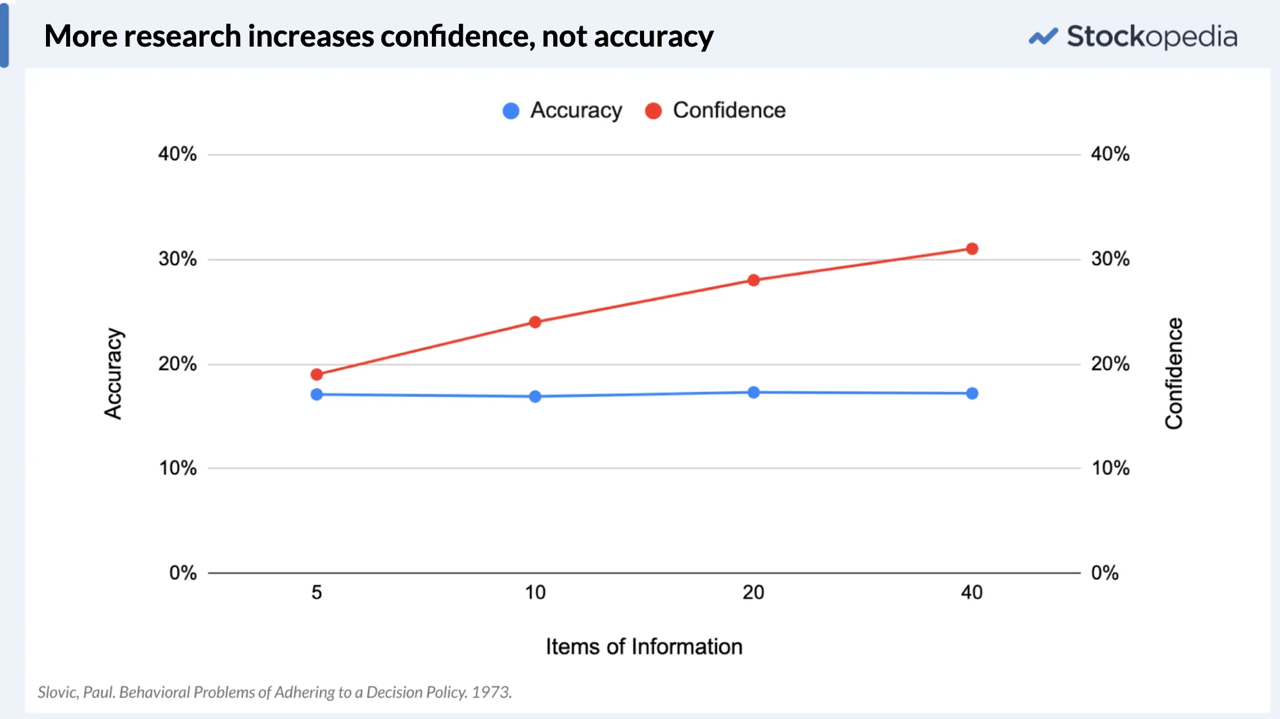
There’s a study from 1973 by Paul Slovic. He asked horse racing experts to predict winners when given increasing amounts of data. At up to five data points on each horse, their accuracy improved. Beyond that? Their confidence kept increasing, but their accuracy completely flatlined.
It’s a hard to swallow truth – more research makes us more confident, not more correct.
So if you find yourself doing hours of research and becoming more and more convinced in your convictions – just remember that confirmation bias can be really expensive.
I’ve been there. In 2008, just before the financial crisis, I had 50% of my portfolio in a single AIM-listed biometrics stock. I’d done the work: bought the product, built the DCF, met the CEO. I “knew” it would multibag. Just give me ten minutes with my younger self and I’ll save him hundreds of thousands of pounds.
Stage 4: The Craftsman – turning insights into rules
So when you’ve done your fair share of gambling, following, and over-researching – you may reach a point where you stop asking “what do I think about this stock?” and start asking “what really works in the market?”
It’s a subtle shift, but it’s everything. Most of the great investors made this shift. Graham. Buffett. Slater. O’Shaughnessy. They didn’t just gather information – they defined investment criteria based on the evidence of what really works.
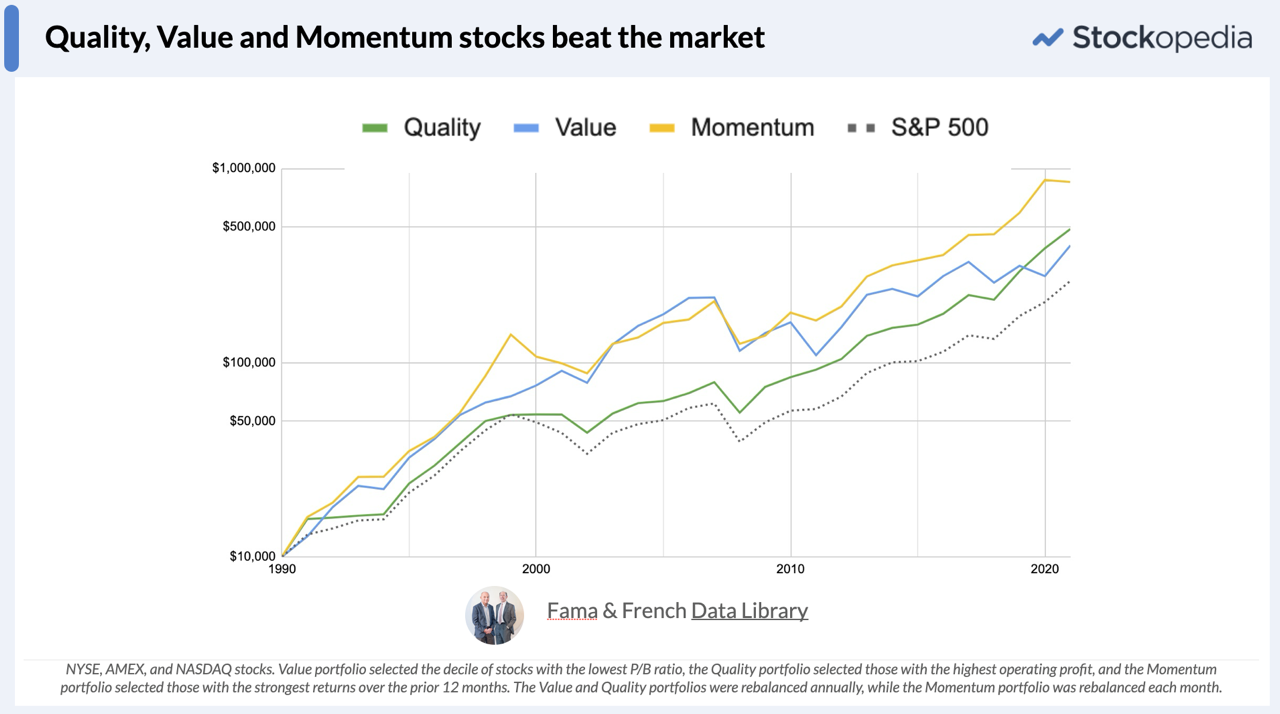
Because when you start researching what really works – across all markets in history – there are only a few core return drivers that consistently pay off.
Quality – good, profitable stocks tend to outperform unprofitable, junk.
Value – cheap stocks (versus earnings or assets) tend to outperform expensive stocks.
Momentum – shares with positive price and earnings trends tend to outperform.
Not every stock with these characteristics succeeds, but on average investing in shares with these key characteristics shifts the odds in your favour. The study below is by Fama & French – Fama won the Nobel Prize for validating these insights.
Understanding this is where the shift happens.
The Craftsman moves from stock-picking based on opinion, to rule-building based on evidence.
These three characteristics, which we call QVM, are measurable for every share. And when something can be measured, then rules, criteria and checklists can be built on them. They can be the basis of a sound, repeatable process.
Even Charlie Munger, Warren Buffett’s partner, and one of the wealthiest stock market researchers that ever lived once said:
“No wise pilot, no matter how great his talent and experience, fails to use his checklist.”
Because what sets the best investors apart isn’t how much they know about their investments – it’s how they turn their knowledge of what really works into a repeatable process.
What’s next?
This first article is really about recognising the journey that many of us investors go on – from gambler to follower to researcher to craftsman.
In the next article of this four article series, I’ll show you how to start turning the QVM return drivers into practical rules you can apply to improve your investing.
And if you want to know more about building a rules-based process that works – we will be hosting a webinar on the 22nd May. You can sign up here.
Rightmove has maintained its outlook in its latest trading update covering the first four months of 2025.
As Britain's leading property portal, Rightmove is both a beneficiary and facilitator of increased activity in the UK property market.
Rightmove is a highly efficient cash-generating business. But what can its results tell us about the wider market?
The company has reaffirmed its full-year guidance of 8-10% revenue growth, supported by product-led expansion and increasing membership.
Average Revenue per Advertiser (ARPA) is progressing in line with previous forecasts, driven by the ongo...
IAG announced a solid set of Q1 results on Friday, underpinned by strong performance in North Atlantic routes.
IAG has delivered smashed expectations in the first quarter, with revenue climbing 9.6% to €7.0 billion, exceeding market expectations of €6.8 billion, and operating profit nearly tripling to €198 million, significantly outpacing the forecasted €133 million.
The group pointed to British Airways showing notable improvement, and both Iberia and Vueling maintaining their positions amongst the world’s most ‘punctual’ airlines.
“IAG has been delivering for both passengers and investors alike after landing a big profit beat in the first quarter. The group’s market-leading networks, strong brands, and fierce operational focus continue to drive performance skyward. Profitability’s also getting a helping hand from falling fuel costs,” said Aarin Chiekrie, equity analyst, Hargreaves Lansdown.
“IAG shows no signs of slowing, and demand for its routes remains strong despite the current pressure on consumers’ incomes.”
North Atlantic routes were the biggest area of strength in terms of passenger revenue per ASK (available seat kilometre) with 13% growth. Africa, the Middle East and South Asia also show signs of promise with 3% growth, while domestic lines in the UK and Spain were disappointing.
Investors will be pleased to see a bump higher in the dividend, whilst the company continued its commitment to shareholder returns by completing €530 million of its ongoing €1.0 billion share buyback programme during the quarter.
Looking ahead, IAG has reinforced its long-term strategic outlook with an order for 71 widebody aircraft, positioning itself for sustained growth despite anticipated cost increases.
“We continue to see resilient demand for air travel across all our markets, particularly in the premium cabins and despite the macroeconomic uncertainty,” said Luis Gallego, IAG Chief Executive Officer.
Fleet expansion
IAG has announced plans for a substantial expansion of its long-haul fleet, with orders placed for 53 new aircraft from aviation giants Airbus and Boeing.
The multi-billion pound deal includes 32 Boeing 787-10 Dreamliners earmarked for British Airways, whilst 21 Airbus A330-900neo aircraft will be flexibly allocated across the group’s other carriers—Aer Lingus, Iberia and LEVEL.
Further to the confirmed orders, the agreements include options for additional aircraft. British Airways may exercise rights to purchase up to 10 extra Boeing 787s, whilst IAG holds similar options for up to 13 additional Airbus A330-900neos.
These latest acquisitions follow previously announced orders disclosed today, comprising six Airbus A350-900s for Iberia, alongside six Airbus A350-1000s and six Boeing 777-9s destined for British Airways’ fleet.
Quantum computing shares rallied in the US after D-Wave Quantum released Q1 results and sparked a wave of optimism that the sector could be on the verge of generating meaningful revenues.
D-Wave reported hugely improved financial results for the first quarter of fiscal 2025, achieving record revenue of $15.0 million, representing a substantial 509% increase from the $2.5 million recorded in the same period of fiscal 2024.
The results validate quantum computing’s investment case and demonstrate real-world demand for quantum computing systems at scale.
“The first quarter of 2025 was arguably the most significant in D-Wave’s history, especially in terms of our unique ability to deliver quantum value today to our customers and the scientific community,” said Dr. Alan Baratz, CEO of D-Wave.
“We recognized revenue on our first Advantage™ system sale to a major research institution, moved an additional customer application into commercial production, and became the first to demonstrate quantum supremacy over classical computing on a useful real-world problem. The end result was a record revenue and gross profit quarter.”
The revenue growth was primarily driven by the sale of a quantum computing system, resulting in a record gross profit of $13.9 million and an improved gross margin of 92.5%.
D-Wave has made significant technological strides, including demonstrating quantum computational supremacy on a real-world magnetic materials simulation problem. D-Wave’s annealing quantum computer solved a problem in minutes that would have otherwise taken a million years.
The company highlighted a range of commercial applications of the tech, including Ford Otosan deploying a hybrid-quantum solution that reduced vehicle scheduling time from 30 minutes to under five minutes, and Japan Tobacco successfully employing D-Wave’s quantum computing in drug discovery processes.
D-Wave Quantum shares were 38% higher at the time of writing, helping peers Rigetti Computing and Quantum Computing Inc. higher by 8% and 10%, respectively.
The FTSE 100 rose on Thursday after the Bank of England cut interest rates and warned of the impact of trade tariffs on UK GDP growth.
The Bank of England has cut interest rates to 4.25% as it seeks to mitigate the negative economic consequences of Donald Trump’s tariffs.
“Despite the UK economy growing more than predicted in February (latest data available), policymakers remain laser-focused on bolstering domestic momentum,” said Myron Jobson, Senior Personal Finance Analyst, interactive investor.
“The latest rate cut signals a bid to turbocharge GDP growth, ensuring the UK can weather external headwinds while fostering a more resilient economic outlook.”
London’s leading index was 0.2% higher in the immediate reaction to the decision, after being as much as 0.4% higher beforehand.
After keeping rates on hold in March, the Bank of England made its fourth interest rate cut since it started reducing rates from 5.25% in August last year. Interest rate futures markets are predicting another three cuts this year.
Investor sentiment also received a welcome boost from reports of a trade deal between the US and UK which is due to be released later on Thursday. Details are scant, but any progress will be a major positive for the UK and its equity markets.
“A trade deal between the two countries could provide more certainty for UK businesses as to how the future will look, so they can plan accordingly,” explained Russ Mould, investment director at AJ Bell.
“It might also put the UK in a more favourable light with foreign investors looking to dial down US exposure and wondering where they should reallocate money.”
FTSE 100 movers
3i shares rose 1% after the private assets focused investment trust reported a 10.1% return for the year and 6.3% increase in the target dividend.
The interest rate cut also helped private equity trust shares in the hope that the private equity sector will enjoy a pickup in activity fueled by lower rates.
“With the Bank of England finally trimming the base rate to 4.25%, we could well see a noticeable shift in M&A appetite, especially from private equity, who have been slightly more cautious of late with such comparatively high rates,” said Hamish Martin, Partner at LAVA Advisory Partners.
Next shares were firmly higher after the retailer produced yet another resoundingly strong trading update. Sales jumped 11.4% in the first quarter, well ahead of management’s expectations.
“Next has always been a master at managing expectations, recognising that as a public company it always pays to under-promise and over-deliver and it has done it once again with the latest update,” Russ Mould said.
“First-quarter trading was ahead of expectations, helped by warmer weather causing people to pull forward purchases of summer clothing.
“Prudently, Next is expecting a pullback in the current quarter and it has left sales guidance for the year as a whole unchanged – although it has nudged profit guidance higher, reflecting just how strong the increase in full-price sales was in the first quarter.”
IMI was the FTSE 100’s top riser, gaining 5%, after the engineering firm reported strong order growth for its Process Automation segment.
“We are pleased to reconfirm our guidance for the full year,” said Roy Twite, Chief Executive of IMI.
“We continue to expect to deliver another year of mid-single digit organic revenue growth in 2025. As expected, organic revenue in the first quarter was modestly lower than last year and Group margins were up.
Airtel Africa shares fell 7% and were at the bottom of the FTSE 100 leaderboard after being hit by currency swings.
Degradable plastics developer Symphony Environmental Technologies (LON: SYM) has raised £2.5m at 20p/share from Quantum Leap Capital. The subscription will be in two tranches and Quantum Leap Capital will have a 5.26% stake. The subscription price is more than double the market price even after a 123.1% rise to 7.25p.
Electronic monitoring technology developer Big Technologies (LON: BIG) is appointing Ian Johnson as chief executive and Mike Johns as finance director, replacing Daren Morris who has been stood down as a director and put on gardening leave. Ian Johnson is moving from executive to non-executive chairman of Niox (LON: NIOX) on 14 May. First quarter revenues were 11% ahead at £12.9m if the Colombia contract is excluded. The share price rebounded 17.3% to 91.5p.
AI-focused digital marketing services provider Silver Bullet Data Services (LON: SBDS) increased first quarter revenues by 15% to £2.31m. This is normally a slow quarter. A global retailer has awarded the company a contract worth $1.5m over two years. Committed services revenues are nearly three-quarters of 2025 target revenues. The share price improved 7.79% to 41.5p.
Building and plumbing products distributor Lords Group Trading (LON: LORD) had a tough 2024 with a like-for-like decline in the merchanting division revenues of 3.6% and a 10.4% fall in plumbing and heating revenues. Underlying pre-tax profit slipped from £10.4m to £3.8m. First quarter like-for-like growth is 11% in merchanting and 22% in plumbing and heating. That does compare with a weak period of the previous year. Forecasts assume growth of around 5% this year. There have also been cost savings. Property disposals have led to a £2m gain and they will help to cut net debt from £32.4m to £16.5m. The share price recovered 7.27% to 29.5p.
FALLERS
Wishbone Gold (LON: WSBN) has identified eleven new gold targets at the Crescent gold project in the Mosquito Creek area of Western Australia. The company has appointed Apex Geoscience Consultants to manage the ground exploration and drilling at the Red Setter Dome. Hot Rocks Investments (LON: HRIP) has a 3.2% stake. The Wishbone Gold share price slipped 15.7% to 0.215p.
Retailer Mothercare (LON: MTC) continues to find trading to be tough in the Middle East. Worldwide system sales were 18% lower in the year to March 2025. EBITDA will halve to £3.5m and there will be a small pre-tax loss. Forecasts for 2025-26 and 2026-27 have been reduced and the loss is forecast to increase to £700,000 in 2025-26. This reflects the reduction in franchised outlets and destocking by Boots ahead of the distribution agreement ending. Net debt at the end of March 2025 is estimated to be lower than previously forecast at £3.7m. The full results will be published in August. The share price declined 12.8% to 2.24p.
Trinidad-focused oil and gas producer Touchstone Exploration (LON: TXP) has raised £15.4m at 20.5p and secured a six-year term loan of $30m. The loan is to fund the acquisition of the company that owns a 65% interest in the Central Block gas asset. That would add 2,000 barrels of oil equivalent/day of net production. The NPV10 valuation is $42.9m. The share issue will finance the drilling of development wells. Net production should exceed 8,000 barrels of oil equivalent/day, which could be nearly double February production. The share price is 10.8% lower at 20.75p.
Film and TV subtitling and dubbing services provider Zoo Digital (LON: ZOO) says work is coming through more slowly than expected. The timing of projects remains uncertain. Revenues for the year to March 2025 have been reduced by 3% to $49.4m and the loss increased to $7.4m. A 23% cut in forecast 2025-26 revenues to $42.5m means that Zoo Digital could continue to be loss making. Even so, net cash could improve from $2.6m to $3m. The share price dipped 7.65% to 9.35p.
Caledonian Holdings (LON: CHP), formerly Vela Technologies, made an unrealised loss of £277,000 in the quarter to March 2025. There was cash of £787,000at the end of March 2025, following a £1.2m placing. The main disposals were part of the holdings in EnSilica (LON: ENSI) and Northcoders (LON: CODE). Aeristech was placed in administration and the £401,000 investment valuation was written down to nil. Total assets increased by £91,000 to £2.67m. The share price fell 5.56% to 0.00425p.
Ex-dividends
Braime (TF & JH) (LON: BMTO) is paying a final dividend of 10p/share and the ordinary share price is unchanged at 700p.
Braime (TF & JH) (LON: BMT) is paying a final dividend of 10p/share and the A non-voting share price is unchanged at 1550p.
Focusrite (LON: TUNE) is paying an interim dividend of 2.1p/share and the share price recovered 2.5p to 152.5p.
Franchise Brands (LON: FRAN) is paying a final dividend of 1.3p/share and the share price slipped 1.5p to 144.5p.
James Halstead (LON: JHD) is paying an interim dividend of 2.75p/share and the share price is 0.25p higher at 162.75p.
M&C Saatchi (LON: SAA) is paying a final dividend of 1.95p/share and the share price rose 1.75p to 160.25p.
The Property Franchise Group (LON: TPFG) is paying a final dividend of 12p/share and the share price declined 11p to 444p.
Tracsis (LON: TRCS) is paying an interim dividend of 1.2p/share and the share price improved 15p to 450p.
Lloyds shares quickly recovered from the Trump-tariff induced sell-off in early April on the realisation that the bank's UK-focused operations would largely be shielded from the trade war, and the services-oriented UK economy on which Lloyds relies would not be as heavily impacted as other major economies.
Lloyds still has several bearish factors to consider. Net interest margins may be hit by falling interest rates, and the risks attached to motor financing haven't gone away.
That said, recently released Q1 results provided investors with bullish fundamental buy signals that should support...
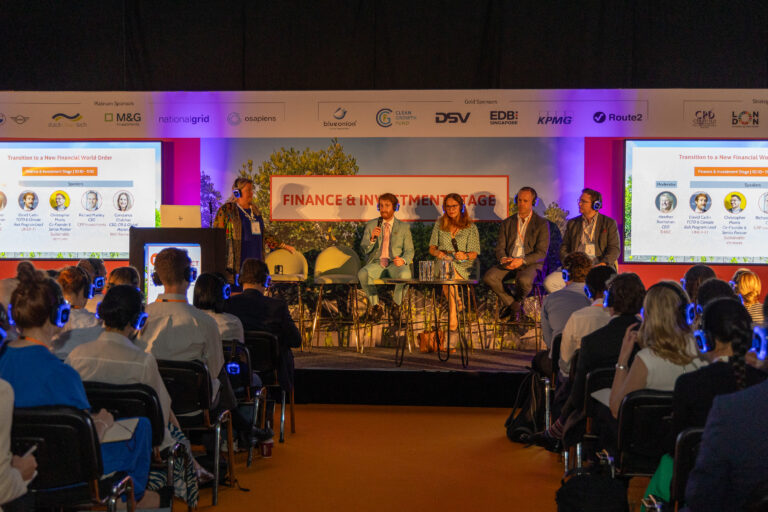
As the UK’s leading sustainability and net-zero event, Reset Connect London returns to Excel London on 24-25 June 2025, offering finance professionals, investors and institutions a vital platform to explore the future of sustainable investment. As the flagship event of London Climate Action Week, Reset Connect London brings together 7,500 attendees, 400 expert speakers and 300 exhibitors, making it the must-attend gathering for those driving financial innovation and sustainable economic growth.
The Finance & Investment Stage: Where Capital Meets Sustainability
The financial sector is undergoing a rapid transformation as investors, institutions and regulators adapt to a new financial world order. The Finance & Investment Stage will examine the challenges and opportunities emerging from evolving compliance frameworks, Climate risk management, Corporate Sustainability Reporting Directive (CSRD) and Corporate Sustainability Due Diligence Directive (CSDDD), and risk mitigation strategies. Key discussions will focus on how capital markets can drive the transition to a low-carbon economy while redefining long-term value creation.
Meet the Experts Shaping Sustainable Investment
Bringing together top voices from venture capital, asset management, private equity, banks, pension funds, institutional investors and regulators, you’ll hear from speakers including:
Sir Andrew Steer, Former President & CEO, Bezos Earth Fund
Recognised as one of Forbes’ 50 most impactful climate leaders, Sir Andrew has led global initiatives in climate finance and sustainable investment.
Wafa Jafri, Partner, UK Lead for Energy & Natural Resources Strategy, KPMG UK
A strategic adviser on energy transition and decarbonisation, Wafa brings deep expertise in policy, corporate strategy and sustainable investment.
Hetal Patel, Head of Sustainable Investment Research, Phoenix Group
Leading Phoenix Group’s climate risk assessment, Hetal has extensive experience in sustainable finance across institutional investments, KPMG and Lloyds Banking Group.
Specialising in climate tech start-ups and sustainable innovation, Emily helps businesses develop commercially viable sustainability-driven solutions.
The event will also feature thought-provoking keynotes from:
Kerry McCarthy, Minister for Climate, Department for Energy Security and Net Zero (DESNZ)
Mike Berners-Lee, Author of There is No Planet B and How Bad Are Bananas?
Explore the Wealth & Investment Management Hub
The Wealth & Investment Management Hub will provide a dedicated space for impact and sustainable focused fund managers, financial advisers, ESG data experts and green finance innovators. The hub will spotlight:
Sustainable investment strategies and the present and future fund opportunities
CSRD) and CSDDD compliance
Innovative financing models for net-zero transitions
Unlock Exclusive Investor Benefits
Take advantage of complimentary VIP Investor Passes, offering access to:
The Pitch & Invest Programme – Engage with the most promising sustainable start-ups and scale-ups.
Exclusive Roundtable Events – Connect with industry leaders, policymakers and fellow investors in high-level discussions.
Priority Seating & Networking Tools – Gain front-row access to key sessions and leverage enhanced event app features, including badge scanning and data export capabilities.
Join the Leaders Defining the Future of Finance
Reset Connect London is where the finance and investment community comes together to shape the next era of sustainable growth. Whether you are an institutional or private investor, venture capitalist, financial planner, wealth manager or corporate finance leader, the event provides the insights, connections and solutions you need to stay ahead.
Register today for your free VIP Investor Pass to unlock exclusive benefits and premium access. Don’t miss the opportunity to be at the forefront of sustainable finance and investment.