
Aldi & Lidl continue to gain market share
Aldi and Lidl are continuing to perform strongly and gain market share.
Data from Kantar Worldpanel showed that in the 12 weeks to 7 October, the big four supermarkets lost market share.
Aldi’s share grew from 6.8% to 7.6%, whilst Lidl saw a growth in market share from 5.2% to 5.6% thanks to a growth in sales.
Tesco (LON: TSCO), Sainsbury’s (LON: SBRY) and Asda lost market shares, whilst Morrissons (LON: MRW) kept its 10.3% stake.
Co-op also saw an increase in growth, with market share increasing from 6.2% to 6.4%.
“Consumer spending often slows in early autumn, after the excesses of summer barbecues and before the festive season kicks off,” said Fraser McKevitt, head of retail and consumer insight at Kantar Worldpanel.
“The arrival of colder weather and darker evenings has inspired consumers to embrace hearty comfort foods and stock up on Sunday roast staples,” he added.
UK consumers are preparing for Christmas early, with over £4 million being spent on mince pies in September alone.
On Tesco’s new discount supermarket that hopes to take on Aldi and Lidl, McKevitt said: “the small number of stores planned means it won’t have an impact on Tesco’s market share without a significant expansion”.
The first Jack’s supermarket opened in September and promised to be the “cheapest in town”.
“We will be the cheapest in town. There are full-range, full-service supermarkets, and clearly people want that, but there is a gap in terms of people wanting smaller, simpler, quicker shops and local produce,” said Tesco’s chief executive, Dave Lewis.
Between 10 – 15 Jack’s stores will open in the next six months.
Scottish Power to use 100% wind generation
Scottish Power is to become the first of the big six energy companies to use 100% wind generation.
Following the £700 million sale of Drax power station, Scottish Power will no longer be relying on fossil fuels in a bid to tackle climate change.
“We are leaving carbon generation behind for a renewable future powered by cheaper green energy,” said the group’s chief executive, Keith Anderson.
The energy company now produces all power from wind farms, including the offshore wind farm in East Anglia One, will open in 2020 and be the world’s largest.
Ignacio Galan, the chairman of Scottish Power’s Spanish owner, Iberdrola (BME: IBE), said: “Iberdrola is acting now to cut carbon emissions 30% by 2020 and be carbon neutral by 2050. The sale of these generation assets is consistent with our strategy.”
Over the past ten years, Scottish Power has closed all of its coal plants. The firm’s five million domestic customers will still be supplied with a mix of green and brown electricity.
Kate Blagojevic, who is the UK head of energy at Greenpeace, said: “Big utilities across Europe have been shedding their dirty fossil fuel infrastructure because it makes economic and environmental sense. This move by Scottish Power shows that the same maths adds up in the UK too.”
“Climate science could not be clearer that renewables are the future for powering our world. We need the government to give renewable energy industry its full backing rather than propping up the fossil fuel and nuclear companies,” she added.
Drax will see a boost to profit, adding an estimated £90 million -£110 million profit in 2019.
The chief executive of Drax Group (LON: DRX), Will Gardiner, said: “As the system transitions towards renewable technologies, the demand for flexible, secure energy sources is set to grow. We believe there is a compelling logic in our move.”
Lloyds share price hits the lowest level since 2016
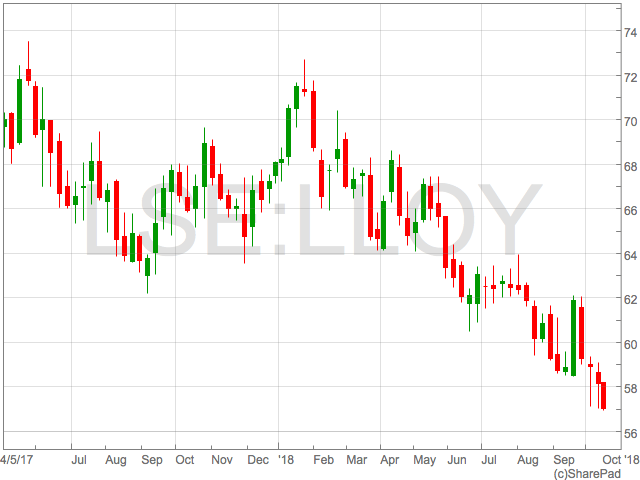
Lloyds (LON:LLOY) share price continued its decline on Tuesday as it broke through 57p for the first time since late 2016.
Lloyds share price has been in a steady decline since January 2018 when the stock formed a double top in the 73p area.
A culmination of fears over Brexit and a slowdown in the UK economy has hit Lloyds shares and the rest of the UK banking sector with those earning a greater proportion of their revenue in the UK being hit the hardest.
 Lloyds trades at a significantly cheaper 12-month trailing price-to-earnings ratio than FTSE 100 peer HSBC plc which trades at 17.2x earnings. Lloyds now trades at 10.7x historical earnings.
The global exposure of HSBC gives the bank a greater degree of diversification than Lloyds which earns the majority of its revenue in the UK.
Lloyds trades at a significantly cheaper 12-month trailing price-to-earnings ratio than FTSE 100 peer HSBC plc which trades at 17.2x earnings. Lloyds now trades at 10.7x historical earnings.
The global exposure of HSBC gives the bank a greater degree of diversification than Lloyds which earns the majority of its revenue in the UK.
 Lloyds trades at a significantly cheaper 12-month trailing price-to-earnings ratio than FTSE 100 peer HSBC plc which trades at 17.2x earnings. Lloyds now trades at 10.7x historical earnings.
The global exposure of HSBC gives the bank a greater degree of diversification than Lloyds which earns the majority of its revenue in the UK.
Lloyds trades at a significantly cheaper 12-month trailing price-to-earnings ratio than FTSE 100 peer HSBC plc which trades at 17.2x earnings. Lloyds now trades at 10.7x historical earnings.
The global exposure of HSBC gives the bank a greater degree of diversification than Lloyds which earns the majority of its revenue in the UK.
UK weakness
However, some investment managers point to the underlying strength of HSBC’s financials as reason for positive sentiment surrounding the stock. Steve Clayton, manager of the HL Select UK Income Shares fund said of recent results: “Financially HSBC is in a strong place, with a common equity tier 1 ratio of 14% and an advances to deposits ratio of just 72%. “The group has announced another quarterly dividend of 10 cents per share, exactly as expected.” HSBC’s common equity tier 1 ratio of 14% compares to 13.9% of Lloyds so the marginal difference in recent measures of financial soundness suggests the market could be pricing Lloyds for deterioration in the near future. This is likely to stem from the uncertainty created by Brexit and a softening in the UK housing market. According to data from Halifax, average house prices fell 1.4% in September. This came after recent news that mortgage activity was slowing across the UK.UK Housing market
Lloyd’s has a £267m exposure to the UK housing market through its open mortgage book with an average loan to value of 43.5%. The health of its mortgage book has been good in recent years as the UK economy steadily expands and house price increases. However, interest rate hikes and a reduction in overseas cash flowing into the UK property market has hit house prices and any further pullback could see recent buyers in negative equity and a souring of Lloyd’s mortgage book. As of June 2018, 1.5% of Lloyd’s mainstream mortgages were in arrears of more than 3 months.Italy’s budget: will Brussels accept?

Following the controversy over Italy’s budget for next year, Italian ministers are “extremely happy” with the final plans. All that is left now is to wait and see if European Commission chooses to accept it.
During a press conference yesterday evening, Deputy Prime Minister Matteo Salvini commented:
“I am extremely happy, we are keeping our promises, slowly but bravely. We are dismantling the previous pension law, giving back the right to work at 400,000 Italians (young people able to pick up the jobs vacated by older people who could retire earlier). We are not raising taxes of any kind for 2019.”
Italy’s budget was submitted ahead of the midnight deadline yesterday.
It includes controversial policies that had been promised by both sides of the coalition during the general election in March. Plans include boosting welfare spending, cutting taxes and altering unpopular pension reforms of 2011. Additionally, Italy’s budget aims to raise the retirement age and set forth a new basic income. “We are keeping all our promises, we are very happy with this budget,” Prime Minister Giuseppe Conte said. “This is the outcome of a lot of work and a lot of meetings that we have transparently made public. We have worked on a project, more than on a budget, we have worked on a project that the country needs, that citizens need. And, best of all, we are keeping the accounts in order, and delivering on our promises at the same time.” Since the end of September, we have seen tensions rising between Rome and Brussels. Ever since the coalition announced a budget deficit equaling 2.4% of Italian GDP, Brussels have been concerned. Despite the figure being under the EU’s limit of 3% of GDP, Italy’s debt stands second to Greece in Europe at 131% of national output. Indeed, whilst deputy Prime Minister Di Maio insists the budget will “abolish poverty”, it fails to meet the EU’s budget rules. Additionally, the increasing deficit is incredibly risky given Italy’s crippling amount of public debt.Italy’s budget could have a tremendous impact on the Euro zone economy as it is the third-largest European economy.
In fact, since the EU backlash began, the euro has fallen and Italian shares and bonds have experienced a sharp sell-off. Moreover, at one point, Milan’s FTSE MIB was at its weakest level in 18 months at 2.4%. Throughout the process, Salvini has criticised the European Commission: “The Enemies of Europe are those sealed in the bunker of Brussels.” But, after some attempts to compromise, Italy’s budget has now been submitted. All that is left now is for the European Commission to assess it and decide whether to accept or reject the plans.Chancellor must spend at least £19 billion to “end austerity”
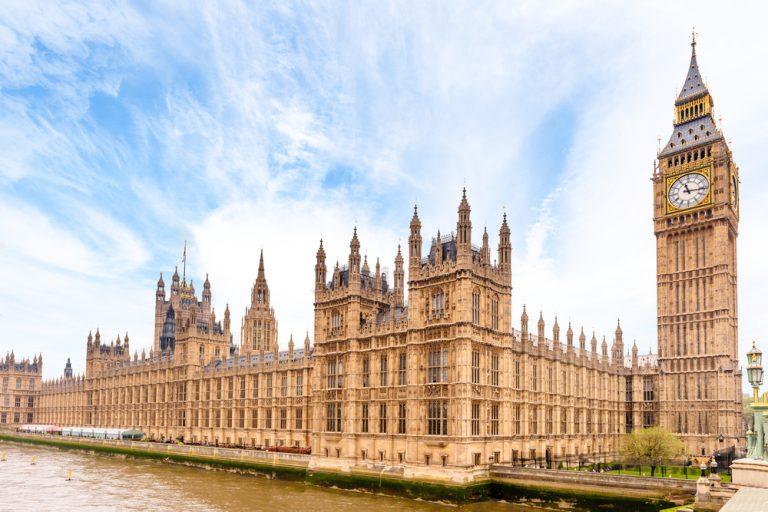
The chancellor can only end austerity by borrowing £19 billion or if Britain’s tax burden is raised. In the event of the latter, Britain’s tax burden will need to be raised to the highest level for almost 70 years. This was warned by the Institute for Fiscal Studies (IFS).
The IFS have warned that even the minimal definition of “ending austerity” would cost the chancellor £19 billion at the very least. Moreover, the IFS said that there was virtually no prospect of a “Brexit dividend” for the public finances. It also predicted that the UK’s economic growth will remain weak for a further two years.
The warning comes just weeks before the chancellor is set to announce the winter budget.
Indeed, the IFS has set out only two methods chancellor Philip Hammond can end austerity. First, this can be achieved by significantly increasing tax. Next, by borrowing such a vast amount of money that Hammond can no longer commit to eliminating deficit. IFS Director, Paul Johnson, has said the decision will “probably be the biggest non-Brexit related decision this chancellor will make”. “He has a big choice,” “He could end austerity, as the prime minister has suggested.” “But even on a limited definition of what that might mean would imply spending £19 billion a year more than currently planned by the end of the parliament. An increase of that size is highly unlikely to be compatible with his desire to get the deficit down towards zero.” “Alternatively, the chancellor could stick to his guns on the deficit and leave many public services to struggle under the strain of a decade and more of cuts.” “He could reconcile these demands by raising taxes, and in principle there are plenty of good options.” However, Boris Johnson has said that it is less likely the government will increase taxes. “Increasing borrowing is clearly the line of least resistance,” “If I had to guess I would guess borrowing will be higher than the number in the spring statement.”Contactless payments more popular than chip-and-pin, Worldpay reveals

Contactless payments are now more popular than the traditional chip-and-pin transactions. This is the first time this has happened in the UK, according to the payment processing company Worldpay.
Worldpay is the processor for a variety of large and small businesses globally. It was the UK’s largest payment processing company before it was purchased for 9.3 billion by American rival Vantiv. The two now operate as a combined group with head quarters in Cincinnati.
According to Worldpay, contactless payments exceeded chip-and-pin back in June. Indeed, 51% of in-store card transactions were paid via contactless. This figure rose to 52% in July.
The data showed that the use of contactless payments rose by a sharp 30% from June 2017 to June 2018.
One reason for the growing use of the hassle-free form of payment is an increase of its upper limit. Indeed, the upper limit on transactions has risen to £30. This, in conjunction with an increased number of businesses accepting the payment method, has driven its popularity. Some of the main businesses to see a move to chip-and-pin payments are fashion retailers, Worldpay revealed. This is followed by betting shops and department stores. Executive vice president at Worldpay, Steve Newton, commented: “The rise of contactless is part of a bigger story: it’s not simply about tap and go – it’s about convenience and reducing the parts of the shopping experience that customers find irritating, like queuing and waiting to pay.” Both contactless and chip-and-pin payments overtook cash transactions for the first time last year. British Retail Consortium figures show that last year card payments accounted for more than half of all UK retail transactions. This year, contactless payments have exceeded chip-and-pin. More and more businesses are accepting the method and advances such as Apple Pay are making contactless transactions easier than ever. At 16:39 GMT -4 yesterday, shares in Worldpay Inc (NYSE:WP) were trading at -1.66%.Paddy Power Betfair to pay £2.2 million penalty

Paddy Power Betfair is set to pay a £2.2 million penalty over a variety of shortcomings. One of these failings include allowing a customer to gamble with large sums of stolen charity money.
Following an investigation by a Gambling Commission, Paddy Power Betfair was found to be failing in certain areas.
An example its shortcomings is the company’s lack of communication with customers who exhibited signs of a gambling problem. In addition, the investigation also revealed the company failed to carry out anti-money laundering checks. The investigation was focused on the behaviour of five customers in 2016. One of which used the Betfair online service to gamble a “significant amount of money” stolen from a charity. This was not the only incident of stolen money being gambled. Indeed, it was found that another customer had also been actively gambling stolen money. Moreover, the Gambling Commission identified failings in “source of wealth and responsibility checks” for three customers. Paddy Power Betfair must fork out £500,000 received from the gamblers. This is alongside an additional £1.7 million towards a responsible gambling strategy made by the commission. Additionally, money will be returned to the charity it was stolen from by a gambler. The executive director of the Gambling Commission, Richard Watson, said: “As a result of Paddy Power Betfair’s failings significant amounts of stolen money flowed through their exchange and this is simply not acceptable.” “Operators have a duty to all of their customers to seek to prevent the proceeds of crime from being used in gambling.” Furthermore, the chief executive of Paddy Power Betfair, Peter Jackson, has commented: “We have a responsibility to intervene when our customers show signs of problem gambling.” “In these five cases our interventions were not effective and we are very sorry that this occurred.” “In recent years, we have invested in an extensive program of work to strengthen our resources and systems in responsible gambling and customer protection.” At 09:07 BST today, shares in Paddy Power Betfair PLC (LON:PPB) were trading at +0.72%.Amazon.com to snap up stake in India’s Future Retail Ltd

Amazon.com Inc is likely to purchase around a 7-8% stake in India’s Future Retail Ltd through an investment arm.
The final agreement is likely to involve some exclusive clauses. Once the deal has been finalised, Amazon will most likely establish a microsite for Future Retail brands.
The cash-and-stock deal is said to be in its final stages and is valued at 25 billion rupees (£257.1 million). The exacr figure of the final valuation will be revealed closer to the signing of the deal.
This deal is set to be the latest in a series of purchases by Amazon in one of the fastest expanding markets.
The news was reported on CNBC – TV18, where it was revealed that other tech giants has expressed interest. Indeed, Google and Alibaba backed Paytm has also expressed interest in snapping up a stake.
The 7-8% acquisition will allow Future Retail to face its rivals both physically and online.
Interestingly, Future Group has claimed in the past that it would not turn down a partnership with a global giant.
For Amazon, this deal could strengthen its presence in the physical space and expand its portfolio even further.
Additionally, it could allow the tech giant to take on Walmart. This is not its first acquisition of an Indian company. In fact, in 2017 Amazon purchased a 5% stake in Shoppers Stop, valued at 180 crore. Even more recently, however, the online giant joined with the private equity firm Samara Capital to buy the retail chain More. Both companies have refused to comment on the claims. In other news, we reported that Amazon had been exposed earlier this week for its warehouse casualties. At 19:59 GMT -4 yesterday, shares in Amazon.com (NASDAQ:AMZN) were trading at -1.55%. At 13:03 GMT +5:30 yesterday, shares in Future Retail Ltd (NSE:FRETAIL) were trading at +5.39%. At 18:02 GMT -4 yesterday, shares in Google (NASDAQ:GOOGL) were trading at -1.62%.Romanovitch to step down from Grant Thornton
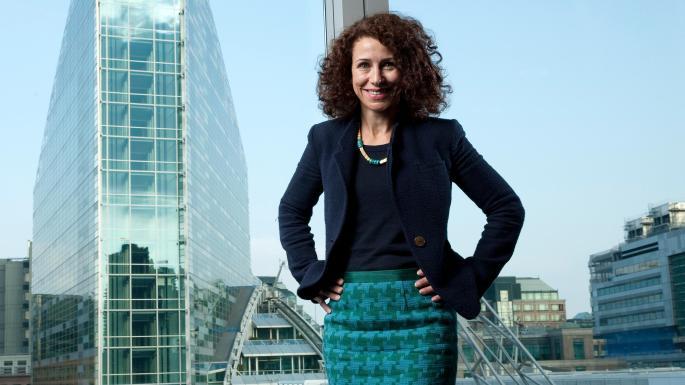
Sacha Romanovitch has announced plans to step down as Grant Thornton’s chief executive by the end of the year.
Romanovitch is the first UK female chief executive of a major City accountancy firm and has been at Grant Thornton for 28 years.
“As we enter the next phase of our plans, following discussions with Grant Thornton’s board, we have agreed that the time is right for a new chief executive to take the firm forward,” she said.
“I will be working to support a smooth transition to our next chief executive, focusing on continuing to deliver sustainable value for our clients through our diverse and talented team,” she added.
Romanovitch, who has been the group’s chief executive since 2015 and partner since 2001, will step down once a successor has been found later this year.
Ed Warner, independent chair of Grant Thornton UK’s partnership oversight board, said: “Following discussions with Sacha, the board has agreed that a new CEO is the logical next step to create long-term sustainable profits for the firm.”
Romanovitch introduced changes at the firm, which included capping her own salary at 20 times the firm’s average pay.
She also overhauled the partnership structure with a John Lewis-style profit-sharing scheme for all staff, instead of just partners.
In September, the chief executive was attacked for creating a “culture of fear” within the company.
An anonymous letter stated the firm was “out of control” as well as having “no focus on profitability.”
She responded to the letter: “A small cadre of partners will find it hard we are making decisions that will depress profits in the short-term but will help profits in the long-term … If profits get unhinged from purpose it might not hurt you now, but it will come back and bite you on the bum.”
Ford boss: Brexit could be “pretty disastrous”

Ford (NYSE: F) has been the latest carmaker to warn against a no-deal Brexit.
Steven Armstrong, the group’s European boss, warned that a no-deal Brexit could be “pretty disastrous” and could affect operations in the UK.
“For Ford, a hard Brexit is a red line. It could severely damage the UK’s competitiveness and result in a significant threat to much of the auto industry, including our own UK manufacturing operations,” Armstrong told the BBC.
“While we think this is a worst-case scenario and that a UK-EU deal will be reached, we will take whatever action is necessary to protect our business in the event of a hard Brexit,” he added.
The warning came on the same day Nissan and AstraZeneca (LON: AZN), who both said a hard Brexit was harming business.
Armstrong told the BBC his views about the suggested Canada-style trade deal, which were not positive.
“If this was introduced for all UK-EU trade, the level of congestion and blockages at the ports would undermine our just-in-time manufacturing system,” he said, highlighting the customs and border checks.
Ford is the latest carmaker to warn against Brexit impacts to business. Toyota (TYO: 7203), Jaguar Land Rover and BMW (ETR: BMW) have all said that Brexit could affect operations in the UK.
A spokesperson from Nissan (TYO: 7201) said on Monday: “In agreement with our employee representatives, the 2019-2020 pay negotiations in our UK plant and technical centre will commence in 2019 when we have better clarity on the future business outlook.”
Armstrong also made clear that his comments were not an excuse to minimise operations in the UK after the contract at the Bridgend plant ends in 2020.
“We have to look at what’s happening within our broader business. We have been very clear since [JLR] decided to put their business elsewhere that we would continue to look for options for Bridgend,” he said.
The comments come as Theresa May prepares for a Brexit summit on Wednesday, which will discuss the Northern Ireland border.