Oil prices hit a four year high ahead of Iran deadline

The price of oil hit a new high on Monday, with the benchmark surpassing $70 a barrel.
Oil prices rallied to a high that has not seen since 2014, primarily driven by troubles in Venezuela and concerns over the US reimposing sanctions in Iran.
Donald Trump’s decision over whether the US will withdraw from a 2015 international agreement with Iran is due May 12.
The US President has not confirmed what he will decide by May 12 but has suggested plans to withdraw, saying that the accord is “a horrible agreement for the United States.”
“That doesn’t mean I wouldn’t negotiate a new agreement,” he added.
The head of research for the Middle East and North Africa region at MUFG bank, Ehsan Khoman, said: “There is some scope for profit-taking now that prices are at 42-month highs but that is been overshadowed by the potential re-imposition of sanctions on Iran.”
Ole Hansen, head of the commodity strategy at Saxo Bank A/S in Copenhagen, said: “The market at this stage is pricing in the US stepping away from the nuclear deal, so it’s allowed the risk premium to build even further. If Trump should decide either to postpone or go for a surprise renegotiation of the deal, the oil price could slump by $5 quite easily.”
Iran’s President, Hassan Rouhani, said that if the US is to leave the agreement it will “entail historic regret”.
“We have plans to resist any decision by Trump on the nuclear accord,” the President said.
“Orders have been issued to our atomic energy organisation … and to the economic sector to confront America’s plots against our country. America is making a mistake if it leaves the nuclear accord. If America leaves the nuclear accord, this will entail historic regret for it.”
In the lead up to Trump’s decision, Boris Johnson has travelled to the US to urge the President to not scrap the deal.
Brent Crude was 1.14 percent and reached $75.64 per barrel – the highest level since November 2014. U.S. West Texas Intermediate (WTI) crude futures increased by 85 cents to $70.57.
John Lewis denies Amazon’s takeover approach for Waitrose
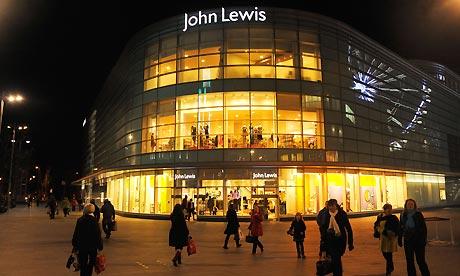
John Lewis Partnership has denied speculation that Amazon approached the group last year in a bid to takeover Waitrose.
According to reports over the weekend, a senior Amazon (NASDAQ: AMZN) executive had made contact with John Lewis (LON: JLH) over a potential deal but talks had been blocked by the board.
Since Amazon’s online delivery service, Amazon Fresh, was launched in the UK two years ago analysts have suggested the internet giant could be interested in buying up a UK supermarket chain.
John Lewis Partnership chairman, Sir Charlie Mayfield, denied any approach from Amazon. “These times are ripe for speculation but there has been no approach to the Partnership by Amazon regarding Waitrose and nor would I expect there to be,” he said.
Amazon said that it did not comment on speculation.
Amazon has been rumoured to make a grocery acquisition in the UK after its $13.7 billion (£10.12 billion) purchase of Whole Foods Markets in the US.
John Lewis has vehemently denied the approach from Amazon. Because the group is owned by its employees, a potential sale would have been very controversial.
Amazon’s growing strength as a retailer has been considered a threat to the market. The proposed £15 billion merger between Sainsbury’s (LON: SBRY) and Walmart-owned Asda (NYSE: WMT) is understood to be an attempt to create and new grocery superpower and fight off Amazon’s growing strength.
According to Terry Hunter, the managing director of digital commerce group Astound, the proposed Sainsbury-Asda merger “shows that the two chains feel they will be stronger together as they reposition themselves to combat the growing threat from the low-cost German supermarkets and Amazon.”
Nestle pays $7.2bn to sell Starbucks products

Nestle (VTX: NESN) will pay Starbucks $7.2 billion (£5.2 billion) in cash to sell the company’s coffee around the world.
The Swiss-based food giant will own the rights to market Starbucks coffee (NASDAQ: SBUX) in a “significant step” for the group.
“This global coffee alliance will bring the Starbucks experience to the homes of millions more around the world through the reach and reputation of Nestle,” said Kevin Johnson, Starbucks chief executive.
Mark Schneider, Nestle’s chief executive, announced the group’s third biggest acquisition with plans to boost the company’s profits through expansion.
Schneider described the deal as “a great day for coffee lovers around the world”.
The Nescafe and Nespresso owner said that 500 Starbucks employees will transfer over to Nestle business but will remain located in Seattle.
Matthew Barry, an analyst at Euromonitor, said the deal was important for Nestle who is attempting to reinforce its position as the world’s biggest coffee company.
“Nestle is far and away the largest hot drinks company globally, with more in sales than the next five largest hot drinks companies combined.”
“However, Nestle’s leadership position is less secure than it once was,” he said.
Despite the deal between the coffee giants, a Nestle source revealed that the Nestle name will not appear on Starbucks products in order to avoid consumers “to perceive that Starbucks is now part of a bigger family.”
Nestle expects the deal to contribute positively to its earnings per share and growth targets in 2019.
Previous deals with Nestle include the 68 percent stake it purchased in Blue Bottle Coffee for $425 million last year. The group also sold its US sweets and chocolate business to Ferrero Group for 2.7 billion Swiss francs (£1.9 billion).
Nestle shares rose 0.5 percent in early trading.
GBP/USD fails to gain traction despite weak US jobs release
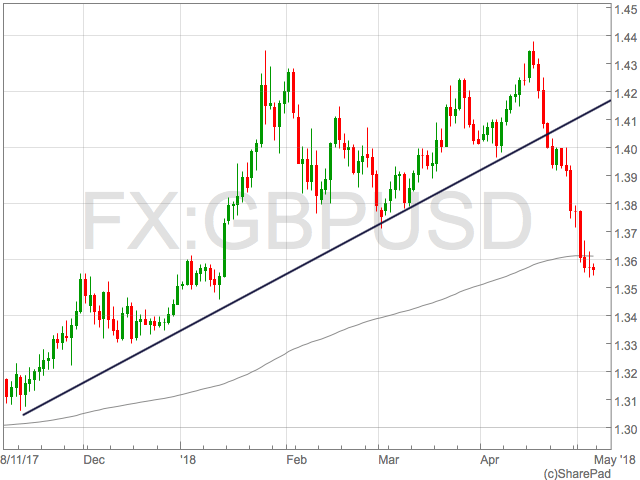
The cable rate failed to rebound on Friday despite a week of sharp gains and a miss in the headline Non-Farm payroll release.
The US added 164,000 jobs in April missing estimates of 192,000. while the unemployment rate fell to 3.9%, the lowest for 18 years.
The miss in the key jobs figures caused weakness in dollar with USD/JPY sinking sharply but the dollar weakness provided to reprise for GBP/USD which languished beneath the 1.3600.
 GBP/USD broke a solid 6 month uptrend in mid April and has since dropped nearly 1,000 points as the UK economic outlook deteriorates and reduces the chance of a rate hike at the Bank of Englands next meeting.
In early 2018 markets had priced in the rate hike for May but have since violently unwound this trade causing the cable rate to retreat from the highest levels since the vote to leave the EU.
GBP/USD broke a solid 6 month uptrend in mid April and has since dropped nearly 1,000 points as the UK economic outlook deteriorates and reduces the chance of a rate hike at the Bank of Englands next meeting.
In early 2018 markets had priced in the rate hike for May but have since violently unwound this trade causing the cable rate to retreat from the highest levels since the vote to leave the EU.
GBP/USD broke a solid 6 month uptrend in mid April and has since dropped nearly 1,000 points as the UK economic outlook deteriorates and reduces the chance of a rate hike at the Bank of Englands next meeting.
In early 2018 markets had priced in the rate hike for May but have since violently unwound this trade causing the cable rate to retreat from the highest levels since the vote to leave the EU.
FTSE 100 outperforms
The weakness in the sterling has reignited the strong negative correlation between sterling and the FTSE 100 with London’s leading index outperforming its European and US counterparts throughout the week.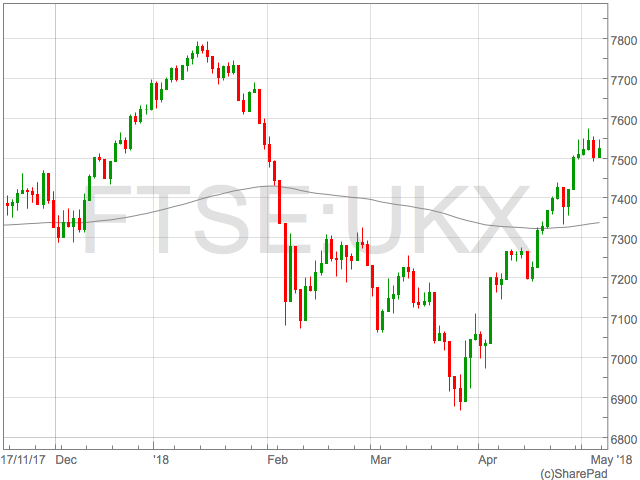
BT to announce 6,000 job cuts
BT (LON: BT.A) is set to announce plans to 6,000 jobs worldwide in a new £500 million cost cuttings drive.
The telecoms giant is expected to reveal the news next Thursday alongside their annual financial results.
First revealed by the Financial Times, the company is attempting to rebuild confidence among investors following the Italian accounting scandal.
Chief executive Gavin Patterson will announce the group’s plans to cut around six percent of the company’s 98,000 global workforce. The additional cuts will result in 10,000 jobs cut in the last year.
If the plans take place, it will be the largest round of redundancies in almost a decade.
The group announced plans to cut 4,000 roles last May in order to save £300 million over the next two years.
The jobs affected are likely to be managerial and back-office personnel.
The most recent cost-cutting drive is in order to make up for the Italian accounting scandal, which cost the group £530 million to resolve.
Last month, boss Graham Sutherland stepped down allowing wholesale head Gerry McQuade to take control.
“I’d like to thank Graham [Sutherland] for all he has done for BT over the past 12 years. During his time as CEO of the businesses in Ireland and MD of BT Business, he materially improved the profitability and performance of those divisions,” said Patterson.
“Most recently as CEO of BT business and public sector he has successfully led the integration of EE business into BT and the turnaround of our public sector division. I wish him all the very best for the future.”
Tesla reports record loss, shares fall 7pc

After posting a record loss of $710 million, shares in Tesla slumped over seven percent wiping more than $3.4 billion off the value of the company.
The California-based company posted poor results, which were then followed by founder Elon Musk making light of the losses. Musk took to Twitter to write “la la la” while linking the results for this year’s first quarter.
The company’s founder also appeared to have lost patience during a call in which Wall Street analysts tried to ask questions about Tesla’s future financial health.
Cutting off a question, Musk told an analyst: “Next, next. Boring bonehead questions are not cool. Next.”
When asked about what percentage of customers had chosen to personally configure their Model 3 vehicles, Musk replied: “We’re going to go to YouTube. Sorry, these questions are so dry, they’re killing me.”
While Tesla reported losses of $710 million, the company did bring in more revenue than expected. Analysts predicted a revenue of $3.28 billion but Tesla brought in a revenue of $3.4 billion – up 26 percent from the same period last year.
Despite various problems in the factory, which led the Freemont plant to temporarily close last month, Musk insisted that the group was on track to hit its target of 5,000 vehicles a week by the end of June.
“Our focus is on the Model 3. We need to get that to above 5,000 a week at a good margin. We need to become a profitable company,” said Musk.
The group have said they hope to be profitable by the third quarter of 2018.
Snap shares plummet following disappointing results

Shares in Snapchat’s parent company plummetted after the group revealed poor results for this year’s first quarter.
Snap’s (NYSE: SNAP) share price fell 22 percent to $10.96 (£8.05) in early trading after the group revealed only four million new users in the first three months of 2018.
As well as a poor first quarter, the social media group said that growth and revenue is also likely to slow in the second quarter.
The results come following the app’s major re-design, which led to 1.2 million users had signing a petition to reverse the changes.
Following the changes to the app, Kylie Jenner released a tweet asking “does anyone else not open Snapchat anymore?”,which shortly led to $1.3 billion wiped off the company’s value.
“It is not clear to us why the app redesign – the first product Snap ever tested at scale – was rolled out broadly, and we are even less clear on why it hasn’t been more aggressively rolled back already,” said Deutsche Bank analyst, Lloyd Walmsley.
Revenue in the first quarter also came below analyst expectations, coming in at $230.7 million (£169.4 million).
Snapchat continues to struggle against rivals Facebook and Instagram, which both have a much wider range of users.
Bill Fisher, an analyst at eMarketer said: “While the user base continues to be dominated by younger age groups, Snapchat’s full revenue potential will remain somewhat restricted.”
“And with the financial muscle of Facebook behind Snapchat’s close competitor, Instagram, the company is going to have to work ever harder for those ad dollars.”
Boosting your income with this iShares Emerging Markets bond ETF

iShares JP Morgan Emerging Market Local Government Bonds ETF
A great income provider, this low cost bond ETF is an excellent way to invest in a broad basket of emerging market fixed income. Emerging market assets are inherently higher risk than those of developed markets, and that is reflected in the higher yield for holding EM assets, and the potential for high overall returns. As western central banks, alongside those in Japan, have driven bond yields to record low levels with as series of rate cuts and quantitative easing programmes, emerging market bonds present themselves as an attractive option for income-seeking investors. The ongoing 0.5 per cent charges of this ETF also allow for investors to retain more of the returns yielded by the underlying asset, when compared to traditional fund options. For instance, the Templeton Emerging Bond Fund and the First State Emerging Bond Fund charge ongoing fees of 1.88 per cent and 1.42 per cent, respectively. Ultimately, the ETF contains a basket of treasuries included in JP Morgan’s Emerging Markets Local Government Bond Index including issues ranging from Brazil, Mexico, Poland, South Africa, Colombia, Thailand and Chile. The broad spread of allocation provides a satisfactory level of diversification throughout the EM bond universe, so those less attractive bonds from countries such as Chile who have experienced only 1.6 per cent GDP growth are offset by the strong prospects of South Africa, which is undergoing its own political shifts, and Peru, which is enjoying a natural resource-driven expansion. Additionally, the higher yield of the included bonds allows the fund to provide a 4.6 per cent yield, paid biannually.Heathrow reports positive results for first quarter
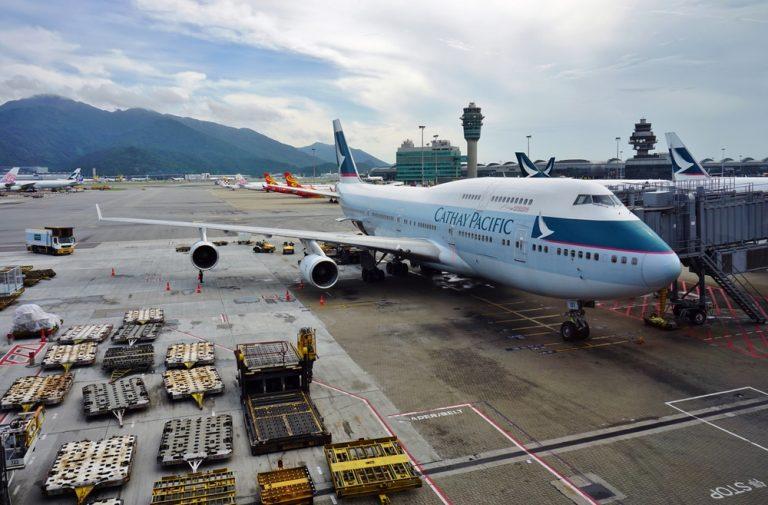
Heathrow airport has reported record-breaking results for the first quarter of 2018.
Between January and March 2018, 200,000 passengers passed through Europe’s busiest airport every day – a 3.1 percent increase from the first quarter of 2017.
“We’re delighted that passengers are choosing Heathrow in record numbers – it’s a strong signal that we’re delivering value for money,” John Holland-Kaye, Heathrow’s chief executive.
“We’re within touching distance of Parliament voting on expanding Heathrow and now more than ever we’re committed to developing and delivering a hub airport that Britain can be proud of for generations to come.”
The airport’s operating profit was £220 million, up eight million from the same period last year. Spend from retail earnings increased percent cent to £8.82 for the average passenger.
Data released by the airport showed the busiest destination remains Europe. Passengers to South America have increased by 6.9 percent.
The third runway has not yet been approved but if plans are given the go-ahead, it would be open by 2025.
The new runway has faced a backlash with a government analysis showing that it would expose an additional two million people to aircraft noise.
It has long been clear that the DfT have understated the numbers who will be impacted by an expanded Heathrow’s noise,” said Paul McGuinness, the chair of the No 3rd Runway Coalition.
“So it’s hardly surprising to learn that these calculations were not presented to the public and parliament. The DfT wish to conceal the true impact of expanding this highly disruptive airport.”
Heathrow maintains that even with a third runway, fewer people will be affected by the noise.
“We stand by our commitment to expand Heathrow while reducing the number of people affected by noise, compared to today. We are currently consulting with our local communities on airspace modernisation, which will redesign how planes fly over Heathrow in coming years,” a spokesperson said.
“Any future modelling of noise impacts must take into account these changes, as well as the stringent mitigation and insulation plans Heathrow will put in place, which will continue to reduce the number of people affected by our operations.”
How can you invest wisely to enjoy retirement?

Retiring at a reasonable age and having enough saved to live comfortably is becoming an ever-distant dream for some
How can you make sure that you have enough savings to enjoy a comfortable retirement? To support a reasonable level of income in retirement, around 10-15% of annual income should be saved, yet few people maintain this level. So, the question is, why is there such a gap between what we need when we retire, and what is available to us? Furthermore, how can we ensure we have enough to enjoy our twilight years.Pensions and retirement – the funding gap between what we have and what we need
One factor that affects the capacity to sustain ourselves through retirement, is that we are living far beyond the years the pension was designed. In 1960, if the average individual would retire at the age of 65, they would usually live another 6.1 years on their pension and savings. In 2015 those who retired at the age of 65 would live another 16 years beyond that to just over 81 years old. This longer period influences how much the government can afford to pay out via pensions, especially as public funds are already stretched. There is also a gap between what we need to live comfortably, and what we have saved to live comfortably. This issue mainly affects women, as their retirement balances are on average 30-40% lower than their male counterparts. The problem would be far less severe if the age at which we retire increased in correlation with a longer life expectancy. Yet, that is not the case, and in some countries, such as Poland, the age of retirement is falling. The gap between what we need for retirement and what is available is widening and is compounded by our increased life expectancy. There is also a falling birth rate, which is then affecting how many people of working age are available to support those of retirement age. In 2050 there will be 4 workers per retiree, compared with 8 today. There is a lack of knowledge surrounding pension plans and savings. This means that employees may be opting for a basic company pension plan that does not cover them for the future. Coupled with the rise in the number of casual / self-employed workers (globally over 50% of the workforce) who are the least likely to have a pension plan in place, widens the gap.So, how can we build a nest egg for retirement?
Those who have bought shares or put money into a savings account for retirement might find that the interest they are receiving is not enough. Returns on these types of investments are running at historic lows, sometimes 1%. As we listen to our clients who have invested, building equity to supplement their pension was one of their main motives. One of our investors, Patricia Readshaw, commented “I was coming up to retirement and you cannot simply live on fresh air. You must have savings to fall back on for security. It is worrying when you don’t have a lot of savings set aside. Especially if you are by yourself”. This is where retirement home investments are gathering momentum. As we have mentioned, people are living longer so the need for care homes is more pronounced. This results in excellent occupancy rates, and the caveat of a luxury retirement home is that it attracts self-paying residents, which in turn makes it a more profitable business model compared to care homes.