Lloyds and Scottish Widows have terminated their asset management contract with Standard Life Aberdeen (LON:SLA), in the wake of the merger between Standard Life and Aberdeen Asset Management.
Shares in Standard Life Aberdeen fell over 4 percent on the news, with the fund manager set to lose revenue and take a £40 million impairment charge as a result of the relationship loss.
Lloyds, who own life insurance company Scottish Widows, have sent notices to Standard Life Aberdeen seeking to terminate the investment management arrangements. The latter company currently manages £109 billion worth of assets for Scottish Widows.
Keith Skeoch and Martin Gilbert, Standard Life Aberdeen’s chief executives, said: “We are disappointed by this decision in the context of the strong performance and good service we have delivered for LBG, Scottish Widows and their customers. We will be discussing the implications of this with LBG and Scottish Widows.”
Scottish Widows CEO Antonio Lorenzo said the tie up had created a “material competitor” , adding that “it is now appropriate to review our long-term asset management arrangements to ensure they remain up-to-date and that customers continue to receive good service and investment performance.”
The termination is subject to a 12 month notice period.
Standard Life Aberdeen (LON:SLA) shares are currently trading down 4.88 percent at 370.20 on the news (0915GMT).
InnovaDerma (LON:IDP) shares sunk over 3 percent on Thursday morning, despite the release of strong first half figures.
Revenue rose 31 percent during the first six months of the financial year to £4.2 million, up from £3.2 million a year ago. Gross profit increased by 20.6 percent to £2.22 million, with the company attributing the increase to growth in both the direct to consumer and retail channels.
The company also said in its statement that it is looking to expand further into Europe and the US, and that it expects profits to grow considerably over the next half of the year.
Executive chairman Haris Chaudhry said: ‘With good momentum behind the key brands and significant orders expected, the Board remains confident in meeting market expectations for this financial year.’
‘I am pleased with the initiatives that we have taken to progress further our core brand Skinny Tan from self-tanning into a beauty brand and in the very successful launch of Roots, both of which are expected to deliver marked improvement in revenues during this half year.’
‘We are confident in our immediate and long-term prospects and of emerging as a fast-growing international business with a diverse portfolio in the beauty, life sciences and personal care space.’
Despite the strong report InnovaDerma (LON:IDP) shares are currently trading down 3.59 percent at 188.00 (0859GMT).
Aveva (LON:AVV) reported a strong final quarter of 2017 for Schneider Electric, with a “record” EBITA figure beating its own target.
Aveva, who combined with Schneider Electric’s software business in late 2017 in a deal worth over £3 billion, reported a continued growth in SE’s licencing and maintenance revenue streams. However, this was partly offset by a slight decline in services revenue.
The group reported a 90 basis points organic increase in its 2017 adjusted core profit (EBITA) margin, ahead of its own target, as improving prices and cost management cuts begin to take effect.
Adjusted earnings before interest, taxes and amortization (EBITA) came in at 3.65 billion euros ($4.55 billion), with an adjusted core profit margin of 14.8 percent.
Schneider Electric (EPA:SE) shares are currently trading up 3.29 percent at 71.52 (0845GMT).
With the global sell-off continuing to push stocks lower over the past couple weeks, the so-called Donald Trump effect may have reached its climax.
Despite the market optimism that followed the election of decidedly pro-business Trump, the first weeks of February have signaled perhaps an end to record highs of 2017.
Last week, global stocks fell amid concern over adjustments to monetary policy and on the back of strong economic data from the US.
Despite a market rebound in Wall Street and European markets in recent days, Japan’s Nikkei 225 still remains in the red, in light of the strength of the Yen.
Accordingly, the FTSE 100 is currently up 46 points (0.65 percent), Germany’s Dax is up 0.9 percent, and the French Cac has risen 0.5 percent. Similarly, the FTSE MIB in Italy also rebounded 0.7 percent.
“We suspect that investors’ fears over inflation should subside over the coming weeks, which will help to stabilise equity markets, long-term yields and bring levels of volatility back down,” explained Derek Halpenny, analyst at MUFG , in comments to the Financial Times.
“But after the scale of this equity price correction, investors are likely to remain defensive this week. Even a slight upward surprise in the inflation data could be enough to warrant a further sell-off.”
[youtube https://www.youtube.com/watch?v=hjHuwDNcOjE?rel=0]
Ultimately, strong European economic data pushed European stocks on the whole higher on Wednesday morning, driving the slight recovery in the markets.
Specifically, Eurozone industrial production proved better-than-expected, with growth of 0.4 percent in December in comparison to the month higher, demonstrating an annual gain of 5.2 percent. Analysts had been expecting growth of 0.2 percent and 4.2 percent.
Moreover, Eurostat, the EU statistics office, said that eurozone GDP grew by 2.5 percent during 2017, marking its fastest growth rate since 2007.
However, UK economic data continued to disappoint with the slowest GDP growth across the G7 countries, behind Italy.
Nevertheless, given the focus upon inflation, markets will be bracing themselves for the scheduled release of US consumer price data, which is set to be revealed tomorrow.
It remains to be see whether the stock market rally during the latter half of 2017 and so-called ‘Trump effect’ will continue as a trend in the new year.
N4 Pharma (LON:N4P) is a consumer-driven pharmaceutical company developing reformulations of a number of key drugs. These have the potential to produce very attractive returns for shareholders in the form of an estimated £300 million of sales if they achieve full commerciality.
As it stands, the Midlands-based pharmaceutical company is working on drugs for the treatment of erectile dysfunction, hypertension, Hepatitis B and cancer.
However, the inclusion in our selection of AIM shares for 2018 comes not so much from the diseases and disorders their drugs target, but more N4 Pharma’s lean patent-backed business model and a cash pile to support the next phases of key trials.
N4 Pharma has two divisions in generics and vaccines, with the generic division at the forefront of plans for 2018 in their Viagra alternative, Sildenafil MR. The Sildenafil reformulation has a potential market of up to 100 million people in the USA and Europe suffering a degree of erectile dysfunction (ED).
Game-changing Trials
With Sildenafil, the company is aiming to provide a much-improved treatment for ED and in the process, provide a gaming changing revenue source for N4 Pharma.
Viagra is currently the market leader with an estimated $1.6bn in annual sales. Despite dominating the market, Viagra has a number of draw backs which are targeted for improvement in N4 Pharma’s clinical trials of Sildenafil.
The improvements are based on the onset of plasma concentration and the time this concentration lasts. Viagra’s weakness comes in the one-hour onset time which then peaks very quickly before wearing off in 4-6 hours.
Sildenafil is targeting outperformance of Viagra with action onset of just 15-30 mins and a steady plateau of concentration ranging from 12-20 hours. In addition, Sildenafil MR is also unaffected by food whereas food intake Viagra can prolong the onset of action.
Well Funded
N4 Pharma is set to conduct small-scale human trials in Q1 2018, with a view of seeking pre-IND guidance from the FDA which will pave the way for approval.
N4 Pharma conducted a placing in 2017 and ensured the funds to conduct the necessary trails of Sildenafil. The firm is confident that if the first round do not produce the desired results, they will not need to go back to the markets for a second set of trials.
If the trials prove successful, it opens the door for the first ‘milestone payment’ in the form of a licensing fee from a partner.
Milestone Payments
We touched on N4 Pharma’s lean business model and the process of bringing in a partner with a licensing fee is integral to this. N4 Pharma will not conduct any manufacturing or even marketing of any drugs.
Distribution will be outsourced with N4 receiving a milestone payment, enabling the firm to progress with the development of further intellectual property in the vaccines division.
The vaccines division is working on the development of DNA based vaccines to challenge current widely used applications of cancer vaccines. Patent for Nuvec have already been filed along with filings for anti-depressant drug Duloxetine and Sartans, used in the treatment of hypertension.
While these patents are not a priority for N4 Pharma in 2018, the pipeline provides opportunity to push the business forward in the wake of Sildenafil licensing agreements.
This article was originally published in the free UK Investor Magazine print edition, register your address for a subscription here.
It’s a commonly-held belief that higher rewards involve higher risk, something that the instinctively risk-averse might find off-putting. But the adage isn’t strictly true, as we’ll show in this article. If you just follow a few simple steps, you can cut the risk in a property investment to the barest minimum – and reap some serious rewards.
Step 1 – stay away from residential
Some potential investors who are wary of the volatility of stocks and shares seem to think that residential property is the way to go instead – “You can’t go wrong with bricks and mortar…”
This is no longer the case.
For a start there’s the serious increase in buy-to-let problems brought about by rising house prices, legislation, licensing, Stamp Duty surcharges and a growing tax burden.
And if you’re considering a residential property as a vehicle for capital growth, this is in fact a very high-risk approach. The residential property market is hugely susceptible to external forces and you could end up with your capital locked into an asset you can’t move on without incurring a substantial loss.
An investment property needs to yield consistent income from settled, long-term tenants and there should be solid prospects for appreciable capital growth.
Step 2 – investigate commercial property options
Commercial property to the uninitiated will probably mean shops, offices, industrial units or storage pods. It surprises many to find out that the biggest returning UK investment opportunities are serviced apartments and purpose built student accommodation – if they’re in the right place. You should look for a location with high rental demand and a scarcity of suitable properties.
Because developments in these sectors tend to consist of 100+ units, costs can be spread thinly across a lot of owners resulting in purchase prices which compare favourably with a buy-to-let mortgage deposit.
Remember, commercial property is just a box which earns its owner money; that’s a prospective buyer’s sole consideration when you choose to resell. If your property has a demonstrable history of regular income delivery, it will attract global interest.
Step 3 – check your safety nets
And, giving the lie to old saying, the highest-yielding apartments and student properties can also require the least risk on your part.
Some of the more enlightened developers choose to make their profit through regular rental income growth rather than via an inflated initial sale price. In these circumstances, they retain the freehold, while you receive 120-250 year leasehold ownership. You will receive an assured annual NET income of 8-12%, contracted directly with the developer who will be your tenant for the next 10 years – the highest yield in UK property for the lowest risk.
And because your developer has a vested interest in your mutual property, they will install a management team onsite 24/7 to run and maintain it, meaning not only is your income secure and sector-leading, it’s totally effortless too. Because it’s fully transferable at resale, it will be very attractive to other property investors around the world, allowing you to make as much as 40% capital growth.
James Harrington, Business Development Manager at sector specialists Emerging Property comments “Of course, there’s no such thing as a totally risk-free investment, we wouldn’t claim otherwise. But we genuinely believe that these fixed income terms provide unmatched owner security as it’s the developer who’s taking on all the risk for the 10-year period. A 10-year build warranty and onsite management provide even further reassurance, meaning our owners won’t have to pay out another penny for the duration of their contract whatever happens – no repairs, no refurbishment, no replacements, nothing.”
This article is sponsored by Emerging Property, please find more information here.
Shares in Europe continued their decline on Friday morning following continued weakness in major US equity indices.
Investors hoping for some reassurance from central banks were severely disappointed as the Bank of England Governor, Mark Carney, suggested that rates would rise sooner than the market had been pricing in and the Fed’s Dudley said recent stock market declines were ‘small potatoes’.
“The little decline that we’ve had in the equity market today has virtually no implications for the economic outlook,” said New York Fed President William Dudley.
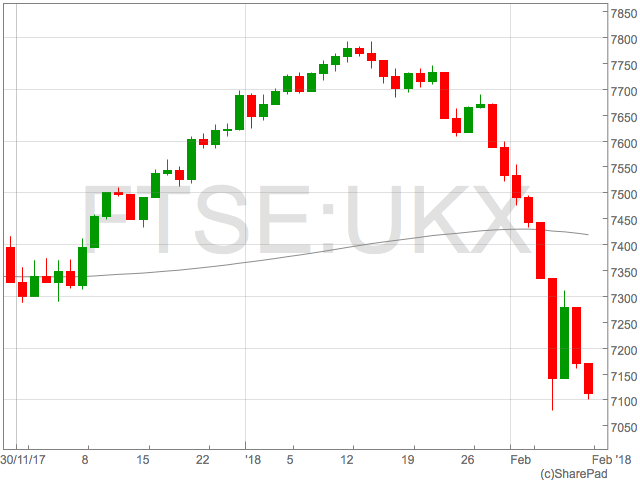
The FTSE 100 was hovering around 7100 at midday in London on Friday and the German Dax touched 12001.
The FTSE 100 is now roughly 10% off the recent high, a level that is classed as a ‘correction’. A bear market is categorised as a 20% drop from a market top.
The Bank of England’s monetary policy committee voted unanimously to keep the key interest rate at 0.5% at their latest meeting, despite rumours of a possible rate hike.
The FTSE 100 sunk in anticipation of the news, before picking up slightly in the wake of the announcement. Whilst all members of the committee voted to keep rates at the current level this month, they did say a rate rise could be on the cards sooner than previously expected.
The minutes said rates were likely to rise “earlier” and by a “somewhat greater extent” than they thought at their last review in November. There is speculation that the next rate rise could come as soon as May.
Michael Metcalfe, global head of macro strategy at State Street Global Markets, commented: “Markets had moved quickly this year to discount more tightening from the BoE. The hawkish tilt of this meeting will at the very least, vindicate these moves and possibly encourage further expectations. What will be key now is to watch how sterling responds, as a much quicker appreciation could produce a faster fall in inflation and potentially nullify the need for a more rapid tightening cycle.”
Travel operator Thomas Cook (LON:TCG) has “got the year off to a good start”, seeing a 7 percent revenue rise in the first quarter of the year.
Seasonal underlying operating loss improved by £10 million to £42 million, with its full year outlook remaining in line with expectations. Gross profit increased by £16 million to £376 million, despite a 50 basis point fall in gross margin to gross 21.5 percent due to higher hotel prices in Spain and fewer long haul sales.
The group said: “From all that we see so far, customers’ appetite for a summer holiday abroad shows no sign of slowing down. We’ve taken early action to meet strong demand for destinations in the Eastern Mediterranean. This has enabled us to shift capacity out of the Spanish islands where we have seen a continuation of the margin pressures we experienced last summer.”
The group’s own airline also saw an improvement in performance, reporting an underlying loss of £13 million – an improvement of £9 million.
Peter Fankhauser, chief executive of Thomas Cook, said:
“This remains a highly competitive – and, at times, unpredictable – market, as the disruption in the airlines sector in recent months demonstrates. However, based on current trading and the continued progress we are making on implementing our customer-focused strategy for profitable growth, we expect to deliver a performance in line with current expectations for the full year.”
Shares in Thomas Cook are currently trading down 2.87 percent on the news, at 121.70 (0846GMT).
Investment manager Ashmore Group (LON:ASHM) reported an 18 percent growth in assets under management on Thursday, boosted by strong performance across the emerging markets.
The group reported net inflows of $7.9 billion over the six months to the 31st December, and positive market performance of $3.2 billion.
Profit before tax fell by 18.5 percent to £99 million, leading diluted earnings per share to sink 19 percent. However, net inflows investment processes continued to deliver strong investment performance, with 82 percent of AuM outperforming benchmarks over one year, 93 percent over three years and 87 percent over five years.
“The favourable environment for Emerging Markets is reflected in Ashmore’s solid operating performance during the period,” said chief executive Mark Coombs.
“We expect another good year of performance across the range of Emerging Markets asset classes in 2018, as economic conditions continue to be supportive, valuations remain attractive, and therefore investors continue to increase allocations.”
Shares in Ashmore Group are currently down 0.67 percent at 417.20 (0938GMT).







 Step 2 – investigate commercial property options
Commercial property to the uninitiated will probably mean shops, offices, industrial units or storage pods. It surprises many to find out that the biggest returning UK investment opportunities are serviced apartments and purpose built student accommodation – if they’re in the right place. You should look for a location with high rental demand and a scarcity of suitable properties.
Because developments in these sectors tend to consist of 100+ units, costs can be spread thinly across a lot of owners resulting in purchase prices which compare favourably with a buy-to-let mortgage deposit.
Remember, commercial property is just a box which earns its owner money; that’s a prospective buyer’s sole consideration when you choose to resell. If your property has a demonstrable history of regular income delivery, it will attract global interest.
Step 3 – check your safety nets
And, giving the lie to old saying, the highest-yielding apartments and student properties can also require the least risk on your part.
Some of the more enlightened developers choose to make their profit through regular rental income growth rather than via an inflated initial sale price. In these circumstances, they retain the freehold, while you receive 120-250 year leasehold ownership. You will receive an assured annual NET income of 8-12%, contracted directly with the developer who will be your tenant for the next 10 years – the highest yield in UK property for the lowest risk.
And because your developer has a vested interest in your mutual property, they will install a management team onsite 24/7 to run and maintain it, meaning not only is your income secure and sector-leading, it’s totally effortless too. Because it’s fully transferable at resale, it will be very attractive to other property investors around the world, allowing you to make as much as 40% capital growth.
James Harrington, Business Development Manager at sector specialists Emerging Property comments “Of course, there’s no such thing as a totally risk-free investment, we wouldn’t claim otherwise. But we genuinely believe that these fixed income terms provide unmatched owner security as it’s the developer who’s taking on all the risk for the 10-year period. A 10-year build warranty and onsite management provide even further reassurance, meaning our owners won’t have to pay out another penny for the duration of their contract whatever happens – no repairs, no refurbishment, no replacements, nothing.”
This article is sponsored by Emerging Property, please find more information here.
Step 2 – investigate commercial property options
Commercial property to the uninitiated will probably mean shops, offices, industrial units or storage pods. It surprises many to find out that the biggest returning UK investment opportunities are serviced apartments and purpose built student accommodation – if they’re in the right place. You should look for a location with high rental demand and a scarcity of suitable properties.
Because developments in these sectors tend to consist of 100+ units, costs can be spread thinly across a lot of owners resulting in purchase prices which compare favourably with a buy-to-let mortgage deposit.
Remember, commercial property is just a box which earns its owner money; that’s a prospective buyer’s sole consideration when you choose to resell. If your property has a demonstrable history of regular income delivery, it will attract global interest.
Step 3 – check your safety nets
And, giving the lie to old saying, the highest-yielding apartments and student properties can also require the least risk on your part.
Some of the more enlightened developers choose to make their profit through regular rental income growth rather than via an inflated initial sale price. In these circumstances, they retain the freehold, while you receive 120-250 year leasehold ownership. You will receive an assured annual NET income of 8-12%, contracted directly with the developer who will be your tenant for the next 10 years – the highest yield in UK property for the lowest risk.
And because your developer has a vested interest in your mutual property, they will install a management team onsite 24/7 to run and maintain it, meaning not only is your income secure and sector-leading, it’s totally effortless too. Because it’s fully transferable at resale, it will be very attractive to other property investors around the world, allowing you to make as much as 40% capital growth.
James Harrington, Business Development Manager at sector specialists Emerging Property comments “Of course, there’s no such thing as a totally risk-free investment, we wouldn’t claim otherwise. But we genuinely believe that these fixed income terms provide unmatched owner security as it’s the developer who’s taking on all the risk for the 10-year period. A 10-year build warranty and onsite management provide even further reassurance, meaning our owners won’t have to pay out another penny for the duration of their contract whatever happens – no repairs, no refurbishment, no replacements, nothing.”
This article is sponsored by Emerging Property, please find more information here.
 Step 2 – investigate commercial property options
Commercial property to the uninitiated will probably mean shops, offices, industrial units or storage pods. It surprises many to find out that the biggest returning UK investment opportunities are serviced apartments and purpose built student accommodation – if they’re in the right place. You should look for a location with high rental demand and a scarcity of suitable properties.
Because developments in these sectors tend to consist of 100+ units, costs can be spread thinly across a lot of owners resulting in purchase prices which compare favourably with a buy-to-let mortgage deposit.
Remember, commercial property is just a box which earns its owner money; that’s a prospective buyer’s sole consideration when you choose to resell. If your property has a demonstrable history of regular income delivery, it will attract global interest.
Step 3 – check your safety nets
And, giving the lie to old saying, the highest-yielding apartments and student properties can also require the least risk on your part.
Some of the more enlightened developers choose to make their profit through regular rental income growth rather than via an inflated initial sale price. In these circumstances, they retain the freehold, while you receive 120-250 year leasehold ownership. You will receive an assured annual NET income of 8-12%, contracted directly with the developer who will be your tenant for the next 10 years – the highest yield in UK property for the lowest risk.
And because your developer has a vested interest in your mutual property, they will install a management team onsite 24/7 to run and maintain it, meaning not only is your income secure and sector-leading, it’s totally effortless too. Because it’s fully transferable at resale, it will be very attractive to other property investors around the world, allowing you to make as much as 40% capital growth.
James Harrington, Business Development Manager at sector specialists Emerging Property comments “Of course, there’s no such thing as a totally risk-free investment, we wouldn’t claim otherwise. But we genuinely believe that these fixed income terms provide unmatched owner security as it’s the developer who’s taking on all the risk for the 10-year period. A 10-year build warranty and onsite management provide even further reassurance, meaning our owners won’t have to pay out another penny for the duration of their contract whatever happens – no repairs, no refurbishment, no replacements, nothing.”
This article is sponsored by Emerging Property, please find more information here.
Step 2 – investigate commercial property options
Commercial property to the uninitiated will probably mean shops, offices, industrial units or storage pods. It surprises many to find out that the biggest returning UK investment opportunities are serviced apartments and purpose built student accommodation – if they’re in the right place. You should look for a location with high rental demand and a scarcity of suitable properties.
Because developments in these sectors tend to consist of 100+ units, costs can be spread thinly across a lot of owners resulting in purchase prices which compare favourably with a buy-to-let mortgage deposit.
Remember, commercial property is just a box which earns its owner money; that’s a prospective buyer’s sole consideration when you choose to resell. If your property has a demonstrable history of regular income delivery, it will attract global interest.
Step 3 – check your safety nets
And, giving the lie to old saying, the highest-yielding apartments and student properties can also require the least risk on your part.
Some of the more enlightened developers choose to make their profit through regular rental income growth rather than via an inflated initial sale price. In these circumstances, they retain the freehold, while you receive 120-250 year leasehold ownership. You will receive an assured annual NET income of 8-12%, contracted directly with the developer who will be your tenant for the next 10 years – the highest yield in UK property for the lowest risk.
And because your developer has a vested interest in your mutual property, they will install a management team onsite 24/7 to run and maintain it, meaning not only is your income secure and sector-leading, it’s totally effortless too. Because it’s fully transferable at resale, it will be very attractive to other property investors around the world, allowing you to make as much as 40% capital growth.
James Harrington, Business Development Manager at sector specialists Emerging Property comments “Of course, there’s no such thing as a totally risk-free investment, we wouldn’t claim otherwise. But we genuinely believe that these fixed income terms provide unmatched owner security as it’s the developer who’s taking on all the risk for the 10-year period. A 10-year build warranty and onsite management provide even further reassurance, meaning our owners won’t have to pay out another penny for the duration of their contract whatever happens – no repairs, no refurbishment, no replacements, nothing.”
This article is sponsored by Emerging Property, please find more information here.