
28/10/2016
RBS disclose £469m loss, investors stay positive

Royal Bank of Scotland disclosed a £469 million loss for the third quarter, after restructuring costs and “legacy issues” overshadowed progress.
The bank made a £2.5 billion loss for the first nine months of the year, failing to show concrete recovery after its £45.5 billion government bailout in the wake of the financial crisis. Its £469 million loss was more than double expected by analysts and compares to a sizeable profit made in the same quarter last year.
RBS also confirmed that it would miss the deadline to sell its Williams & Glynn bank, set by the European Commission for the end of 2017. It was ordered to sell the banking business to prevent RBS having too dominant a position in the market, and has already missed the first deadline of November 2013 without receiving a penalty from the European body.
Earlier this week Clydesdale Bank confirmed it had made an offer for Williams & Glynn, after a deal with Santander fell through.
Investors reacted positively to the news, with shares up 5 percent in early trading. RBS chief executive Ross McEwan commented:
“We’ve said that 2015 and 2016 would be noisy as we work through legacy issues and transform this bank for customers.
“These results reflect that noise. Our core business results were good with a £1.3bn adjusted operating profit, our best quarter since 2014.
“The core business has now delivered on average over £1bn in adjusted operating profit for the last seven quarters.”
RBS is still 73 percent owned by the government following its emergency bailout in 2008.
BT face £145 million cost after “accounting errors” in Italian division
BT have taken a £145 million hit following the uncovering of “accounting areas” in their Italian division.
The company have found instances of “inappropriate management behaviour” following an internal investigation into BT Italia division.
The irregularities were found following the appointment of external advisers to assist with assessing the extent of the issue. BT noted that their inquiry uncovered “certain historical accounting errors” and that it had “ressessed certain areas of management judgment” as a result.
Whilst the company stated that the activity had not impacted upon its reported earnings, the stipulated charge of £145 million was deemed “our current best estimate of the financial impact based on our internal investigation. The writedown relates to balances that have built up over a number of years.”
The telecoms company also added that Brexit and its destablising effect upon the pound may impact financial progress. However, the company board emphasised that the impact is unlikely to br substantial in the long-term.
“While the future nature of Britain’s trading relationship with the EU and globally is currently uncertain, the board does not expect the result of the referendum to have a significant impact on our outlook … We continue to monitor the longer term impact of the UK’s decision to exit the EU.”
BT Sport noted that average audience figures rose by 1 percent, excluding its freeview channels and digital channels and in spite of the competition encountered from the Rio Olympics coverage.
“We are benefiting from our new Saturday early evening slot for Premier League matches, with better viewing figures,” BT said.
According to the latest reported figures, total revenues for the group increased by 35 percent to £6 billion in the three months to the end of September. In addition, pre-tax profits remained unaffected exhibiting a rise of 5 percent in the quarter to £671 million. However, these figures notably do not take into account the company’s recent £12.5 billion acquisition of the mobile network EE, which was completed in January.
Debenhams report a 10% drop in profits
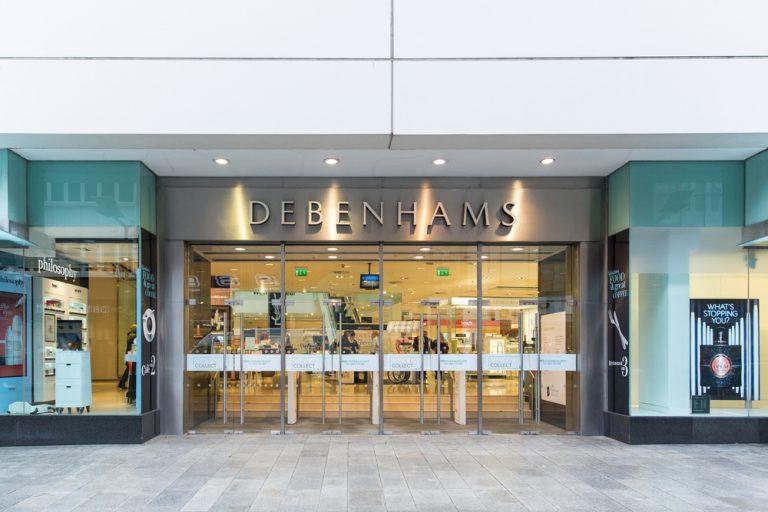
Debenhams (LON:DEB) reported a 10 percent drop in profits on Thursday, as the department store saw a decrease in clothing sales.
The UK’s second largest retailer reported a 7 percent slide in pre-tax profits to £105.8 million in the three months to September. However, underlying profit margins rose by 0.5 percent to £118.2 million.
Additionally, the company’s pension scheme encountered some difficulties and slipped into a deficit of £4.1 million on September 3rd, compared with the end of August surplus of £26.2 million. The group attributed these difficulties to a decrease in bond yields, which was partly mitigated by a growth in their pension asset numbers. As a consequence, the group announced plans to reduce debt by £260 million by the following year.
“Our diversified business model together with good cash generation and reducing debt means that Debenhams is in good shape to withstand a market background that remains uncertain,” said company chairman Sir Ian Cheshire.
“Our strategy to re-balance the business towards non-clothing has supported our performance, with strong progress in beauty, gifting and food,” he continued.
The retailer maintained that its current strategy, which involves shifting away from clothing, had proved successful and had paid dividends. The company reported strong growth in beauty, gift and food department revenues and noted a 9.3 percent increase in its online sales, with particular growth from mobile revenue.
Debenhams have just recently appointed a new chief executive, Sergio Bucher, who was formerly vice-president of Amazon. He has been tasked with updating the company’s online operations as well as attempting to reconfigure the retailer for overseas markets.
Additionally, the group have announced that they will issue a final dividend of 2.4p per share, with the full-year dividend up by 0.7 percent to 3.4p per share. Shares in Debenhams rose by 2.4 percent to 55p in early trading.
Weak iPhone demand continues to hit Apple
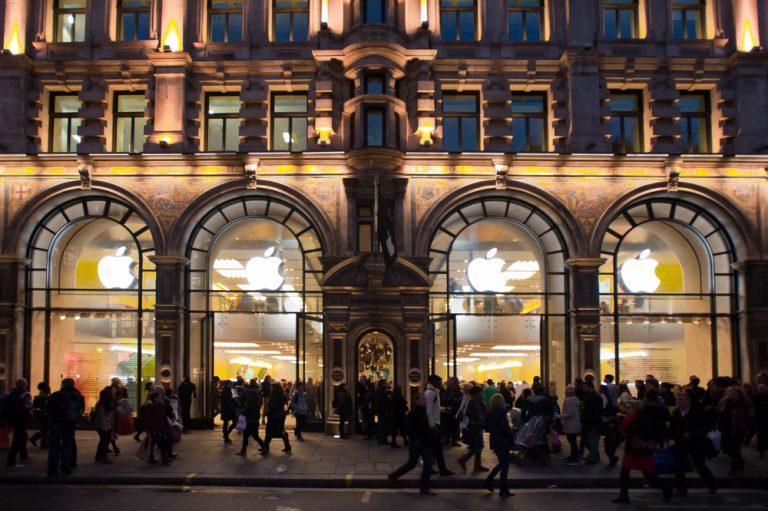
Apple has reported a fall in annual revenue for the first time in over 10 years on Wednesday, after another quarter of weak demand for iPhone handsets.
The group sold 45.51 million iPhones in the three months to 24 September, beating analyst estimates but falling for the third quarter in a row. Quarterly revenue fell to $46.9 billion in the three months to September, down from $51.5 billion in the same quarter last year. In Greater China, traditionally one of the group’s strongest markets, revenue also fell 30 percent after a 33 percent fall the quarter before. This compares to the same period last year, where revenue from Greater China doubled. In a statement, Apple CEO Tim Cook said:“Our strong September quarter results cap a very successful fiscal 2016 for Apple.
“We’re thrilled with the customer response to iPhone 7, iPhone 7 Plus and Apple Watch Series 2, as well as the incredible momentum of our Services business, where revenue grew 24 percent to set another all-time record.”
“We are pleased to have generated $16.1 billion in operating cash flow, a new record for the September quarter,” said Luca Maestri, Apple’s CFO. “We also returned $9.3 billion to investors through dividends and share repurchases during the quarter and have now completed over $186 billion of our capital return program.”
Alongside the statement, the company forecasted a higher-than-expected holiday season revenue of between $76 billion and $78 billion. Apple (NASDAQ:AAPL) shares were fell over 3 percent in pre-market trade.26/10/2016
Nintendo sales fall despite strength of Pokemon Go

Nintendo shares fell on Wednesday after the company announced a fall in both sales and operating profit for the full year.
Operating profit came in under analysts’ expectations at 30 billion yen, combined with a 33 percent fall in sales for the six months to September. The company disclosed an operating loss of 5.95 billion yen over the six month period, a signifiant fall from the 8.98 billion disclosed for the same period last year.
However, net profit was aided by the sale of Nintendo’s controlling stake in US baseball team the Seattle Mariners, as well as licensing fees for Pokemon Go.
Last month Nintendo announced the release of its first game designed for a mobile platform, Super Mario Run, developed with Mario’s creator Shigeru Miyamoto. The company may be hoping that this will counteract the falling sales of video game hardware, which saw over a 50 percent decrease in demand in the first half of 2017. Shares in Nintendo have fallen 8 percent this month, but have risen 46 percent since the start of the year.
Brexit unlikely to affect 2017 mergers and acquisitions, says new survey

Post-Brexit challenges are unlikely to affect business mergers and acquisitions, according to the latest research from KBS Corporate.
The study revealed that 94 percent of Private Equity and Venture Capital Houses were confident about the long-term future of the M&A market, and the wider economy in general. 97 percent of the survey respondents planned to use their funds at the same rate for the rest of this year and going into 2017, showing an undeniable optimism about the UK economy going forward.
KBS Corporate’s director, Simon Daniels, commented:
“Our research also found that respondents were of the opinion that a fundamentally profitable business is an attractive acquisition no matter the circumstances, indicating that 2017 may well be in line with record levels experienced in 2015.
“Acquisitions of ‘UK centric’ businesses, whose operations are unaffected by the European Union, are also likely to continue at the current pace going into 2017.
“Meanwhile, UK exporting businesses are becoming increasingly more attractive following the recent depreciation of the value of the pound against other major currencies. The effect of this is cheaper UK imports for foreign businesses and consumers, which has accelerated demand.”
KBS Corporate see investors becoming more active in 2017, widening the pool of potential suitors to negotiate with and ultimately creating a more productive environment for businesses hoping to sell.
According to Daniels, now is also the most tax-efficient time in recent history to sell.
“Entrepreneurs’ tax relief, which grants business owners a preferential capital gains tax rate of just 10 percent on business gains of up to £10 million, has been extended to include long-term investors, whilst capital gains tax has been slashed by 8 percent for all business owners,” he added.
AT&T shares fall despite CEO’s confidence on Time Warner merger

Shares in US telecoms group AT&T fell nearly 2 percent today, despite its CEO saying he is confident the company’s proposed acquisition of Time Warner will be approved by US regulators.

US lawmakers and both presidential candidates have voiced concerns over the merger, which was announced on Saturday. However AT&T’s CEO Randall Stephenson believes the deal will be approved, saying in an interview with CNBC:
“While regulators will often times have concerns with vertical integrations, those are always remedied by conditions imposed on the merger, so that’s how we envision this one to play out.”
If the deal goes ahead, it will be the biggest merger announced so far this year. AT&T have agreed to pay $85.4 billion for the company, which owns CNN and HBO. It will combine AT&T’s 130 million strong customer base with content from Warner Brothers and three major US cable TV channels; HBO, Cartoon Network and CNN. A Senate sub-committee responsible for competition will hold a hearing in November and are set to examine any anti-trust issues arising from the merger. AT&T shares fell nearly 2 percent on Monday, currently trading down 1.63 percent at 36.88 (1753GMT). Several credit ratings companies have lowered their assessment of the companies in the wake of the announcement. MoffettNathanson downgraded Time Warner to “neutral”, saying in a report today: “We are unprepared at this point to assign anything higher than a 50/50 probability of deal approval.”24/10/2016
Manufacturing exports boosted by sterling weakness, CBI says

Manufacturing exports have benefited significantly from the weakness of the pound, according to the latest data by the Confederation of British Industry (CBI).
The industrial trends survey has revealed that exports grew by their fastest pace in over two and a half years in the three months up to October. The data showed around 29 percent of firms polled reported an increase in total orders, with 20 percent reporting a decrease. One in five companies said they were more optimistic about the business situation than three months ago, but 28 percent were less so.
“Manufacturers are optimistic about export prospects and export orders are growing, following the fall in sterling,” commented Rain Newton-Smith, CBI’s chief economist.
“However, the weaker pound is also feeding through to costs, which are rising briskly and may well spill over into higher consumer prices in the months ahead.
“Access to skills clearly remains a high priority, so manufacturers will be looking to the government to implement a new migration system that meets the needs of business while responding to clearly-stated public concerns.
“Maintaining a preferential route between the UK and the EU, our largest trading partner, will be important,” she stated.
Additionally, the CBI warned that the pound’s weakness was “a mixed blessing”, and its devaluation had resulted in the fastest rise for price of average units in over three years.
Moreover, 47 percent of those surveyed said the depreciation of the pound had impacted their business negatively, while 32 percent said deemed the impact to have been a positive development.
The CBI stated that companies will be largely focused on the Chancellor’s November Autumn Statement for further clarification on the Goverment’s intended industrial strategy.
“Ultimately, all businesses need greater clarity from the Government on the fundamental issues of skills and barrier-free access to EU markets as soon as possible,” added Ms Newton-Smith.
Hanjin announce closure of European operations
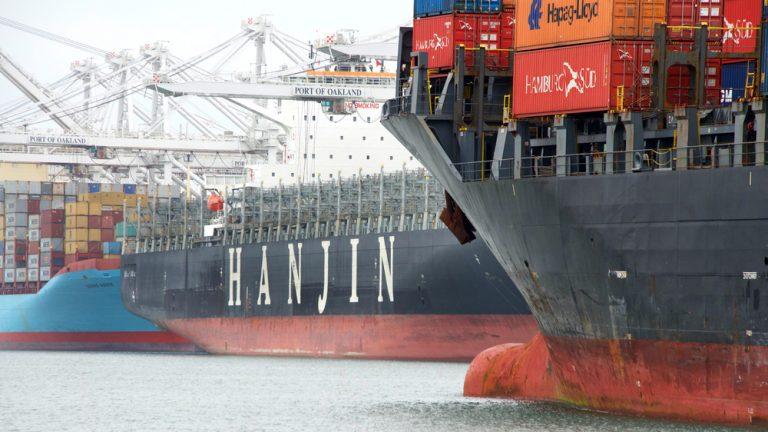
Global shipping firm Hanjin have announced their intention to close all European operations, causing shares to plunge by 12 percent.
The company has said it is likely to cease its activities in more than 10 countries, including its European headquarters in Germany. The firm expects to initiate the closure process in Europe as early as this week, following approval from the Seoul Central District Court. Earlier in the month, Hanjin received permission to auction major assets, including its Asia-US route network, in order to commence repayments to creditors.
The announcement resulted in a 13.9 percent plunge in share price during trading in Seoul. Almost 80 percent of Hanjin’s value has been wiped out over the past year following the report of a £342 million loss.
The South-Korean firm filed bankruptcy claims earlier this year after encountering persistent financial difficulties. Hanjin Shipping then filed for receivership in August, following the refusal of creditors to go ahead with a proposed restructuring plan for the firm’s $5.4 billion (£4.4 billion) debt. This has marked the biggest bankruptcy declaration in the shipping industry to date.
The continued financial struggles of The South Korean shipping company have been attributed to the ongoing general downturn in the container shipping industry in recent years. This has been considered to be as a result of a combination of factors including weak global GDP, overcapacity on container vessels, changing consumer spending patterns as well as the economic slowdown in China.
Hanjin is South Korea’s largest shipper, and it also makes up one of the top ten in the world’s largest carriers in terms of capacity potential.
London remains attractive to real estate investors despite Brexit

London remains the top destination to invest in commercial real estate, despite Britain’s decision to leave the European Union, coming in ahead of Paris, Berlin and Munich.
38 percent of institutional real estate investors cited London as the top European city to invest in commercial real estate, ahead of Berlin at 36%, Munich at 31% and Paris at 22%. The figures, released by real estate platform BrickVest, suggest fears that Britain may be unattractive to investors in the wake of the European Referendum result may be exaggerated.
According to BrickVest, three in ten institutional investors believe Brexit will either increase or significantly increase European commercial real estate investment opportunities. A further one in four institutional investors believe that Brexit will have no impact on commercial real estate investment opportunities.
Emmanuel Lumineau, CEO at BrickVest, commented: “Our research has identified London as the number one European city to invest in commercial real estate as investors seek to capitalise on potential price discounts and market uncertainty. However Germany dominates across the leaderboard and we have seen plenty of appetite from investors looking to capitalise on income producing portfolios across Europe and take advantage of the Brexit vote.
Immediately after the referendum result in June investment into UK commercial property dropped to lowest level in two years, causing prices for British real estate began to fall. However, BrickVest’s research suggests this may be shortlived.
“Like any trading market out there, you need a critical mass but you also need standardisation, automisation and trust, as well as institutional quality to make it happen which we believe is lacking in our real estate industry,” Lumineau added.
Four of the top ten European cities named in the research were German, highlighting a clear positive trend towards German commercial real estate.