Super-prime property sales fall 86 percent post-Brexit

0
Uncertainty over the future of Britain’s relationship with the EU and increasing residential property taxes have led to an 86 percent fall in super-prime property sales, according to the latest statistics from the Land Registry. Over the three months to August 2016, seven times fewer super-prime properties – those above £10 million – were sold than in the same period last year. The average price paid for the top five most expensive sales fell 25 percent from £22 million to £16.3 million.

Sales in the UK’s capital remained stronger than the rest of the country, with all sales within the three months to August being on property in London. This is in comparison to the same period last year where 30 percent took place elsewhere in the country, according to data analysis by London Central Portfolio (LCP).

The reduction in super-prime activity in the last three months could have a negative effect for the British government, who may receive £45 million less in Stamp Duty receipts. According to LCP, these findings could significantly impact next year’s Stamp Duty receipts as top end sales, which were expected to counter lower levels of Stamp Duty under £1m, fall away and prices drop.

Naomi Heaton, CEO of LCP, commented: “Despite roughly stable Stamp Duty takings in the financial year to April reported by HMRC, next year may see a different picture, particularly as the it took account of a major rush in March. Transactions increased 72 percent over February as buyers sought to beat the 3 percent Additional Rate Stamp Duty (ARSD) deadline, buoying overall receipts.”

17/10/2016

New business bank Redwood submits license application

0

A new business bank is to be founded by Jonathan Rowland and Gary Wilkinson, offering commercial mortgages and business deposit accounts to SMEs across Hertfordshire, Bedfordshire and Buckinghamshire.

Rowland and Wilkinson submitted a banking license application to Financial Conduct Authority and the Prudential Regulation Authority today, and hopes to receive its license in early 2017. The bank will be named Redwood Bank and is expected to attract £50 million worth of investment from a number of high profile investors, including Wildcat Capital Management, Falcon Edge founder Rick Gerson and David ‘Tiger’ Williams of Williams Trading.

AFP’s majority shareholder will the company owned by David and John Rowland, Acorn Global Investments Ltd, who have extensive experience and a successful track record in the banking and finance sectors. Subject to regulatory approval Jonathan Rowland will be the Redwood Bank’s chairman – Jonathan was the Chief Executive of Kaupthing Bank between 2009 ad 2013 and played a leading role in the restructuring and subsequent recapitalisation of the bank into Banque Havilland S.A. and Banque Havilland (Monaco) SAM.

“This is an ideal time to apply for a full banking licence; the major banks have not returned to anywhere near their pre-crisis business lending levels and the uncertainty caused by Brexit is likely to worsen the situation. At the same time, SMEs have shown a strong appetite for new market entrants offering competitive rates and superior customer service. Against this backdrop, we have a compelling opportunity to build a secure, robust and profitable bank”, Jonathan said.

The senior management team of Redwood will be led by Gary Wilkinson as Chief Executive, again subject to regulatory approval. Gary has over 30 years’ experience within financial services, and is the former Chief Executive of Cambridge & Counties Bank, which provides lending and deposit products for SMEs.

Miranda Wadham on 17/10/2016

UK economy ‘faces prolonged weakness’, report says

0
 

The UK economy faces a “prolonged period” of weakness, according to the latest report from EY Item Club.

According to a recently released Autumn report, think tank EY Item Club’s research has indicated the UK economy will experience weaker growth as consumer spending slows and businesses begin to reduce investments.

Despite predictions that the economy will grow by 1.9 percent this year, it warned that with inflation levels continuing to rise performance will be negatively affected. The report also warned that the UK economy’s relative stability since June’s Brexit vote was “deceptive”, and markets are yet to feel the full ramifications of the referendum result.

Whilst initial measures undertaken by the Bank of England to calm markets have been somewhat effective, the pound has continually begun to weaken sharply against the euro and the dollar, a worrying sign that the worst is perhaps yet to come. This sentiment was echoed in the comments made by a Bank of England (BOE) official to BBC’s Radio 5, who said inflation may potentially surpass original BOE targets of 2 percent.

The EY report reiterated these concerns, having projected inflation to rise to 2.6 percent in the next year, before settling down to 1.8 percent in 2018. Consumer spending growth is expected to slow from a projected 2.5 percent this year to around 0.5 percent in the following year, and 0.9 percent in 2018.

Business investment has also been forecast to fall due to uncertainty over Britain’s future trading relationship with the EU, dropping 1.5 percent this year and more than 2 percent in 2017.

EY has predicted that the impact of weaker consumer spending combined with lower investment will result in the UK’s GDP growth dropping considerably to 0.8 percent next year, before eventually increasing to 1.4 percent in 2018.

EY Item Club is a forecasting think tank group that provides insight and analysis into businesses and economic development.

Snapchat moves closer to stock market flotation

1
Social media giant Snapchat moved closer to flotation on Friday, after confirming that Morgan Stanley and Goldman Sachs would underwrite the initial public offering. The IPO is expected to value the company at $25 billion, making it the largest social media company to float on the stock market since Twitter. The IPO is rumoured to take place before March 2017. The Snapchat app allows users to send and receive messages and photos – called ‘snaps’ – which then disappear after a maximum of 10 seconds. It has seen a strong growth in popularity, attracting high-profile users such as Michelle Obama and Gigi Hadid. It has 150 million users watching 10 billion videos a day, and has seen a 350 percent increase in use over the last year. Data from eMarketer shows that Snapchat may have the potential to bring in nearly $1 billion in advertising revenue by the end of 2017, a strong increase on the $367 million it is predicted to make from adverts this year.
14/10/2016

Sky report revenue rise as advertising dips

Sky reported a rise in revenue on Thursday, accompanied by news of a slowdown in advertising income.

Like-for-like revenues – which mitigate the impact of currency movements – rose 5 percent in the last quarter to September. Subscriber numbers increased by 106,000 over the same period, a decrease on last year’s increased figure of 134,000.

However, advertising revenue in both the UK and Ireland fell around 3 percent. In a statement, Sky reiterated that these were still competitive figures in a tough market.

Sky, which generates about a third of its business in Europe in countries such as Italy, Germany and Austria, has said that its group revenues had also seen gains. This was seen to be as a result of the stronger euro against the pound sterling, as European sales in euros are recalculated into sterling. As a result of continuing pound weakness against the Euro, Sky saw group revenues rise by 13 percent to £3.1 billion.

The company continue to generate strong viewership and revenue numbers for sporting channels, particularly football. Whilst Sky have paid a supplementary £600 million for its Premier League broadcasting rights, it has reassured that they were already seeing strong returns on the investment, ultimately the move was improving efficiency, with operating costs for the quarter notably lower than the previous year.

These figures follow a 19 percent plunge in the company’s shares the last 12 months, as investors worry about the broadcaster’s ability to compete with digital streaming services such Netflix and the cost of investing in expensive sporting rights.

Sky Chief executive, Jeremy Darroch commented: “We finished the quarter strongly after a slower start against the backdrop of the Rio Olympics and Uefa Euro 2016.

“We are on track financially in a year of investment on screen.”

The company emphasised that the released figures showed that growth had been promising “across all territories and categories”.

Hargreaves Lansdown issue warning over investor confidence

Hargreaves Lansdown issued a profit warning on Thursday, after a slowdown in new business growth. According to figures, net new business intake in the September quarter stood at 1.1 billion, down 22 percent from the 1.4 billion recorded in the first quarter of the year. The total number of active client numbers increased by 20,000, down 17 percent from 24,000 in the first quarter of 2016. However, assets under administration rose 9.5 percent from August to the end of September to a record £67.6 billion, stimulated by stock market rallies. The firm had also benefited from increased client trade demand following the June Brexit vote. In a statement, the firm said: “Despite the higher stock market levels, investor confidence has fallen and there remains much uncertainty about the future economic environment weighing on investors’ minds,” it said in a statement. “Future stock market levels and investor confidence will have a significant part to play during the remainder of our financial year.” Following the warning, Hargreaves Lansdown’s shares fell 2.8 percent. This marks a decrease of around 20 percent since the start of the year. The FTSE All Share index was up 6.8 percent during September, according to figures by Reuters. This was attributed to boosts in profits for companies with overseas income, as a result of a the continued devaluation of sterling in the wake of the U.K’s decision to leave the European Union.

Tesco and Unilever row sparks #Marmitegate

2
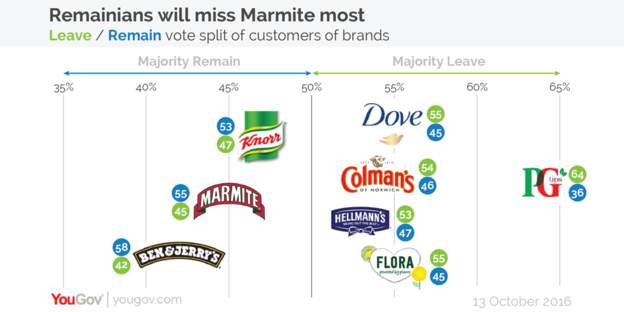
British supermarket Tesco are running short of products after a row with food and grocery manufacturer Unilever. Unilever have moved to increase the prices of their products by 10 percent after sterling’s recent devaluation. Tesco have so far resisted moves from the company to up the prices of their products, causing a shelf shortage of several items. However, the bosses of both Unilever and Tesco have said they are sure the situation will be resolved “quickly”. Marmite, PG Tips tea and Pot Noodles are among the brands taken off the Tesco online store on Thursday. Tesco have thus far refused to up prices, with many analysts agreeing with their position; producers tend to operate with a 20 percent – 30 percent margin, whereas supermarkets struggle with a margin of between 2 and 3 percent. Both Tesco and Unilever warned on the possibility of increased food prices ahead of the referendum. However, according to a poll by YouGov, it appears that the current goods deficit will hit both Remainers and Leavers alike. According to the survey, Leavers favour Unilever brands such as PG Tips, with Remainers favouring Ben & Jerry’s. 4a810e00-48d1-49af-896a-22ebeb1a9b70 The row has hit the share prices of both Unilever (LON:ULVR) and Tesco (LON:TSCO), dragging the FTSE down from last week’s highs. Unilever is currently down 3.96 percent at 3,576, with Tesco faring slightly better down 2.40 percent (1346GMT).
13/10/2016
 

Small businesses still planning to grow in post-Brexit economy

Three quarters of small businesses in the UK are looking to expand within the next two years, showing a generally optimistic mood in the business sector post-Brexit.

73 percent of businesses with over five employees have plans to grow dramatically or moderately over the next two years, according to a new report by Albion Ventures. However half of the 1,000 SMEs surveyed said that finding skilled staff to fill positions is one of the biggest challenges, an issue that may grow worse post-Brexit. Businesses in the manufacturing, construction, medical and healthcare sectors are the most affected, relying on candidates with job-specific training to fill the roles.

On a sector basis, manufacturing companies remains the most bullish about growth and the most relaxed about Brexit. Small businesses are largely split on the impact of Brexit, with 36 percent unworried by the referendum result, and 41 percent expecting it to be a hindrance. However, this opinion varies greatly depending on demographic – those in London are the most concerned, and over half of businesses owned by Millenials expect Brexit to cause problems in the long run.

Patrick Reeve, Managing Partner at Albion Ventures, commented on the report: “Against a backdrop of profound change, one element that has remained reassuringly unchanged is the optimism underlying the UK’s small businesses. Firms are looking to grow their headcount and productivity is on the increase. The biggest barrier to growth, finding skilled staff, is generated by success rather than failure.

“The downside is that the economy is coming under capacity constraints at a time of considerable political uncertainty. While many of the pressures on growth we have seen in recent years have eased, the skills that enable us to compete are in short supply.”

12/10/2016

Brexit may affect National Living Wage, report says

0
 

Brexit may have a detrimental effect upon future growth of the National Living Wage, according to a report by The Resolution Foundation.

The think-tank’s latest research indicates that leaving the European Union will detrimentally impact the anticipated growth of the national wage boundaries in coming years. The report stated that weak pay growth rates, as a result of such developments, would ultimately see around a 10p decrease in the projected figures for living wages. Specifically, the foundation’s report predicts that the National Living Wage in 2020 will hit around £8.20, less than previous estimations.

However, the report said the expected 10p-an-hour increase will still deliver annual rises of up to £600 for over 4 million workers in the U.K. In addition, it also calculated that subsequent increases in wages will help conditions for many, with around 800,000 individuals set to be out of low pay by 2020.

Conor D’Arcy, a policy analyst at The Resolution Foundation, said: “While there is much uncertainty over Britain’s long-term economic outlook, most economists agree that wage growth in the next few years is likely to be weaker than expected prior to the referendum.

“That means we’re unlikely to see the £9 national living wage that George Osborne talked about in this parliament. As we approach the autumn statement we’ll soon learn what the [national living wage] will be next year. An increase to around £7.50 will deliver a welcome annual pay rise of up to £600 for full-time staff.

“Though that’s less than the £800 raise previously forecast, it’s sensible that the size of the rise adjusts in line with wages of typical workers. This flexibility means that calls from some businesses to scale back the wage even further are wide of the mark.”

The National Living Wage initiative was introduced in April of 1999 by Tony Blair’s government, and has been steadily increasing since. The current rate was set in April 2016 and stands at £7.20, or £6.20 for under 25 year olds.

Previously, an increase in living wages for under 25’s was regarded as the centrepiece of the former Chancellor, George Obsorne’s economic budget targets that were set out earlier in 2015. However, this report raises serious questions about the viability of these targets in the post-Brexit economic climate.

Monarch secure £165 million loan

Monarch have secured an £165 million investment from majority shareholder Greybull Capital, after concerns the airline would be unable to renew its ATOL membership.

The struggling budget airline had faced troubles earlier this year after rumours that they were unable to renew its membership of the Air Travel Organisers’ Licensing (Atol) scheme, which ensures costumers can receive refunds should a participating airline collapse.

Earlier this summer, Monarch had stated that more funding would be necessary, warning in its annual report that it needed to obtain around £35 million in funding from its majority owner Greybull Capital or alternatively, an external lender.

The airline had been participating in negotiation talks with its major stakeholder Greybull Capital and Boeing earlier in the week to secure the necessary financial assistance. The increased investment from Greybull Capital will allow Monarch to be in a position to comply with the Civil Aviation Authority’s (CAA) financial health check-list and ultimately renew its Atol membership.

Greybull Capital purchased a majority 90 percent stake in the company in 2014, with an initial investment of £125 million. Greybull Capital are also major investors in Scunthorphe’s Steelworks.
“It is testament to the extensive effort by all parties, over the past weeks and months, that we are able to announce the largest investment in our 48-year history, as well as the renewal of our Atol licences,” said Andrew Swaffield, chief executive of Monarch Group.

Monarch were able to renew their license just hours before the CAA deadline earlier in September. The CAA had agreed to initially extend its license for 12 days until the 12th of October. The CAA has nonetheless said that it would “continue to monitor the company” in its “period of extension”.

This latest investment will ease the mounting pressure on Monarch and ensure that securing further CAA licensing will prove an easier feat.