
Mario Draghi leaves rates unchanged
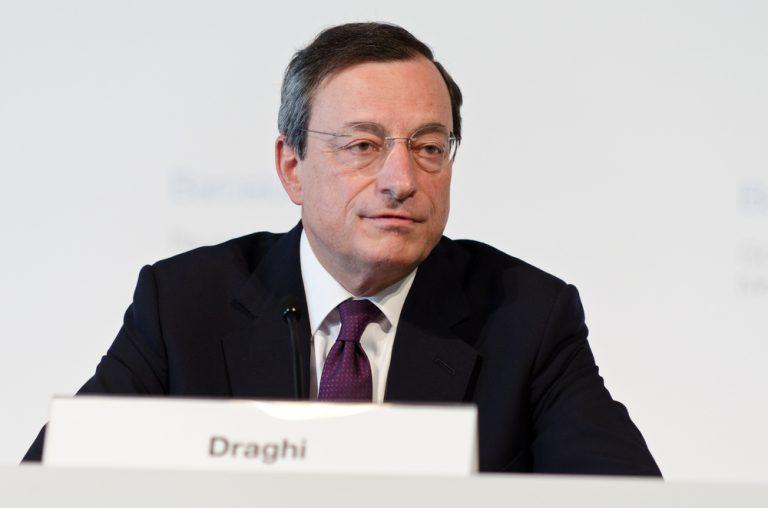
In today’s decision on lending and borrowing rates the president of the European Central Bank, Mario Draghi, has left all rates unchanged.
The Central Bank’s interest rate will remain at 0% and the deposit rate stays at -0.4%. The marginal lending facility is held at 0.25%.
The move to keep rates at low levels had been expected. Mario Draghi has frequently confirmed that his policies to lead the recovery of the Euro Area will be focused on adding liquidity to the markets.
Draghi started his credit easing measures in June 2014. He stressed that the ECB’s QE program will continue to run until at least March 2017 and all rates will remain at low levels for an extended period.
In his opening statement to today’s session Draghi stated: “…the recovery of the euro area economy gained momentum at the start of the year. It is expected to proceed at a moderate but steady pace, supported by solid domestic demand and the effective pass-through of our monetary policy measures to the real economy.”
He further reported that since the new easing programs have been initiated, bank lending rates fell by over 80 basis points and reached historically low levels in April this year. Draghi said, the ECB will continue on their current path hoping to encourage economic activity in the Euro through these practices.
In the press conference that followed the release of the decision, Draghi said that European banks are in a better position than in 2009 which to some part was influenced by the ECB’s efforts to strengthen the sector and ensure solvency.
He commented on Brexit noting that European financial markets responded with “encouraging resilience” to the UK vote to leave the EU. This comes only two days after ZEW indicators on European economic sentiment showed pessimistic investor outlook.
In regards to Turkey’s failed coup attempt and how it may affect the Euro zone recovery, he stated that it is difficult to tell how big geo-political issues will impact the economy and with Turkey in particular, it will be very difficult to gauge immediate near term influences on the European economic recovery.
The ECB has indicated that more stimulating monetary measures may still be used as Mario Draghi repeated he will use all tools available to him. He said the ECB will closely watch economic development of the region over the coming months to formulate a appropriate strategy of response. This approach rings the same as the Bank of England’s recent decision to postpone changes to policy measures until post-Brexit movements in the economy become more clear.
Mastercard seals deal to buy 92.4% of VocaLink

Mastercard Inc (NYSE:MA) today announced that it has agreed to buy London based VocaLink Holdings Ltd for £700m with the prospect of adding £169m if performance targets are met.
The US based card issuer is the world’s second largest payment network provider and its latest move to acquire a London based firm shows its growing presence on the UK market. Mastercard will buy a 92.4% stake in VocaLink in a deal that will see VocaLink shareholders retain a 7.6% stake in the company for a minimum of three years once the transaction has been processed.
VocaLink is a system that processes automated payments for banks, government agencies and businesses handling in total up to £6 trillion UK payments a year. It operates as a collection of 18 banks all induced in shared ownership including Barclays, HSBC, Lloyds, RBS and Santander.
Royal Bank of Scotland has one of the highest stakes in VocaLink at 21.4% and is expected to see profits of up to £150m. Other owners, such as Barclays, who today announced they will share the majority of their 15.2% stake, will earn up to £133m from the sale. Co-op Bank, one of the smaller shareholders of 3.3%, will earn up to £28.3m.
Mastercard chief executive Ajay Banga said:
“We’re excited about the opportunity to play a bigger role in payments in the UK, a very strategic market for us,”
Brexit and terror threats hit EasyJet as revenue slides
EasyJet (LON:EZJ) today released its trading statement for the third quarter reporting a ‘difficult and uncertain operating environments’, the negative language used in the release has led to a 6% fall in shares.
EasyJet reported that total revenue in its Q3 ending June 30 had dipped 2.6% to £1.196m driven by the impact of sale cancellations across the markets. The airline had however increased passengers carried by 5.8% to 20.2m as capacity rose by 5.5% to 21.9m seats.
As a result of the dip in revenue, total revenue per seat (yields) fell 7.7% reporting a constant currency basis at £54.54 per seat.
The company recently reported that air traffic control strikes and a disruption in bookings in the aftermath of the Egyptair plane crash had knock on effects in its revenue per seat outcome. In what has been a difficult period for the Luton based company, increasing threat of terror attacks across Europe as well as Brexit has sent company’s shares down 39% over the last six months.
EasyJet faces further geo political challenges as it reports that the recent terror attacks in Nice, France and the recent failed coup in Turkey have highly impacted passenger activity. The airline suffered a total 1,121 cancellation in its Q3 compared to 726 in the same period last year. It states that these cancellations were mainly driven by runway closures at Gatwick, severe weather and air traffic congestion issues costing up to £20m.
One of the company’s biggest challenges was its short haul flight capacity due to its short range distance to destinations such as France, where it operates a margin of 65% capacity as well as an exposure of 37% in London’s airspace. As a result of flight cancellations and air traffic congestion, the airline experienced a 350% increase in delay minutes from June last year.
EasyJet Chief Executive, Carolyn McCall said:
“The economic and operating environment has been difficult in the third quarter due to a number of factors including air traffic control strikes and other industrial action, runway closures at London Gatwick and severe weather.
These factors combined with industry capacity growth in short haul continue to have an impact on industry yields at a peak time of year. More recently currency volatility as a result of the UK’s referendum decision to leave the EU as well as the recent events in Turkey and Nice continue to impact consumer confidence”
The disruption comes just as company is due to expect the summer vacation season to take full swing and is hoping that this will boost its sales performance, casting a shadow over the ability of the airline to meet full year targets.
21/07/16
Delays in Japan Pokémon Go launch affect stock markets

Japanese Pokémon Go launch delayed dragging down Nintendo shares
The smash hit app Pokémon Go, which allows people to catch Pokémon in their real-life surroundings before training them up to battle others, has taken the world by storm. The app already launched in 30 countries world wide. Japan was supposed to become the first Asian country to have access to the app this morning. The launch was however delayed to the afternoon after a leak of confidential emails between app developer Niantic, the Pokémon Company and McDonalds – publicised that McDonalds restaurants are to become the game’s first official sponsored locations. Later in the day the re-planned launch was also cancelled due to concerns that the servers may overload. An immense influx of users is to be expected in Japan since the country is home to the creators of Pokémon and likely to be one of the countries with the greatest hype around the new game. Game developer Niantic has said they are working hard on ensuring sufficient server capacity for the expected user load. They are confident that the game will be able to accommodate huge user capacity once the it launches. The new launch date is expected to be as soon as Thursday. Disappointment over the delays sent Nintendo shares down 10 percent this morning. This ended a ten-day rally in which the owner of intellectual property rights to Pokémon doubled the market value of its stocks. McDonalds Holdings Japan stock prices have however entered into another day of appreciation. Yesterday, in the first day of trading since McDonalds Japan started selling Pokémon Toys in their Happy Meals, stocks had already gained 5.2 percent, reaching its’ highest levels since late 2001. Since it has become public that the 3,000 McDonalds restaurants in Japan will become Pokémon gyms (virtual arenas where players can come to battle one another) shares have jumped another 14 percent to its highest on Wednesday. At close on Wednesday share price stood 9.84 percent higher than the day before. Shares are expected to rise further for all three company participants in the deal once the game launches in Japan and expands further into Asia.Microsoft shares rally as profits rise $3.1bn

Microsoft Corporation (NASDAW:MSFT) today reported of a strong growth in its commercial cloud computing business that have boosted Microsoft’s Q4 revenue way above Wall Street expectations sending shares rallying +4%
The boost in revenue comes from a $12.1 billion ‘run rate’ growth in commercial cloud revenue, a high margin influx from $8 million recorded a year earlier.
Revenue for the ‘intelligent cloud’ business which included it’s Azure cloud platform climbed 7% to $6.7 billion as revenue for the cloud platform grew by an astonishing 102%.
Despite revenues running high, operating profit dropped 17% down to $2.19 billion.
Microsoft’s Chief executive, Satya Nadella said:
“This past year was pivotal in both our own transformation and in partnering with our customers who are navigating their own digital transformations, the Microsoft Cloud is seeing significant customer momentum and we’re well positioned to reach new opportunities in the year ahead.”
Overall adjusted revenue for the biggest technology firm in the world increased by $420 million to $22.6 billion on top of a $3.1 billion profit for the three months ending June levelling out to 39 cents per share. This marks an improvement from last year’s results which saw the company lose $3.2 billion – 40 cents per share – as sales in the Nokia phone purchase fell 70% resulting in a $7bn loss.
Microsoft therefore beat estimates of 58 cents per share, reporting a total income of 69 cents per share.
Microsoft stated that the 7% drop in year-over-year revenue standing at $20.6 billion, was due to the net revenue deferral from windows 10 of $2 billion. Yet revenues still attained a high figure as numbers on the online version of Office increased 59%. The highs meant that sales in PC software took a hit of 4%.
For the full fiscal year, Microsoft reported earnings per share of $2.10 GAAP as non GAAP revenue stood at $92 billion alongside an operating income of $27.9 billion.
At 10:35am EDT Microsoft traded at 56.35 + 3.26 (6.13%)
20/07/2016
TalkTalk loses 9,000 subscribers in Q2
In its latest trading update, TalkTalk (LSE:TALK) reported that despite revenues remaining on track, the broadband base remained 9,000 lower in the Q2.
Since the hack on the company’s data base in October 2015 that released the personal data of 160,000 people and sent pre-tax profits plummeting over 50% to £14m, TalkTalk have been working on reforms which featured a continuous cut to costs.
Revenues for the Telecommunication firm had slipped 0.4% alongside on-net revenues that declined 2% in the three months ending 30 June. There was however strong growth in corporate revenue from customers, which grew by 7.5%.
On-Net churn, which is the measure of customers who discontinue their subscription, stood at 1.36% compared with 1.5% seen the same time last year. In the aftermath of the hack, 100,000+ scrapped their subscriptions in the Q3 of 2015.
As the customer base on broadband fell 9,000 lower in the Q2, the TV customer base also took a hit as numbers fell by 23,000. There were signs of improvement however, as mobile customer volumes year-on-year increased by 48,000 as well as a 36,000 rise in fibre customers.
The company’s reforms are aimed at improving the services for existing customers as the group stated that it remains on track to deliver £35-40m worth of savings by the end of the fiscal year. Improvements are being made to fault diagnostics and a new simpler billing process to improve customer service.
TalkTalk reaffirmed shareholders that it expects revenue for the full year 2017 to ‘grow modestly’ with growth expected to be seen in its’ broadband base and business amounting to £320-360m.
In the immediate reaction to its’ update, the FTSE 250 company climbed 5% in the first hour growing up to 232.70p per share before declining later on to 225p.
A 2:09pm BST TalkTalk Telecom Group PLC traded at 219.30 -3.40 (-1.53%)
20/07/16
S&P lowers Deutsche credit ratings to negative
Standard and Poor’s this week announced that is has lowered its’ credit ratings for Deutsche Bank from stable to negative citing market conditions in the aftermath of the EU Referendum which may lead to further complications for the banks reforms.
It claimed that the German Banks restructuring and business model will be put at risk if operating conditions remain ‘adverse’ meaning that execution plans will not be made effectively.
S&P said:
“Although market conditions may recover somewhat from the weak first quarter of 2016, ultra-low interest rates and generally subdued client trading activity may persist for the foreseeable future. These pressures affect the entire sector but we believe they are particularly unhelpful for Deutsche Bank as it seeks to strengthen capital and maintain its franchise while fundamentally restructuring its business model and balance sheet.
Although it is not our current base-case scenario, we see a risk that the achievement of Deutsche Bank’s targets under Strategy 2020 may be challenged if operating conditions remain adverse.”
Despite Moody’s downgrade of Deutsche Bank’s long-term senior debt ratings down to BAA2 and long term deposit ratings to A3 in May, S&P stated that they will keep the banks BBB+ credit rating for its long term unsecured debt.
In early 2014 the bank first came under scrutiny for its oversized derivative exposure and high leverage as well as high profile moves within its top-end employment structure.
The bank has since outperformed the worst of predicted scenarios and started to implement a rigorous restructuring plan to secure its stability. However, first quarter earnings have missed targets, prompting new lowering of credit ratings.
Credit ratings guide investors and give clear analysis of the credit-worthiness and associated risks in an issuer’s ability to meet their commitments. The lower credit rating and continuing low interest rates are likely to impact the performance of Deutsche for the foreseeable future which have promoted credit agencies to lower their ratings.
Deutsche Bank is expected to stick to its plans announced in October which will see a reduction in jobs, suspension of dividend payments and exit from up to 10 countries in order to stabilise risk assets.
Shares in Deutsche Bank reduced by 3.25% in the later stages following the statement at €12.73
20/07/2016
Volkswagen earnings exceed expectations for Q2

Volkswagen (ETR:VW) has posted record earnings despite taking another hit over emissions-cheating scandal.
The operating profits for the first half of 2016 did decline by 12 percent to €5.78billion. However, this implies operating profits of €3.4billion in the second quarter, €300million higher than expected.
Revenues rose 3.7 percent to €98.7billion in the first half of the year compared to last year’s first half. Vehicle deliveries were up 5 percent and sales rose by 0.8 percent.
The company stated today that improvements in the European car market and the return of corporate fleet orders has helped earnings exceed expectations.
In September last year the group admitted to illegally installing software to deactivate pollution controls in 11 million diesel vehicles causing concerns of crippling settlements.
Volkswagen had initially put €16.2billion aside to undertake the technical fixes on vehicles involved and cover legal charges. Another €2.2billion will now be added for this purpose.
This decision came the same day as three US states filed new official law suits against the Group related to the emission scandal.
Shares
Investors however, were not moved by the renewed legal action against the firm. Following the earnings announcement last night, the markets were quick to react when trading opened this morning. Shares peaked at €124.1 at 9.20am GMT, up 6.7 percent to opening level. In the wake of the scandal, shares plummeted from €169.7 on September 16th down to €92.4 by October 2th. Volkswagen AG shares were trading at €123.4 at 12.05am GMT.UK unemployment down in May
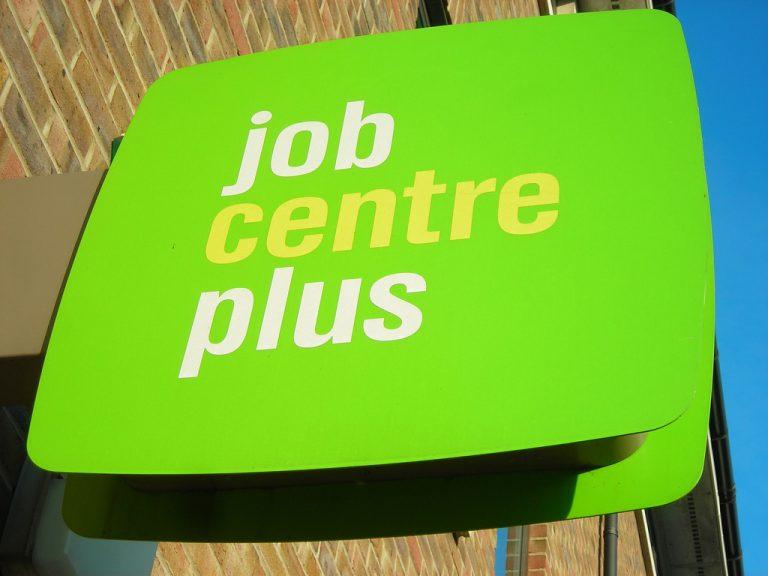
Data on UK unemployment for May reflected positively on the UK labour market as new claimants came in at a record low and unemployment fell.
While the Claimant Count rate remained at 2.2%, the numbers of people claiming jobless benefits sunk from the April figure of 12,200 to only 400. The ILO unemployment rate has dropped by 0.1 percentage point to 4.9 percent, the lowest it has been in 11 years.
Surprisingly, growth in average earnings excluding bonuses has reduced slightly from 2.3 to 2.2 percent. The figure which includes earnings from bonuses has however increased by the expected 0.3 percentage points to 2.3 percent.
Although this data shows an expansion in the labour market which should reflect positively on the UK economy and the GBP, there has been little movement in the currency’s strength on basis as experts warn that data may not be representative of the new post-Brexit reality.
James Smith, Economist at ING, stated:
“Perhaps this [the results] is an indication that the uncertainty heading into the referendum didn’t affect hiring to the extent that had previously been assumed, although it is possible that this is simply reflected more heavily in June’s data released next month.” Smith also said that the Bank of England is similarly unlikely to give the figures much weight in their decision making on monetary policy actions in August. First post-Brexit figures on UK unemployment and earnings will not become public until September, meaning that effects in the market based on labour market information may delay until then.Italian banking shares drop further

Italian Banking shares dropped over the course of the day as the European Commission rules in favour of bail-ins.
The EU Court of Justice confirmed its legality citing the Slovenian 2013 bail in. The court stated that, “Burden-sharing by shareholders and subordinated creditors as a prerequisite for the authorisation, by the commission, of state aid to a bank with a shortfall is not contrary to EU law.”
The ruling confirms consensus post the Global Financial Crisis and ongoing European Banking Crisis that the tax-payer should not be the one bearing the majority of the costs of a banking bail-out.