EU anti-trust watchdogs have blocked the tie-up between 02 and Three, after fears that it would lead to higher prices and reduced options for consumers.
Telefonica was planning to sell the O2 network to CK Hutchison, the owner of Three, in a deal worth £10.3 billion. It would have reduced Britain’s major phone networks to just three, prompting the European Commission to veto the deal.
European Competition Commissioner Margrethe Vestager said in a statement:
“The goal of EU merger control is to ensure that tie-ups do not weaken competition at the expense of consumers and businesses.”
“We want the mobile telecoms sector to be competitive, so that consumers can enjoy innovative mobile services at fair prices and high network quality.”
The decision was made despite concessions offered by Hutchinson, including a five year price freeze.
Sterling to fall 20 percent on Brexit, says think tank
Sterling is likely to drop 20 percent straight after a Brexit vote in June, according to The National Institute of Economic and Social Research (NIESR).
If Britain votes to leave the European Union on the 23rd June, the think tank also forecast soaring prices and a 1 percent drop in economic growth over the next year.
“The longer term impact of leaving the EU could reduce GDP by anything between 1.5% and 3.7% by 2030 depending on the subsequent relationship between the UK and the EU, as well as the rest of the world”, the Institute said in its report.
Toyota forecasts steep sales drop
Japanese automaker Toyota forecast a 35 percent fall in income for the current fiscal year, down to 1.5 trillion yen.
Vehicle sales were also down across most regions. However, operating income increased by 103.4 billion yen.
TMC executive vice president Takahiko Ijichi said: “Operating income increased by 103.4 billion yen compared to the previous fiscal year. The positive factors such as cost reduction efforts and favorable foreign exchange rates more than offset the negative factors such as decreased vehicle sales and increased expenses, particularly labor costs and R&D expenses.”
Shares have remained largely unaffected by the news, with Toyota (TYO:7203) trading down 0.76 percent after hours.
Top 25 hedge fund managers earn more than nations
The world’s top hedge fund managers earned more than the entire economy of Namibia last year, according to a report by Alpha magazine.
Kenneth Griffin, founder and chief executive of Citadel, and James Simons, founder and chairman of Renaissance Technologies, were in first place, earning $1.7 billion each.
Heavily criticised Wall Street salaries pale in comparison to these figures, with the US’s top banker Jamie Dimon taking home just $27 billion.
The list features 25 fund managers, and in its 15 year history has yet to feature a single woman.
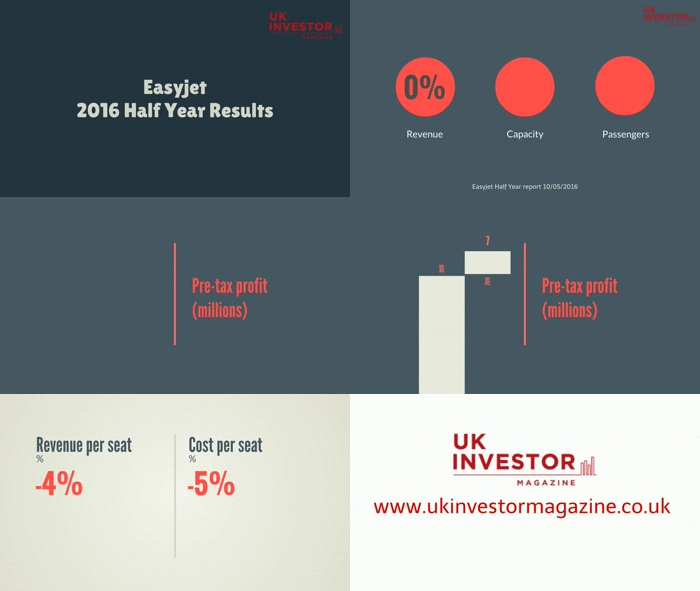
Budget airline Easyjet announced a larger-than-expected half-year loss on Tuesday, after terrorist attacks and strike impacted on sales.
The company disclosed a pre-tax loss of £24 million for the half year to March, a huge decrease from a profit of £7 million the year before. Analysts are expecting the company to report a pretax profit of £721 million for the 12 months ended September 30th.
Easyjet are the latest in a string of airline groups to be hit by weaker demand following terrorist attacks on European cities, including British Airways owner IAG and Lufthansa.
Shares are trading up 2.01 percent on the news, at 1499.54 (1122GMT).
High street hit by cold weather, says BRC
The unusually cold spring has hit demand on the high street, with retail spending flat for the second month in a row in April.
The latest figures from the British Retail Consortium showed a weak demand for fashion and footwear, with consumers sticking with their old winter clothes in the face of chilly weather.
“Flat total sales mask a very mixed picture: some retailers benefiting from the healthy housing market, while other are evidently more susceptible to the effects of lower consumer confidence,” BRC chief executive Helen Dickinson said.
On a like-for-like basis, sales fell by 0.9 percent in April – their worst performance since August of last year.
Gap narrows between Leave and Remain in the business sector
More business people are planning to vote Leave in the upcoming EU referendum that initially thought, according to the latest survey by the British Chambers of Commerce.
54% of its 2,200 members surveyed in April said they would vote Remain, down from 60% in February’s survey.
37 percent will now be voting to leave, a 7 percent increase on two months ago.
However, 90 percent of those surveyed said they were now unlikely to change their opinion ahead of the vote.
Mixed quarter for German economy, but overall strong
The German economy has had a mixed quarter, with a drop in industrial output offset by a surprising increase in exports.
Industrial output fell 1.3 percent, well above the 0.2 percent forecast by analysts and its biggest decline since August 2014. However, foreign demand from outside the eurozone drove factory orders throughout March, propping up the economy.
Industrial output rose by 1.8 percent overall on the quarter:
“The industrial sector has overcome its foreign trade related weak phase of the second half of 2015,” the Economy Ministry said. “The economic trend in the industrial sector is currently pointing upward.”
Recently, questions have been asked about the way the government and regulators have brought the new Innovative Finance ISA (IF ISA) to market. We think differently.
With any new product it is wise not to have an overly aggressive launch, which, as we’ve seen, can ruffle some feathers. By launching the IF ISA with only the few properly regulated platforms,rather than the entire P2P market, the launch can be more effectively controlled by government and regulators. Another advantage of launching the IF ISA with newer platforms is to allow these potentially challenging and more innovative platforms to offer more competition and choice in the marketplace. Failure to do this could result in a monopoly, similar to the one operated so dangerously by the large banks prior to the financial crisis.
Chris Hancock, Crowd2Fund
It must be considered that implementing business procedures to manage the IF ISA across the entire sector and government departments will be no easy feat. The current approach will give businesses and government departments time to build the required processes without being overwhelmed with huge volumes and thus ensuring a smoother transformation of the ISA market. As this is an opportunity of up to £400 billion in potential investment funds, care must be taken in order to make sure that this development is not wasted and that investor funds are safeguarded.
One particularly onerous task with the roll out of the IFISA is that all IF ISAs across every platform must be reported to HMRC; this can only be achieved when post-launch volumes and nuances have been identified. Putting this in place requires a clearly thought through, properly defined strategy so as not to disrupt legacy reporting processes for other cash or stocks and shares ISAs. We are confident the government and regulators are working towards this plan. Giving newer players a boost will increase competition, which will accelerate innovation and the service provided for the consumer. This is the primary motivation for developing these new products in the first place. Our first-to-market IFISA app is a great example of this.
Crowd2Fund is one of the few crowdfunding platforms which is directly FCA regulated and is the only platform offering both debt and equity investment types. Whilst gaining full FCA certification was a lengthy process, it has helped us offer our customers a best-in-class service. We believe it is taking time for the older platforms to become regulated due to the enormous operational and technical shift required to build a robust platform that is compliant with the strict FCA standards, which are notably higher than the previous obligations of P2P platforms.
If platforms continue to steam ahead without these processes in place, the financial services sector will be vulnerable to even greater risk, possibly compromising the security and credibility of the UK economy at large, as well as the FinTech industry.
At Crowd2Fund we’re thrilled to be offering our IF ISA at a generous 8.7% APR return* and help ambitious, innovative British businesses grow at the same time. We will continue on our path of slow, steady, sustainable growth whilst continuing our aim to offer consumers the best product and service in the marketplace.
Peace in Europe could be at risk is Britain decides to leave the EU, David Cameron has warned, as polling day grows closer.
The Prime Minister said that Britain has regretted “turning its back” on Europe in the past, and said that the EU was central to peace-keeping within Europe. He argued that “isolation” has never served Britain well, continuing:
“Can we be so sure that peace and stability on our continent are assured beyond any shadow of doubt? Is that a risk worth taking? I would never be so rash as to make that assumption.”
However the ‘Out’ campaign has called this argument into question, saying that regardless of whether the country votes to leave the EU NATO will keep Britain safe.
With the 23rd June polling day just over a month away and local elections out of the way, campaigns on both sides are heating up. View our video of how the campaigns stand so far below:
House prices fall, say Halifax
British house prices fell more sharply than expected in April after the introduction of a new tax on the purchase of rental properties, according to mortgage lender Halifax.
House prices fell by 0.8 percent in April, double what was expected by economists and down from a 2.2 percent jump in March.
House prices also slowed on the year, rising by 9.2 percent in the three months to April, down from 10.1 percent in the three months to March.
China rules in favour of Facebook in trademark row
A court in Beijing has ruled in favour of Facebook and against the Zhongshan Pearl River company, who registered the name ‘face book’ as a trademark.
The court said they had “violated moral principles” with “obvious intention to duplicate and copy from another high-profile trademark”.
This ruling was made despite Facebook being banned in China, leading to speculation that the country’s stance against the social media site may be softening. During a recent visit, Facebook founder Mark Zuckerberg met with China’s propaganda chief Liu Yunshan and media guru Jack Ma.
Greggs shares up despite “softer” trading conditions
Sales growth at bakery chain Greggs slowed over the last quarter after tough March trading conditions.
Like-for-like sales were up 3.7 percent in the first 18 weeks of 2016, down from the 6 percent increase this time last year.
In a statement, the company said:
“As has been widely reported, conditions on the High Street were softer in March before recovering in recent weeks; these conditions were reflected in our own performance.
“Input cost inflation remains low despite increased wage costs… we expect to make progress in line with our previous expectations”.
Shares are currently up 5.34 percent at 1,125.00 (0930GMT).
Japanese shares fall after market holiday
Japanese markets fell this morning after a break from trading for a three-day bank holiday, with investors remaining cautious before US jobs data released later.
Japan’s benchmark Nikkei 225 index was down 0.7 percent at midday, after a 0.4 percent jump at the start.
Most Asian markets followed this trend, with the Shanghai Composite closing down 2.82 percent, and the Hang Seng down 1.79 percent.
Service sector slows British economy to worrying levels
The British economy slowed in April on worries ahead of the EU referendum to the point of possible rate cuts, according to a new survey of the services industry.
Economic growth may drop to just 0.1 percent in the run-up to the vote – its weakest rate since 2012.
Markit chief economist Chris Williamson said yesterday’s fall in the service industry, the UK’s traditionally dominant sector, may lead to the Bank of Englang using monetary policy to “revive growth” – as it has done at these levels in the past.
Alibaba profits soar by a third
The world’s biggest e-commerce company, Alibaba, saw profits trip in the year to March 31st.
Profits saw a rise of 193 percent, with sales rising by 101 billion yuan. Chief executive Daniel Zhang said the company had “finished the fiscal year on a very strong note.”
The company has recently been struggling in the light of newer competitors such as Baidu and JD.com, with shares dropping by a third. However, these strong results may be a sign that the company is getting back on track, with shares on the New York market rising nearly 4 percent.
Rupert Murdoch’s media empire New Corp reported a net loss of $149 million for the three months to March, after being hit by a $280 million legal charge in the US.
The group also saw revenue fall 7 percent and revenue from its Harper Collins publishing arm fall 11 percent, citing “currency headwinds” as a reason for the fall.
News Corp’s Chief Executive Robert Thomson called the company’s third quarter performance “disappointing”, adding that the company was:
“on track to see improvements in the fourth quarter, with the expansion of our digital real estate business, foreign currency comparisons hopefully beginning to ease, and cost saving initiatives taking firmer root.”
Shares remain largely unaffected in pre-trade, up 0.16 percent at 12.17 (0804GMT).
Growth in the UK’s services sector, the key to the UK’s economic growth, fell to its weakest in more than three years in April.
According to the latest survey by Markit, the Business Activity Index fell sharply to 52.3 from 53.7, the lowest since February 2013. Any figure above 50 shows growth.
Chris Williamson, chief economist at Markit, commented:
“The slowdown in the service sector follows similar weakness in manufacturing and construction to make a triple whammy of disappointing news on the health of the economy at the start of the second quarter. The PMI surveys are collectively indicating a near stalling of economic growth.”