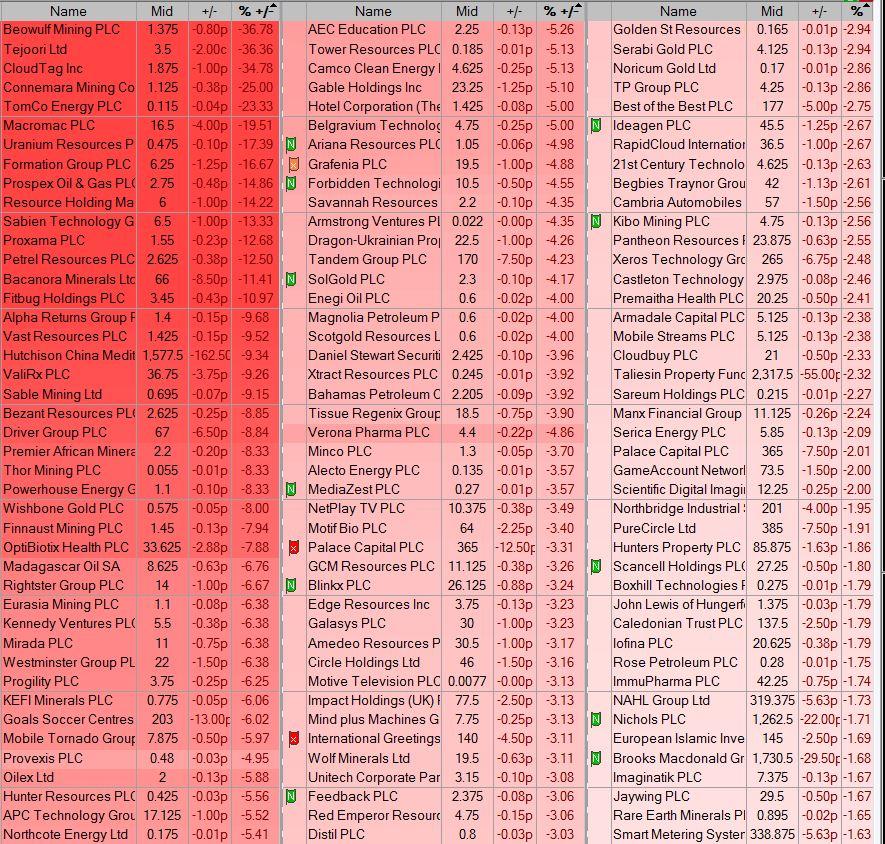
Never be afraid of taking advantage of lower share prices of companies that you follow when they are suddenly being hit for six by shock announcements.
The market always overreacts to such news that was unexpected, it is a form of protection some might say.
How many times have we seen it before?
A company announces that expectations will suddenly not be met, its shares fall drastically, but that is when the ‘cheap buyers’ strike.
They come in for a ‘quick recovery bounce’ or because the particular company’s value is suddenly out of line with its sector.
Just such ...
Brave Bison acquistion expands sports media business
Digital advertising firm Brave Bison has announced plans to acquire sports marketing company Engage Digital Partners Limited for up to £10.6 million, payable in cash and shares over three years.
The deal, expected to be completed in early January 2025, will significantly expand Brave Bison’s sports and entertainment division.
Engage, established in 2012 following a management buyout from Endemol Sport, works with major sports brands, including Formula 1, ICC, Real Madrid, and New Zealand Rugby. The company employs 130 people across offices in London, Dubai, India, and Australia and provides round-the-clock service delivery.
The merger will combine Engage’s operations with Brave Bison’s existing sports network, which includes partnerships with PGA Tour, Ryder Cup, and US Open. The enlarged sports and entertainment division is expected to generate £16 million in pro-forma turnover.
The acquisition terms include an initial enterprise value of £2.1 million, equity consideration of £2.0 million, and potential contingent payments of up to £6.5 million over three years, subject to performance conditions. The equity portion is tied to Brave Bison achieving a minimum share price of 3p per share and meeting financial targets.
While Engage is projected to generate £6.9 million in turnover with an adjusted EBITDA loss of £0.3 million for the year ending December 2024, the acquisition is expected to become earnings accretive for Brave Bison in the medium term.
Alongside news of the acquisition, Brave Bison reported trading in line with market expectations, with anticipated FY24 Adjusted EBIT of £3.6 million and projected net cash of £7.0 million following the acquisition.
Aquis weekly movers: Invinity Energy’s next generation
Invinity Energy Systems (LON: IES) has launched its next generation flow battery ENDURIUM. This has higher efficiency and is designed to be manufactured in Scotland in high volumes. This new product is likely to be the main source of orders from now on. There are already orders for ENDURIUM. Invinity Energy Systems is expected to move into profit in 2026. The share price jumped 61.5% to 1.05p.
Fuel additives developer SulNOx Group (LON: SNOX) has raised £1.875m via subscription at 46.6p/share and an exercise of warrants at 29p/share. A subsidiary of McQuilling has invested in the subscription and it is the preferred partner in the US market. The share price increased 12.8% to 61.5p.
Vinanz Ltd (LON: BTC) intends to move to the Main Market. This depends on the FCA approving the prospectus. Shares will be issued to all option and warrant holders. The share price rose 7.02% to 15.25p.
Cannabis-based medicines developer Ananda Developments (LON: ANA) says its MRX1 drug candidate has passed through drug stability timepoints ahead of a phase 1 and two phase 2 studies. The share price is 2.67p higher at 0.385p.
FALLERS
Shares in Incanthera (LON: INC) continue to fall after it was accused of potential patent infringement in the formulation of its Skin + Cell skincare range. Even though Incanthera believes that there is no merit to the accusation, the launch of the Skin + Cell range of products has been delayed. The share price slipped a further 26.1% to 4.25p.
Equipmake (LON: EQIP) has launched a strategic review that could lead to the sale of the company. The company is still waiting for the final agreement for a $6m licence with a commercial vehicles manufacturer. It is running short of cash with £1.9m currently in the bank. That should last until March. A further share issue or a strategic partner will be required if Equipmake is to remain independent. VSA has been appointed as corporate adviser. The share price fell 6.25% to 1.875p.
Marula Mining (LON: MARU) says contract mining should begin at the Blesberg lithium and tantalum mine in South Africa during February 2025. There is a planned leasing agreement for support vehicles. The share price dipped 5.56% to 4.25p.
Coinsilium (LON: COIN) has appointed Oberon Capital as its joint broker. The company has entered a strategic advisory services agreement with TAND3M.io. The share price is 2.33% lower at 4.2p.
AIM movers: Warpaint London bid for Brand Architekts
Warpaint London (LON: W7L) is bidding 48p/share in cash for Brand Architekts (LON: BAR), valuing the company at £13.9m. There is a share alternative. Warpaint London believes that its relationships with retailers will help to boost sales of the health and beauty brands, such as Skinny Tan and Super Facialist, owned by Brand Architekts, which has high overheads compared with its revenues. The acquisition should be earnings enhancing in 2025. Brand Architekts shares doubled to 48p. Warpaint London shares fell 6.12% to 522p. That is after raising £14m at 510p/share with up to £1m more to come from a retail offer.
Cannabis-based medicines developer Celadon Pharmaceuticals (LON: CEL) has finally received the balance of £150,000 from the May 2024 subscription at 105p/share. The share price increased 40.8% to 17.6p.
Blue Star Capital (LON: BLU) said it did not know why the share price was rising. After this announcement it turned out that Christophe Sebakhi had increased his shareholding from 4.1% to 6.2%. The share price ended the week two-fifths higher at 0.0175p.
K3 Business Technology (LON: KBT) is selling its UK SYSPRO business NexSys to SYSPRO owner Advent for £36m. This business generated 109% of group EBITDA and 28% of group revenues. K3 Business Technology intends to return cash to shareholders. The company’s remaining operations are K3 Fashion and Pebblestone, the IKEA software business and other retail software. The share price improved 37.6% to 86p.
FALLERS
SDX Energy (LON: SDX) plans to leave AIM because of the costs of the quotation and the greater flexibility as a private company. Potential investors would prefer to invest in an unquoted company. It is the intention to put in place a matched bargains facility. The strategy continues to be to become a vertically integrated gas and renewable energy producer in Morocco. If shareholders agree, then the quotation will be cancelled on 9 January. SDX Energy joined AIM in May 2016 at 18p/share. The share price slumped 63.6% to 0.71p.
Fashion retailer Quiz (LON: QUIZ) has been hit by falls in online and stores revenues, although there was an improvement in international revenues, in the four months to the end of November. There was a sharp decline in November. Overall revenues fell 6% to £24.9m. Annual costs will be increased by £1.7m as a consequence of the Budget. Net debt is £2.8m and the £4m of bank facilities could be fully utilised by early 2025 and additional funds will be required. The company’s founder has offered a £1m loan. The share price dipped 43.2% to 3.04p.
United Oil & Gas (LON: UOG) has not received the $620,000 owed following the disposal of Egyptian and discussions continue with EGPC. Costs are being reviewed and they will be reduced to a bare minimum. Talks concerning the farm out in Jamaica have been suspended until the New Year. The share price dipped 41% to 0.115p.
Goldstone Resources (LON: GRL) is in talks with Blue Gold International concerning an extension for the repayment of the £2.7m owed through convertible loan notes. It was due to be repaid at the end of November and Goldstone Resources has five business days to negotiate the extension or it will be obliged to repay the loan notes. The share price fell 39.7% to 0.95p.
FTSE 100 slips after Non-Farm Payrolls beat expectations
The FTSE 100 slipped on Friday after the US Non-Farm Payrolls beat expectations, suggesting underlying strength in the US economy. This puts a damper on the argument for dramatic changes to borrowing costs.
London’s flagship index had been trading in a tight range for much of the week, and the highly anticipated monthly US jobs report did little to provide a catalyst for the FTSE 100 to break out of the 8,320 – 8,380 range.
After an October report heavily influenced by storms, the US bounced back with the creation of 227,000 jobs in November. Economists expected 200,000 jobs to be added to the US economy in November.
“The November US labour market report showed a rebound from the dismal, weather-affected October report, as the overall employment situation remains resilient,” said Michael Brown Senior Research Strategist at Pepperstone.
“Headline nonfarm payrolls rose by 227k in November, a touch above consensus expectations, but well within the forecast range. At the same time, the prior 2 months of data was revised higher, by a net 56k, taking the 3-month average of job gains to +173k.”
The strength of job creation will present something of a dilemma to investors who were hoping for additional interest rate cuts in the coming months.
The US equity market has enjoyed a prolonged period of strength supported by hopes of interest rate cuts but today’s data only serves to push the expectations of future rate cuts further out.
The conundrum for investors is whether the Federal Reserve should await negative economic news with ramifications for corporate earnings before cutting rates or attempt to orchestrate a soft landing. Both options have their risks.
Judging by the reaction in equities after the news hit the wires, the Non Farms have done little to alter many traders views on the market and the promise of Donald Trump seems to be enough to support stocks for now.
“The question investors will be asking themselves is, with the US economy booming does the Fed really need to keep cutting interest rates,” said Nicholas Hyett, Investment Manager at Wealth Club.
“The incoming Trump administration is set to do everything it can to spur domestic economic activity, and with tariffs potentially pushing up the cost of imports the combination of surging demand and restricted supply could trigger a resurgence in inflation. With labour markets seemingly doing well enough on their own interest rate cuts look increasingly unnecessary.”
The major corporate news on Friday was the agreement by Direct Line to a revised takeover offer by Aviva.
“Direct Line has finally relented, accepting Aviva’s 275p per share offer after resisting an earlier proposal in recent weeks,” said Matt Britzman, senior equity analyst, Hargreaves Lansdown.
“The deal, a mix of cash, shares, and a small dividend, delivers a 73% premium to Direct Line’s pre-offer price. Direct Line’s board had been holding out, insisting they could make it on their own. But even they had to admit that Aviva’s proposal is a golden ticket they’d struggle to match independently. Confidence in their solo strategy aside, this offer was just too good to pass up.”
Britzman continued to explain the move by Aviva was relatively opportunistic after a torrid year for Direct Line.
“Let’s not sugarcoat it: Direct Line has hit some serious potholes lately,” Britzman said.
“Market share has been sliding, underwriting hasn’t exactly been flawless, and regulators have been knocking on the door. But with a fresh leadership team at the wheel, the company has been working on a bold turnaround plan. For Aviva, the price is pushing the limit of good value but snapping up Direct Line could be a strategic jackpot.”
Frasers Group was among the top fallers, shedding 2.5%, as brokers lowered their price targets after the retailer lower profit guidance this week.
AIM movers: Likewise gaining market share and SDX Energy leaving AIM
Distribution Finance Capital (LON: DFCH) says trading has been better than expected and there is a write back on the RoyaleLife settlement. Panmure Liberum has upgraded its pre-tax profit forecast before the additional £3m RoyaleLife write back, which then adds a further 21% upgrade. The 2024 pre-tax profit forecast is £18.7m, falling back to £13m in 2025. The loan book will end the year at £650m-£700m, but the net interest margin will be higher than anticipated. The share price is 13.9% higher at 37p.
Floorcoverings distributor Likewise (LON: LIKE) in contrast with some companies had a strong October and November when sales were 11% ahead. Year-to-date growth is 7.5%, which represents an increase in market share. Margins are also improving. Zeus has maintained its 2024 pre-tax profit forecast at £2m, although sales are ahead of expectations. The share price rebounded 11.3% to 17.25p.
Semiconductor designer EnSilica (LON: ENSI) has won another long-term design and supply contract. The total contract value for the deal with an industrial test equipment provider will be more than $30m over ten years. This comes with an upfront payment to help the cash position. The share price improved 10.3% to 48p.
Ethernity Networks (LON: NET) chief executive David Levi has acquired five million shares at 0.13p/share on top of the 4.89 million shares bought in the placing at 0.133p/share. The share price recovered 9.62% to 0.1425p.
Nativo Resources (LON: NTVO) intends to acquire the Morrocota gold mine in Peru, which is 3km away from the Bonanza gold mine, where it has a 50% stake. The two mines share some facilities, and they have the same quartz vein systems. The cost is £125,000 in shares issued at 0.00288p/share. The share price rose 8% to 0.0027p.
FALLERS
SDX Energy (LON: SDX) plans to leave AIM because of the costs of the quotation and the greater flexibility as a private company. Potential investors would prefer to invest in an unquoted company. It is the intention to put in place a matched bargains facility. The strategy continues to be to become a vertically integrated gas and renewable energy producer in Morocco. If shareholders agree, then the quotation will be cancelled on 9 January. SDX Energy joined AIM in May 2016 at 18p/share. The share price slumped 55.3% to 0.85p.
Fashion retailer Quiz (LON: QUIZ) has been hit by falls in online and stores revenues, although there was an improvement in international revenues, in the four months to the end of November. There was a sharp decline in November. Overall revenues fell 6% to £24.9m. Annual costs will be increased by £1.7m as a consequence of the Budget. Net debt is £2.8m and the £4m of bank facilities could be fully utilised by early 2025 and additional funds will be required. The company’s founder has offered a £1m loan. The share price dived by 34.4% to 3.51p.
Rockfire Resources (LON: ROCK) is raising £660,000 via a placing at 0.12p/share and there is a retail offer than could raise a further £120,000. The cash will be spent on the development of the Molaoi zinc silver lead germanium project in Greece. The share price fell 22.9% to 0.135p.
AI stocks GenIP, Cel AI and Sealand Capital Galaxy all deserve higher valuations
The growth prospects for London-listed GenIP, Cel AI, and Sealand Capital Galaxy suggest they deserve higher valuations given the potential size of the Generative AI market in which they operate.
According to estimates by various research houses, the global Generative AI market will be worth anything between $255bn and $826bn by 2030.
When you look at GenIP, Cel AI, and Sealand Capital Galaxy’s valuations, it’s clear that current market pricing does not reflect the extent of the opportunity in Generative AI.
Yes, these are higher-risk small-cap companies at the beginning of their growth cycle, but the potential for rapid top-line growth is underappreciated.
We delve into each company’s operations and the specific real-world problems it uses Generative AI to solve for its clients.
GenIP
Revenue-generating GenIP has already achieved material orders for its Generative AI analytics services and offers investors the potential for exponential growth.
After developing and implementing its own Generative AI models, GenIP has demonstrated a clear demand for its new Generative AI-enhanced services, which are designed to assist in commercialising new technology.
The company plays a vital role in assisting research institutions’ Technology Transfer Offices (TTOs) in commercialising new technology discoveries and providing the leadership to take innovations to market.
GenIP is ‘laser-focused on building’ on its early momentum and is on the verge of launching a marketing campaign that should accelerate traction with its target market of universities, investment funds and corporate research units.
Since its IPO in October, the company has announced a doubling in the pace of orders from a Fortune 100 technology company and the penetration of global markets with new customers in Saudi Arabia. GenIP currently works with around 40 research institutions and plans to roll its services out to potentially 1000s more.
The company offers two core services: Invention Evaluator, which provides Technology Transfer Offices with detailed analytical reports to help them assess the commercial prospects of new technology discoveries, and Vortechs, an executive search service enhanced by Generative AI and targeted at the technology transfer market.
Internet giants Google and Yahoo were founded following technology transfer by research institutions, while the mRNA vaccine was made possible following university research.
These are just a few examples of the commercial success of technology transfer. GenIP is helping Technology Transfer Offices ensure more such discoveries reach their full market potential.
Sealand Capital Galaxy
Sealand Capital Galaxy recently announced a proposed investment in EVOO AI. The deal is yet to be confirmed as it is subject to a due diligence period. The recent share price appreciation may unwind rapidly if the deal falls through, and investors should treat the dramatic rally with caution.
That said, should the investment go ahead as planned, Sealand Galaxy will have secured exposure to an exciting corner of the Generative AI market.
EVOO AI plans to revolutionise the luxury goods sector through advanced data analytics and consumer insights. The company’s flagship application, Olive, is positioned as a luxury e-commerce marketplace, differentiating itself through influencer-curated boutiques and personalised shopping experiences. Olive is due to launch in 2025.
The technology combines proprietary and open-source AI models to analyse market trends and consumer behaviour, providing detailed intelligence to consumers, retailers, and luxury brands.
EVOO has outlined an ambitious 12-month roadmap that includes completing an equity funding round and expanding its network of luxury brand partnerships. The company also plans to soft-launch its Olive marketplace platform, with a focus on onboarding established influencers. Additionally, EVOO is exploring the possibility of a public listing to enhance its access to capital markets.
Cel AI
Cel AI targets the make-up and skincare market with AI technology that helps consumers select products. Defined as ‘Your personal beauty
advisor, in your pocket’ Cel AI’s AI chat features provide beauty tips and access to thousands of product offers.
As demonstrated by this week’s news that Warpaint London is to acquire Brand Architekts, the beauty market is highly competitive, with hundreds of different options for consumers. Cel AI’s service will be well-placed to assist in matching consumers with brands and represents an opportunity to streamline new product discovery with the power of AI.
The company hasn’t released much detail about its plans to establish a foothold in the market, but any news of traction, however large or small, could make the current £400k market cap look very good value.
Aviva agrees £3.6bn Direct Line takeover
Insurance giants Aviva and Direct Line have announced an agreement for the takeover of Direct Line by Aviva after a revised bid was accepted by Direct Line.
The proposed deal values Direct Line at 275p per share, and comprises three elements: a cash component of 129.7p per Direct Line share, which Aviva plans to fund through its existing cash resources; an equity component of 0.2867 new Aviva shares per Direct Line share; and dividend payments totalling up to 5p per Direct Line share, subject to board approval.
The offer presents a significant short-term uplift for Direct Line shareholders, representing a 73.3% increase over Direct Line’s closing share price on November 27, 2024, and a 49.7% premium compared to the company’s six-month volume-weighted average share price leading up to that date. Upon completion of the transaction, Direct Line shareholders would hold approximately 12.5% of Aviva’s issued share capital.
Direct Line rebuffed an initial offer totalling 250p per Direct Line share and has secured an additional 10% for its shareholders.
Direct Line said that while it maintains confidence in Direct Line’s standalone prospects and its new leadership team, it recognises the potential value creation opportunity presented by the combination. The proposed merger is expected to generate substantial synergies, potentially delivering additional value for shareholders of both companies.
“Direct Line has finally relented, accepting Aviva’s 275p per share offer after resisting an earlier proposal in recent weeks,” said Matt Britzman, senior equity analyst, Hargreaves Lansdown
“The deal, a mix of cash, shares, and a small dividend, delivers a 73% premium to Direct Line’s pre-offer price. Direct Line’s board had been holding out, insisting they could make it on their own. But even they had to admit that Aviva’s proposal is a golden ticket they’d struggle to match independently. Confidence in their solo strategy aside, this offer was just too good to pass up.
“Let’s not sugarcoat it: Direct Line has hit some serious potholes lately. Market share has been sliding, underwriting hasn’t exactly been flawless, and regulators have been knocking on the door. But with a fresh leadership team at the wheel, the company has been working on a bold turnaround plan. For Aviva, the price is pushing the limit of good value but snapping up Direct Line could be a strategic jackpot. It cements their place as a heavyweight in the UK home and motor insurance markets and brings fresh opportunities to steer Direct Line’s transformation, while squeezing out efficiency gains from their combined scale.”