S&P 500 technical analysis review 25th March 2024

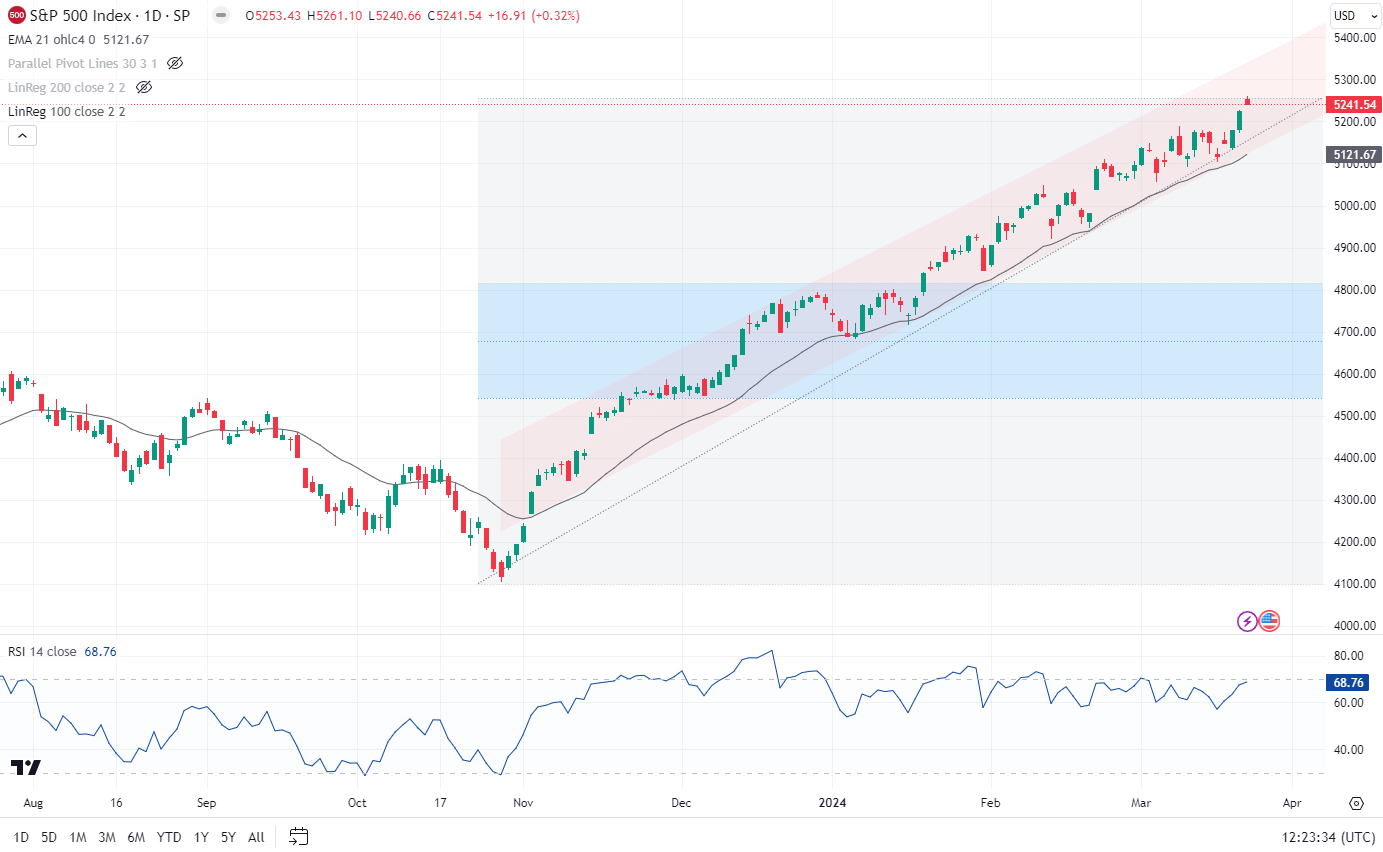
In the first of our weekly reviews, we will take a look at how the S&P 500 sits currently. The chart describes how price action has been in an extremely tight bullish trend since the lows in October last year. Ever since the Fed started to suggest thatthe rate hiking cycle had peaked and that rate cuts were looming, the market has seen steady and consistent buying.

On this chart we also throw up a Fibonacci retracement channel calculated from the October lows to the recent all time highs. This is not meant to be a forecast of where price action will fall to, but instead it is meant to highlight where the index could fall to.

After a strong move like this it is quite common for price action to retrace around 50% of the previous move. The 50% level currently is around 4,700.

Were this to happen in the coming months you will doubtless read many reports of “The S&P 500 is crashing”. In reality this would only be a fall of around 11% and the long term bullish trends would remain intact, so it would not be a major long-term concern. So

 investors and traders alike need to be aware that a simple relatively minor correction down towards the 4,700 could occur in the coming months, if the Fed for example was to push back hopes of future rate hike cuts.

There are wider concerns on the underlying state of the US economy, there is plenty of anecdotal evidence to suggest that the US consumer is starting to feel the pinch. However the top tier companies in the S&P 500 have so far been largely immune to this effect.

So, unless/until more evidence emerges the extremely strong bullish trend looks set to continue. In order to turn more cautious we would need to see price action drop out of this trend, currently around 5100. As this would be the first warning sign of a more meaningful correction.

As things stand though the short and medium term trends are strong, leading to a positive skew on the index and its constituents, and that on any future weakness a move towards 4,700 would seem to be a natural move.

Why companies left AIM in February 2024

There were three companies that left AIM in February 2024, plus the reverse takeover of Location Sciences by Sorted Group Holdings (LON: SORT). Two of the companies got into financial difficulties and the other was taken over. MicroSalt (LON: SALT) was the only new company joining AIM during the month.
12 February
Safestyle UK
Safestyle UK is a PVC windows manufacturer, which had a mixed time on AIM. In recent years it has generally lost money and trading has been tough. The board appointed administrators from Interpath for the main subsidiaries in October 2023. At the end of 2023, the board s...

Director deals: Trident Royalties directors spot a bargain

There has been director buying in shares of Trident Royalties (LON: TRR) following its fourth quarter statement and the finalising of a new credit facility.
An organisation related to executive chairman Al Gourley bought 350,000 shares at 35.91p each and 115,875 shares at 34p each, taking his stake to 2.73%. Finance director Richard Hughes bought 73,040 shares at 35.33p each and 50,000 shares at 34.2p each, taking his stake to 0.34%.
Non-executive Leslie Stephenson acquired an initial 4,000 shares at an average price of 46.6 cents each.
The current share price is 34.25p, which values Trident R...

Aquis weekly movers: S-Ventures selling snacks to AIM shell

Steve Hutchinson has taken his Oscillate (LON: MUSH) stake above 3%. The share price improved 35.3% to 0.575p.

TruSpine Technologies (LON: TSP) chairman Geoffrey Miller has increased his shareholding to 7.24%, while Oberon Investments raised its stake to 12.6%. The share price recovered 23.1% to 0.8p.

Gunsynd (LON: GUN) shares rose 17.9% to 0.165p on the back of an institutional investor investing $1m ($750,000 in cash and $250,000 in support services) in the US subsidiary of Rogue Baron (LON: SHNJ), where it currently has a 17.45% stake. Rogue Baron has also raised £20,000 at 0.5p/share. The share price is 1.18% ahead at 0.43p.

Aquis Stock Exchange owner Aquis Exchange (LON: AQX) increased revenues from £19.9m to £23.7m, while pre-tax profit rose from £4.5m to £5.2m. The Aquis Stock Exchange revenues improved from £1.6m to £1.8m. The main growth came from technologies and data. The share price is 9.38% ahead at 385p.

Cadence Minerals (LON: KDNC) says that the capital spending optimisation programme has been completed at the Amapa iron ore project. Savings of $63.2m have been identified and production could be 5% higher at 5.5 Mtpa of iron ore concentrate. The share price is 5% higher at 5.25p.

Supernova Digital Assets (LON: SOL) has completed the acquisition of Hyperslot PTE for £225,000 in shares at 0.15p each. Andrew Offit increased his shareholding from 14.1% to 15.2%. The share price increased 3.7% to 0.14p.

Arsen Torosian has replaced David Carr as chief executive of Tap Global Group (LON: TAP). He is the largest shareholder and was previously chief strategy director. Steven Borg will become finance director. The share price edged up 3.57% to 1.45p.

FALLERS

S-Ventures (LON: SVEN) has agreed to sell its food and snacks business in return for shares in AIM-quoted RiverFort Global Opportunities worth £3.5m. That would leave S-Ventures as an investment company with shares in the acquirer. Sales for the 12 months to September 2023 were £17.4m, rising to the £21.6m in the 15 months to the end of 2023. Net debt was £7.1m at the end of September 2023. An additional £3m of loans have been agreed, including £1m from RiverFort Global Opportunities. The share price slumped 25.5% to 2.05p.

KR1 (LON: KR1) has invested $600,000 in Moondance Labs, which is building Tanssi, which helps appchain deployment. The share price dipped 5.41% to 87.5p.

Marula Mining (LON: MARU) has signed a long-term offtake agreement with Fujax UK for the Blesberg lithium and tantalum mine in South Africa. This an agreement for 100% of production until the end of 2026, with a minimum of 50,000 tonnes at a grade of 6% lithium. There is an option for a further three years. A mining right has been received from the authorities for the plans to expand the stockpile reprocessing operations. The share price fell 2% to 12.25p.

Brewer Shepherd Neame (LON: SHEP) improved like-for-like retail sales by 6.2%, although beer volumes fell 10.5% with own beer volumes down 16.7%. Overall, interim revenues grew 4% to £89m and underlying pre-tax profit was 10% ahead at £3.8m. The brewing division returned to profit. The interim dividend was 5% ahead at 4.2p/share. Beer volumes continue to decline, while the retail sales growth rate has slowed. The share price slipped 1.06% to 702.5p.

AIM weekly movers: Roadside Real Estate wakes up to stake value

1

Roadside Real Estate (LON: ROAD) shares soared 129% to 8p after it sold part of its stake in Cambridge Sleep Sciences to CGV Ventures 1 for £6m. The total stake cost £2.7m and Roadside Real Estate still owns 65%, having sold a 10% stake, so it still has to be consolidated. Management is considering selling the rest or demerging the company so that it can concentrate on its core property interests.

Digital media company XLMedia (LON: XLM) is selling European and Canadian gaming assets to Gambling.com for an initial $37.5m with potential deferred consideration of $5m. Some of this cash may be paid out to shareholders. These assets generated 2023 revenues $21.4m and underlying EBITDA of $6.6m out of estimated group 2023 revenues of $50m and EBITDA of $12m. Pro forma net cash is likely to be around $35m, after taking account of deferred consideration of $4m payable for past acquisitions. Cavendish estimates that XL Media is worth £48m, including the cash. The share price improved 93.8% to 12.5p, valuing the company at £32.5m.

Investment company APQ Global Ltd (LON: APQ) says book value was 23.87p/share at the end of February 2024, up from 6.02p/share at the end of 2023. This is based on the unaudited revaluation of private investments, particularly US-based Delphos International. At the end of June 2023, the Delphos International stake was valued at $6.26m. The share price jumped 83.3% to 5.5p, having been 9p at one point.

Personalised diagnostics developer GENinCode (LON: GENI) says that the risk of ovarian cancer algorithm test has received a recommendation by NICE as the preferred test for ovarian cancer surveillance in individuals deemed to be at risk. The focus is identifying and managing familial and genetic risk. The earlier ovarian cancer is diagnosed the better. The share price rose 64.3% to 5.75p.

FALLERS

Live Company Group (LON: LVCG) returned from suspension 61% lower at 0.8p. This follows a refinancing and sale of majority interest in StartArt. Creditors are being settled in shares and a £1.77m convertible loan provided by the chairman, as well as converting some of his loan notes. A placing raised £352,000 at 1p/share. There could be more cash to come from strategic investors.

Metallurgical coal miner Bens Creek (LON: BEN) has drawn down $7.5m of its working capital facility provided by shareholder Avani Resources, which has also advanced an additional $1.25m. The share price halved to 2p.

Hummingbird Resources (LON: HUM) says operations at the Kouroussa gold mine have been suspended by the main contractor because of a dispute. Contract volumes have not been met because of delays. Notice has been provided to Corica that if production does not recommence by 19 March, then the contractor can be replaced. However, Corica says that Hummingbird has breached the contract by failing to make payments, but the company disputes this. Net debt was $140m at the end of 2023 and $77m is due to be repaid this year. Management is in close contact with the primary lender. The share price dipped 47.3% to 5.8p.

Supercapacitors manufacturer Cap-XX (LON: CPX) has secured £2m from a placing and subscription at 0.1p/share ensuring that it does not run out of money. Dr Graham Cooley increased his stake from 3.13% to 11.1% prior to the fundraising. Cap-XX settled its patent litigation with Maxwell/Tesla ahead of the fundraising, but the terms are confidential. Up to £200,000 more can be raised through a REX retail offer. The offer closes at 3pm today. The share price declined by 40.5% to 0.116p.

Cornish Metals eyes global tin demand as South Crofty asset move towards production

After presenting at our Investor Conference at the London Stock Exchange (LSEG) 13th March, we explore Cornish Metals and its progress towards restarting tin production at the South Crofty tin mine.

Key facts CORNISH METALS (LON & TSX-V: CUSN)

Market capitalisation: £50.5m

Price: 9.35p

52-week high/low 16p / 8.90p

Analyst Valuation per share: 32p – 48p

Cornish Metals is a mineral exploration and development company, which holds extensive mineral rights in an underexplored region in the UK, is mainly focused on its South Crofty tin project in Cornwall.

As a group its flagship projects are the South Crofty tin project and the United Downs copper-tin project.

The United Downs copper-tin project area is located within the boundaries of, or adjacent to, four former copper, tin and zinc producing mines.

The company has recently made a new discovery at United Downs, which is a near surface, high-grade copper-tin discovery, some 5 miles to the east of South Crofty.

In addition, the company holds 15,000 hectares in exploration licenses.

It also maintains an interest in the Nickel King project, an exploration property which is prospective for nickel in the Northwest Territories in Canada, and the Sleitat project, an exploration property which is prospective for tin and tungsten in Alaska.

The company also holds a royalty on two non-producing tungsten assets located in the Northwest Territories and the Yukon, Canada.

Additionally, it owns interests in exploration properties prospective for tin in Alaska and nickel in the Northwest Territories, Canada.

Cornish Metals holds a free carried interest and royalty on lithium projects in Cornwall through Cornish Lithium.

The South Crofty Story

Cornish Metals is principally centred upon developing the considerable opportunities in developing the South Crofty tin mine in Cornwall.

Tin mining in that region can be traced back to 2,300 B.C.

Large-scale production first started at South Crofty in the mid-1600s, although the first documented production dated in 1592.

The mine was in operation intermittently from then until its closure in 1998, brought about by the prolonged period of depressed tin prices.

It has been identified that historical production between 1700 to 1998 totalled over 450,000 tonnes of tin from the Central Mining District of Cornwall, in which South Crofty is situated.

The mine went into serious decline after 1985 and eventually closed in 1998.

Several companies attempted to revive the mine between 2001 and 2013.

Significant advances were made, primarily the agreement to secure a site for future mill construction, and the grant of a mining permit which is valid until 2071, subject to certain planning conditions being met.

Unfortunately, the timing of the mine permit grant in 2013 coincided with very poor market conditions in the resource sector and the assets were put into administration in 2013.

The mine has seen production from near-surface copper mineralisation and deeper tin-only mineralisation.

The focus has been to evaluate the deeper tin-only mineralisation that occurs primarily from a depth of 400m below surface.

The project was acquired from Administration by Cornish Metals in 2016.

In 2017 the company completed a Preliminary Economic Assessment that demonstrated the economic viability of re-opening the mine.

The company gained its AIM listing in 2021 and secured a ‘cornerstone investment’ from Vision Blue Resources a year later.

Today the South Crofty tin project is a strategic asset for the long term – with planning permission to construct a new processing plant.

Mineral Resource Estimate

In 2023 the company received an updated Mineral Resource Estimate that increased its expected tonnes by 39% and contained tin by 32% in the Indicated category for its Lower Mine.

It is considered that there is the potential for the identification of further resource growth at South Crofty, while also evaluating its nearby Wide Formation structure interest over a 1.6km strike.

Preliminary Economic Assessment

The company is due to publish a Preliminary Economic Assessment within the next three months, with a Feasibility Study in this Summer.

Today the group is focused on advancing the South Crofty high-grade, underground tin Project through to a construction decision, as well as exploring its additional mineral rights, all located in Cornwall.

The South Crofty project is fully permitted, having underground permission through a mining licence valid until 2071, as well as planning permission to construct a new process plant and with a permit from the Environment Agency to dewater the mine.

Dewatering

Dewatering is an essential process of removing water from a location – virtually every mine site needs to account for dewatering at some point in time.

Most mine operations are susceptible to flooding – some more than others.

The geographic location and climate of the area play a major factor in dewatering needs.

Heavy rainfall, water tables, nearby rivers and lakes can lead to catastrophic flooding that shuts down operations with costly results.

As for underground mines, flooding is usually controlled because these types of mines are not directly influenced by surface waters, so the real concern is how to deal with underground water.

Usually, to keep flooding under control in underground mines, users need to consider:

· Removing potential water hazards

· Filling surfaces that might collapse during or after the flooding process

· Installing water diversion systems

· Installing, at both the surface and underground, a system to monitor hydrogeological and geotechnical aspects, and

· Projecting hydrological and hydrogeochemical development of mine waters

When a mine extends below the water table, due to gravity, the groundwater will infiltrate mine workings, the constant influx leads to flooding and the only way to stop the water is by reducing the water table or continually pumping out the water.

The Dewatering Process started at South Crofty in October 2023 and should be completed before April next year.

Refurbishment, exploration and development work is accelerating at South Crofty with dewatering of the flooded historic mine workings now well underway and a Preliminary Economic Assessment for the resumption of production due to be presented later this year, ahead of a full feasibility study and formal investment decision for first production by the end of 2026.

Now Is The Time To Bend To The ‘Tin Cry’

Tin is a ‘Critical Mineral’, as defined by the UK, USA, and Canadian governments, with approximately two-thirds of the tin mined today coming from China, Myanmar and Indonesia.

It is important to note that there is no primary tin production in Europe or North America.

A little of it is present everywhere in ways that are essential to our quality of life.

Called the ‘glue’ of metals, it is used to bind things together.

Tin connects almost all electronic and electrical infrastructure, making it critical to the energy transition – responsible sourcing of critical minerals and security of supply are key factors in the energy transition and technology growth.

It is a critical component of high-tech hardware and electrical vehicles, and also robotics and renewables use the metal.

When a bar of tin is bent it emits a characteristic creaking, known as the ‘cry of tin’.

Over the next decade tin has many opportunities in lithium ion and other batteries, solar PV, thermoelectric materials, hydrogen-related applications and carbon capture.

South Crofty has the 4th highest grade tin Mineral Resource globally and benefits from existing mine infrastructure including multiple shafts that can be used for future operations.

The company is currently targeting the start of tin mining by the end of 2026.

The Price Of Tin

It has been predicted that the global tin market is projected to shift from a surplus of 6,000 tons in 2023 to a deficit of 5,000 tonnes this year.

On the demand side, rising sales in semiconductors and technology, especially in AI and automotive chips, are expected to bolster tin prices, supported by increased global demand for semiconductors.

In the last twenty years the price of tin has risen significantly from around $3,700 to over $28,000 per metric tonne, while forecasts exist for over $29,000 per metric tonne this time next year.

Shareholders

This group’s equity is listed on both the AIM and the TSX-V markets.

Shareholders include Vision Blue Resources with 25.95% of the group’s 535m shares in issue, other holders include Osisko Development (8.57%), Lansdowne Partners (6.23%), N Reed (5.50%) and finally Management and Directors (3.07%).

Analysts View

In a recent report earlier this month, analysts at Hannam & Partners concluded that the diluted target valuation for Cornish Metals is 32.3p per share.

At brokers SP Angel its analysts consider that Cornish Metals has made significant progress towards a reopening of the South Crofty tin mine and on exploration at the nearby United Downs project.

They note that the company is currently dewatering the South Crofty mine workings in preparation for the completion of a feasibility study later this year.

Management raised £40.5m in equity to fund the dewatering and feasibility study work.

The brokers suggest that South Crofty has the potential to produce approximately 4,000 tonnes pa of tin equivalent and to help the UK become increasingly self-sufficient in tin.

Furthermore, they report that a new discovery at the Wide Formation, Carn Brea has the potential to expand the mine at South Crofty, while work at United Downs could enable a second mine development in later years.

More positively, they conclude that the group’s shares have a valuation of 48p per share.

Following its recent appointment as Joint Broker with SP Angel, Cavendish Capital Markets can shortly be expected to publish its analyst’s views, with the Final Results for the year to end January 2024 being announced within the next month.

FTSE 100 closes in on fresh record highs

The FTSE 100 was closing in on record highs on Friday after another upbeat session took the index within 1% of all-time record highs.

It’s the FTSE 100’s time to shine. After weeks of wallowing in mediocracy as US, German and Japanese equity indices broke to fresh record highs, London’s leading index is now within touching distance of setting new records.

The record high of 8,012 was set over a year ago, in February 2023, and the index has traded as low as 7,257 since then.

“After a stunning session on Thursday, the FTSE 100 continued its ascent at the end of the trading week with a 0.6% rise to 7,930. Little by little it is edging back towards the 8,000 mark which was hit in February 2023,” said Russ Mould, investment director at AJ Bell.

The Bank of England Governor’s suggestions that interest rates would soon be cut ignited a bumper rally in UK stocks yesterday, spilling over into a second session.

The FTSE 100 was up 0.5% at 7,929 at the time of writing after hitting highs of 7,960 earlier in the session.

“Upbeat statements in the UK and US helped heave the FTSE 100 up to the next level in Thursday’s trading, with the index closing at six-month highs. Positive momentum has continued with further gains squeezed out at the open,” said Sophie Lund-Yates, lead equity analyst, Hargreaves Lansdown.

“The overall mood remains better than at the start of the week, as Andrew Bailey suggested markets are right to expect more than one interest rate cut this year. His comments included a positive update on the latest inflationary markers, which showed things are remaining less sticky than feared.”

The gains were broad on Friday, with most industry sectors gaining on the day. Cyclical stocks were in favour, and strength was evident in banks and housebuilders. Miners missed out on the rally and were among the few stocks trading in the red.

Phoenix Group was the FTSE 100’s top gainer, surging over 8% after revamping its dividend policy as cash generation rose to over £2bn in 2023.

“Life insurer Phoenix is incredibly popular with retirees thanks to its generous dividends, and shareholders will be celebrating a near-8% rise in the share price after better-than-expected results and a positive outlook for cash generation and debt reduction,” Russ Mould said.

JD Sports was the biggest faller after UK retail sales declined in February. Next and Frasers Group also suffered.

AIM movers: Trakm8 fails to secure software contract and APQ NAV jump

0

Investment company APQ Global Ltd (LON: APQ) says book value was 23.87p/share at the end of February 2024, up from 6.02p/share at the end of 2023. This is based on the unaudited revaluation of private investments, particularly US-based Delphos International. At the end of June 2023, the Delphos International stake was valued at $6.26m. The share price jumped 175% to 5.5p.

Biodegradable and antimicrobial plastic additives developer Symphony Environmental Technologies (LON: SYM) has raised £1.4m at 3.5p/share and will raise up to £500,000 more through a PrimaryBid retail offer. The issue price was well above the market price, which has risen 42.86% to 3p. Chief executive Michael Laurier is subscribing £105,000. Net debt was £740,000 at the end of February. The additional cash will fund the scale-up of the business and provide working capital during trials by potential customers.

Forecasts for Intercede Group (LON: IGP) have been upgraded following an order for a new testing service for a US Federal Agency. This is the seventh upgrade by Cavendish in the past 12 months and it has raised its 2023-24 earnings expectations from 7.4p/share to 7.7p/share. However, profit is expected to be lower next year. The share price improved 13.1% to 112.5p.

Steel structures supplier Billington (LON: BILN) has revealed new orders worth £90m over 24 months. They are in a range of sectors including food, energy from waste and logistics. Margins are tight and the sector remains tough. This helps underpin the 2024 pre-tax profit forecast of £8m, which is a decline from the estimated 2023 figure of £13.3m, but it is well above the 2022 figure. The share price is one-eighth higher at 450p.

FALLERS

Fleet management technology provider Trakm8 Holdings (LON: TRAK) failed to secure the large software contract it was expecting in the year to March 2024. The contract could be signed later this year, but the 2023-24 forecast will not be met. Trading has also been weak in February and March due to lower insurance connections. Revenues of £16.4m are expected and a loss of £1.4m instead of the forecast pre-tax profit of £1.8m. Next year’s forecast will also be downgraded. The share price has slumped 35.7% to 9p.

Supercapacitors manufacturer Cap-XX (LON: CPX) has secured £2m from a placing and subscription at 0.1p/share ensuring that it does not run out of money. Cap-XX settled its patent litigation with Maxwell/Tesla ahead of the fundraising, but the terms are confidential. Up to £200,000 more can be raised through a REX retail offer. The offer closes at 3pm today. The share price declined by one-quarter to 0.1275p.

Kore Potash (LON: KP2) has raised $530,000 from a convertible loan note issue. They are convertible at 0.38p/share. The cash will be spent on further work on the Kola potash project. Chairman David Hathorn intends to subscribe $150,000 for shares after the 2023 results are published. The share price fell 14.3% to 0.45p.

Hutchmed (China) (LON: HCM) has started the registration stage of the phase II/III clinical trial of sovleplenib in adults with warm antibody autoimmune haemolytic anaemia in China. Positive trial results can be used for a New Drug Application. The share price dipped 4.17% to 264p.

Good Energy’s attractive valuation set to be reinforced by full-year results

Good Energy is scheduled to release full results on 26th March, and investors can look forward to another year of growth supported by increased customer numbers and the delivery of its strategy to make Good Energy an end-to-end energy services company.

Good Energy supplies its customers with 100% renewable energy generated from a base of around 2,000 UK-based clean energy generators. However, Good Energy is far from just an energy supplier.

Having identified consumer demand for the full suite of energy services and taking steps to divest its generation assets, the company has established a vertically integrated business model that services households through all stages of energy consumption.

Vertically integrated household energy services

In addition to supplying energy, the company provides environmentally conscious households with heat pumps, EV chargers, smart meters, and home batteries to store electricity generated from solar power. Good Energy also installs solar panels and facilitates the sale of excess energy back to the grid through the company’s smart export tariffs.

Vertical integration of household clean energy services affords Good Energy a competitive advantage that is integral to winning customers and creating shareholder value. As part of its strategy to become an end-to-end supplier of energy services, Good Energy has recently acquired one heat pump company and two solar installation companies to bolster the rollout to new customers.

Providing customers with solutions that help them generate, store, and even supply energy back to the grid has made Good Energy a one-stop shop that will, over time, help the shares command a higher valuation. Recent acquisitions in the sector and the value attributed to organisations with a diversified energy supply and storage model demonstrate this.

Increasing customer base

Good Energy has successfully grown its customer base, and new customer numbers will be in focus in the group’s upcoming results. The company has identified a total addressable market of 900,000 households it plans to target over the next two years which equates to up to a £10 billion market opportunity.

After recently launching Smart Export and Solar Savings propositions to 40,000 customers as of the end June 2023, the company said it expects to increase this to 75,000 by the end of the year. Should this be achieved, Good Energy will be a major player in the space. This is a major focus for Good Energy in the coming years.

The UK challenger energy company sector is certainly exciting, and Good Energy is one of the most exciting companies in it, both in terms of growth prospects and the opportunity for investors.

The group’s revenue jumped 45.6% to £156.1m in the first half of 2023 and profit after tax soared to £12.0m. EBITDA was £14.9m.

Anecdotal evidence of customer satisfaction from review sites and recognition by the industry press should not be overlooked. The company has a 4.8 Trust Pilot rating which significantly exceeds most of its competitors, by some margin. Good Energy has been ranked at the top of Which’s green energy rankings for three years in a row.

In a trading statement released last year, the company said trading head been ahead of expectations in the ten months to the end of October.

Should the company achieve a similar level of EBITDA growth in the second half as it did in the first half, it will trade at an attractive valuation given its current £57m market cap. Good Energy’s full-year results are set to value the company on an EV/EBITDA basis significantly below that of recent transactions in the space.

Good Energy shares have rallied this week, arguably in anticipation of a strong set of full-year results.

1Spatial targets £400m traffic management market with geospatial SaaS solution

The UK Investor Magazine was delighted to welcome 1Spatial to our Investor Conference at the London Stock Exchange 13th March.

In this article, we feature geospatial SaaS company 1Spatial, summarising its investment case as presented by the team at last week’s event.

Key facts 1Spatial (LON:SPA)

Market capitalisation: £66m

Price: 59p

52-week high/low 65p / 44p

Analyst Target Price: 80p

Based in Cambridge, with some 350 employees globally, the highly innovative 1Spatial group, is a global leader that has been at the forefront of providing software to manage location data for over 30 years.

It provides Location Master Data Management software, solutions and business applications, primarily to the Government, Utilities and Transport sectors via the 1Spatial platform.

The group, which has operations in the UK, Ireland, USA, France, Belgium, Tunisia and Australia, helps its customers to make better business decisions by unlocking the value of location data.

The group’s user-friendly, no-code, cloud-enabled solutions and business applications facilitate automated data governance, while delivering increased efficiencies and significant cost-savings.

Its solutions ensure data governance, facilitating the efficient, effective and sustainable operation of customers around the world.

Three Main Platforms

The generator for the group’s development into two new markets is based upon its existing enterprise business – namely its Location Data Management software platform, which is the heart of 1Spatial and its competitive advantage.

The fast-developing other platforms are two new high gross margin Software as a Service (SaaS) platforms, which are cloud-based and fully scalable.

SaaS is a software licensing and delivery model, where software is licensed on a subscription basis and is centrally hosted.

1streetworks is a platform that can create a compliant traffic management plan in less than two minutes, requiring no specialist software or hardware, able to be accessed from anywhere, on any browser in real time by all stakeholders.

The 1Streetworks’ cloud-based SaaS solution is the first solution in the market to fully automate the production of traffic management plans, diversion routing and asset inventory lists and has the potential to fundamentally change the industry.

It is worth noting that there are some 4m roadworks a year on low-speed roads alone, which gives the group an addressable market worth over £400m in ARR.

Aimed at the US market, the NG9-1-1 (Emergency Services) platform is the next generation cloud service that enables counties and cities to cleanse their data, ensuring compliance with National Emergency Number Association standards and ensuring accuracy of location data for NG9-1-1 call routing.

Geospatial Data Analysis

Geospatial data analysis involves collecting, combining, and visualising various types of geospatial data which is used to model and represent how people, objects, and phenomena interact within space, as well as helping to make predictions based on trends in the relationships between places.

The company aims to solve the world’s most difficult geospatial challenges with its leading software and solutions, thereby enabling its customers to make better informed decisions saving money, saving time, saving lives and contributing to a more sustainable world.

The Geospatial Information Systems Market is currently worth $10bn, which is estimated to more than double by 2027 to $21bn, and secondly, the mainstream Master Data Management market, which is worth $16.6bn but estimated to triple by 2030 to $54bn.

The 1Spatial Platform

The 1Spatial platform is a comprehensive set of data and system agnostic LMDM software components which helps ensure master data is compliant, current, complete, consistent, and coordinated – and that customers can be confident it will remain that way as it evolves.

It allows them to master their data on any device, anywhere, anytime and can be deployed as SaaS in the cloud, on-premise, or as a hybrid of both.

The 1Spatial Platform consists of a complete set of LMDM software components, which combine servers, portals, dashboards, software development kits, application

programming interface, data connectors, business-focussed applications, the patented 1Integrate rules engine and the 1Data Gateway self-service web portal.

Group Clients

The group works together with government, utility and transport sectors around the world to meet the green agenda, support the investment in infrastructure upgrades and help organisations implement strategies in response to the digital transformation taking place across all industries.

It collaborates with global partners on large-scale data transformation projects and tap into a broader network of prospective clients.

Globally the company’s 1,000 plus clients include national mapping and land management agencies, utility companies, transportation organisations, government and defence departments.

The group’s key customers are located in over 25 countries across the globe.

In the UK & Ireland its clients include UK Power Networks, HS2, United Utilities, Ordnance Survey, the Department for Environment Food & Rural Affairs, and the Rural Payments Agency amongst hundreds of others.

In the US its fast-growing customers list includes Google, United States Census, Coltrans, and an increasing number of States Government bodies.

Included in its France & Belgium clients roll are EDF, VINCI, Veolia, Airbus, and Engie.

In Australia Hunter Water, Nova Systems, North East Water are amongst businesses on its clients list.

Its Partners

The company partners with major technology consultancies and GIS providers such as ESRI, CGI, Atkins, Version 1, QinetiQ, Atos, Infosys, Version1, VertiGIS Studio and Landmark.

Its partners include tech consultancies, systems integrators, software developers, professional services firms and geospatial specialists.

Recent Orders

The group continues to invest in its SaaS based solutions, notably 1Streetworks in the UK alongside NG911 in the US.

Trials for both these products have progressed well over the last 12 months, resulting in the first 12-month licence for 1Streetworks with UK Power Networks and five annual NG911 SaaS licences.

In late February this year following completion of a successful paid trial, the UK Power Networks gave the company a 12-month contract for its 1Streetworks Traffic Management Plan solution.

UK Power Networks has 190,000km of cables and delivers thousands of streetworks every year across London, the South-East and East of England, to maintain safe and reliable power supplies to 19m people.

The company has a further four paid trials currently in place, together with several additional paid trials due to commence in the first half of 2024 across utilities, highway authorities and traffic management organisations.

For the NG911 SaaS application, the company is exploring a partner-led go to market strategy to accelerate the growth, which will provide wider market coverage of this key market.

Going Forward

The group considers that the demand for location data has never been greater.

1Spatial sits right at the heart of significant growth opportunities across multiple sectors, enabling a smarter, safer and more sustainable world.

It has a valuable customer base, while it operates a scalable business model and is enjoying a strengthening financial position.

Targeting ARR Growth

Annualised Recurring Revenue is the annualised value at the year-end of committed recurring contracts for term licences and support and maintenance.

The group’s existing enterprise business enjoys a 53% annual recurring revenue.

The potential for its two newer SaaS focussed businesses offers massive scope for very much higher ARR – with 80% being a near-term aim.

The group is focussed on growing recurring subscription term licences, its SaaS strategy and other recurring revenue from long-term contracts will continue to deliver revenue growth with improved gross margins.

Professional Shareholders List

Amongst the larger shareholders in the group’s equity Columbia Threadneedle Investments hold 19.94% of the group’s 110,859,545 shares in issue.

Others include Canaccord Genuity Fund Management (17.63%), Azini Capital Partners (12.37%), BGF Investment Management (6.25%), JO Hambro Capital Management (3.95%), Octopus Investments Nominees (3.71%), Herald Investment Management (3.56%), and Downing (3.02%).

Analyst Views

Ahead of the Final Results to end January this year, being announced on 24th April, analysts Andrew Ripper and Caspar Erskine at Liberum Capital have the shares of the group rated as a Buy, with a Target Price of 80p.

They estimate that the last year’s revenues were £32m (£30m) while its pre-tax profits were £2.2m (£1.8m), lifting earnings up to 2.0p (1.6p) per share, with no dividend being paid.

For the current year their figures suggest £35m in sales, £3.2m profits and 2.8p per share of earnings.

Analysts Max Hayes and Dan Ridsdale at Edison Investment Research have estimates for the 2024 results to show £32.1m sales, EBITDA of £5.5m (£5.0m), with earnings per share of 1.6p.

For the 2025 year to end January they have £35.2m revenues, £6.5m EBITDA and 2.3p of earnings.