Coinsilium (LON: COIN) says that the SalitaFinance AI-driven platform, where it has a 6.7% stake, has received investment from a top ten global infrastructure bank. Another investee company, crypto friendly payments company Greengage Global has secured an agreement with a new regulated partner and this will enable the earlier launch of Greengage’s US dollar currency accounts along with forex and SWIFT payments services for clients. The share price jumped 68.6% to 2.95p. That is just below the peak earlier this year.
Lord Nicholas Monson has increased his stake in Lift Global Ventures (LON: LFT) from 4.96% to 5.33%. The share price soared by three-fifths to 0.4p.
Investment Evolution Credit (LON: IEC) has appointed Axis Capital Markets as corporate broker to help to raise up to £100m via the previously announced bond offering. The share price is 50% higher at 60p. The December 2023 admission price was 4.5p.
RentGuarantor (LON: RGG) has entered a three-year marketing deal with student letting company University Living. The rent guarantee service will be promoted to residential tenants. This will broaden access to the market. The share price increased 1.46% to 278p.
FALLERS
Brewer Adnams (LON: ADB) has asked advisers to explore options for funding growth plans. The B share price fell 19% to 2550p.
Marula Mining (LON: MARU) has published a shareholder circular to gain approval for a subscription by AUO Commercial Brokerage. The first subscription will raise £3.75m at 3.75p/share with further subscriptions potentially raising £4.78m at 10p/share. The general meeting is on 8 March. The share price dipped 2.38% to 10.25p.
London’s leading index stormed higher on Friday, with cyclical sectors leading the charge after a strong Asian session helped boost China-focused stocks and NatWest earnings beating estimates.
The FTSE 100 was 1.3% higher at 7,701 at the time of writing.
“As we head towards the spring, the market seems to be getting more optimistic and, after a tricky few weeks, the FTSE 100 is close to regaining the levels it saw at the start of 2024,” said AJ Bell investment director Russ Mould.
“The inflation shock from the US earlier in the week seems to have been shrugged off for now, even if it has pushed back expectations for when the Federal Reserve will start cutting interest rates.
“Gains in Asia and the US overnight were augmented by better-than-expected results from NatWest which helped drag the rest of the banking sector higher and the retail sector was lifted by a pretty stunning rebound in retail sales in January from December’s miserable figures. The data was way ahead of expectations and suggests, despite the UK slipping into a technical recession, the UK consumer remains surprisingly resilient.”
The rally was broad, with 87 of the FTSE 100 constituents gaining at the time of writing. China-focused stocks added significant points to the index, helping the FTSE 100 outperform European indices.
Miners Antofagasta, Rio Tinto, and Anglo American were all up over 3%.
NatWest was the top gainer, jumping 5% after the bank’s full-year profits beat analyst estimates. The bank benefitted from the higher interest rate environment and managed to minimise the outflow of customer deposits. Provisions for bad debts were also contained as economic conditions supported loan book health.
Lloyds and Barclays rose 3.4% and 2.3% in sympathy.
Heavyweight AstraZeneca rose 2.5% ahead of its ex-dividend date next week.
Segro said it was ‘well-placed to deliver attractive returns’ in 2024 on Friday as it released full-year results.
The Real Estate Investment Trust manages 10.4 million square metres of warehousing and industrial in the UK and across Europe.
The rising interest rate environment hasn’t been kind to real estate companies, but Segro today demonstrated it was adapting to higher borrowing costs and successfully passing them on to customers in the form of higher rents. Elevated interest rates weighed on the portfolio’s NAV which fell 6.1%.
The company has a strong landbank and investors will be encouraged by the ability to grow rental income amid economic concerns.
Segro’s like-for-like rental income grew 6.5% over the past year as total rental income, including new completions, rose 12.5%.
Higher rents were being passed on to investors in the form of a 5.7% increase in the full-year dividend.
“Segro investors have endured a bumpy ride over the last couple of years. However, this morning’s strong earnings report will give shareholders a lot to be positive about. An increase in pre-tax profits and rental incomes, while great news for Segro, is perhaps an even bigger reflection of a resilient economy, highlighting the strong demand for commercial premises,” said MarkCrouch, analyst at eToro.
“The warehouse and industrial property owner expects to increase passing rents by more than 50% over the next three years and while macroeconomic and geopolitical uncertainty remain heightened, Segro has kept up their glowing trend of increasing the dividend, something they’ve done each year for over a decade.”
Segro were confident the year ahead would be more favourable for the company and said they were ‘well-placed to deliver attractive returns and continued growth in earnings and dividends.’
“SEGRO delivered a strong operating performance in 2023, despite the weaker macroeconomic backdrop. Significant rental uplifts on the standing portfolio and our profitable development programme have driven further growth in both earnings and dividends,” said David Sleath, Chief Executive of SEGRO.
“Last year, tighter monetary conditions resulted in a modest, yield-driven valuation decline; however, we are reassured by continued rental growth across our markets. Market expectations for lower interest rates, if sustained, provide a positive backdrop for a recovery of investment market sentiment as the year progresses.”
Broker Fiske (LON: FKE) improved revenues by nearly one-third to £3.46m in the six months to December 2023 and it made an operating profit. A positive interest contribution enabled pre-tax profit to jump from £28,000 to £429,000. Dividend payments are resuming with a 0.25p/share interim. Cash has increased to £4.1m, having paid £110,000 for an additional stake in Euroclear. The holding value of the stake has increased. Assets under management and administration rose by 5%. Investment management fees have risen by one-fifth. The share price jumped 29% to 60p.
Plexus Holdings (LON: POS), the best performing AIM share in 2023, has won a £1m contract to provide wellhead equipment and services for multiple plug and abandonment in the Netherlands sector of the North Sea. Work will start in the second quarter and last nine months. The share price is one-fifth higher at 18p. That is lower than at the start of the year, but it is still 900% ahead since the end of 2022.
Bushveld Minerals (LON: BMN) has received $4m payment from Southern Point Resources, which will be repaid when the $12.5m subscription is finally received. This takes the interest free loans to $6m, which have been paid to a South African subsidiary. Southern Point Resources says that the subscription will be paid by 28 February. The financial position of the company is being managed so that vanadium production, which has restarted, can continue until the rest of the cash is received. The share price rose 18% to 1.475p, but it is 30% down this year.
Audioboom (LON: BOOM) says that in January podcasts were downloaded by more than 38.6 million unique listeners. That is a new record and is 9% ahead of the average monthly reach in the fourth quarter of 2023. Audioboom could move into profit in 2024. The share price increased 8.42% to 257.5p.
FALLERS
Baron Oil (LON: BOIL) has raised £3m at 0.05p/share, while the retail offer generated £260,000. The market price dived 26.7% to 0.055p. This will fund drilling preparations for the Chuditch-2 appraisal well south of Timor-Leste, which is planned for the fourth quarter. Shell discovered the Chuditch-1 gas field in the Chuditch production sharing contract in 1998. Timor-Leste authorities recently approved the farm-up agreement with TIMOR GAP Chuditch Unipessoal relating to the production sharing contract. Baron Oil’s subsidiary will retain 60% of the production sharing contract and the partner, which has increased its interest from 25% to 40%, will be responsible for 20% of all costs, including the Chuditch-2 appraisal well.
Beowulf Mining (LON: BEM) is raising cash to invest in Kallak iron ore project in northern Sweden and the graphite anode materials plant in Finland. There will be a rights issue and a PrimaryBid retail offer in the UK raising up to £7.5m in total. A formal decision on the fundraising and pricing will be made on 7 March. A capital reorganisation will reduce the par value of the shares from 1p to 0.1p. The cash will be spent on the Kallak pre-feasibility study and environmental studies, which will enable the application for an environmental permit. The share price slipped 21.9% to 1.25p.
Caspian Sunrise (LON: CASP) has provided an update on the BNG contract area and well 142 has returned to production. Oil is currently flowing at 160 barrels of oil/day and production has been increased at well 805. Overall production is currently 1,900 barrels of oil/day. Selling prices are $32-$34/barrel. The share price declined 1.92% to 2.55p.
The Synergia Energy (LON: SYN) general meeting passed all the resolutions including the fourth which will allow the board to issue up to 2.75 billion shares. The share price fell 4% to 0.12p.
The Goldplat share price is down 35% over the past year despite recent half-year and quarterly operating profits rising compared to the same periods a year ago.
There have been a number of disruptions in operations in recent months, yet one could argue not to the degree that would justify the low valuation.
Goldplat is profitable. Yes, profits have fallen away in recent years but Goldplat is still an entity operating profitably. Indeed, profits grew in H1 2024 compared to H1. Ghana is the standout unit with an ‘exceptional’ operating profit of over $1.8m in Q2 alone. Low recovery rates in South Africa offset otherwise strong performance in Ghana. H1 profit increased to $3.3m.
“This was a bitter-sweet quarter with good results in Ghana alongside losses on estimated gold receivable in South Africa. I’m confident that the team has implemented the necessary controls to eliminate these losses going forward,” said Werner Klingenberg, CEO of Goldplat.
“Ghana continues to benefit from engagements and marketing efforts over the last 5 years and we aim to build on the momentum into Africa and South America.”
The company specialises the the recovery of gold from what would otherwise be classed as waste. A vital part of mining’s circular economy, one may question why the stock is flying under the radar of many investors.
WH Ireland recently lowered its EPS forecast to 1p per share from 2p which would mean the stock still trades at 6x forward earnings. Arguably good value.
Costs may be a concern. The company has said they are required to spend £500,000 on upgrading its facilities, and £750,000 on generators, but this is well covered by cash in the bank. There is a low risk of additional funds being required should operations continue as they have been.
Delays in the delivery of diesel generators have knocked output, but this will likely prove to be transitory and shouldn’t impact the valuation over the long term.
The disappointing Goldplat share price performance may just be the result of the company not receiving the coverage it deserves. For many investors, this is a stock they simply won’t be aware of.
There is also a vagueness of what comes next for Goldplat. The CEO alludes to a declining South African gold market and says they wish to leverage their strengths into new minerals and metals but stopped short of detailing what they could actually be. Small-scale operations with the cash resources of Goldplat have the means to set out a clearly defined growth strategy, which seems to be missing.
Again, this is possibly a breakdown in communications resulting in investors being left unsure about the company’s future.
NatWest shares rose on Friday after the bank beat profit expectations as higher interest rates helped boost income and provisions for bad loans remained stable.
There is a lot for NatWest investors to be pleased about in today’s report. Major profit and income metrics were better than expected as NatWest reaped the rewards of elevated interest rates. Total income rose to £14.3bn in 2023 from £13.2bn in 2022 and attributable net profit rose to £4.4bn from £3.3bn.
Offsetting an otherwise bumper year for NatWest, customer deposits did fall slightly amid higher savings rates competition and net impairment charges were slightly higher than the last year – but much better than many would have feared at the beginning of last year.
The key profitability metric, Net Interest Margin, was 3.04% for 2023, 19 bps higher than 2022.
“NatWest is out with a big profit beat as Paul Thwaite gets confirmed as permanent CEO. Impairment charges were better than expected as customers continued to show remarkable resilience in the face of higher inflation and interest rates. Absent any major shock to unemployment, low default rates are expected to continue over 2024,” said Matt Britzman, equity analyst, Hargreaves Lansdown.
“Retail customers continue to go in search of better rates from longer-term savings accounts. But crucially for NatWest, the pace of deposit migration was significantly slower in the fourth quarter than in the prior. Perhaps a sign that the peak in migration has come and gone – good news for net interest margins.”
The group said they expect income to be £13.0-13.5 billion in the year ahead reflecting anticipated declines in interest rates. This would be consistent with 2022’s income levels but lower than this year’s income.
Notably, NatWest omitted Net Interest Margin guidance from their outlook which may have perplexed investors given this had been the driver of higher profits over the past year.
NatWest shares were 5% higher at the time of writing.
by Eric Chan, Investment Manager, abrdn Asian Income Fund Limited
Eric Chan pens his thoughts on his recent trip to Australia, where he spoke to some of our holdings and potential prospects around their businesses and the broader macro outlook there.
Purpose of the trip
I wanted to get a better feel of where our holdings are and how they see the operating environment heading into 2024. I was also keen to speak to managements of some prospects that we are monitoring, as well as gain deeper insight into the broader macro themes that are driving sentiment and economic activity.
Key takeaways
Big macro theme: Immigration
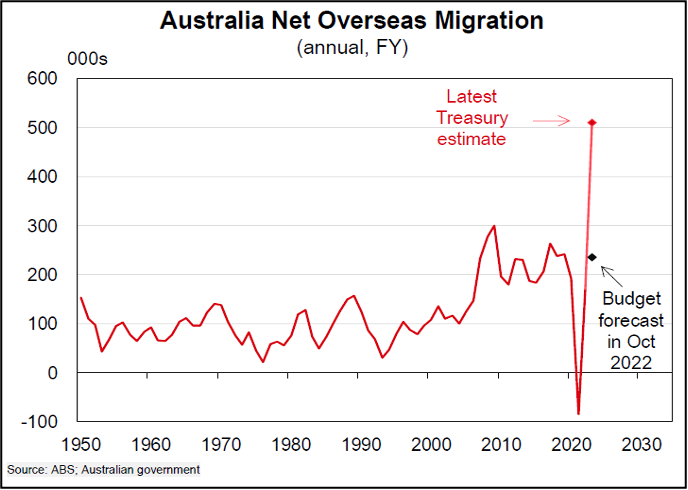
Source: Australian Economic Comment, 2023 in one chart, 11 December 2023, HSBC Global Research
Through 2023, a key macro theme has been the sharp rise in inward migration to around half a million people, from an expected 235,000 forecast in October. This will potentially underpin the economy’s growth and will likely put upward pressure on property prices, as well as provide some relief from the acute labour and skills shortage. While household consumption has slowed considerably, the population growth will help stem the decline in consumer spending, while preserving resilience in absolute terms. While minimum wage increases and Enterprise Bargaining Agreements will keep wage inflation sticky into 2024, thus keeping the central bank’s policy stance relatively hawkish, the influx of workers in a labour-constrained economy might help alleviate some of the pressure.
BHP: Progressing well away from coal
Source: BHP annual report 2023
Well-thought transition path: Our meeting with the resources group BHP was encouraging in terms of how it is thinking through its transition plan of moving away from coal-related assets and messaging this to connect with the affected communities better. Thermal coal has always had a stigma to it, but being public about its engagement on how best to address this and how they are caring for the transition to new jobs of old coal workers has helped to alleviate the stigma. BHP still retains one thermal coal asset but it is because it could not find a buyer for it. The group will close the mine by 2030 which it sees as an optimal time to close from a value perspective and give it time for a transition of its workforce. Meanwhile, there were also other positives from the meeting. The group indicated that it would keep the dividend payout to a minimum 50% of earnings and regarded this level as sacrosanct, ensuring a stable level of dividend streams for shareholders. Its capex guidance is an indicative range for pipelines and extends to 2026, with A$10 billion this year followed by A$11 billion for the two years after.
“I’ve always found my trips to Australia incredibly insightful and a great way to reset one’s views and perspectives when looking at the market from overseas. With Australia being such a strong domestic-driven market, the on-the-ground insights, local stories, and personal conversations with companies give greater colour into the investments that we have made and inspires new ideas and themes that otherwise may have been missed by investors looking at the market from afar.”
Outlook
The domestic backdrop remains challenging, given a slowing economy, elevated inflation and a tight labour market. We expect earnings risk over the short to medium term as economic activity softens and as the consumer adjusts to higher interest-servicing costs. However, the recent trip has made us relatively more hopeful that the economy is approaching an inflection point and we will look to opportunistically add to quality companies that are ready to benefit from a turnaround in the economy.
We remain biased towards businesses with strong pricing power and defensive business moats, and we favour businesses with clear growth prospects that are leveraged to long-term structural shifts. Our holdings’ defensiveness (i.e. their robust balance sheets and prospects for generating healthy through-the-cycle earnings and dividend growth) is also a positive. Many of our companies are also leaders in governance and sustainability, positioning them well to adapt to the future. This will ensure that the portfolio remains resilient despite the current uncertain times.
Companies selected for illustrative purposes only to demonstrate the investment management style described herein and not as an investment recommendation or indication of future performance.
Important information
Risk factors you should consider prior to investing:
The value of investments, and the income from them, can go down as well as up and investors may get back less than the amount invested.
Past performance is not a guide to future results.
Investment in the Company may not be appropriate for investors who plan to withdraw their money within 5 years.
The Company may borrow to finance further investment (gearing). The use of gearing is likely to lead to volatility in the Net Asset Value (NAV) meaning that any movement in the value of the company’s assets will result in a magnified movement in the NAV.
The Company may accumulate investment positions which represent more than normal trading volumes which may make it difficult to realise investments and may lead to volatility in the market price of the Company’s shares.
The Company may charge expenses to capital which may erode the capital value of the investment.
Movements in exchange rates will impact on both the level of income received and the capital value of your investment.
There is no guarantee that the market price of the Company’s shares will fully reflect their underlying Net Asset Value.
As with all stock exchange investments the value of the Company’s shares purchased will immediately fall by the difference between the buying and selling prices, the bid-offer spread. If trading volumes fall, the bid-offer spread can widen.
The Company invests in emerging markets which tend to be more volatile than mature markets and the value of your investment could move sharply up or down.
Yields are estimated figures and may fluctuate, there are no guarantees that future dividends will match or exceed historic dividends and certain investors may be subject to further tax on dividends.
Derivatives may be used, subject to restrictions set out for the Company, in order to manage risk and generate income. The market in derivatives can be volatile and there is a higher than average risk of loss.
Other important information:
Issued by abrdn Investments Limited, registered in Scotland (No. 108419), 10 Queen’s Terrace, Aberdeen AB10 1XL. Both companies are authorised and regulated by the Financial Conduct Authority in the UK. abrdn Asian Income Fund Limited has a registered office at JTC House, 28 Esplanade, St Helier, Jersey JE4 2QP, JTC Fund Solutions (Jersey) Limited acts as the administrator, and the Collective Investment Fund is regulated by the Jersey Financial Services Commission.
The UK Investor Magazine was thrilled to be joined by Stephen Crosher, CEO and Co-Founder of RheEnergise, to discuss the company’s long-duration power storage technology designed to enhance and stabilise the distribution of renewable power.
RheEnergise is revolutionising pumped hydro energy storage which turns small hills into giant batteries. RheEnergise has developed a high-density, low-viscosity liquid that enables the storage of power to be released in times of high energy demand.
Stephen provides comparisons against other power storage methods including lithium batteries and traditional pumped hydro.
RheEnergise are engaged with major players in the power industry and has a number of early facilities planned for 2024.
The company is currently raising funds on Crowdcube as part of a wider funding round to scale the business in line with growth in power storage demand.
The FTSE 100 shook off the news no one wanted to hear on Thursday; the UK has entered recession after retail sales crumbled in the key festive trading period.
The long-feared UK recession was confirmed on Thursday as GDP declined 0.3% in the fourth quarter after a 0.1% in the prior quarter. Two consecutive quarters of contraction are considered a technical recession.
However, UK stocks barely blinked with the FTSE 100 gaining 0.1% in Thursday afternoon trade, even as heavyweight dividend payers dragged on the index as they traded ex-dividend.
“Confirmation that the UK is in recession has done nothing to knock UK stocks off course. An economy pushing through mud is not new news and if anything, it might encourage the Bank of England to think harder about cutting interest rates to avoid further economic deterioration. That’s certainly how the market views the situation as UK equities ploughed ahead,” said Russ Mould, investment director at AJ Bell.
“There were only six fallers on the FTSE 100 and three of those were down to trading without the rights to their next dividend, being BP, Shell and Imperial Brands.”
GDP is a lagging indicator and is only a measure of what happened in the past having little impact on the future company earnings – the metric equity investors are most concerned with.
There will be concerns about the composition of the GDP contraction as far as it was centred around retail spending – which is a leading indicator for the economy.
“Today’s GDP data is a reminder of the headwinds the UK economy faces, with retail sales a particular area of weakness across a broad-based decline in economic activity,” said Adam Vettese, Market Analyst at eToro.
In addition to the big dividend payers losing ground today, retailers Marks & Spencer and Tesco were among the losers after news of poor retail spending.
Notably, Kingfisher was the top riser after being upgraded to ‘buy’ by Citigroup analysts.
Jarvis Securities (LON: JIM) has announced a first quarterly dividend of 1.75p/share and the shares go ex-dividend 22 February. Jarvis Securities did not pay a fourth quarter division for the previous financial year. The third quarter dividend was 2.25p/share. A FCA skilled persons review was ongoing, and this was hampering the ability to pay dividends, so today’s announcement is a positive sign. A phase 1C report is due to be published by the FCA. The share price has jumped 49% to 76p.
MicroSalt (LON: SALT) has announced a marketing collaboration with food and beverage exporter American Trading International. This will make the company’s low-sodium salt product available in up to 80 countries around the world. The share price has risen a further 14.7% to 97.5p. The placing price was 43p. Majority shareholder Tekcapital (LON: TEK) says that another investee company Guident is integrating its autonomous vehicle remote monitoring and control technology in the MiCa autonomous shuttle. The Tekcapital share price is 10.7% higher at 15.5p.
Sareum (LON: SAR) says it has completed the single ascending dose part of the food effect study for autoimmune disease treatment SDC-1801. This indicates that there are no serous adverse effects. The share price improved 13.3% to 42.5p.
FALLLERS
Renalytix (LON: RENX) has lost some of the gains from earlier in the week following the publication of interim results. Revenues fell from $2.16m to $1.17m. Net cash used in operating activities increased from $15.3m to $17.3m. There was cash of $5.62m at the end of 2023. Management admits that it will need to raise more cash. The share price is 29.7% lower at 32p, but it is still treble the level it was five days ago.
M&A activity remains weak at professional services network operator DSW Capital (LON: DSW) and that will hit this year’s profit. There appeared to be an improving trend, but January was poor and that hit network revenues. February is also set to be disappointing. The other activities are trading well. The 2023-24 pre-tax profit will be between £600,000 and £700,000, instead of previous expectations of £1.2m. There was cash of £2.7m at the end of January 2024. The share price slumped 17.4% to 50p.
Premier African Minerals (LON: PREM) has raised £2.475m at 0.275p/share. The cash will be used to complete payments for processing plant and equipment, plus operating costs, for the Zulu lithium project. Commercial production should resume by the end of February. The share price dived 14.4% to 0.2825p.
Gattaca (LON: GATC) is still finding the permanent staffing market difficult and first half net fee income is expected to decline 16% to £18.9m. This has led to downgrades for full year net fee income, but cost cutting has meant that the full year pre-tax profit forecast is maintained at £3m. The figures will be second half weighted. The share price slipped 11.2% to 111p.
Ex-dividends
BP Marsh (LON: BPM) is paying a dividend of 2.68p/share and the share price is unchanged at 450p.
Knights Group Holdings (LON: KGH) is paying an interim dividend of 1.61p/share and the share price is 0.75p higher at 136.25p.
Mattioli Woods (LON: MTW) is paying an interim dividend of 9p/share and the share price fell 10p to 580p.
Ramsdens Holdings (LON: RFX) is paying a final dividend of 7.1p/share and the share price slipped 5p to 187.5p.