


FTSE 100 reverses early losses and heads for flat week
The FTSE 100 was set to close the week flat after the index reversed early losses on Friday.
London’s leading index was trading 0.36% higher at 7,468 as traders prepared for the market close. This week’s trade has been dominated by key themes including interest rates and China – all factors set to drive trade as we move into the autumn.
The Federal Reserve and Bank of England will meet later in September to decide on rates so one would expect investors to start to position for these decisions next week.
“The market continues to wax and wane with every data release as investors desperately look for signs the end is in sight on interest rate hikes. Overnight there was weakness on Wall Street as the enmity between China and the US continued to impact the tech sector – reports Chinese government workers have been banned from having iPhones taking a bite out of Apple,” said Russ Mould, investment director at AJ Bell.
“These developments are bitter news for the consumer electronics giant as it gears up for the expected launch of the iPhone 15 on 12 September.”
US equities fell yesterday with Apple dragging the S&P 500 lower. Apple and the S&P 500 both rebounded on Friday.
Melrose was the FTSE 100’s top faller on Friday after reversing yesterday’s rally. The big corporate story on Friday was Berkeley Group Holding’s trading update and reaffirmation of their profit outlook. Berkeley Group Holding shares were dead flat at the time of writing.
JD Sports was 2% higher after Berenberg raised their price target to 225p.
AIM movers: Drilling in Angola for Corcel and AMTE Power rescue fundraising
Corcel (LON: CRCL) continues to rise following yesterday’s announcement that the Tobias-13 well in Angola, where Corcel has an 18% interest. This field has previously produced 29 million barrels of oil and the remaining oil in place could be 65 million barrels of oil. Corcel contribution to costs is $1.6m. The share price improved a further 30.9% to 0.36p – the highest level since May.
Atlantic Lithium (LON: ALL) has secured terms of agreement with the Minerals Income Investment Fund of Ghana for total investment of $33m. There will be $28m of investment in the company’s subsidiaries in Ghana for 6% of the lithium portfolio (although Piedmont can earn more of Ewoyaa to reduce the relevant stake to 2.7%). There will also be a $5m investment in Alliance Lithium at 21p/share, plus warrants exercisable at 29.4p each. This cash will help to provide funding for the Ewoyaa project. There have been concerns about changes to mining legislation in Ghana. The share price jumped 27.4% to 26.5p.
Power Metal Resources (LON: POW) has discovered a significant helium anomaly at the Perch River uranium project. Helium is a product of radiogenic decay, so it is a sign of uranium mineralisation. The share price is 14.3% higher at 0.8p.
Better trading news from musical instruments retailer Gear4Music (LON: G4M) with cost reductions securing improving margins. The second-hand service has started well and handled several thousand trade-ins since March. This service is being broadened to Europe. A trading statement will be released on 19 October. The share price has recovered 18.3% to 103.5p.
FALLERS
AMTE Power (LON: AMTE) is raising £2.1m at 1.7p/share at 1.7p/share, plus an additional retail offer to raise £250,000. The share price slumped 75.4% to 2.275p. The battery technology developer is raising the cash to keep going until the proposed cash injection of £2.5m is completed. Due diligence by the potential investor could continue until the end of October and it believes that it can introduce potential offtake customers to AMTE.
Harland & Wolff (LON: HARL) increased interim revenues by nearly two-thirds to £25m and it expects to reach £100m for the full year and this could double in 2024. Recent contract wins mean that the order book is worth £1bn. However, the estimated 2023 loss has been increased from £15.6m to £22m due to higher costs. That leads to higher net debt of around £114m, which is expected to rise to £144m in 2024. The share price fell 9.84% to 13.75p.
Satellite communications equipment supplier Global Invacom (LON: GINV) has fallen a further 14.3% to 3p because it is asking shareholder permission to leave AIM and maintain the one on the Mainboard of the Singapore stock market. There is a lack of liquidity on AIM, and this makes it difficult to raise cash.
Anne Whitaker is stepping down from the board of Faron Pharmaceuticals (LON: FARN). Dr Marie-Louise Fjallskog and Christine Roth are being appointed to the board at a general meeting on 22 September. The share price is 5.88% lower at 320p.
Berkeley Group Holdings maintains profit guidance despite macro challenges
Berkeley Group Holdings issued a relatively upbeat trading statement on Friday in which the housebuilder said they were maintaining their profit guidance and were receiving a decent level of enquiries.
The emphasis here is ‘relatively upbeat’. The company, like most housebuilders, is suffering from higher mortgage costs and their reservation rates have crumbled.
Despite the risks from a deteriorating macroeconomic picture, Berkeley was confident enough to reaffirm its pretax profit guidance of £1.05bn for the coming year.
“We’ve seen a similar story across the rest of the housebuilders this earnings season. It looks like the recent interest rate hikes pushing up mortgage costs are causing a relative lack of urgency among new buyers as private sales reservations dropped 35%,” said Aarin Chiekrie, equity analyst at Hargreaves Lansdown.
“Pricing’s remained resilient though, due to the constrained supply of new-build and second-hand homes, giving Berkeley the confidence to reiterate its guidance for £1.05bn of pre-tax profits across the coming two financial years, weighted slightly towards the current year. That represents declines of around 10% in consecutive years.
“In the meantime, Berkeley’s taking action to protect its financial resilience by carefully matching its supply with demand and completely stopping spending on new plots of land. That’s expected to keep net cash at £325m by the end of October, down around 20% since April but should be enough to help cushion the impact of lower sales in the near term.”
Chiekrie highlighted a competitive advantage Berkeley has over its peer group in as far as the homebuilder is focused on London and is likely to enjoy more resilient demand than elsewhere in the country.
“Looking bigger picture, Berkeley’s London focus offers something different to peers, and demand in the capital’s likely to remain more robust than other areas of the country. Add to the mix that the UK housing market’s suffering from a fundamental supply shortage, and the long-term picture doesn’t look so bleak. But in the short term, there’s plenty of stormy clouds for Berkeley to weather.”
Premier African Minerals shares are declining to attractive levels for the adventurous

Premier African Minerals shares are not without their risks. The company has previously failed to meet production deadlines at their Zulu lithium project and is now under tremendous pressure to meet revised targets.
Should these be missed, their offtake partner Canmax is entitled to impose shareholder value-eroding measures including penalty payments, taking newly issued shares in Premier African Minerals, and even taking a direct interest in the project.
That said, Premier African Minerals have given up a substantial amount of their value since touching 1p in April this year and are approaching a level where the balance of risk and reward will start to become attractive to the adventurous investor.
Premier African Minerals’ Zulu lithium project contains 20.1Mt @ 1.06% Li2O & 51.05ppm Ta2O5 at a 0.5% Li2O cut-off. This makes the project potentially world-class.
Premier African Minerals have recently raised £9m to fund the project’s development, including £5m from their partner Canmax. This should meet their immediate needs and reduces the chance of further dilution in the short term.
However, the risk sits with their ability to execute the extraction of the lithium. So far, Premier African Minerals have failed to meet 1,000 tonnes per month production and now have until 1st November to get their house in order and ramp up production.
It will be a tense wait for investors.
Nonetheless, investors weighing the balance of risks to reward on a minimum 2 to 1 basis may see value around 0.30p – 0.40p. This would assume this year’s high of 1p as an upside target and downside around 0.1p, should Premier fail to meet production targets and Canmax start taking $1.5m tranches of newly issued shares on a regular basis.
Harland & Wolff shares fall on profit-taking amid accelerating losses
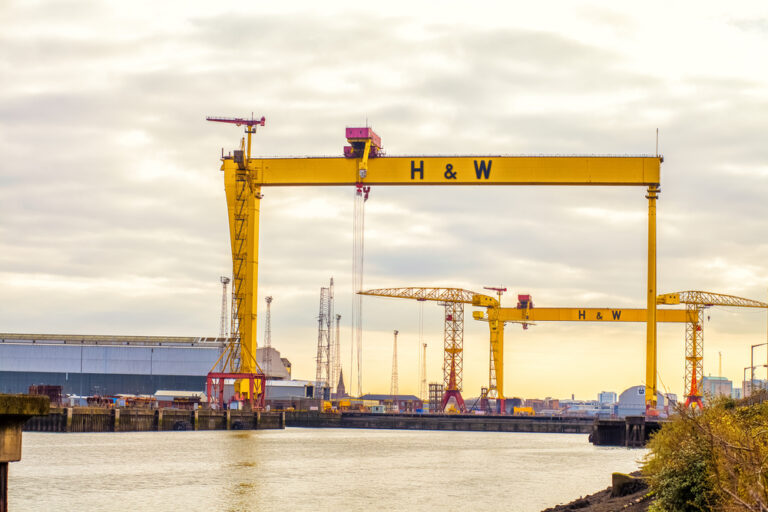
Harland & Wolff reported a £15.92m EBITDA loss in the first half of 2023, predominantly due to heavy investment in headcount ahead of major contract delivery. The company’s EBITDA loss was £12.71m in the same period last year.
Despite the loss, the company has a strong order backlog of around £1bn over the next seven years, up £100 million since March.
Nonetheless, Harland & Wolff shares slipped in early trade on Friday as investors to the opportunity to book profits. Harland & Wolff was trading down 9% at 13.8p at the time of writing. The stock had touched lows around 9p in July.
Harland & Wolff revenue soars
Revenues rose 65% to £25.53m from £15.41m a year earlier but were weighed down by cost pressures around labour, energy and inflation impacting the cost of sales and 19.4% gross margin.
The loss comes as Harland & Wolff positions itself for substantial contract delivery over the coming years. This includes a Fleet Solid Support subcontract with Navantia worth £700-800m. The company has also secured a £60-70 million mid-life vessel upgrade contract and won a £1.5 million heavy lift vessel contract since the end of June.
Harland & Wolff expects full-year revenues of £100m, with significant increases in the second half as work begins on the Fleet and M55 contracts. It reiterated revenue guidance of £200 million for 2024. The company is negotiating a new £200 million credit facility to fund ongoing working capital requirements.
At the end of June, Harland & Wolff had net debt of £88.53 million, reflecting an upsized $100 million credit facility, up from $35 million in March 2022.
Direct Line sells commercial insurance business

Direct Line Group (LON: DLG) bounced back by 16.1% to 174.275p even though its loss increased. The motor and home insurer is selling its brokered commercial insurance business to RSA Insurance for an initial £520m with potential for up to £30m.
The company, whose brands include Direct Line and Churchill, will focus on its core retail, personal and small business markets and the deal significantly improves its financial position. There should be a capital release of up to £270m, with an initial release of £170m when the transaction is approved by shareholders. The business generated an operating profit of £34m in 2022.
Gross written premium and associated fees grew 10% to £1.62bn in the first half of 2023, although the number of policies was lower. The loss jumped from £11.1m to £76.3m. There was a positive investment return, but the interest income fell.
The solvency capital ratio is 147%. Tangible net asset value is 72.8p/share.
There is no dividend and there are two conditions that have to be met before they restart. The first is capital coverage reaching the upper end of the agreed range and the second is when it starts generating cash from the motor division. Direct Line has to compensate home and motor clients because of overcharging and that will cost around £30m.
The second half is likely to continue to be poor, but there is the prospect of motor margins improving in 2024.
Sound Energy shares sink to all-time lows as investors flee

On Thursday, Sound Energy traded at the lowest level since listing in London in 2005. Sound Energy shares touched lows of 0.76p on Thursday and have lost 98% of their value over the past five years.
Investors appear to be dumping the stock after more Convertible Loan Notes were converted at the beginning of the month.
Under a Convertible Loan Note agreement totalling £2.5m, £1m has been converted into newly issued Sound Energy shares with £1.5m remaining. The outstanding amount means further dilution for Sound Energy shareholders, should they be converted.
Sound Energy is developing Morrocan gas assets and expects its maiden revenue in early 2024. The company has arranged project financing which is said to be the first of its size for gas assets in Morroco.
FTSE 100 rallies as Bank of England Governor Bailey indicates interest rates near peak
The FTSE 100 was a clear outperformer on Thursday as London’s leading index enjoyed a boost from comments by the Bank of England’s governor.
While US equity indices were being dragged lower by Apple after news China is banning government officials from using iPhones, the FTSE 100 rallied on hopes the hiking cycle was near an end.
Speaking to the Treasury Select Committee of MPs, Bank of England Governor Bailey said there were signs inflation would fall dramatically by the end of the year. This would allow the BoE to stop hiking interest rates.
Hopes we could be near peak interest rates sparked a rally in UK stocks, and the FTSE 100 was trading 0.3% higher after reversing a soft start to the session.
A peak in interest rates will be a good thing for equity markets in the short term, but it raises the question of whether good news for stocks is bad news for the economy.
Questions will soon be asked about the reasons behind the fall in inflation and whether softer inflation data will result from slower economic growth.
If this is the case, the stock market rally may prove short-lived. Nonetheless, reaching terminal interest rates will reinvigorate equity bulls in the short term.
The FTSE 100 was 0.3% higher at the time of writing, significantly outperforming the S&P 500, which was 0.6% in the red.
FTSE 100 movers
Melrose was the FTSE 100’s top gainer after 1st half revenues surged and operating profit jumped. The group is solely focused on the aerospace industry after divesting GKN automotive businesses this year.
Melrose shares gained 5% on Thursday, and Rolls Royce moved 3% higher in sympathy.
China-focused stocks were again the worst performers, with Prudential falling 2.8% and miners firmly in the red.
AIM movers: Angle extends life of cash pile and CVS investigated by CMA

Diagnostics firm Angle (LON: AGL) trebled interim revenues to £1.2m, but the cash outflow was still £9m. Annual cash savings of £5m have been identified and this will help the cash pile last into early 2025. There were higher sales of Parsortix circulating tumour assessment systems as well as higher services revenues. Contracts are being won for the services operation and management is hopeful that it can win business with larger pharma companies. The broadening of the offer into molecular diagnostics is increasing the size of the addressable market as well as making the Parsortix system more attractive to clients. The share price rebounded 23.9% to 14.25p.
Mosman Oil & Gas (LON: MSMN) has decided not to invest additional cash in the Falcon lease in the US. The lease is being transferred to 84 Energy Corp in exchange for the equipment on the lease, which saves up to $200,000 in abandonment costs. The Galaxie lease has not been renewed. The book value of the leases of A$472,000 will be written off. The share price jumped 23.6% to 0.034p.
Tertiary Minerals (LON: TYM) says the Swedish government has annulled its previous rejection of the Storuman fluorspar project exploitation concession. The government decided that the develop of the deposit was as important to the national interest as reindeer husbandry. Fluorspar can produce fluorine for the lithium-ion battery market. The primary focus is still the Zambian licences. The share price rose 16.3% to 0.125p.
Graphene technology developer Directa Plus (LON: DCTA) has won a €5.5m, three-year contract with Liberty Galati in Romania. The value could increase to €8m. The contract is for processing oily mills sludge in steel production. This underpins current forecasts. The share price improved 6.9% to 46.5p, having been 58p early in the morning.
FALLERS
Shares in CVS Group (LON: CVSG) have slumped 29.6% to 1468.5p because of a CMA review of the veterinary market. It is assessing business practices for household pets because costs have risen faster than inflation. CVS says a shortage of vets is pushing up costs. The full year results will be published on 21 September.
Medical imaging technology developer Polarean Imaging (LON: POLX) reported lower interim revenues because no new polarisers were sold in the period. The first half cash outflow was $6.8m and there was cash of $9.9m at the end of June 2023. This should last until the second quarter of 2024. The slow market adoption of Xenoview means that commercial targets have been withdrawn. The share price dived 22.4% to 11.25p.
Chaarat Gold (LON: CGH) says the $55.4m sale of the Kapan mine should complete in September. First half gold equivalent production fell 12% to 26,523 ounces and the cost increased by 10% to $1,556/ounce. Talks continue with Xiwang for a potential $150m investment in a joint venture focused on the Tulkubash project. The share price fell 12.8% to 5.625p.
Capital equipment manufacturer Mpac (LON: MPAC) increased interim revenues by 4% to £52.8m and pre-tax recovered from £1.1m to £1.9m. Order intake soared in the period. Services generated one-third of revenues in the first half, but the mix will change as recent order wins are satisfied in the second quarter. The order book has risen 15% to £77.5m since the end of 2022 and includes higher margin healthcare machinery. This helps to underpin forecasts of a better second half. The battery cell assembly plant business remains a significant longer-term opportunity. Net cash is £2.2m. Shore forecasts a near doubling of underlying pre-tax profit to £6.9m in 2023. Even so, the share price declined 10.7% to 187.5p.
Builders’ merchant Lords Group Trading (LON: LORD) is outperforming its rivals. But trading is getting tougher because of higher interest rates and lower construction activity. Interim revenues improved 4% to £222.6m, helped by acquisitions, but pre-tax profit fell from £8.4m to £7.7m. The interim dividend is maintained at 0.67p/share. Cenkos has reduced its 2023 pre-tax profit forecast from £17.8m to £13.2m. The share price slipped 10.2% to 61.5p.
Ex-dividends
Alpha Financial Markets Consulting (LON: AFM) is paying a final dividend of 10.5p a share and the share price is unchanged at 360p.
James Cropper (LON: CRPR) is paying a final dividend of 4p a share and the share price fell 5p to 730p.
GlobalData (LON: DATA) is paying an interim dividend of 1.4p a share and the share price is down 0.5p to 153.5p.
Globalworth Real Estate Investments (LON: GWI) is paying an interim dividend of 14 cents a share and the share price declined 6 cents to 262 cents.
H&T (LON: HAT) is paying an interim dividend of 6.5p a share and the share price is 2p lower at 410p.
Holders Technology (LON: HDT) is paying an interim dividend of 0.25p a share and the share price is unchanged at 61p.
Ramsdens Holdings (LON: RFX) is paying an interim dividend of 3.3p a share and the share price is 5p lower at 230p.
Solid State (LON: SOLI) is paying a final dividend of 13.5p a share and the share price is 25p higher at 1325p.
Totally (LON: TLY) is paying a final dividend of 0.13p a share and the share price is up 0.35p to 8.35p.