lettingaproperty.com is digitalising UK letting processes and have attracted 20,000 landlords to their service to date.
Having secured investment from institutional investors Mercia Asset Management, the company is now planning their next stage of growth and raising funds to deliver on their strategy.
Jonathan details their journey so far and outlines the opportunity for investors in the digitalisation of the UK rental market.
CLIQ Digital, the streaming services and digital marketing company, have achieved record sales and earning in 2022 as their memberships hit an all-time high.
CLIQ’s 2022 preliminary results exceeded both the management’s outlook and market expectations.
The streaming company’s FY 2022 sales surged 84% to €276m and helped EBITDA grow to €44m, up from €27m last year. The robust financials were driven by a 45% increase in members to 1.9 million.
“2022 was another fantastic year for CLIQ with record memberships, sales and earnings as well as the introduction of cliq.de – our new and most advanced streaming service tailored to the German market,” said Luc Voncken, CEO.
CLIQ Digital employs direct to consumer performance marketing campaigns to cost effectively win new members. Paying testament to CLIQ’s prowess in securing new customers efficiently, 2022’s marketing spend more than doubled to €112m, and CLIQ still produced record high sales and earnings.
CLIQ believes their marketing model will continue to produce strong results in 2023 and expects sales to exceed €345m with further increases in EBITDA.
CLIQ Digital dividends
CLIQ’s success has translated into bumper distributions for shareholders. CLIQ doubled their distributions to shareholders through dividends in 2022 and currently yields around 3.2%.
Despite paying sharply higher dividends, the company has increased their cash position which will allow for further investment in growth going forward.
“CLIQ concluded the year with the highest net cash position in the Group’s history, whilst also having paid record dividends. Despite macroeconomic headwinds, we continue to see a strong market for our streaming services,” said Ben Bos, member of the Management Board.
Tekcapital shares rose in early trade on Tuesday after their portfolio company MicroSalt announced their low-sodium salt shakers will be stocked in additional stores in the US.
MicroSalt will partner with Giant Foods who operates 160 stores across the Delaware, Washington DC, Maryland, and Virginia. Giant Foods’ current product mix is aligned with MicroSalt’s mission to provide healthy low-sodium salt shakers that can help fight cardiovascular disease.
The Giant Food’s partnership adds to a recent commercial agreement with Prestly Foods and expands their footprint across US retail outlets. MicroSalt are stocked in over 2,000 Kroger supermarkets in the US.
Tekcapital shares jumped 5% to 18.8p following the announcement on Tuesday.
“We are extremely excited that Giant has joined with us to provide low sodium solutions to its customers. This is a tremendous step in our march toward reducing excess sodium consumption. Our MicroSalt shakers empower consumers to salt their food to taste with less sodium,” said Rick Guiney, CEO of MicroSalt.
The growth in revenues and profits is showing through at the delivery solutions specialist DX (Group) (LON:DX.).
The first half trading was strong, some 15% ahead, leaving the group well-positioned for the second half period.
Both divisions, DX Freight and DX Express, contributed to revenue growth and both have improved margins against the same period last year.
The group, which is a well-established provider of a wide range of delivery services to both business and residential addresses across the UK and Ireland, reported operational improvements and price increases boosted margins, while net new business in each division was healthy, with a strong pipeline of opportunities.
It is continuing its depot network expansion, helped by the end period net cash of £36.4m, with its £20m invoice discounting facility undrawn. Four new depots were opened in the first half, with two expected to open in the second half year.
DX now provides one of the widest ranges of overnight delivery services in the market, as well as logistics services. Items that DX transports range from confidential documents and valuable packages to large, awkward-to-handle freight, unsuitable for automated conveyor.
Newly appointed CEO Paul Ibbetson stated that:
“I believe that DX is in a strong position to build on the firm foundations that have been established over the last five years and has further significant growth opportunities ahead of it.”
Analyst Opinion – Target Price of 50p
Analyst Gerald Khoo at Liberum Capital rates the group’s shares as a Buy, assessing a 50p a share target price.
His estimates for the current year to end June are for revenues to increase to £467m (£428m) taking pre-tax profits up to £26.7m (£20.2m), with earnings of 3.3p (2.6p) and a dividend of 1.5p (nil) per share.
For the prospective year he sees £490m sales, £32.4m profits, earnings of 3.8p and a 1.7p dividend per share.
Conclusion – further to rise in price
A year ago, dealings in this group’s shares were suspended and were then requoted last October. Since when they have been down to 21p, before gradually recovering in price to around 30p.
On the basis of Liberum’s estimates they are undervalued and could continue to increase in price ahead of the interim figures due at the end of February.
The FTSE 100 reversed early losses on Monday ahead of crucial central bank decisions later this week, which could set the tone for the rest of the first quarter’s financial market’s trade.
Both the Federal Reserve and Bank of England will meet this week and subsequently provide decisions on interest rates.
The FTSE 100 was trading 0.1% higher at 7,773 at the time of writing.
Voting members will weigh stubbornly high rates and softer economic conditions, while having to manage market expectations of rate trajectories.
The Federal Reserve is expected increase rate by 25bps while the Bank of England is predicted to power on with 50bps.
With this weeks hikes largely priced into markets, investors will be keenly watching their press conferences for insight into the pace of future rate hikes.
“The FTSE 100 started Monday firmly on the back foot as investors started to display a bit of nervousness ahead of two big central bank announcements,” said AJ Bell investment director Russ Mould.
“For the most part 2023 has been smooth sailing for stocks but two icebergs lurk in the waters this week in the form of the Federal Reserve and Bank of England interest rate decisions.”
“How far might they dial back rate hikes and the hints they might drop about the future trajectory of their policy decisions are the two things which will be keeping investors up at night.”
Sainsbury’s
Sainsbury’s was again the top riser on the FTSE 100 following news of a stake purchase by Bestway last week. The purchase has undoubtedly increased speculation about a full takeover of Sainbury’s after a period devoid of major M&A rumours.
Filtration technology supplier Porvair (LON: PRV) had a strong end to its financial year, but it will be difficult to maintain margins this year. Even so, Porvair has exposure to clean technology growth markets that should enable it to increase profit over the coming years.
The relative small profit decline in the year to November 2020 shows the resilience of the business and group profit is much higher than in 2018-2019. There is a wide spread of products, so there is no dependence on one sector. There is also a geographic spread of business, although the US is the biggest market.
In the year to November 2022, revenues improved from £146.3m to £172.6m, while underlying pre-tax profit rose from £14.8m to £19.4m. Prompt price increases to cover higher costs helped to improve profit and supply constraints were managed.
Divisions
The biggest improvement was in the aerospace and industrial division, with aerospace demand getting back to pre-Covid levels. Microelectronics demand was also strong as semiconductor manufacturers invest in increasing capacity, although this is likely to be a short-term cyclical boost.
The laboratory division improved its profit even though the corresponding period had additional Covid-related work. A new water analysis instrument did better than expected.
Metal melt quality division revenues grew slightly faster than the other divisions. This division benefits from the increasing use of aluminium as a replacement for other materials.
Aluminium will increasingly replace steel in electric and hybrid vehicles due to its lighter weight and this quality of aluminium requires filtration by Porvair technology. There is also a move from PET bottles to aluminium cans for drinks because of their recyclability.
The total dividend was increased from 5.3p a share to 5.7p a share. Net cash is £18.3m and that is set to rise to more than £24m at the end of November 2023. That can finance capital investment to improve productivity and fund suitable acquisitions if they can be found.
Peel Hunt forecasts a reduction in underlying operating margin from 11.5% to 10.7% this year. That means that although revenues are set to grow, pre-tax profit could decline to around £18m before starting to grow again.
At 598p, the shares are trading on 19 times prospective earnings. Supply chain problems are easing, and forecasts could prove to be overly cautious but at this point they are sensible.
Online Blockchain (LON: OBC) plans to launch a new non-fungible token project based on The Rocky Horror Show. A deal has been struck with Interfishnet, which holds the rights to the musical. It is 50 years since its first performance. Online Blockchain will receive a share of revenues. The share price jumped 17.1% to 24p.
Caspian Sunrise (LON: CASP) has unexpectedly struck oil above the expected formation at the Deep well 802 on the Deep Yelemes structure. The drilling had reached 3,900 metres and management expected to find oil at 4,300 metres. Flow rates have been between 700 and 900 barrels/day. This could eventually become a significant addition to production. There is already an attractive yield from the monthly dividends paid out of cash flow. The share price improved 14.3% to 5.9p.
Remote site services provider RA International (LON: RAI) has been awarded a contract by the Foreign, Commonwealth and Development Office to provide construction services for the High Commission in Botswana. This is valued at £3.3m. There are also three orders via a joint venture for the US Navy base in Diego Garcia worth $8.2m. The share price rose 13% to 13p.
On Friday evening it was announced that Frasers Group (LON: FRAS) had increased its stake in N Brown (LON: BWNG) from 5.04% to 17.9%. The share price moved up 10.6% to 35.375p.
European Metal Holdings (LON: EMH) has gained EU approval for potential grant funding from the Just Transition Fund of €1.6bn for the 49%-owned Cinovec lithium tin project in the Czech Republic. The maximum grant could be €49m. WH Ireland estimates a fair value of 184p a share. The share price increased by 12% to 42p.
Sustainable biopesticides developer Eden Research (LON: EDEN) says Mevalone has been authorised in Italy for home garden use to control fungal pathogens. This is the first product authorisation for home gardens. In 2022, revenues were 55% higher at £1.7m. The share price rose 10.5% to 5.25p.
Interim revenues at Cloud-based data analytics provider Rosslyn Data Technologies (LON: RDT) dipped slightly to £1.4m. Even so, annualised recurring revenues rose by 11% to £2.5m, suggesting more positive momentum. Most clients have been migrated to the new Rosslyn Platform. A new three-year contract worth £285,000 has been won with a defence sector client. The share price slumped 23.5% to 0.65p.
Fintech Tintra (LON: TNT) has received the $10m subscription at 1178p a share from UAE-based Ares FZE, which will help to finance the business until the end of this year. That is equivalent to 4.24%. Every two shares come with a warrant exercisable at 504p each, although this is dependent on the market capitalisation of the company reaching $500m. Allenby has published its initiation note on Tintra. The subscription price is a massive premium to the market price at the end of last week, but it still fell 11.9% to 185p.
Beximco Pharmaceuticals (LON: BXP) increased interim revenues from £146.7m to £164.4m, but post-tax profit fell from £14.3m to £10.4m due to higher overheads and a reduction in other income. Foreign exchange also had an effect. Cash generation helped to reduce debt. Synovia Pharma continues to be integrated into the Bangladesh-based generic pharma products and ingredients supplier. The shares declined by 7% to 46.5p.
Gold production by Pan African Resources (LON: PAF) was lower than expected in the six months to December 2022. There were 92,000 ounces produced, which was 7% below forecast. Pan African Resources still expects full year production of 195,000-205,000 ounces. Higher capital investment meant that there is net debt of $50m. The share price fell 7.2% to 17.15p.
PREM lies on the verge of first lithium production and enjoys strategic investment that could well be increased in the near future.
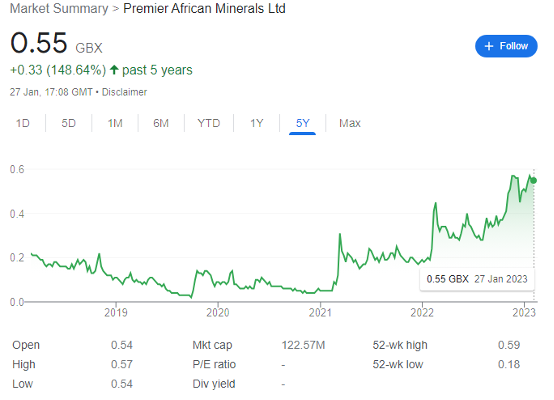
As an avid enthusiast in FTSE AIM companies, Premier African Minerals (LON: PREM) currently constitutes my best ever investment, having risen from circa 0.03p from my initial trade in early September 2019 to 0.55p at present — an increase of over 1,700%.
And I’ve been adding slowly to this position ever since, having advocated for CEO George Roach’s excellent opportunity across multiple publications.
Of course, I don’t profess to have a crystal ball — and similar ultra-speculative calls haven’t ended so well; a similar sized investment in Savannah Resources has essentially been on a road to nowhere over the same timeframe, though I expect similar share price movement when Europe eventually wakes up to the critical minerals supply gap.
To be clear, penny stock investing is not for the faint-hearted; the risk-reward ratio is significantly elevated on the AIM market, which is full of highly speculative companies not yet generating income and for whom one RNS can decimate or skyrocket the share price.
And when it comes to exploratory miners, the risks are even worse — as many battle-scarred veterans can attest. Share placements, poor drilling results, capital problems, political shifts, and a veil concealing investor information are all common problems. Of course, this won’t come as a surprise to any seasoned investor hunting for opportunities.
Lithium explorers like PREM are particularly risky as early investments because even with the best will in the world (and often backed by Chinese money) mines can take years to be brought to production, and the non-fungibility of lithium means that quality can be difficult to ascertain compared to the traditional hard commodities such as oil, iron, or gold.
A short history of PREM
With this in mind, it’s worth noting that while PREM shares have returned 149% over the past five years, very long-term investors have lost money since its 3p+ peak in June 2015.
Premier African Minerals launched its IPO on the AIM market in 2012, offering an 1,800-hectare tungsten mining operation, and for about a year all seemed well. The share price surged as the company seemed ready to begin production, but this was moderated by share placements as PREM sought to stop widening losses and expand into lithium mining at its then-new Zulu claims.
In 2019, the miner was hit by political instability, when Zimbabwe’s National Indigenisation and Economic Empowerment Fund caused PREM’s tungsten mines to cease production and sent its share price into the doldrums; as a high-risk investor, this was my buy-in point.
But optimism is once again with the FTSE AIM lithium explorer. To be clear, PREM also operates interests in tungsten, manganese, and potash projects across Africa. But the crown jewel remains its Zulu Lithium and Tantalum Project in Zimbabwe, which by some measures is the fifth-largest high-quality lithium deposit in the world.
Zulu in brief
I have in the past nominated PREM as London’s answer to Australia’s Pilbara Minerals — another lithium miner I have followed for years, and which has seen similarly meteoric value rises. Of course, PLS has been in production for some time now, but at long last PREM is very nearly there.
PREM owns a 100% interest in the Zulu project, which as well as being globally significant, is likely the largest undeveloped lithium mine in Zimbabwe, a country which already has some of the largest proven hard rock lithium reserves in the world.
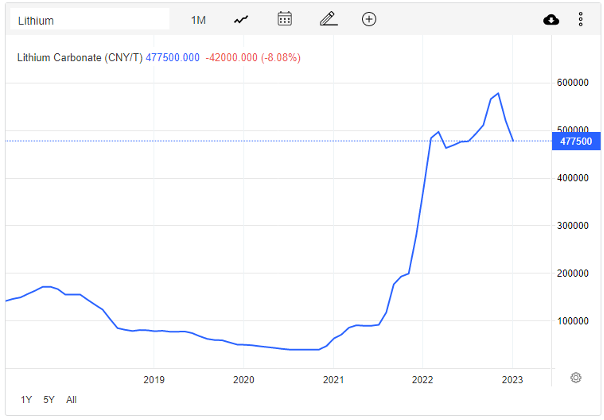
Further, lithium carbonate prices remain at historically elevated levels, at 477,500CNY/tonne in China. And the world’s largest lithium producer, Albemarle, expects prices to leap another 40% from current levels by the end of the year.
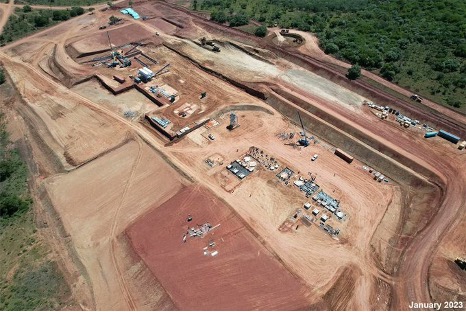
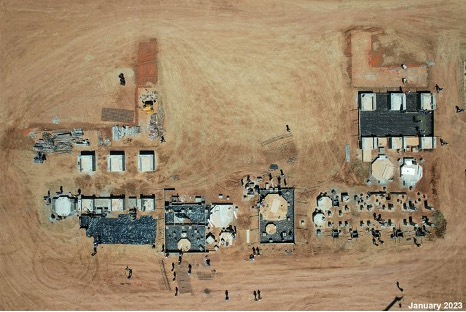
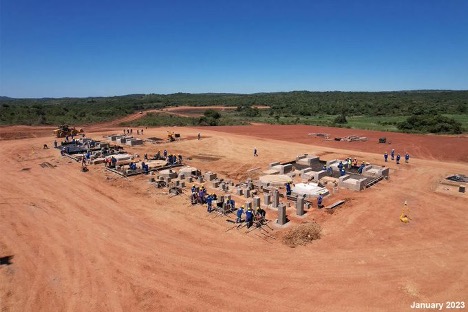
Roach has consistently targeted Q1 2023 as the quarter when PREM will metamorphize from lithium explorer to producer. Today, he confirmed ‘we are into the home stretch with pilot plant construction and site activity is frenetic with multiple work streams all targeting the same near-term completion date…activity in the pilot plant assembly areas is now on a 24/7 basis. In the absence of any unforeseen issue, I expect that first shipments of SC6 will commence in Q1 as projected.’
Technical details are available in full on LSE, but for brevity, results include 6.2m of lithium oxide grading 1.15% and tantalum pentoxide grading 32 parts per million from 209m, and 6.3m of lithium oxide grading 1.5% and tantalum pentoxide grading 73ppm from 268m.
It should be noted that there is a large backlog of assay results to be processed and Roach accepts that ‘it is not possible to accurately predict either the feed grade of spodumene rich material reaching the floatation circuit, nor to predict the final concentrate grade, or final tonnage production rate. That is the nature of a pilot plant.’
The company is targeting annual production from the pilot plant of 50,000 tonnes of spodumene concentrate (SC6), though the CEO enthused in a November interview that this could technically reach 70,000 tonnes, with further capacity possible as modules are added. As Roach notes, ‘the design capacity on the floatation circuit anticipates a mass pull of up to 30% at a design feed rate of 40 tons per hour of milled material. This represents a potential 12 ton per hour of spodumene rich concentrate.’
For the sceptical, PREM remains relatively active on social media, so investors do not need to take Roach for his word and can see the delivery and installation of the pilot plant as it progresses. However, this initial plant covers only a small part of the entire Exclusive Prospecting Order claim.
As a caveat, while first production seems very likely by the end of March, small delays are not uncommon when setting up mining plants. As the saying goes: rush once, pay twice.
Comparison to Kodal Minerals
Given PREM’s African location and London listing, it’s inevitable that there will be comparisons to Kodal Minerals; however, I think this is perhaps a little unfair. KOD’s lithium asset in Mali is 3,000 miles from PREM’s, and its recently signed deal with Hainan Mining is significantly different than the deal PREM has with Suzhou.
However, my personal perspective is that Kodal has given up a majority ownership of its assets in return for certainty of returns; and the deal it signed was overall very favourable.
Meanwhile, PREM has a strategic partner in fellow Chinese investor Suzhou TA&A Ultra Clean Technology Company, which owns 13.38% of the company, has injected $35 million into the pilot plant, and has signed an offtake deal for 50% of all spodumene initially produced. PREM is free to sell the remaining 50% to the highest bidder.
Incidentally, Roach holds 7.1% of the company’s shares, always an encouraging sign. And an often-missed detail — Suzhou cannot reduce its overall shareholding without losing its offtake rights to a commensurate degree. To my mind, this leaves PREM with a higher level of risk than KOD, but with a strong chance of much higher rewards.
And crucially, production is beginning imminently at Zulu, while KOD’s Bougouni Project is at least a year away from its first shipment.
For clarity, I hold both companies in my model portfolio as long-term investments.
China and valuation speculation
I speculate that Suzhou is planning either a full buyout or a much larger strategic position in Premier African Minerals, using only have publicly available information to form my case.
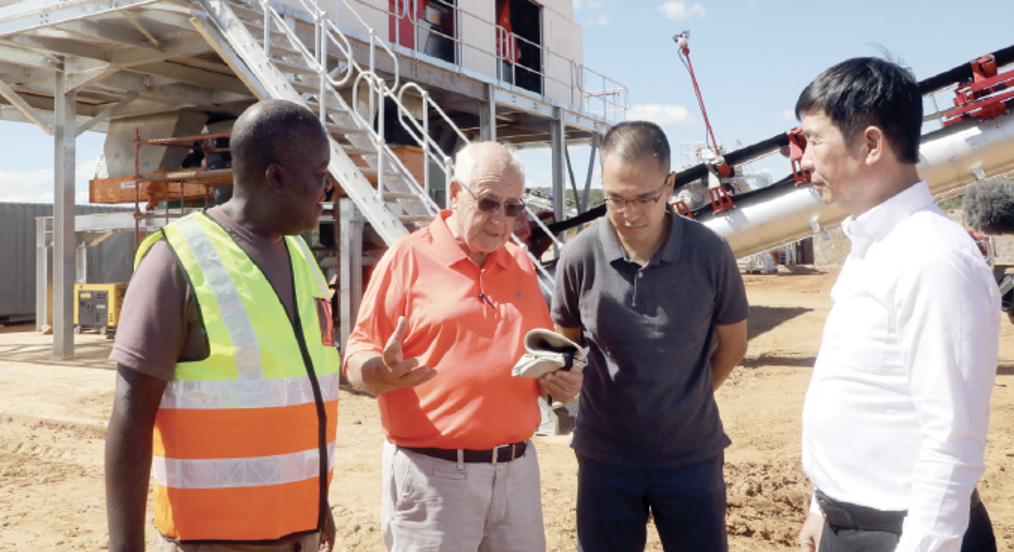
On 12 January, multi-billionaire Chairman and 35% Suzhou stakeholder Pei Zenzhue (the surname is a transliteration so will be spelt differently elsewhere) made a visit to the country to inspect recent progress made. Billionaires do not inspect sites operated by £122 million companies without a specific reason.
It’s worth noting that Suzhou plans to use its half of PREM’s spodumene to supply Yibin Tianyi, China’s leading lithium chemicals producer, which it owns jointly with CATL, the world’s largest EV battery maker. And through a holding company, Zenzhue also owns a 5.8% stake in CATL.
According to a local paper, the billionaire enthused that ‘the local Zulu team is very hardworking and I am quite impressed. Zimbabwe is a safe investment destination, and I am confident that this lithium project will be a success.’ Notably, he also has a $30 million investment in Mutoko to the east of the country. And Suzhou also has a strong history of shrewd lithium investments, including in Mineral Resources and AVZ Minerals.
After recent new laws banning raw exports from artisanal miners, Roach has made clear that the Zulu deposit should ‘benefit the country, the fiscus, people and as we go forward we should be able to see that there is further processing of lithium bearing minerals; undertaken and done in this country.’
For their part, Zimbabwe Deputy Minister of Mines and Mining Development Polite Kambamura has argued that ‘if we continue exporting raw lithium we will go nowhere. We want to see lithium batteries being developed in the country.’ The minister is eyeing a $12 billion industry by the end of 2023, and it’s possible that Zenzhue’s visit was to calm any fears over increased Chinese involvement.
One advantage of Chinese politics is that business strategy adheres far less stringently to the boom-and-bust mining supercycle. Indeed, western-listed miners are actually decreasing investment in maiden resources as the world goes into recession, as investors fret over the short-term depressive effect on commodity prices, even though the longer-term supply gap means prices are only heading one way over the longer term.
And Chinese companies play the long game. One thing the Kodal deal has shown is that factories in the country are desperate for quality lithium sources and are particularly attracted to ex-Australia lithium because their dependence on the western producer could become a problem as Sino-US tensions escalate over tech, Ukraine, and Taiwan.
And if all the lithium mined in Zimbabwe is eventually processed in the country rather than in China, the 50% not bound to Suzhou could find its way to Europe or the US, and at the very least could be subject to a bidding war between the continents.
However, Zenzhue could also be playing both sides of the chess board. In September, CATL announced that it was investing €7.5 billion on its second European battery manufacturing plant in Hungary, the country’s largest ever investment. Meanwhile, Chinese investors are also planning to construct a $450 million battery-metals industrial park inside Zimbabwe. The Sabi Star, Arcadia, and Bikita projects already all enjoy serious Chinese investment to the tune of hundreds of millions of dollars.
Outside of Zimbabwe, dozens of lithium explorers have been subject to Chinese buyouts or increased strategic investment; Bacanora, Goulamina, Lithea, the list goes on and on. Indeed, Canada recently forced Chinese businesses to divest their stakes in three Canadian lithium companies, citing national security.
And as lithium demand rockets, my view is that 13.38% of PREM and 50% of its lithium is not going to be enough for long. 3p per share seems a realistic possibility within the next 12 months.
This article has been prepared for information purposes only by Charles Archer. It does not constitute advice, and no party accepts any liability for either accuracy or for investing decisions made using the information provided.
Further, it is not intended for distribution to, or use by, any person in any country or jurisdiction where such distribution or use would be contrary to local law or regulation.
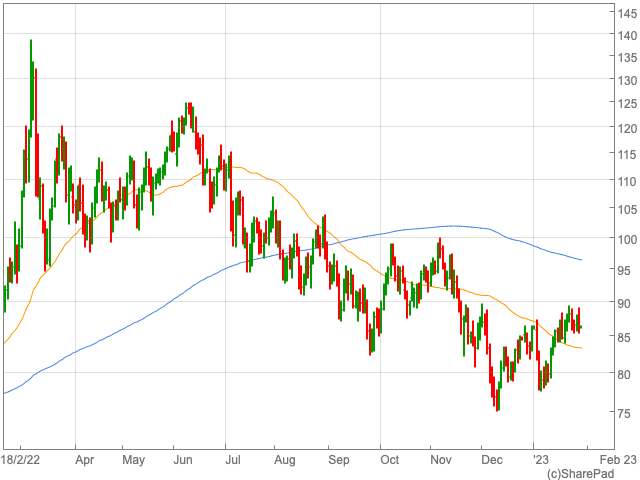
Shell shares have plateaued since August last year with the share price trading within a tight range between 2,300p and 2,400p, although there have been brief forays outside of this range.
With the Shell share price offering very little in the way direction, the valuation of the company will be brought into question with upside momentum fading away.
The invasion of Ukraine by Russia sparked a rally in global energy prices and helped lift oil majors, including Shell. Higher oil prices meant higher profits, but this is now largely priced.
To some extent, higher oil prices was a story for 2022 and the more benign environment for oil has been a contributor to the sideways trade in Shell’s equity.
Early in January, Shell provided a ‘teaser’ Q4 update note ahead of their Q4 results. The update included estimated ranges of earnings for each segment. Shell shares rose after the release, but the upper end of these range must be met to support the share price further.
Strong gas trading is expected to support group earnings.
Shell shares
The range-bound nature of Shell shares could come to an abrupt end this Thursday if we receive a worse than expected quarterly deterioration in the company’s upstream and refining segment earnings.
Shell’s Q3 Upstream segment earnings fell to $5.4bn from $6.4bn in Q2. Shell’s Q3 2021 Upstream earnings amounted to $1.3bn.
One would expect Q4 Upstream earnings to retreat further back to 2021 levels after the company indicated so in their update note.
Analysts consensus earnings for 2022’s total Upstream earnings is $17.7bn.
Brent oil is well below recent highs at $86 per barrel and recent rallies have been quickly sold into by traders. The average oil price recorded by Shell in Q4 will almost certainly be lower than Q3.
A lower oil price is bad news for Shell shares. The company is starting to experience a downtrend in refining margins after recording bumper earnings from the unit last summer.
The prospect of lower profitability in this area will be a concern for investors. Couple this with possible softness in the Upstream segment, and 2,300p may start to seem a little expensive.
Holding shares over results always risks short-term volatility, but Thursday’s results are highly anticipated and may represent a turning point in the Shell share price.
Hargreaves Services (LON: HSP) continues to trade at a large discount to NAV, while UK operations are growing. The property portfolio provides plenty of upside to the NAV.
Margins and profit improved in the first half. German associate company HRMS made an increased contribution in the first half, but the bumper conditions are unlikely to continue.
The share price is 438p, which is a 27% discount to NAV of 603p a share. That does include a small amount of goodwill, but that I more than offset by the fact that property assets are included at cost, and these could be much more valuable than the ...