Beazley gross premiums grow 27%, records $50m Ukraine impact

0

Beazley shares were up 4.7% to 425.8p in early morning trading on Friday after the company announced a written gross premiums increase of 27% to $1.2 billion from $971 million year-on-year in its Q1 2022 trading update.

Beazley attributed its premiums rise to growth across the majority of its sectors, driven by rate increases and expanded market exposure.

The insurance firm reported a 17% boost to premium rates on renewal business against a 16% uptick in Q1 2021, and confirmed that the group’s combined ratio guidance remained at approximately 90% for FY2022.

“The year has started well with gross premiums written increasing by 27% and growth slightly ahead of our expectations across all divisions,” said Beazley CEO Adrian Cox. 

“This is primarily driven by Cyber where rates have doubled in the first three months of 2022.” 

“Whilst the overall rating environment remains positive, the rate change across parts of our business is beginning to moderate.”

However, Beazley highlighted an initial estimate of exposure to Russia’s invasion of Ukraine of around $50 million net of reinsurance, excluding the firm’s aviation sector.

The company also took a $92 million investment loss against a gain of $27 million in Q1 2021.

“The impacts of the war in Ukraine go far beyond those which are financial, and our thoughts are with everyone who is impacted by this terrible conflict,” said Cox.

“We continue to monitor the situation closely and have assessed our potential exposures across our business.”

“To date we have seen a small number of claims with respect to the conflict and we remain confident in our combined ratio guidance of around 90% for the full year.”

Beazley announced investments and cash at $7.7 billion from $6.7 billion year-on-year, alongside a year-to-date investment return loss of 1.2% against a 0.4% return in Q1 2021.

UK Oil & Gas shares leap 25% with production permit

1

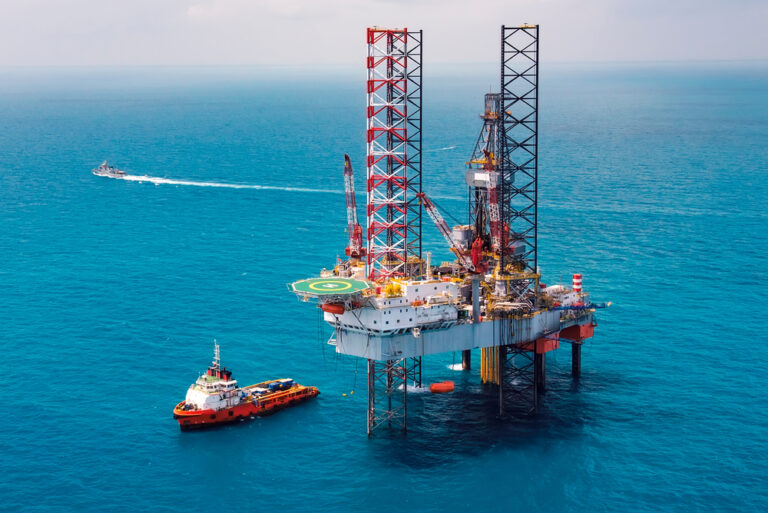
UK Oil & Gas (UKOG), a majority shareholder of Horse Hill Developments and operator of the Horse Hill Oil Project in the Weald Basin in southern England received a production permit from the Environment Agency on Thursday which helped boost the company’s shares by 25% to 0.14p.

UK Oil & Gas stated that the Environment Agency has issued a full production permit to UKOG’s 85.6% owned Horse Hill oil field.

Production and water re-injection activities, waste gas incineration, maintenance and the drilling of additional development wells are all allowed under the production permit.

To date, production at Horse Hill has been governed by prior testing consents that prohibit the reinjection of produced saline formation water.

UKOG may now go on with its plans to turn Horse Hill-2z into a water injector by 2022, eliminating the requirement for costly transportation and disposal of produced saline formation water at third-party sites.

On September 24, 2019, the Environment Agency received the initial application for the production permit, which was submitted 31 months ago.

Following the production permit, a feasibility study for resuming Kimmeridge production as well as new Portland infill drilling locations is underway.

George Frangeskides, Executive Chairman, UK Oil & Gas, commented, “This is welcome news. We look forward to hearing of the Operator’s plans for enhancing productivity and delivering on the inherent, and to date largely untapped, value of the Horse Hill Oil Field.”

Trainline: Outlook exceeds pre-covid era

0

Trainline announced a 222% jump in net ticket sales and 181% growth in revenue due to the ease of Covid-19 restrictions supporting the company which led the ticketing platform’s shares to rise 10% to 309p on Thursday.

Trainline noted a 222% increase in group net ticket sales to £2.5bn in line with the group’s guided range set out in its half-year trading update, despite the impact of Omicron in the fourth quarter.

As net ticket sales recovered over the year, the group’s revenue also recovered to £189m, which was 181% higher than 2021.

The UK Consumer segment contributed 248% to £153m, Trainline Partner Solutions generated £15m and International sales brought in £21m.

Trainline’s gross profit rose by 214% to £153m, noting a 279% increase to £129m in the UK Consumer segment followed by Trainline Partner Solutions contributing £11m and the International segment generating £13m.

Adjusted EBITDA was £39m compared to a loss of £25m in 2021 which lead to a basic loss per share of 2.5p versus 19.1p for Trainline.

The group’s operating free cash flow amounted to £166m as adjusted EBITDA and working capital inflows improved with the recovery in net ticket sales.

Trainline noted a decrease in net debt from £241m to £90 as a result of the recovery in trading leading to a positive operating free cash flow.

The group reported a 39% increase in customers that transact 2+ times a month compared to pre-Covid times and sold over 1m railcards in the UK during FY22.

Trainline launched flexi tickets and piloted digital season tickets which converted 27% more time-checkers to customers in comparison to pre-COVID times.

Since Trenitalia’s launch, tickets sold doubled as high-speed routes liberalise such as Paris-Lyon and the group scaled marketing investments in its International segment which delivered record new app customer acquisitions.

Trainline FY 2023 Guidance

Trainline predicts robust growth in FY2023, with net ticket sales in the range of £3.8-£4.2bn, with the bottom of the range exceeding FY2020, which was the year before COVID.

Revenue in the range of £280-310m, higher than FY2020, and adjusted EBITDA in the range of £70-75m are projected, with increased investment in its international segments, is expected by the group.

Jody Ford, CEO of Trainline said, “Our strong performance and positive outlook for next year reflects our relentless focus on supporting the rail industry’s recovery, making greener rail travel easier and better value for customers.” 

“In the UK, we are constantly innovating our app experience for commuters, including personalised journeys and easy rebooking, while also scaling digital railcards.”

“In Europe we are investing to become the rail app of choice. Customers are increasingly looking to Trainline to find value as choice spreads across markets with the entry of new rail operators.”

Helios Towers shares rise on 23% revenue growth

0

Helios Towers shares were up 3.8% to 114.3p in late afternoon trading on Thursday, after the telecommunications company reported a 23% year-on-year revenue growth to $127.5 million compared to $103.6 million for Q1 2022.

The firm reported a 4% increase in revenue from $122.3 million quarter-on-quarter.

The Africa-focused group announced a 20% EBITDA rise to $66.7 million against $55.8 million the previous year, which the company attributed to three acquisitions closed over the last 12 months and organic tenancy growth in established markets.

Helios Towers mentioned that its EBITDA gains were partially offset by corporate SG&A investments which supported the firm’s transformational expansion from five markets to ten.

The company announced a 2% uptick in EBITDA against Q4 2021 from $65.6 million.

However, Helios Towers mentioned an operating profit decrease of $2.7 million to $14.4 million year-on-year, driven by higher depreciation from acquired assets.

The group confirmed a portfolio free cash flow increase of 34% to $49.9 million year-on-year, which Helios attributed to its rise in EBITDA, lower maintenance and corporate capital additions and lower tax payments.

Helios commented that its lower tax payments were partially offset by higher lease payments as a result of the company’s higher site count.

The company reported a 76% increase in cash generated from operations to $52.7 million year-on-year, driven by the gains in EBITDA and working capital movements.

The telecom infrastructure firm highlighted that its business was underpinned by long-term contracted revenues of $4.2 billion against $2.8 billion in Q1 2021, of which 99% was sourced from multinational MMOs, with an average remaining life of 7.4 years compared to 6.6 years the previous year.

Helios Towers reconfirmed its guidance for 2022, with projections of 1,200 to 1,700 organic tenancy additions, 60% of which are set to be new sites, a lease rate per tenant increase between 3-5% to $26,400 since last year, and an adjusted EBITDA margin between 51-53%.

“We have seen strong growth this quarter with revenue up 23% year-on-year, driven by continued organic demand in our established markets in addition to the contributions from our three new markets of Senegal, Madagascar and Malawi,” said Helios Towers CEO Tom Greenwood.

“Our recent platform expansion is progressing well, as we become the most diversified towerco in the region with the doubling of our sites and markets.”

“We have many exciting years ahead as we move to a new phase of our journey and launch our 5 year sustainable business strategy – focused on driving growth, impact, margins and returns.”

Small & Mid-Cap Roundup: Trainline, Virgin Money, Domino’s, UK Oil & Gas

0

FTSE 250 gained 1.2% to 20,457 and the AIM was up 0.6% to 1,004 on Thursday as companies including Trainline and UK Oil & Gas supported the indices.

Trainline shares flew 10.5% to 307p after the group reported a pre-tax loss of £15.5m from £106.8m in 2021.

Trainline reported an increase in revenue from £67.1m to £188.5m as significantly higher net ticket sales signalled a recovery for the rail industry from the pandemic.

Puretech shares gained 7.3% to 180p after the group approved a share buyback of up to $50m.

Morgan Advanced Materials increased 7.4% to 293p after the industrial products manufacturer reported an 11% sales growth in Q1 on an organic constant-currency basis compared to 2021.

The group said its Molten Metal Systems business grew the strongest, with sales growth of 16% YoY on the same basis, and its performance in line with executive guidance.

Playtech shares were trading up 1.5% to 522p after the group reported an “excellent” start to the year, as adjusted EBITDA came in at €100m in the first quarter.

Helios Towers shares rose 4% to 114p after the Africa-focused mobile phone tower developer posted revenue of $127.5m, a 23% increase YoY from $103.6m.

Helios said the increase in revenue was driven by acquisitions in Senegal, Madagascar and Malwai, as well as strong organic tenancy growth across the company.

IMI shares were trading up 4.3% to 1,407p after the engineering firm reported a 9% increase in revenue to £421m due to order book growth.

Derwent London shares gained 3.7% to 3,009p following the group’s announcement of its plan to acquire City Road Island EC1 for £239m, and said that its rent collection levels in the first quarter were in line with pre-pandemic levels again in its Q1 business update.

Virgin Money shares tumbled 7.6% to 163p despite the group reinstating its interim payout, and posted a sharp rise in pretax profit from £72m to £315m.

Hiscox shares plummeted 7.2% to 887p after the specialist insurer battled high inflation and interest rate rises, resulting in a quarterly loss in its investment return.

Hiscox Retail premiums climbed to $670.8m from $663.9m, as it continued “to progress with positive momentum”.

Domino’s Pizza Group shares dropped 5% to 316p despite reporting an order growth in the first quarter due to recovery of collections, which grew 45%.

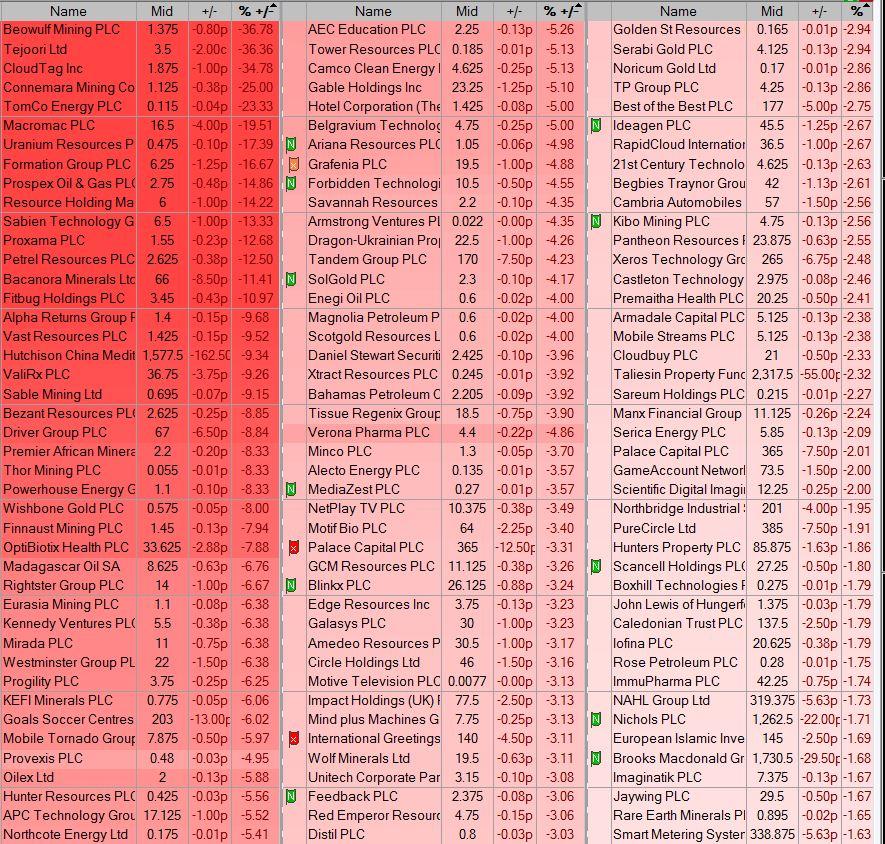
Vast Resources shares tanked 20% to 1.6p, as shares rebounded from gains made on Tuesday.

Petro Matad shares were trading down 13% at 3.6p after the Mongolia-focused exploration firm said the recent increase in Covid-19 related lockdowns and travel restrictions in China continued to affect Mongolia, alongside the fact that no Chinese oil rigs are currently operating in the region.

UK Oil & Gas shares soared 42% to 0.16p after the company stated that the UK Environment Agency had granted its 86% owned Horse Hill oil field a full production permit which enabled production and water re-injection operations, incineration of waste gas, maintenance and the drilling of further development wells.

i-nexus shares were trading up 18% to 5.6p following the software company’s announced appointment of Drew Whibley to the board as chief financial officer, effective from August 1.

Petard shares rose 15.6% to 13p following the group’s swing to a pretax profit of £502,000 from a loss of £1.2m, as revenue increased 4.6% to £13.6m from £13m in 2021.

Open Orphan shares gained 5.6% to 14p following the company’s announcement that hVIVO, Open Orphan’s subsidiary, signed a contract for a new study with an existing Big Pharma client to act as a vaccination site for a Phase II field study of the client’s respiratory syncytial virus (RSV) vaccine candidate.

FTSE 100 gains despite BoE interest rate hikes

0

The FTSE 100 was up 1.5% to 7,610.8 in early afternoon trading on Thursday, as the market enjoyed a rally despite the Bank of England’s decision to hike interest rates to 1%.

The gains in the market could be linked to the Federal Reserve’s 0.5% interest rates hike, which came 0.25% below the expected 0.75% jump, giving investors cause for celebration with a wide slate of sectors gaining across the FTSE 100.

“The reason why the market jumped was down to previous fears that the central bank would be even more aggressive with rate rises to curb inflation,” said AJ Bell investment director Russ Mould.

“There was a lot of chatter about whether the Fed would have been bold enough to deliver three quarters of a percentage point rise. Federal Reserve chair Jay Powell gave the answer the market was looking for – no, that is not ‘actively’ being considered.”

“Investors breathed a sigh of relief and hence share prices went up.”

A slate of positive results from companies including Shell and Next boosted the market, as Next defied inflation fears of high street decline with a 285% surge in retail growth, and Shell profits tripled to $9.1 billion on the back of skyrocketing oil prices.

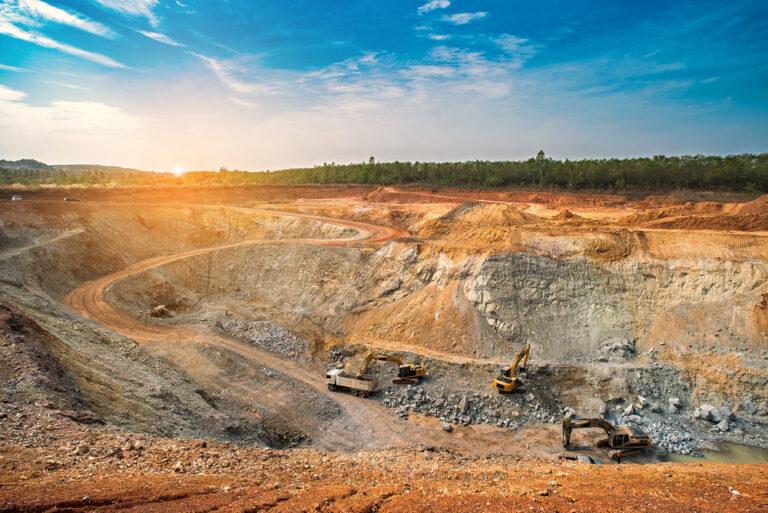
Endeavour Mining shares surged 9.1% to 21,190p after the firm reported climbing revenue on the back of an 8.5% year-on-year increase in gold prices and increased levels of production.

Mondi shares gained 6.9% on the back of strong Q1 2022 results, with a 63% rise in pre-tax underlying earnings to €574 million compared to €353 million the previous year.

Shell shares gained 4.1% following the energy giant’s massive profits boost despite its Russian operations exit, as the company tripled its profits for Q1 2022 to $9.1 billion against $3.2 billion the last year.

The oil and gas company attributed its profits to soaring oil prices, with Brent crude exceeding $120 per barrel in March this year and currently at $110 per barrel on the back of scarcity fears due to Russia’s war in Ukraine.

Anglo American shares rose 4% to 36,500p after the mining company announced the appointment of Tim Livesey as a non-executive director of the firm.

Hikma shares plummeted 8.2% on the back of an announced delay to its Jazz Pharmaceuticals generic version of Xyrem, the company’s treatment for narcolepsy, causing a downgraded revision of its generics business guidance.

Bank of England hikes interest rates to 1%

1

The Bank of England announced a 0.25% hike in interest rates to 1%, the highest rate in 13 years.

The Bank of England’s nine rate-setters voted six against three to raise interest rates to the projected 1% expected by the market, as a result of 30-year high rates of inflation sweeping the UK.

The three opposing rate setters pushed for a greater increase to 1.25% in a bid to curb the skyrocketing inflation, which is expected to soar to 10% in Q4 2022.

Households Suffering

Analyst pointed out that the bitter rates jump would cause the most damage to households already struggling with rising inflation, the Covid-19 pandemic and rising energy prices.

“The move by the Bank’s rate-setters to increase rates lumps even more pain on households struggling with the cost of living crisis,” said AJ Bell head of personal finance Laura Suter.

“With inflation at 7% and expected to hit double digits in October, when the energy price cap rises again, it might have seemed like the Bank’s hand was forced.”

“The global nature of the drivers of inflation means that this increase to 1% is very unlikely to beat inflation into a hasty retreat, but what it is certain to do is pile more misery on people already having to rely on debt just to pay their bills.”

Inflation is set to hit a 9% rate across April in light of the 54% energy price cap rise, with the rate predicted to peak in October as energy bills climb higher on the back of increased energy bills.

“We expect inflation to rise further to around 10% this year,” said the Bank of England in a statement.

“Prices are likely to rise faster than income for many people. That means that people will be able to buy less with their money.”

“The UK economy has been recovering from the effects of Covid, but we expect the increased cost of living to lead to slower growth overall.”

BoE Fighting Inflation

The Bank said it aimed to curb inflation back to its 2% goal, and added that it expected to fall back within its ideal rate in around two years.

“[We] do have tools to make sure inflation comes back down to our 2% target. The main tool we use to bring inflation down is to increase interest rates,” said the Bank.

“We raised the UK’s most important interest rate (Bank Rate) from 0.1% to 0.25% in December 2021, to 0.5% in February 2022, and then again to 0.75% in March. This month we have raised Bank Rate to 1%.”

“We expect inflation to fall back next year and be close to our target in around two years.”

Recession Concerns

The looming prospect of a recession weighed on the announcement, with the Bank of England forecasting a potential GDP fall of close to 1% in Q4 2022 on the back of the rising energy price cap in October.

The institution reported a revised estimate to UK growth in 2023, anticipating a 0.25% contraction as opposed to its previous projection of 1.25% growth.

The outlook for 2024 appeared similarly grim, with a mere 0.25% growth predicted against its former 1% growth forecast.

Unemployment is also expected to hit 5.5% by 2025, as the UK suffers the second-largest hit to real household disposal income since 1964.

Further Interest Rate Hikes

The Bank of England confirmed that interest rates could continue to climb as high as 2.5% within a year, with many predicting that the Bank will hike rates to 1.25% at the next decision in June.

“Last time rates were at 1% they only sat there for less than a month, before being cut again to 0.5%. Anyone with borrowing will fear that the same will be true this time around, and that the Bank will increase rates again to 1.25% at the next meeting in June,” said Suter.

“That seems almost inevitable, with the Bank now predicting that rates will hit around 2.5% by this time next year.”

“This fourth increase in a row by the bank means that in the space of less than five months we’ve seen rates leap from 0.1% to 1%. And that means anyone with debt has seen a significant increase in their costs.”

Reach shares tank 20% as revenue falls

0

Reach announced strong strategic development and digital revenue growth amid a more competitive market, but shares dropped 20% to 127p in early afternoon trading on Thursday.

Reach noted a decline in group revenue by 0.9% YoY as the war in Ukraine impacted advertiser demand.

The group recorded a 9.3% YoY growth in digital revenue, whereas print revenue fell by 4.2% in the latest trading update.

Reach said that the market has seen weaker advertiser demand and average yields over the last two months, with the war in Ukraine dramatically decreasing the amount of ‘brand safe’ material available to news publishers.

While this has resulted in lower growth than anticipated, the group is strengthening the quality of our digital sales, with significant growth in higher-yielding revenues such as PLUS+ becoming a larger part of the mix.

PLUS+ data has recently been integrated into three of the top advertising agencies’ online marketplaces, and Reach is continuing to develop customer profiles and employ technology, such as its AI contextual tool Mantis, to encourage greater consumer time on site.

Reach is continuing to invest in the Customer Value Strategy, with its cost base being reshaped to support data and technology investments.

However, the group has observed substantial rises in operating expenses since the middle of March, particularly in print, where the impact of newsprint hikes would now surpass previous projections.

Additional measures, such as the acceleration of efficiency programmes, modifications in print manufacturing, and activities regarding print cover prices, have been made to help counteract this.

As a result of the more adverse economic conditions, Reach forecasts a flat group revenue for the year, with a higher mix of circulation revenues and lower digital contribution than originally expected.

The impact of recent newsprint inflation is fully reflected in the group’s cost forecasts for the current fiscal year, and efforts are already being taken to help offset the impact on operational profit.

Jim Mullen, CEO of Reach said, “We’re developing a more sustainable and profitable long-term future for the business, with delivery of the strategy progressing well, despite a more challenging economic backdrop.”

“The effective collection and use of data are supporting the growth of our higher yielding digital products, which are becoming an increasing part of our revenue mix. We’ve taken swift action to address the impact of inflation on our cost base and the business remains strongly cash generative, supporting the investment in data and technology that is key to future growth.” 

Endeavour Mining reports 14% gold production rise

0

Endeavour Mining shares spiked 8.4% to 2,104p in late morning trading following a slate of positive results from the company, including a 14% Q1 2022 gold production to 357koz and a relatively flat AISC at $848 per oz.

The mining group reported that it was well-positioned to hit its FY2022 guidance of 1,315 to 1,400koz at an AISC of $880 to $930 per oz.

Endeavour added that its adjusted net earnings rose $22 million to $122 million, representing a 2% increase on a per share basis to 49c per share, with an operating cash flow saw a boost of $96 million to $299 million and a 23% rise on a per share basis to $1.21.

The company said its net cash position increased by $90 million over Q1 2022 to $167 million, despite $101 million paid in capital returns to shareholders.

The mining firm paid out a dividend of $70 million over the quarter, amounting to $200 million in dividends paid out since Q1 2021.

Endeavour Mining reported the continuation of its share buyback programme, with $31 million in shares repurchased across the quarter, totally $169 million since the programme started in April 2021.

“We are pleased to have started the year on a strong footing with both production and all-in sustaining costs well positioned to meet full year guidance,” said Endeavour Mining CEO Sebastien de Montessus.

“This performance has resulted in robust cash flow generation during the quarter which, in line with our capital allocation framework, was used to further strengthen our balance sheet, to continue our attractive shareholder returns programme, and to reinvest back into our business.”

“Our net cash position has improved by $90 million to reach $167 million by the end of the quarter, and we also returned more than $100 million to shareholders over the period through dividends and buybacks.”

Derwent London to acquire City Road Island EC1

0

Derwent London announced that it had exchanged a conditional contract to purchase the freehold of City Road Island EC1, which houses the Moorfields Eye Hospital and the University College London Institute of Ophthalmology for £239m on Thursday.

Derwent London said that Moorfields Eye Hospital NHS Foundation Trust and UCL, as part of the Oriel joint project, are selling the facility for £239m before costs which is contingent on final Treasury approval, which is expected in the second half of 2022.

Completion of the purchase is also contingent on Oriel delivering the new eye hospital at St Pancras and then vacating City Road Island, which is expected to happen in early 2027.

Derwent London has hired architects AHMM and a whole professional team, and as part of its regeneration plans, it will engage the community extensively.

This significant 2.5-acre site, which includes approximately 400,000sqft of existing buildings, is in the heart of the Tech Belt, where the group has significant assets.

According to our first assessments, the site has the potential to provide a large 750,000+ sqft campus with ample public space and high environmental credentials.

Paul Williams, CEO, Derwent London, said, “We are delighted to have secured such an important central London regeneration opportunity in the heart of the Tech Belt, where we aim to deliver the next generation of distinctive ‘long-life, loose-fit, low carbon’ commercial space.”

“This is a significant step towards realising the Oriel joint initiative. Oriel will bring together UCL’s formidable research base with Moorfields’ world-class healthcare delivery in one integrated centre of research, education and care,” added Professor Alan Thompson, Dean of the UCL Faculty of Brain Sciences.

The acquisition is likely to have a minimal impact on the company’s profitability once it is completed.

The £239m payment that Derwent London will pay upon completion of the transaction is in accordance with the market value of the estate, which does not yet have planning consent, and will be funded by undrawn lending facilities and cash.

The contract also includes potential overage provisions that may be payable if the site receives planning approval and/or is sold within a certain time frame.

The potential sums payable under such overage arrangements are subject to an aggregate cap, which includes the purchase consideration due at completion.

Martin Kuper, Chief Executive of Moorfields Eye Hospital NHS Foundation Trust stated, “This is an important step forward for our plans for Oriel, a new eye care, research and education centre. The sale of our City Road Island, which is conditional on Treasury approval of Oriel, is a key element of our funding strategy.”

“All proceeds will be reinvested in the new centre to secure the long-term future of world-leading eye care, research and education in a way that represents value for money and benefits our patients. We will continue to maintain our strong links with Islington Council as plans for City Road Island progress.”

Derwent London shares rose 3.5% to 3,003p in early morning trade on Thursday.