Pensions Regulator declares war on scammers with new strategy

4

The Pensions Regulator has declared war on scammers with a new three-pronged strategy to protect savers from predators and punish criminals found guilty of participating in fraudulent activity.

The scheme reportedly aims to educate pension trustees and savers on the threat of scams, stop practices which might harm retirement outcomes, and fight fraud via the prevention, disruption and punishment of criminal parties.

The Regulator said it launched the strategy to tackle the fresh wave of scammer activity amid the cost of living crisis, with spiking inflation and the rising energy price cap this autumn leaving a growing number of UK households at risk of fraud.

“The last two years have already been incredibly difficult for millions of people, with Coronavirus and lockdowns taking a massive toll on people’s physical and mental wellbeing, including their financial health in some cases. On top of this, the cost-of-living is rising rapidly, with the energy price cap set to surge yet again later this year,” said AJ Bell head of retirement policy Tom Selby.

“All of this means millions of Brits face being on or near the financial precipice in 2022. Depressingly, this is a perfect environment for scammers to thrive.”

The soaring cost of living crisis has led many people to seek urgent measures to make ends’ meet, with credit card borrowing surging as families eat into their savings and into debt in desperation to put food on the table.

The desperate situation unfortunately provides a ripe harvest for criminals to reap, at the risk of immense consequences for vulnerable pensioners and savers.

“Unscrupulous fraudsters will attempt to take advantage of vulnerability through any means possible, from offering ‘early access’ to pensions to pushing dodgy investments promising sky-high, guaranteed returns,” said Selby.

“Offers such as these might be particularly tempting to people experiencing inflation on the brink of double-digits.”

“However, the reality is that, unless you are in serious ill-health, accessing your pension early will lead to a huge tax penalty from HMRC, while being lured by the promise of sky-high investment returns from a scammer could see you lose everything.”

The Pensions Regulator’s new strategy has been met with a warm welcome, with its effort to spread intelligence and launch new preventative protections lauded as essential in the current economic environment.

“Regulators are right to get on the front foot on this and the vast majority of the pensions industry stands ready to help educate customers about the risks,” said Selby.

“It is particularly positive TPR is taking steps to improve intelligence sharing and testing new scam prevention solutions. It is vital firms share any concerns they have about schemes, firms or individuals with the relevant authorities, and vice versa, to ensure as many savers as possible are protected.”

How to avoid fraudulent activity

AJ Bell shared five tips to avoid scam attempts, including to hang up if an known party contacts you to discuss your pension, don’t associate with unregulated so-called advisors and don’t entertain prospects of “sky-high” investment returns from overseas or crypto opportunities.

“While telephone, text, email and social media remain the primary weapons of choice for the modern con artist, some continue to knock on doors; usually targeting older people they think are more likely to be vulnerable,” said Selby.

Additionally, don’t listen to schemes offering “guaranteed” returns, and don’t rush into a decision linked to your pension without absolute due diligence.

“Nothing, and I mean nothing, is guaranteed when it comes to investments. If a company you’ve never heard of says it can deliver GUARANTEED returns of any amount, don’t touch them with a barge pole,” said Selby.

If you are unsure about an investment or an advisor, check the Financial Conduct Authority’s (FCA) ScamSmart website, or talk to a regulated financial advisor about your situation.

Spanish government green lights €1.8bn Rolls Royce sale

0

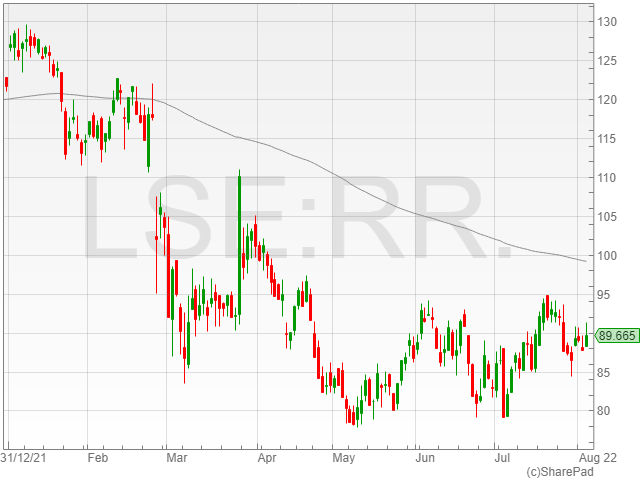
Rolls Royce shares rose 1.6% to 89.2p in late afternoon trading on Wednesday after the luxury car group received the green light from the Spanish government to sell its ITP Aero subsidiary for €1.8 billion.

The group has been purchased by a consortium of investors led by Bain Capital Private Equity, with the transaction scheduled to close in the coming weeks.

Rolls Royce announced that all regulatory authorities had approved the deal.

The agreement reportedly completes the company’s disposal programme launched on 27 August 2020 to raise proceeds of at least £2 billion.

The finance from the deal is set to help rebuild Rolls Royce’s balance sheet to support its ambition to return to an investment grade credit profile in the medium term.

Rolls Royce commented ITP Aero would remain an important strategic supplier and partner for the car manufacturer across its Civil Aerospace and Defence programmes.

OPEC+ raises oil output by 100k barrels per month

OPEC+ has reportedly chosen to raise its oil output by 100,000 barrels per month in its latest meeting on Wednesday.

The increase is set to cover a mere 86 seconds of international demand, and was described as “so little as to be meaningless,” according to Eurasia Group managing director for energy, climate and sustainability Raad Alkadiri. “As a political gesture, it is almost insulting.”

OPEC+ said in a statement that the “severely limited availability of excess capacity” served to necessitate a lower output, and added that emergency oil stocks had reached their lowest levels in over thirty years.

The organisation also confirmed that OECD commercial oil stocks stood at 2,712 mb in June 2022, coming 163 mb lower than last year and 236 mb beneath the 2015-2019 average.

OPEC+ noted the lack of investment in the oil sector over recent years which had led to atrophied capacity along the upstream, midstream and downstream value chain.

The price of benchmark Brent Crude oil rose to $101 per barrel following the report after a fall to $99 earlier in trading.

FTSE 100: Avast soars and Taylor Wimpey defies housing market slowdown concerns

0

The FTSE 100 ground out a 0.3% gain to 7,436 early afternoon trading on Wednesday, as the market’s eyes turned to US House Speaker Nancy Pelosi’s recent return from Taiwan and the meeting of OPEC+.

“Investors already have more than enough on their plate. Now they find themselves having to make room for one more worry, as tensions build between the US and China,” said AJ Bell investment director Russ Mould.

“So far the response has been to hold military drills and step up sanctions on a country it regards as a breakaway province.”

US markets remained steady, with pre-open trading seeing a 0.4% rise in Dow Jones future to 32,497, a 0.4% gain in the S&P 500 to 4,111.2 and a 0.4% uptick in the NASDAQ to 12,978.

Asian markets seemed to trend in split directions, with a 0.4% climb in the Hang Seng to 19,767 and a 0.7% fall in the Shanghai SSE to 3,163.6.

Meanwhile, the price of Brent Crude oil cracked the $100 per barrel mark after dipping to $99 in earlier trading following reports that OPEC would be increasing output by a mere 100,000 barrels per day from September.

Experts described the miniscule rise as an “insult” to US President Biden, with the increase covering an equivalent of 86 seconds of worldwide demand.

OPEC’s refusal to raise its output was linked to its lack of spare capacity among parties to add more barrels, along with a necessity to ensure cooperation with Russia as part of the extended OPEC+ collaboration.

Interestingly, current supply fears have actually been met with reverse concerns over demand, following weaker than projected economic data from China in Q2 2022 reported last week.

FTSE 100

Avast shares surged to the top of the FTSE 100 with an absolutely outstanding 42.7% spike of 42.7% to 682.4p after the Competition and Markets Authority (CMA) reported its provisional green light for the company’s acquisition by NortonLifeLock.

The £6 billion agreement had been under investigation by the institution for possible competition violations, however it confirmed the merged company would still face credible competition, including from major rival McAfee.

Taylor Wimpey shares gained 5.1% to 126.2p, defying concerns of a housing market slowdown with a revised operating profit guidance at the top end of market expectations for FY 2022.

The company announced completions slightly ahead of expectations at 6,790, falling below its 7,219 completions in HY1 2021.

Taylor Wimpey confirmed rising cost inflation of 9% to 10%, however it commented the inflation would be offset by house price increases of 4% to 5% in the coming year.

“First half results from Taylor Wimpey were impressive, no question about it. To be guiding toward profit at the top end of consensus forecasts, despite facing challenges around surging raw material costs, shortages of skilled workers and lingering supply chain issues, is no mean feat,” said AJ Bell investment director Russ Mould.

“Unlike some of its peers, Taylor Wimpey is on track to hit volume targets and, like a gazelle eluding a hungry lion, house price growth somehow continues to outpace inflationary and interest rate pressures for now.”

“Taylor Wimpey is not alone in having a strong balance sheet and it has invested in land at attractive prices. This, plus the long-standing supply and demand imbalance in the UK housing market, provides at least some confidence in the long-term outlook.”

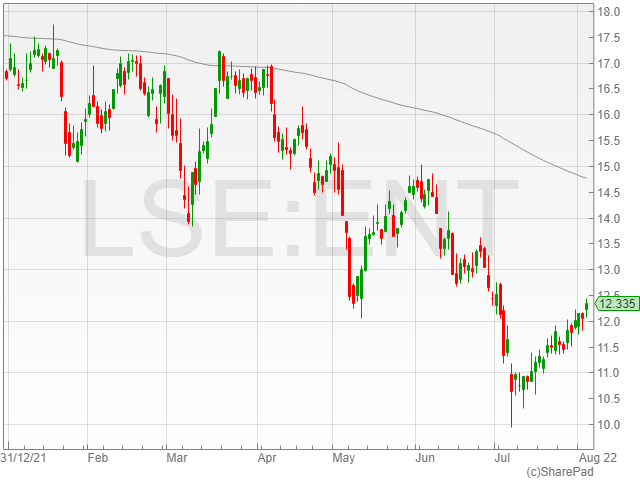
Entain shares rose 2.4% to 1,234.5p following the successful extension of its community sports investment-based partnership with the Trident Leagues.

The gambling firm commented the multi-year extension would provide essential funding for the company in the years ahead.

Rolls Royce shares climbed 2.2% to 8,978.5p following its reported approval from the Spanish government to sell its ITP Aero subsidy for £1.5 billion to a consortium of investors led by Bain Capital Private Equity.

The sale is scheduled to close in the coming weeks, now that all the relevant regulatory authorities have approved the transaction.

“ITP Aero will remain a key strategic supplier and partner for Rolls-Royce across both Civil Aerospace and Defence programmes,” said Rolls Royce in a statement.

Hiscox swings to $107.4m pre-tax loss and $214.1m investment result loss

0

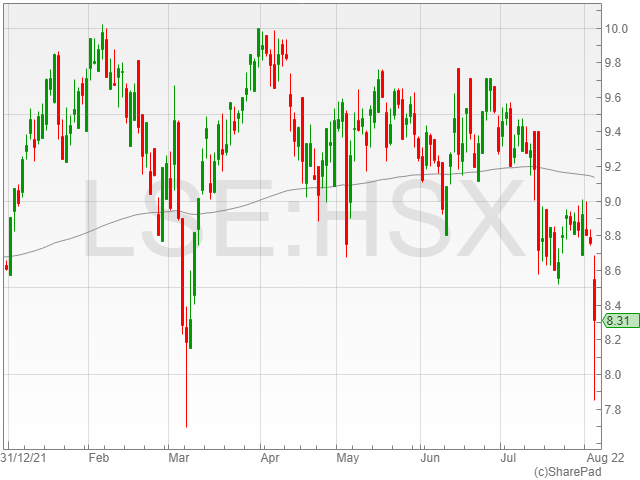
Hiscox shares dropped 5% to 831.4p in late morning trading on Wednesday after the group swung to a pre-tax loss of $107.4 million in HY1 2022 compared to a profit of $133.4 million the last year.

The insurance firm reported an $87.1 million loss for the financial period from a $119 million profit in HY1 2021.

Hiscox linked $48 million in losses to all risks in Ukraine and Russia, and confirmed an investment result loss of $214.1 million against a profit of $61.9 million year-on-year, as a result of spiking interest rates, widened credit spreads and equity markets selling off.

The company highlighted a rise in gross premiums written to $2.6 billion against $2.4 billion despite FX headwinds from a strengthened US dollar, with rate momentum continuing to hit or exceed inflation expectations across all three divisions.

Hiscox also noted a climb in net premiums earned to $1.44 billion from $1.42 billion, with an underwriting result of $123.2 million compared to $99.8 million in the previous year.

Hiscox swung to a loss per share of 25.3¢ compared to 34.8¢ the year before.

“I am pleased with the Group’s performance during the first half of the year as rate strengthening and disciplined growth drove much-improved underwriting profitability,” said Hiscox CEO Aki Hussain.

“Whilst macro-economic and geo-political concerns are affecting the global economic outlook, our strategy and diverse portfolio of businesses continues to create opportunity, and we are well positioned to generate high quality growth and earnings.”

“Our big-ticket businesses have experienced positive market conditions and our well-balanced portfolio is generating attractive returns.”

Hiscox announced a HY1 dividend of 12¢ from 11.5¢ the last year.

Taylor Wimpey, Tekcapital, and a Bear Market Rally with Alan Green

The UK Investor Magazine Podcast is joined by Alan Green as we delve into this market’s key themes and a selection of UK equities.

We start by exploring the current rally in equities and whether it is a bear market rally, or something that can be sustained. Markets welcomed the recent instalment from the Fed which sparked a rally, sending the S&P 500 up 10% from the lows and the NASDAQ up 16%.

UK house prices rose 11% year-on-year in July as the housing market shrugged off cost-of-living crisis concerns. However, the Nationwide Chief Economist pointed to signs of a softening which hit housebuilding shares heavily yesterday. 

Today, Taylor Wimpey shares bounced back following a strong first half update. We look at their results and outlook for the second half of the year.

Tekcapital released half year results last week following their presentation at the UK Investor Magazine Investor presentation in July. The company is to IPO a number of their portfolio companies in the coming months which could increase their portfolios NAV.

We cover the latest update by Kavango Resources on their activities in the Kalahari Copper Belt.

Oil drops to $99 ahead of OPEC+ meeting

The price of oil fell below the $100 mark ahead of the OPEC+ meeting today, with benchmark Brent Crude dipping to $99 per barrel.

The market currently expects producers to keep a steady output, with little to no change in production as supply fears persist on the back of the Russian war in Ukraine.

“There are jitters flowing through the oil market today, ahead of an OPEC+ meeting which is expected to bear little fruit when it comes to changing current output mandates,” said Hargreaves Lansdown lead equity analyst Sophie Lund-Yates.

“This feeds into anxieties about constrained supply which consumers and wholesalers are very well-versed in at this point.”

However, analysts also noted an increase in demand fears, following weak Chinese economic data including a mere 0.4% growth in Q2 and a manufacturing purchasing managers index of 49.0 compared to the expected 50.4 in July.

The current market volatility is expected to continue into the weeks ahead, but the falling oil prices might give consumers reason for relief after several months of skyrocketing prices.

“The interesting flipside is that anxieties about a petering of demand seem to be winning in the battle of sentiment,” said Lund-Yates.

“Very real questions about the health of the global economy mean demand for oil and gas could be in for a contraction that’s so sharp, the supply concerns are void.”

“Continued volatility should be expected while these dual trains of thought continue, and consumers will welcome the reversal in prices to around $100 per barrel, against prices of around $124 as recently as March.”

Petrol prices remain high

The issue remains that these lower prices have yet to make their way onto petrol tills, with UK supermarkets under scrutiny for failing to drop their prices by even half the level wholesale prices have fallen.

“The UK’s major supermarkets have been accused of failing to pass falling wholesale energy prices onto customers, stalling the speed at which people can benefit from the tempering of the oil price,” said Lund-Yates.

“Tesco, Asda, Morrisons and Sainsbury’s have been accused of dropping their petrol prices by less than half the amount that wholesale prices have declined.”

“As the cost-of-living crisis continues to clamp down on people’s incomes, this sort of headline is something these companies don’t need.”

A possible explanation for the failure to pass along lowered prices has been suggested that supermarkets are attempting to make up for the shortfall in demand when petrol prices plummeted over the Covid-19 pandemic.

“At a business level, supermarkets were hampered during the pandemic when petrol prices famously dropped to under one pound, so these groups are arguably making up for these previous shortcomings,” said Lund-Yates.

AIM movers: Zinc Media acquisition and Orcadian Energy farm-out

0

TV programme producer Zinc Media (LON: ZIN) is acquiring The Edge Picture Company and raising £5m at 100p a share. The share price dipped 5.6% to 101.5p. Zinc Media has also launched a £250,000 retail offer via Peel Hunt’s REX platform. The intermediaries involved are Interactive Investor, AJ Bell and Hargreaves Lansdown and the minimum subscription is £50. The Edge is based in London and Qatar and is a brand and corporate film maker. Clients include Barclays, Amazon and FIFA. In 2021, revenues were £8.2m and EBITDA was £800,000. There is initial consideration of £2.1m in cash and shares with up to £3.875m payable if a total of £5m of operating profit is made over the three years to June 2025.

Sabien Technology (LON: SNT) is raising £500,000 through a placing at 10p a share, with potential to raise up to £100,000 more from existing shareholders via a broker option that closes at 5pm on 3 August. The cash will be used to finance the company’s green technology businesses. The share price dived 21% to 12.25p.

Detection technology developer Kromek Group (LON: KMK) shares bounced back today following yesterday’s annual results. The shares increased 15.2% to 10.25p. finnCap forecasts revenues will grow from £12.1m to £18m in the year to April 2023. There is 53% of contracted revenues and 37% going through contract negotiations. The other 10% should come from repeat revenues. Kromek will remain loss-making.

Phoenix Global Resources (LON: PGR) has posted a circular to shareholders to gain approval for its plan to leave AIM. The oil and gas company is holding a general meeting on 1 September. Main shareholder Mercuria Energy is offering 7.5p a share to minority shareholders. The share price moved up 17.7% to 7.3p.

Orcadian Energy (LON: ORCA) has announced the formal farm-out agreement for the Carra prospect in the North Sea. The deal with Carrick Resources requires it to fulfil certain work milestones, which should take four months, and Orcadian will assign a 50% stake in the sub-licence area. This pushed up the share price by 4.76% to 33p.

Oracle Power (LON: ORCP) has been told by the Sindh authorities that it will receive a letter of intent for establishing a 1,200MW hybrid solar/wind, green hydrogen/power project in Pakistan. Oracle Power has to provide a $600,000 performance guarantee. There was a 14% rise in the share price to 0.325p.

Omega Diagnostics (LON: ODX) has completed the sale of the CD4 business for up to £6.1m. The initial £1.1m has been paid. A further £4m will be paid when a clinical study is completed in Kenya. There was a monthly cash outflow of £300,000 a month from CD4. The ongoing focus will be the health and nutrition business. finnCap believes that Omega Diagnostics could breakeven in 2022-23. The relocation to Ely will provide additional capacity. The share price increased 4.7% to 3.35p. Mixed signal ASICs chipmaker EnSilica (LON: ENSI) says contract momentum accelerated in the fourth quarter of the year to May 2022. Revenues and EBITDA are ahead of expectations. Revenues were approximately £15.1m, up from £8.6m the year before, while the EBITDA was £500,000. The share price rose 2.1% to 49.5p, which is just below the recent flotation price of 50p.

IP Group swings to £309.8m HY1

0

IP Group shares increased 1.4% in late morning trading on Wednesday, despite swinging to a loss of £309.8 million in HY1 from a profit of £116.5 million the year before.

IP Group linked its HY1 loss to the reversal of gains on Oxford Nanopore, reflecting a slide in public market interest in life science tools companies.

The company announced a net portfolio loss of £291.1 million against a net gain of £140.4 million, with a climb in net overheads to £11.1 million from £9.6 million.

The IP Group mentioned a net asset value slide to 136.7p per share from 167p per share.

The firm also noted a fall in its balance sheet to £235.7 million against £321.9 million the last year.

“Having acted to ensure that the Group has a strong level of liquidity, IP Group ended the period with gross Cash of £235.7m,” said IP Group CEO Greg Smith.

“This financial strength enabled the Group to continue to invest into our leading companies over the period as well as continuing to return a proportion of all exits to shareholders via dividends and share buybacks.”

“In addition, we have arranged a private market debt issue to provide additional funding flexibility in what may be difficult market conditions.”

The IP Group confirmed a dividend raise to 0.5p per share compared to 0.48p year-on-year.

Osirium Technologies licence extension

0

Cloud-based cybersecurity provider Osirium Technologies (LON: OSI) has secured a three-year privileged access management (PAM) licence extension with an existing customer. The deal has a value of £500,000.

That is equivalent to 30% of the total bookings achieved by Osirium Technologies in 2021. The cash will be paid up front and revenues recognised over the three-year period.

The customer, which is a global asset manager, has been using the PAM service for six years and the latest contract will cover 4,500 devices.

The customer has also extended the use of Osirium Technologies’ privileged process management (PPA) service for another 12 months. The PPA service has been used since 2019. The number of licences has increased from 40 to more than 75.

This shows how Osirium Technologies can win an initial contract with a client and sell additional licences and other services on the back of the initial deal.

Osirium Technologies is forecast to achieve revenues of £1.74m in 2022. It remains loss-making, although deals like the late4st one mean that cash flow is better than the reported loss.

The share price initially jumped on the announcement, but it has lost much of the increase and is currently 8.7% higher at 6.25p.