FTSE 100 drops as EU plans to ban Russia oil

1

FTSE 100 dropped 0.46% to 7,526 on Wednesday as news of plans for more sanctions from the EU to ban Russian oil make headlines in the attempt to slow down the war in Ukraine.

Today, a spike in oil prices followed the EU’s announcement of plans to impose a six-month ban on Russian oil imports, putting even more strain on businesses and people.

Brent crude prices rose 3.6% to $108.8 a barrel after European Commission President Ursula von der Leyen announced the EU’s sixth round of sanctions on Russia.

UBS believes the market is undervaluing the risks associated with energy supply and forecasts Brent crude to trade around $115 a barrel. This won’t help ease the price pressures that are pinching profitability and eroding customer confidence.

Shell and BP shares gained 0.7% to 2,231p and 417p on the back of rising oil prices.

The FTSE 100, UK’s benchmark index weakened further as US Fed rates are expected to increase on Thursday.

Investors grip the edge of their seats while waiting for US Federal Reserve to announce its decision on interest rates, where “a half percentage point rise is widely expected” according to Russ Mould, Investment Director, AJ Bell.

Flutter Entertainment shares rose 7.8% to 8,935p after the Paddy Power owner reported a strong first three months of the year for its US business FanDuel and noted a 6% rise in group revenues to £1.57bn. Flutter also noted a 15% rise in average monthly players to 8.9m.

Entain, Flutter’s rival, saw its shares gain 2.2% to 1,525p.
Mining stocks dragged the FTSE 100 down with Rio Tinto shares falling 2% to 5,532p; Anglo American shares down 0.6% to 3,557p and Glencore shares dropping 0.08% to 483p as an outcome of ratings cut from Liberum weighing on the mining sector.

Retail stocks added to the burden by sinking too. Kingfisher shares fell 6% to 238p, followed by Howden Joinery shares losing 3.5% to 699p, and JD Sports shares trading down 3.2% to 130p.

“Household budgets are constrained and while luxury brands serving the very wealthy usually ride out downturns well and cheaper outlets can attract shoppers who are trading down, more premium high street brands look vulnerable,” added Mould.

Admiral shares lost 3.5% to 2,470p after the car insurer’s rival Direct Line Insurance announced that it’s motor new business premiums increased by mid-single digits early in January and were flat through the rest of the quarter.

National Grid shares dropped 0.5% to 1,189p following the announcement that the electricity distribution business will pay just under £15m to a UK regulator after failing to properly advise some of its most at-risk customers. 

HSBC shares rose 1.5% to 520p after the lender launched its planned $1bn share buyback.

Coral Products acquires Film & Foil Solutions

0

Coral Products acquired 100% of the share capital of Film & Foil Solutions from two private vendors for 3,000,000 which is to be paid in part payments, on Wednesday.

Coral Products is a specialist in the design, manufacture and supply of plastic products, and has acquired the entire issued share capital of Film & Foil Solutions, a leading converter and supplier of flexible packaging film, from two private individuals for consideration of £3m.

The £3m consideration will be broken into 4 parts, where £1,348,760 will be paid in cash on completion, subject to any adjustment on the preparation of completion accounts.

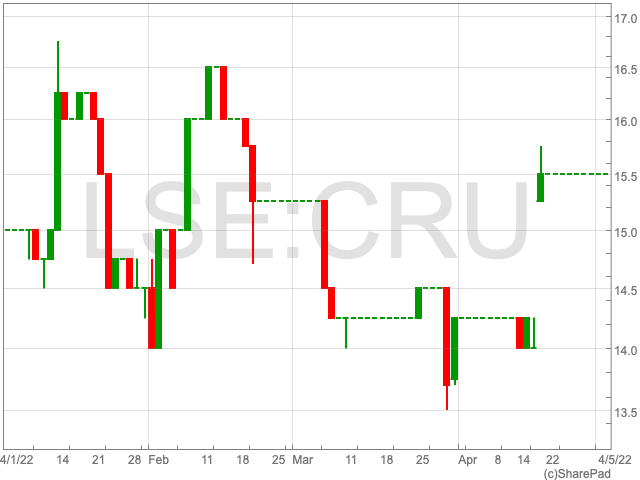
Coral Products said, £750,000 will be paid by issuing shares in the company at a mid-market price of 15.5p on April 29, 2022.

These consideration shares will be settled from the company’s treasury shares, and the firm will make another notification when that happens.

A twelve-month lock-in period will apply to the consideration shares, during which time they will be unable to be sold or transferred said Coral Products.

Further cash payment of £566,240 to be retained in escrow in the event of a contract dispute and released to the vendors on a pound-for-pound basis upon settlement.

The remaining £335,000 cash payment will be kept in escrow against an insurance claim filed by Film & Foil and will be released to the vendors on a pound-for-pound basis if the claim’s minimum settlement sum is met.

The cash consideration for the acquisition is being met from Coral Products’ existing resources, but, as previously stated, the cash consideration under the sale and purchase agreement may be adjusted following the preparation of Completion Accounts if the net asset value falls below an agreed minimum target. If this occurs, more information will be released.

Film & Foil Solutions reported net assets of £3.37m, sales of £10.1m, and profit before tax of £61,000 in its unaudited financial results for the year ending December 31, 2020.

Film & Foil Solutions expects a loss before tax of £174k for the full year ended December 31, 2021, but an underlying profit of £541k after one-off adjustments.

“This acquisition reinforces our focus on niche, specialist operators in the plastics sector. F&F brings to the group another range of skills and market opportunities,” said Joe Grimmond, Executive Chairman, Coral Products.

“The company struggled following a fire in their manufacturing facility in 2019 but the Directors believe that with this transaction, the F&F management team can once again concentrate their efforts in growing the business. The Board anticipates that the acquisition will be earnings enhancing in its first year.”

Wynnstay in line with expectations in Q1

0

The Board of Directors reported at Wynnstay’s Annual General Meeting on March 22, 2022, that trading in the first four months of the new financial year was in line with management expectations across core activities, while fertiliser operations at Glasson continued to see significant one-off gains.

This was due to dramatically rising fertiliser commodity prices, which were triggered by huge increases in the global price of natural gas, which is required to make ammonium nitrate fertiliser for the agricultural and specialist merchanting group.

Fertiliser commodity prices have remained exceptionally high since then, reflecting the implications of the ongoing war in Ukraine, especially the disruption of Russian supply said Wynnstay.

As a result, the Board now anticipates the group’s pre-tax profits to exceed current market estimates for the fiscal year ending in October 2022.

Commodity price inflation will raise group revenue across all activities, including feed, but it should be emphasised that the group’s absolute unit margin model means that group operating profit will not gain proportionally.

Interim results are likely to be released at the end of June or early July, along with a trading update from the Board.

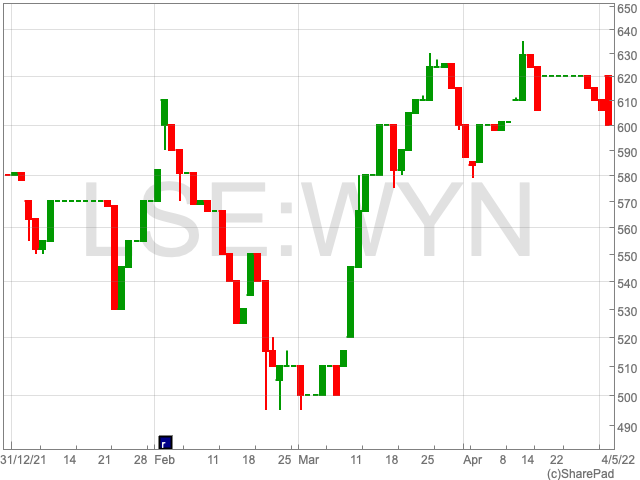
Wynnstay shares have dropped 1% to 600p despite the company stating that trading is in line with expectations.

Rambler Metals strikes 271k oz gold in Ming mine report

0

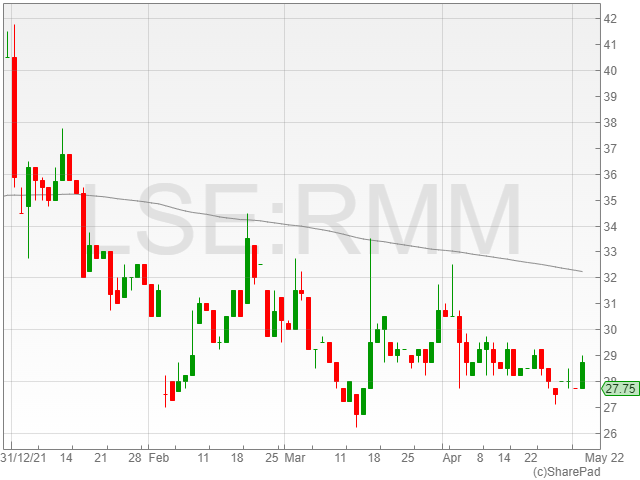
Rambler Metals and Mining shares were up 1.6% to 28.2p in late morning trading on Wednesday, after the mining firm reported an estimated 428,000 tonnes of In-situ copper and 271,000 ounces of In-situ gold in its Canadian Ming Mine update.

The company announced the positive news in its recent Mineral Resource Estimate (MRE), which replaced the partial copper-only estimate from 21 December 2021.

“The addition of gold and silver grades, which predominantly occur in the higher-grade massive sulphides, provide a valuable supplement to the high-grade copper blend that we are targeting from the mine,” said Rambler Metals CEO Toby Bradbury.

“We have embarked on the work of designing and scheduling the life of mine reserves based on first principles, which will form the basis of a new Mineral Reserve Estimate and NI-43-101 report with the objective to complete by the end of 2022.”

Rambler Metals highlighted an estimate of 23.755 million tonnes of measured and indicated resources, grading 1.8% copper and 0.35 grams per tonne of gold.

The group said its inferred MRE included 6.430 million tonnes grading 1.86% copper and 0.38 grams per tonne gold, containing 120,000 tonnes of copper and 78 thousand ounces of gold, at a 1% copper cut-off.

The MRE also mentioned an additional 5% increase of 20,000 tonnes of copper in the measured and indicated categories compared to the previous May 2021 estimate.

Rambler Metals reported that the updated MRE added an 8% rise of an additional 20,000 ounces of gold and 107,000 ounces of silver in the measured and indicated categories from the May 2021 estimate.

The mining company confirmed that all zones at the Canadian operation remained open for extension with further drilling.

“This mineral resource estimate, with copper, gold and silver included, now provides a complete update on the drilling undertaken over the past year from which we had been waiting for precious metals assays,” said Bradbury.

“The copper resource retains the robust 5% increase reported in December 2021, even after mining depletion this year. Significantly, these copper resources include the two new discoveries reported in Q1 2022.”

“While further, closely spaced drilling, will be required to improve the mineral resource confidence level, these new discoveries carry valuable potential as they are close to established infrastructure at higher levels in the mine.”

OSB Group reports 1% net loans growth and £21.6m shares repurchased

0

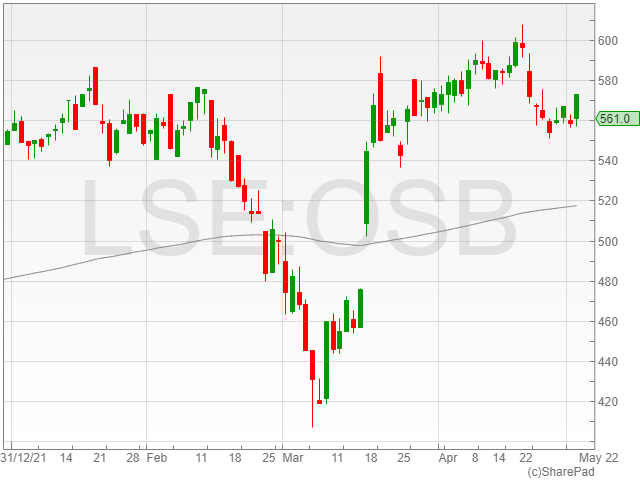
OSB Group shares were up 0.8% to 563p in late morning trading on Wednesday, after the company reported organic originations of £1.1 billion over Q1 2022 from £1.1 billion in Q1 2021.

The specialist lending and retail savings group announced an underlying net loans and advances increase of 1% to £21.2 billion and a statutory net loans and advances rise of 1% to £21.4 billion, which came in line with management expectations.

The firm mentioned that three-plus months arrears remained stable during Q1, and the company confirmed that its underlying net interest margin in 2022 is currently expected to exceed 2021 due to the advantage of recent base rate rises.

The OSB Group also reported its repurchase of £21.6 million worth of shares as part of its £100 million share buyback programme.

“I am pleased with the Group’s performance so far this year. Application volumes continued to grow during the first quarter in our Buy-to-Let and Residential sub-segments supported by the commercial, semi-commercial and bridging products relaunched in January. Current demand for our products remains robust, building a strong pipeline for the remainder of the year,” said OSB Group CEO Andy Golding.

“Our capital position, secured loan book and proven risk management capabilities position us well to respond to the opportunities and challenges ahead.”

“We remain mindful of the ongoing impact of the rising cost of living and geopolitical uncertainty, however, we will deploy our resources to continue to deliver attractive, sustainable returns for our shareholders across the cycle.”

Aston Martin, Wetherspoons, and Vast Resources with Alan Green

Alan Green joins the UK Investor Magazine Podcast for a broad discussion around UK equities and key market themes.

We look at FTSE 100 outperformance vs US peers and how commodities shares have supported London’s leading index during a period of sharp declines in US tech stocks

Aston Martin have soared on a positive update and we look the merits of AML shares trading just below 1,000p.

Wetherspoons could offer opportunity during times of economic downturn and with shares way of 52-week highs and steady sales, the stock may be worth a look. 

Vast Resources has produced a remarkable gain over the past week and we breakdown the reason for the move, and if it has further to go. 

Aston Martin Lagonda appoint former Ferrari exec as CEO

0

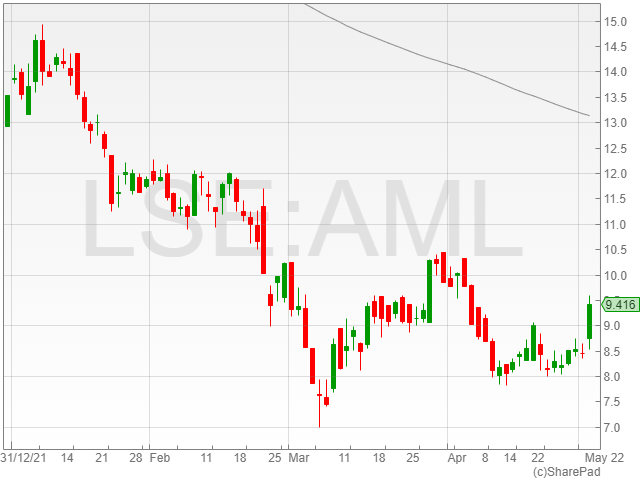
Aston Martin Lagonda shares were up 10.6% to 935.2p in late morning trading on Wednesday, after the company announced the appointment of former Ferrari executive Amedeo Felisa as CEO.

The luxury car group reported that Felisa would replace current CEO Tobias Moers, who is scheduled to step down from the position by mutual agreement with immediate effect.

Moers will reportedly remain with the company to ensure a smooth transition until the close of July.

Felisa joined Aston Martin Lagonda as a non-executive director prior to his appointment as CEO.

The automotive veteran spent 26 years in leadership roles at Ferrari, including eight as CEO and the guide behind the group’s turnaround and growth phase.

Felisa is reportedly set to focus on Aston Martin Lagonda’s strategic objectives, financial targets and road to electrification, starting with the appointment of a fresh wave of external hires to be announced over the coming weeks.

“I am extremely pleased that Amedeo has agreed to take on the role of CEO,” said Aston Martin Lagonda executive chairman Lawrence Stroll.

“He has extensive knowledge of both Aston Martin’s business and the wider automotive industry with an excellent track record and previous experience of leading a major ultra-luxury car manufacturer.”

“His technical acumen and charisma will be inspirational for the entire Company.”

The firm also reported the appointment of Ferraro LaFerrari creator Roberto Fedeli as chief technical officer, who joined the company after 26 years at Ferrari, and is scheduled to start at the group from 1 June 2022.

Fedeli has been confirmed to lead Aston Martin Lagonda’s technical team and accelerate its engineering expertise.

“With the appointment of Roberto, we add another world class name to our team,” said Stroll.

“He will help us deliver our future strategy, with a particular focus on technology advancements, and our in-house engineering capabilities, as we move towards electrification.”

“Roberto is a proven innovator and team builder. He conceived some of the world’s most desirable performance sports cars. His extensive experience of this sector, coupled with his leadership style, will contribute significantly to shape our exciting future product portfolio and reinvigorate our technical team.”

EU plans to sanction Russian oil in major shift

0

The EU plans to invoke further sanctions on Russian oil on Wednesday as worrying developments in the Russia-Ukraine war led to a major shift in the EU’s view of its dependence on Russian oil.

The European Commission recommended a new set of sanctions targeting Russian oil exports, banks, state broadcasters, and army officers to add to the piling Western economic pressure on Russia in light of rising geopolitical tensions.

The oil export embargo, which would be a major setback for Russia, flagging a $1.8tr economy, would be phased in over six months.

The EU has been compelled to implement more aggressive energy measures by Russia’s unprovoked invasion of Ukraine and proof of war crimes.

However, imposing measures that could reduce, or eliminate, the Russian energy supply to the EU has proven to be a difficult issue for the EU. This is due to the region’s reliance on Russia for a variety of energy sources, notably oil.

Russian oil imports accounted for around 25% of the bloc’s crude purchases in 2020, according to the region’s statistics agency.

According to Reuters, EU Commission President Ursula von der Leyen suggested the sixth package of sanctions on Russia in a speech to the European Parliament on Wednesday, which includes cutting off Sberbank, the country’s main lender, from the SWIFT financial transfer system.

The ban had been a contentious issue inside the EU, but it gained traction after Germany backed the proposal.

The sanctions must be agreed upon by the 27 EU member states, and some, such as Hungary and Slovakia, want to be exempted from any ban on Russian oil imports as both countries are heavily reliant on Russian energy.

Russian natural gas, which is used to heat homes and produce energy across the EU, has yet to be targeted by the EU.

On Tuesday, President Vladimir Putin increased the economic stakes for Kyiv’s Western backers by declaring measures to halt the export of important raw materials.

Oil prices have risen 3% to $108 a barrel of brent crude on anticipated higher demand due to bans on Russian oil.

Non-food household goods inflation at highest rate on record

0

Inflation for non-food household goods have hit the highest rate of inflation on record, according to figures from the British Retail Consortium (BRC) and market research firm NielsenIQ.

Non-food inflation climbed from 1.5% to 2.2% in April, with the prices of clothing, furniture and children’s toys soaring at the fastest rate on record since tracking began in 2006.

Food inflation hit 3.5% compared to 3.3% in March, representing the highest rate since March 2013 in light of rising commodities such as cooking oil and wheat, both of which are heavily produced in Russia and Ukraine.

The war raging in Ukraine has sent shockwaves rippling across supply chains, sending the cost of labour and goods skyrocketing on the back of scarcity fears and disruptions.

Covid-19 lockdowns in China have also added to supply chain problems, with manufacturing grinding to a halt in tech hub Shanghai and Chinese capitol Beijing.

“Inflation has been exacerbated by disruption at the world’s largest seaport, following Shanghai’s recent lockdown,” BRC CEO Helen Dickinson said.

The price of living already saw consumers paring back on non-essential items, with the rising 54% price cap shooting household energy bills higher with a £700 per year increase, forcing many to choose between heating or eating on the back of spiking bills.

Inflation also hit 7% in March, piling onto pressure to cut down on unessential purchases and adding an estimated £271 to the average household grocery bill, according to research conducted by Kantar.

“Food prices continued to rise, though fresh food inflation slowed as fierce competition between supermarkets resisted price hikes on many everyday essentials,” said Dickinson.

The Bank of England is scheduled to announce its interest rate decision on Thursday, which is estimated to introduce a 0.25% hike to 1% in an attempt to tackle rising levels of inflation.

Tritax braces for cost inflation, reports near-record demand

0

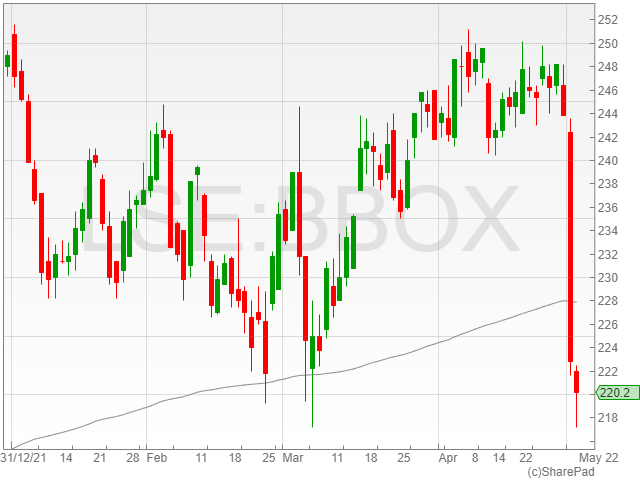
Tritax shares were down 2.2% to 217.8p in early morning trading on Wednesday after the real estate fund manager said complications from cost inflation were impacting the company’s nearer term development pipeline.

The firm reported that it was mitigating some of the cost inflation by its approach to procurement, the use of fixed price construction costs and its ability to capture rental growth.

The company confirmed that low availability and diversified occupier demand had driven growth across its portfolio, with nationwide vacancy rates at 1.6%, spurring occupiers towards commit faster to new build to suit projects and lease speculative buildings under construction.

The group added that its development pipeline included 1.8 million sq ft of construction started, with 56% pre-let, resulting in £6 million of contracted secured rent.

The company currently has 3.1 million sq ft of developments under construction with 1.3 million sq ft pre-let or let, accounting for £8.4 million in contracted rent.

Tritax confirmed that the remaining units held the potential for an additional £15.2 million in contracted rent.

The property fund manager said it remained on-track to deliver an accelerated level of 3-4 million sq ft of development starts across FY 2022 within 6-8% yield on cost target range, with the earnings impact delivered through FY 2023 and FY2024.

The group reported a strong balance sheet, including an extended £50.9 million loan facility with Helaba by three years to a maturity of July 2028, alongside a loan to value in Q1 of 24.2%.

The company added that its current weighted average cost of debt was 2.27%, with 69% fixed and benefiting from an average 6.5 year maturity.