Estate agency Purplebricks (LON: PURP) joined AIM at an inflated valuation and it had over optimistic plans to take over the world with its take on selling houses. That international expansion did not succeed.
The share price peaked at more than 500p in the summer of 2017 and it has fallen by more than 95% since then and it is just above its all time low.
The latest slip up relates to the lettings management business. This relates to how the company has handled the deposits of tenants and related documentation. This could lead to a provision of between £2m and £9m. The final figure is still be...
Oil prices surge 50% in 2021
The economic recovery this year has seen oil prices surge by 50% over 2021, which is the biggest gains in 12 years.
Brent Crude was $52 per barrel in January but is ending the year close to $80 per barrel.
Demand has increased and prices have soared as lockdowns eased and travel has resumed over the course of the year.
“We’ve had Delta and Omicron and all manner of lockdowns and travel restrictions, but demand for oil has remained relatively firm,” said CommSec’s Chief Economist Craig James. “You can attribute that to the effects of stimulus supporting demand and restrictions on supply.”
2021 UK spending: surge in takeaways and online shopping
According to Barclaycard, people were spending most of their money this year on online shopping, home improvements, streaming subscriptions and takeaways.
Despite non-essential shops being closed at the start of 2021, people spent most of their money online as online transactions surged by 88% in March 2021 compared to March 2019.
And whilst hospitality venues were closed at the start of the year, spending on takeaways increased by 62%.
Spending on pets also increased this year as people spent 29% more at vets and pet retailers than in 2019.
Jose Carvalho, head of consumer products at Barclaycard, commented on what we can expect for 2022: “As we look ahead to 2022, the economy will face fresh challenges from rising household bills, inflation, and uncertainty about the new Covid variant.”
“Yet, as we’ve seen over the last two years, consumers and businesses are capable of adapting to and overcoming immense hardship and adversity”.
FTSE posts best year since 2016
The FTSE 100 has posted its best year since 2016.
London’s stock market closed the year 14.3% higher than the start of the year.
Shares rallied over the year amid the vaccine optimism, shrugging off fears of supply chain issues.
Global markets are ending 2021 near record highs, seeing the MSCI World Index has surge 17% this year. It fell just short of records as the discovery of Omicron caused shares to dip.
Matt Weller, global head of research at FOREX.com and City Index, commented: “Generally speaking, higher starting valuations tend to be associated with lower future returns, though that relationship isn’t particularly strong over short (< 5 year) time horizons. Of course, bulls will argue that elevated valuation ratios are justified given the low yields on bonds, unprecedented liquidity injections, and comparatively high profit margins.”
“Notably, we may already be past “peak stimulus” globally. Across the major developed economies, fiscal policymakers are rapidly looking to rein in deficits to improve their balance sheets and mitigate inflation fears. Meanwhile, most major central banks are similarly looking to “normalize” monetary policy after cutting interest rates to 0% (or below in some cases!) and instituting massive asset purchase programs in recent years.”
“At the margin, government spending and interest rates will likely provide less of a tailwind for global indices in 2022 as compared to 2021 or 2020,” he added.
Nine million Brits forced to cancel or postpone holidays
New research has found that nine million people in the UK have been forced to cancel or postpone holidays to the US or mainland Europe due to travel restrictions.
The research by Ziglu, shared with City A.M, found that Brits are spending an additional £2,000 on holidays due to travel restrictions and test requirements.
Mark Hipperson, Founder and CEO of Ziglu, said: “The Omicron variant has forced Governments around the world to introduce new restrictions to help slow the spread and this means disruption for millions of people who have booked holidays.”
“The decision whether or not to travel will be difficult given the need for COVID tests and the possibility of having to quarantine with all the disruption that leads to. The inevitable result will be that many cancel or postpone their trips.”
“Travel companies and some airlines are trying their best to be flexible regarding refunds, but many holidaymakers will end up out of pocket as a result of the changes.”
FTSE dips as travel stocks fall
After hitting a 22-month high, the FTSE has dipped 10 points at 7410.
Travel stocks fell as Omicron case numbers continue to grow, with IAG being the top faller and dropping 2%. Flutter was down 1.4%, Entain was down 1%, whilst BT fell 1.6%.
Travel stocks have continued to fall this week due to Omicron cases and bad weather cancelling flights.
Flight-tracking website FlightAware.com found that over 1,000 flights were canceled within, into, or out of the United States were cancelled just on Monday.
The FTSE hit a 22-month high yesterday, briefly hitting 7,457.14.
Spreadex expert Oliver Males commented at the time: “The FTSE is currently up … as continued optimistic news regarding the new variant is released, such as Boris Johnson announcing that there will be no further restrictions imposed, due to the low severity of Omicron,”
“However, the same cannot be said for the rest of Europe as both the Dax and Cac dropped today, after most of Europe sees a ‘tsunami’ of cases, with France recording over 200,000 cases in the past 24 hours.
“This has in turn led UK travel stocks lower, such as IAG being down over 2%, and holiday operator, TUI, in the red by over 5%.
“Many experts are expecting the Omicron variant to have its real effect in 2022, as inflation is likely to soar, leading to rising interest rates, while the international supply chain is still going to be heavily disrupted.”

House price growth is strongest since 2006
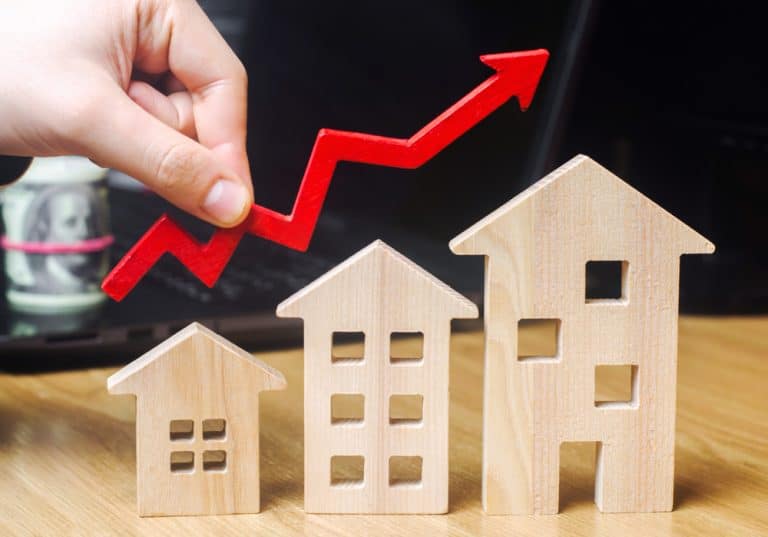
According to Nationwide, UK house prices have had their strongest year since 2006.
December saw house price growth increase to 10.4%, which is up from 10.0% in November.
House prices were up by 1% in December, meaning the average home in the UK now costs £254,822 – £24,000 then the start of the year.
“Demand has remained strong in recent months, despite the end of the stamp duty holiday at the end of September,” said Robert Gardner, Nationwide’s chief economist.
“Mortgage approvals for house purchase have continued to run above pre-pandemic levels, despite the surge in activity seen earlier in the year. Indeed, in the first 11 months of 2021 the total number of property transactions was almost 30% higher than over the same period of 2019.”
“At the same time, the stock of homes on the market has remained extremely low throughout the year, which has contributed to the robust pace of price growth.”
Cost of living set to increase in 2022
UK households are likely to be hit next year amid rising tax and energy bills, along with stalling wages.
The Resolution Foundation has said that next year could be “year of the squeeze”, and higher energy bills could cost households £1,200.
The report said: “The months ahead will not be easy for households who see their wages fall back as energy bills and taxes rise. As Omicron hopefully fades in the early months of 2022, we will come to realise the scale of the challenge posed to household finances.”
UK inflation hit highs in 2021 and is likely to grow next year.
“2022 will begin with Omicron at the forefront of everyone’s minds. But while the economic impact of this new wave is uncertain, it should at least be short-lived. Instead, 2022 will be defined as the ‘year of the squeeze’,” said Torsten Bell, chief executive of the Resolution Foundation.
“The overall picture is likely to be one of prices surging and pay packets stagnating. In fact, real wages have already started falling, and are set to go into next Christmas barely higher than they are now.”