Rize launches new digital payments ETF

 ETF provider Rise has announced the launch of a new ETF providing European investors with access to a basket of digital payment shares.

Their new ETF is designed to focus on companies enabling the digital economy with payments services as well as cryptocurrencies.

Rise recently announced they had reached $500 million in AUM having previously launched a selection of ETFs including the Rize Cybersecurity and Data Privacy ETF, Rize Medical Cannabis and Life Sciences ETF and Rize Environmental Impact 100 UCITS ETF. 

“Our new investment strategy and ETF is a nod to the inevitability that financial services are succumbing to digitisation. In the past decade alone, a new and powerful economy for digital payments has emerged,” said Rahul Bhushan, Co-Founder and Director at Rize ETF.

“This economy offers speed, agility and convenience. It has also instilled a sensibility in us that payment transactions can happen seamlessly in the background as we hop in and out of Ubers.”

“COVID-19, too, has catalysed a cross-generational shift towards contactless payments and digital currencies. But we believe this to be just the start. In the years ahead, ecommerce growth, enthusiastic adoption of transparent payment experiences and alternative transaction modes are going to continue to drive non-cash momentum. We believe this will support valuations of today’s digital payments leaders. Importantly, we also believe that today’s institutional strangleholds on not just payments but also other banking services such as credit, savings, investments, insurance, etc… will get unravelled in the next decade. This will yield a new digital finance economy that is better connected, faster, built for the consumer and most importantly, both equitable and inclusive.”

Economic recovery slows down

0

The UK’s economic recovery has slowed down amid rising Covid rates and global supply issues.

In the three months to September, the economy expanded 1.3%, which is 2.1% lower than pre-pandemic rates.

The was a 0.3% fall in manufacturing output, whilst construction was down 1.5%.

“Growth picked up in September and the UK economy is now only slightly below pre-pandemic levels,” said ONS chief economist, Grant Fitzner.

“This latest increase was led by the health sector, boosted by more visits to GP surgeries in England. Lawyers also had a busy month as house buyers rushed to complete purchases before the end of the stamp duty holiday. However, these were partially offset by falls in both the manufacture and sale of cars.

“Notably, business investment remained well down on pre-pandemic levels in the three months to September. Meanwhile the trade deficit widened as goods exports to non-EU countries fell and imports – particularly of fuel – from non-EU countries increased.”

Commenting on the latest GDP figures, Danni Hewson, AJ Bell financial analyst, said: “The hope had been that once all covid restrictions were firmly in the rear-view mirror the economic engine would be revved and ready but while the economy did grow between July and September that growth slowed considerably.”

“Momentum was undoubtedly lost from the double drag on staff and supply shortages, remember the ‘pingdemic’ and the havoc that created.  One of those drags has been largely dealt with, though there are still sectors struggling to find the staff they need, however its important to note that supply chain constraints have already led to many sectors running down their inventories and stock levels are a far cry for where they would normally be in the run-up to Christmas. 

“Certainly, September’s story was a more optimistic one than that told by July and August. More people were flying, going to the theatre, seeing their doctor in person – all actions that boosted output from the service sector, as did a last-minute rush to complete all those home sales before the final end of the stamp duty holiday.  Construction also enjoyed a welcome bounce back with an increase in maintenance work on schools and offices.”

New AIM admission: Life Science REIT offer

Life Science REIT has launched an offer for subscription and intermediaries offer that can be accessed by small investors via PrimaryBid. The plan is to raise up to £300m and the offer closes on 15 November.

This is a large amount for a new AIM admission to raise and it will be interesting to see how much demand there is from investors. Life Science REIT will be the first REIT on the London market that is focused on life science properties.

Increasing R&D by healthcare companies and spin-offs from universities mean that there will be demand for suitable space and there is a lack of supply. Many new properties that come onto the market find tenants before they are even completed. It is estimated that up to 20 million square feet of additional office and laboratory space will be required over the next two decades.

Life Science REIT will invest in properties that already have tenants, which will provide an immediate income, and other purpose-built properties in development, which can help to increase medium-term NAV.

A 4% yield is being targeted, based on the issue price, with annual growth of 5%. This is an attractive investment for anyone seeking a good, growing yield combined with share price growth.

==========

Life Science REIT (LON: LABS)

Life science-focused property investment

www.lifesciencereit.co.uk

Market: AIM

Offer for subscription, placing and intermediaries offer

Flotation date: 19 November 2021

Issue price: 100p

Amount raised: up to £300m

Expenses: up to £6m

Market capitalisation: up to £300m

Nominated adviser: Panmure Gordon          

Broker: Panmure Gordon

==========

What does it do?

Life Science REIT was incorporated in July 2021 to invest in properties in Oxford, Cambridge and London that have life science businesses and organisations as tenants. The properties are near to universities, hospitals and pharma companies and there is a lack of supply of good quality space.

The types of properties will include laboratories, manufacturing facilities, offices and data centres. Most of the properties will be a combination of offices and laboratories. Rents in Oxford have been catching up with rents in Cambridge and they continue to increase.

Newly set up Ironstone Asset Management is the investment adviser of Life Science REIT. The annual advisory fee is 1.1% of NAV up to £500m.

There is a potential pipeline of investments with a total value of £445m and there are exclusive or advanced negotiations with £305m of these investments. That latter figure includes £220m of properties yielding 5% and £85m of development opportunities. The cash raised should be invested within six months.

Financials

Life Science REIT has the ability to raise up to £350m through the offers and placing, although £300m is the target. Based on £300m, the company wants to achieve a total return of 10% a year over the medium term.

Given the properties that the investment manager is negotiating to buy, it is likely that the top ten tenants will contribute 54% of revenues. Generally, tenants are good quality and there should not be any problems getting the rent paid.

The estimated NAV will be 98p a share after expenses. Ongoing annual expenses could be around £4.2m. Borrowing will be used to buy more properties. Loan to value will be between 30% and 40%.

The initial dividend will cover the period from admission to June 2022. There will then be two dividends each year.

Directors

Claire Boyle (Chair)

Annual fee: na

Dr Sally Forsyth

Annual fee: na

Michael Taylor

Annual fee: na

Shareholders

The firms involved in the intermediaries offer are Interactive Investor, AJ Bell, Equiniti, Jarvis Investment Management and Redmayne Bentley.

Claire Boyle will subscribe for 30,000 shares, Dr Sally Forsyth 20,000 shares and Michael Taylor 20,000 shares. The management team of the investment adviser will invest £3m.


Marks and Spencer, Halfords and Wetherspoons with Alan Green

Alan Green joins the Podcast for an exploration of a selection of UK equities.

We discuss Marks and Spencer (LON:MKS), Halfords (LON:HFD), JD Wetherspoon (LON:JDW) and Power Metal Resources (LON:POW).

With a backdrop of a Bank of England surprising markets by not hiking rates last week, the focus of this Podcast is UK consumer shares and whether their results reflect the doubts the BoE has on the strength of the UK economy.

We question whether M&S recent results are a sign of a turnaround in the business or just a bounce back from the pandemic.

JD Wetherspoons saw a 30% drop in Ale sales contributing to an overall 8.9% drop in like-for-like sales as the company highlighted a change in the demographics of their customers.

Halfords have enjoyed bumper sales from their auto centres sending shares up over 15%.

Asos announces new growth plans, shares remains flat

0

Asos has announced growth plans, where the retailer will target £7bn worth of sales over the next 3-4 years.

The move aims to achieve a compound annual growth rate of 15-20% and double its size in the UK and US. Asos also said it will embark on cost-saving efforts worth £50m-£100m.

Following the announcements, the group’s shares remained flat.

Commenting on the news, Laura Hoy, equity analyst at Hargreaves Lansdown, said: “ASOS the fast fashion darling has lost its spot in the limelight and its attempt to show how it plans to take a leading role again have fallen flat.”

‘It sought to restore investor confidence with a £7bn revenue target over the next 3 to 4 years. To get there the group will double its US and UK businesses and expand its own-brand offerings. However it’s a focus on increasing partner fulfilment that holds the key to longer-term success.”

“The market was decidedly apathetic about ASOS’ grand plans. Although the growth targets are ambitious, it’s hard to get excited about online retailers these days. They’ve enjoyed goldilocks conditions over the past 18 months and a return to normalcy means higher return rates and less incentive to shop online. Add that to supply chain woes and it’s a recipe for near-term volatility.”

Halfords shares jump on strong revenues

0

Rising revenues at Halfords has led to the group raising its profit guidance for the full year.

Full-year profits are expected to be in the £80-90m region, increasing from previous forecasts of £75m.

New growth in profits is from increased demand at autocentres and cycling divisions. Demand for autocentres have seen increase in revenues by 88% compared to 2020, whilst cycling revenues have increased by 8%.

“There is good momentum in our existing business, the strategically important area of motoring services continues to grow strongly, and our recent acquisitions are all performing well,” said chief executive, Graham Stapleton.

“As a result, despite the challenging trading environment, I am very excited about our future growth prospects.”

Shares in Halfords soared 11% to 311.60 this morning at 0850GMT.

Marks and Spencer shares jump on improved outlook

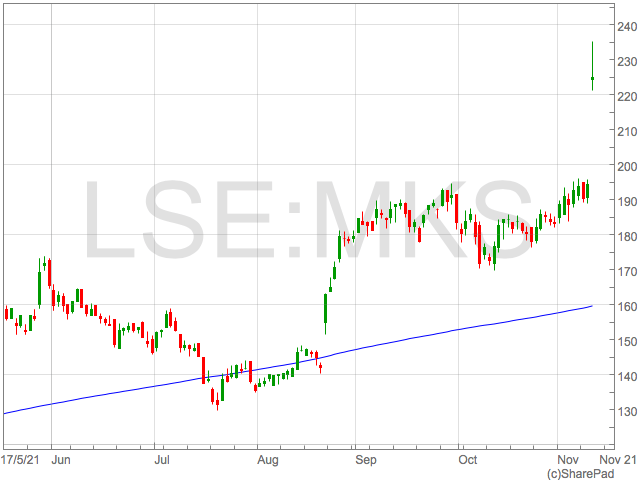
Marks and Spencer shares made strong gains on Wednesday morning after the group said they expected profit for the year to be ahead of expectations.

M&S said they expected profit before tax and adjusting items for the year to be in the region of £500m.

Marks and Spencer shares surged over 15% in early trade on Wednesday following the results.

Profit for the 26 weeks to 2nd October also rose with profit before tax rising to £187.3m. This was a significant swing from a loss of £87.6m last year and £158.8m profit in the same period in 2019, before the pandemic.

Food sales grew by 10.4% whilst Clothing and Home sales continued to disappoint, down 1%.

“Something spectacular must have happened since August for Marks & Spencer to upgrade earnings guidance once again. Back then, it believed pre-tax profit for the year would be above the upper end of a previously guided £300 million to £350 million range. Now it’s talking about profit hitting £500 million which is quite some jump,” said AJ Bell investment director Russ Mould.

“Food sales are doing incredibly well, particularly instore. It has really nailed the proposition with decent quality products and an ever-widening range of items. Quality is the key word as it caters for a specific type of customer who is happy to pay that bit extra for something nice.

“Its online joint venture with Ocado has also helped the business reached a broader audience, such as individuals who want higher quality products but don’t want the faff of visiting a store.

“Clothing continues to be a mixed bag, but the company comes across as more confident about its prospects. Overall sales aren’t growing but operating profit is, thanks to selling more items at full price.

Despite the promising outlook for M&S, they did allude to the fact that supply chain issues were going to drive costs higher but their forecast increase in sales negated a material impact as they embark on a supply chain efficiencies.

“Given the history of M&S we’ve been clear that we won’t overclaim our progress. Unpacking the numbers isn’t a linear exercise and we’ve called out the Covid bounce back tailwinds, as well as the headwinds from the pandemic, supply chain and Brexit, some of which will continue into next year,” said Steve Rowe, M&S Chief Executive.

“But, thanks to the hard work of our colleagues, it is clear that underlying performance is improving, with our main businesses making important gains in market share and customer perception. The hard yards of driving long term change are beginning to be borne out in our performance.”

ITV advertising revenues set to hit new record

0

ITV is set to celebrate its highest advertising revenue in history thanks to the Euros and post-pandemic recovery.

Revenue for the first nine months of the year is up 30% to £1.3bn. The group said total advertising revenue for the full year is expected to jump 24% to reach an all time high.

Carolyn McCall, the chief executive of ITV, said: “By any standards ITV has had an outstanding nine months. Both our Studios and Media & Entertainment (M&E) businesses have performed very strongly. Revenue from each business over the nine months is up both on last year and on 2019. This drove total external revenue up 28% compared to 2020 and 8% higher than 2019.

“We are becoming an increasingly scaled digital business. Our online viewing was up 39% in the nine months which, together with the roll out of Planet V, helped our video on demand advertising (AVOD) revenue to climb 54%. Our monthly active users now stand at 9.6 million, a 22% increase year on year.”

“With the combination of Broadcast and ITV Hub’s mass simultaneous reach, our brand safe addressable advertising product and the strong economy, 2021 looks set to have the highest advertising revenue in ITV’s history, despite the lockdown in Q1.”

AJ Bell investment director Russ Mould commented: “There was always going to be plenty of growth for ITV in 2021 given the comparison with a pandemic disrupted 2020 but for the business to be on course for the highest advertising revenue in its history is an impressive achievement.”

“It underlines the continued relevance of television as a medium to advertisers given its reach and its arguably greater degree of safety compared with digital advertising.”

Zoo Digital revenue surges 64% as demand booms

ZOO Digital (LON: ZOO), a world-leading provider of digital media production services has posted a bumped 64% increase in revenue for the six months ended 30th September 2021.

The rise in revenue was driven by demand fro their subtitling and media services. The jump in revenue helped EDITDA rise 82% to $2.4 million.

Zoo Digital shares spiked as high as 135.7p in the first hour of trading in Wednesday before falling back.

Zoo Digital said they had good visibility on sales through H2 and had a strong pipeline from ‘satisfied customers’.

“Structural tailwinds and our end-to-end services powered by our proprietary systems have fuelled very strong revenue growth while back catalogue work surged as streaming globalises. More recently new production work returned and reached pre-pandemic levels in August,” said Stuart Green, CEO of ZOO Digital.

“We are building on our international capability through partnering and investing in regions of the world where the strongest growth is anticipated. The launch of ZOO Turkey has already strengthened our MENA operations and discussions are underway in further territories to ensure that we are best placed to enhance our offer and grow market share.

“This is our time. We are but one of a handful of players that can meet client needs through our market leading approach. We are confident of strong growth for the foreseeable future. We are currently building increased capacity to accelerate sales and making great strides toward our medium term target of $100 million.”

New premium listing: Stelrad set to warm up

Radiators manufacturer Stelrad Group has strong brands and a significant position in many European markets. Stelrad sells to 40 countries, although the UK is the biggest revenues generator. Radiators will still be needed even if gas boiler sales are ended.
Replacement drives radiator demand with three-quarters of the UK market, with new build accounting for 16%. This makes the business less cyclical. Recent Covid-19 lockdowns have boosted home improvement spending, although revenues were still lower in 2020.
The shares commenced unconditional dealings at 227p before slipping back to 219p. At t...