Top 3 retirement investment strategies

Planning for the later years in life can be exciting, especially when considering the hobbies you can begin, or the destinations you have on your bucket list that you will finally be able to visit. But one of the most important things to plan ahead for is your financial situation when you retire. 

According to the Office for National Statistics UK, the average total expenditure of a retired adult is £10,808, based on factors such as household bills, food and transport (as of 2018). However, the current state pension for 2021/22 is £179.60 per week, which roughly equates to £9,339.20 per year. Therefore, when looking to the future, your State Pension might not be enough to stretch as far as you would like, for the type of lifestyle you want to live. 

Financial planning for retirement will help towards building a stable income, and this could involve investing as a way to generate money for those later years.  A successful strategy needs to have the right balance between risk and the level of return, so, with that in mind, here are some of the top retirement investment strategies that may help towards building a stable financial future

  1. Investments considering the factor of time

When planning your retirement, your current age and the age you are likely to retire, should be taken into consideration. If you are young, and have plenty of time before you stop working, an effective retirement portfolio should be able to withstand the level of risk that will occur over this time. Therefore, investing in stocks could be a good choice as, although the stock market does experience volatility on a short-term basis, in the long-term, they have historically produced steady returns. 

At a younger age, you need to be prepared to have a retirement investment portfolio for more than 10 years, and counteract the rise in inflation rate with your investment choices. However, the older you are when investing for your retirement, the less likely you are to be affected by a rise in the cost of living. 

The nearer you are to retirement age, the more you need to think about the income and preservation of your investment. Therefore, you should look at using a higher level of capital in instruments such as bonds. Although they won’t give you as high as return as stocks, they are less volatile over a short period time, and a more stable and instant income. Whichever strategy you implement at any age, corresponding with a financial planning service or advisor will help you to maintain a strategy that suits your needs. 

2. Retirement income funds

Managing an investment portfolio can be complicated, so a retirement income fund can be a good option, as the capital is managed for you. The fund is mutually accessible, and the manager of the fund allocates your capital across a diverse portfolio of assets. You can deposit as little or as much money as you like, but the hired service will manage and grow your fund to a suitable value, and in a way that suits your retirement plans. 

This is the best option for those who prefer to have someone else place the investments, who most likely have a little more knowledge of the market. This is also better suited to someone who has a few decades left before they retire. 

3. Real estate and investment properties

Another popular investment strategy to help towards your retirement income, is to go down the property route. If you have some time before you retire, purchasing a property that you can sell at a later date could provide you with enough returns to put towards your retirement savings. 

An alternative for those nearer to retirement age is to consider a rental property, sometimes known as an investment property, which can provide a steady monthly income. Understandably, this does require some experience and knowledge of real estate, and can incur other expenses to maintain the property, which should be taken in consideration when planning your retirement investment strategy. 

FTSE 100 enjoys the effects of strong company updates

The FTSE 100 rose early on Tuesday as investors cheered the impact of upbeat corporate results.

The FTSE 100 added 46 points to trade at 7,269 in mid morning trade on Tuesday.

“The FTSE 100 made a strong start on Tuesday, lifted by some strong corporate updates and as investors reacted to the fresh records set on Wall Street overnight,” says AJ Bell investment director Russ Mould.

“The sharp falls seen in September when the index fell below the 7,000 mark are starting to recede into the distance. However, investors will remain wary given the ongoing risks around Covid, inflation and a slowing recovery.”

“Strong corporate results are helping with sentiment. Tomorrow’s Budget in the UK and Thursday’s European Central Bank meeting may help return the wider economy to the forefront of investors’ minds. Whether this will be supportive or have a negative impact on markets remains to be seen.”

Whitbread and Reckitt Benckiser

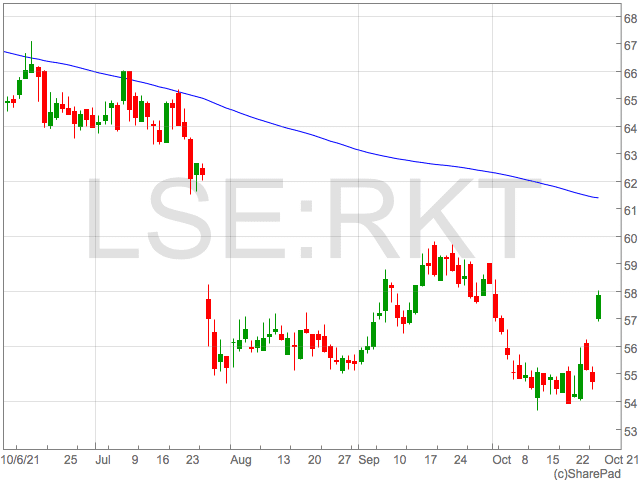
Whitbread and Reckitt Benckiser were significant contributors to the FTSE 100’s gain after both companies released strong updates that pointed to a move towards the resumption of normal trading after the pandemic.

Reckitt Benckiser was the FTSE 100’s top riser after it added 6% in early trade on Monday.

“There’s a lot to like in this morning’s update from Reckitt Benckiser. There is a notable hike in sales forecasts, impressively, every division has outperformed expectations and the company has maintained margin guidance despite the inflationary pressures and supply chain issues which it, like all of its peer group are facing,” said AJ Bell investment director Russ Mould.

Whitbread sees demand bounce back, shares gain

Whitbread shares rose on Tuesday following the release of a very respectable set of results for the crucial summer trading period.

Whitbread reported sales of £661.1m for the first half of 2021 which was significantly above the £250.8mm recorded in the first half of last year.

Whitbread were only able to accept business customers until 17th May this year meaning although revenue was much stronger than last year, it was 39% below pre-pandmeic levels.

Whitbread shares gained over 3% on Tuesday morning following the release of the revenue figures.

“It’s taken a while for Premier Inn owner Whitbread to regain momentum, but with trading ahead of pre-pandemic levels over the summer holidays and well ahead of the wider market the group looks well placed going into 2022. Management have gone so far as to say they think revenues may fully recover this financial year,” said Nicholas Hyett, Equity Analyst at Hargreaves Lansdown. 

“The pandemic has likely seen smaller operators forced to close, creating a  gap into which Whitbread can expand in the UK. Meanwhile expansion in Germany is gathering speed with a pipeline that has the potential to more than double the current active estate. However current bookings in Germany remain low and the group has work to do in improving its brand visibility.”

Leisure demand returns

Whitbread outlined where they saw demand recover and said they were confident in

“Whitbread traded significantly ahead of the market in the UK during the first half of the year, with our regional hotels trading ahead of pre-COVID-19 levels in the last six weeks of the half,” said Alison Brittain, Whitbread Chief Executive Officer.

“This strong performance has continued into the second half, with sustained high levels of leisure demand and resilient demand from tradespeople. Whilst some uncertainty remains over the speed and timing of the market recovery for office-based and international demand and the evolution of the pandemic in the winter months, we believe that UK like-for-like RevPAR run rates have  the potential to reach full recovery in at some point during 2022.

“The operating environment during the summer and into autumn has been challenging largely as a result of our very high occupancy levels, market-wide supply chain issues and a tighter labour supply in the hospitality sector. Although we are not immune from these challenges, we are well placed to respond. Our £100m efficiency programme is well underway and we are “investing to win” in our teams, our hotels and our marketing, in order to continue to grow our market share as demand recovers and as our competitors continue to be under pressure.”

“In Germany, we are well on the way to building a business of scale with a growing national presence. Our open and committed hotel network now stands at 73 hotels, and we continue to look for opportunities to grow our footprint at pace both organically and through acquisitions. The budget hotel market is recovering ahead of the overall market and we are seeing growing demand and occupancy levels in our open hotels, alongside encouraging customer scores.”

Reckitt Benckiser enjoys strong growth and raises 2021 outlook

Reckitt Benckiser has released a robust set of third quarter sale figures that saw like-for-like revenue growth jump 3.3%.

Reckitt’s year-to-date sales rose 3.6% having recorded £9.8bn in sales.

“There’s a lot to like in this morning’s update from Reckitt Benckiser. There is a notable hike in sales forecasts, impressively, every division has outperformed expectations and the company has maintained margin guidance despite the inflationary pressures and supply chain issues which it, like all of its peer group are facing,” said AJ Bell investment director Russ Mould.

“This is testament both to the strength of its brands which have allowed the company to pass through price increases to its customers and to the ongoing transformation of the businesses under CEO Laxman Narasimhan.”

The group’s Helath division was a strong performer as cold and flu medicines bounced backed.

“In September, we reiterated the building blocks which will see Reckitt return to mid-single digit revenue growth and mid 20’s margins,” said Laxman Narasimhan, Chief Executive Officer of Reckitt Benckiser.

There is more to be done, but today’s results are testament to our progress, with 3.3% LFL revenue growth building on the 15.3% growth of Q3 2020. We’ve delivered growth in each of our three GBUs and in each of our three geographic regions, with a balance of volume and price/mix across the portfolio. Nine of our ten largest brands are up double-digits on a two-year basis.”

“Reflecting this strength, we now expect like-for-like net revenue growth for FY 2021 in the range of 1-3%. Despite significant cost pressures, the benefits of our pricing actions, mix and productivity programme, mean our margin guidance is unchanged, and we remain confident in our medium-term outlook.”

Zoopla forecasts record year in 2021 but housing market forecast to slow in 2022

  • 2021’s market is on track to record the highest level of sales (1.5m) since 2007
  • Combined market activity is set to amount to £473bn in transaction value in 2021
  • headwinds forecast for 2021, coming from higher living costs and increased mortgage rates

The property group Zoopla has forecast UK housing activity will have a record year after a enhanced period of activity driven by restrictions and stimulus brought about the coronavirus pandemic.

“2021 is set to be a record year for the housing market with the most moves by homeowners since 2007 and nearly £500bn of home sales,” said Richard Donnell, Zoopla.

Zoopla has predicted there will be £473bn in transaction value this year.

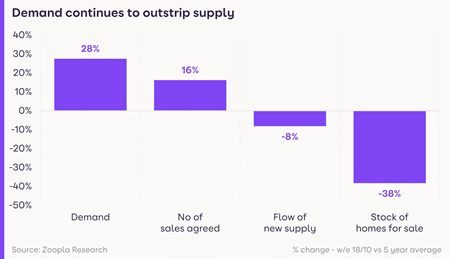
Factors such as the reduced supply of housing has increased house prices in a period buyers scrambled to take advantage of government schemes such as the reduction of stamp duty.

“The impact of the pandemic on the housing market has further to run but at a less frenetic pace. We expect the momentum in the market to outweigh some emerging headwinds from higher living costs and the risk of higher mortgage rates,” Donnell continued.

Zoopla’s research also revealed how buyers in different parts of the market had reacted a the pandemic progressed. Wealthier buyers were more active towards the beginning of the pandemic whilst first time buyers began to come back into the market in 2021.

Despite resilience being maintained in the housing market through 2021, Zoopla sees a significant drop in house price growth in 2022 with the more affordable area of the market supporting prices.

“The latest data shows a turning point in the rate of house price growth, which we expect to slow quickly with average UK house prices up 3% by the end of 2022.”

A recent study by Nationwide found house prices rose just 0.1% in September after a storming summer of house price growth.

New AIM admission: Arrow Exploration on target for production increase

Arrow Exploration is traded on the TSX Venture Exchange and has come to AIM to gain access to London investors and to raise cash to finance the drilling of five wells on the Tapir block in Colombia. This will enable production to increase and thereby generate more cash for the business.
Management believes that if the wells are successful then production could average more than 2,000 barrels of oil equivalent/day, rising to 3,000 barrels/day by March 2023. Onshore wells can be brought into production  
Arden partners forecasts 2022 sales of $20m and EBITDA of $10m. This relies on the succ...

Private equity fundraisings peak in 2021

There was a 19% increase in the amount invested in equity fundraisings to £6.32bn in the third quarter of 2021, according to the latest equity investment market update from Beauhurst. This means that investment for the year as a whole could be double last year.
The number of deals in the latest quarter was lower, although bank Revolut raised £578m on its own – 9% of the total raised. This is based on publicly announced deals.
The new money is predominantly being invested in growth businesses, although there are more seed and venture deals. There were 34 fundraisings of more than £50m. One-thir...

Symphony Environmental Technologies: Upgrading Biodegrading

Symphony Environmental Technologies (AIM:SYM) have been busy  since our last recommendation at 23p with Interims, a strategic  investment at 30p  and most recently an Exclusive Distribution Agreement.  After years of substantial investment in developing its platform technology the Interims to June reported a loss of £0.6m on £4.9m Turnover. There was also substantial progress in many product areas including an increase in customer trials and product-tests currently underway. 
An existing strategic Investor paid 30p for £750k worth of shares with warrants at 40p taking their holding to 14%. 
T...

FTSE 100 starts the week with a positive tone

The FTSE 100 started the week with a spring in its step as London’s leading index neared post-pandemic highs.

The FTSE 100 was 0.34% higher at 7,229 in mid afternoon trade on Monday.

A mixture of strong corporate results and continued momentum in the FTSE 100’s miners helped lift the index.

HSBC

HSBC gained after it reported a $1.6bn pre-tax profit that beat estimates and CEO Noel Quinn said “we believe that the lows of recent quarters are behind us.”

“HSBC is a giant in its industry, and with signs of more positive economic conditions comes a brighter set of results. Pre-tax profits have been buoyed by a huge swing in expected credit losses – with a chunky charge this time last year, turning into a release that buffer this quarter. The group is so confident about the direction of travel, it’s announced a $2bn share buyback programme,” said Sophie Lund-Yates, equity analyst at Hargreaves Lansdown.

“A CET1 ratio well above target risks looking like a waste of uninvested equity, and capital returns are one way to deal with that. However, a lack of available investment opportunities could be a potential concern for more growth minded investors.”

Uncertainty

Despite the strength of the FTSE 100 on Monday, some analysts warned that a number of upcoming events could cause uncertainties in markets which may lead to volatility.

“The combination of a pandemic, recession and supply-side destruction on one side, and massive monetary stimulus, fiscal stimulus and changes in working and consumption patterns on the other means that no-one knows what’s coming next – not even central bankers. If they did, they would hardly still be running policies that were described as emergency measures when they were launched in the wake of the Great Financial Crisis,” says AJ Bell Investment Director Russ Mould.

Ashtead Technology plans AIM flotation

Subsea equipment rental company Ashtead Technology Ltd is planning to join AIM in the second half of November. This is an international business with a spread of activities around the world.

Aberdeen-based Ashtead Technology was formed in 1985 and its initial focus was offshore oil and gas. The market has broadened into offshore windfarms. Services are provided for project development, construction and installation. There are also inspection and maintenance services for the oil and gas sectors. Most of the equipment can be used for oil and gas or windfarms.

The offshore wind market is expected to grow by 19% a year between 2020 and 2025. There is no indication about where in the world the market is going to grow fastest. More clients are opting to rent equipment rather than spend money on buying it. There are nine service centres in the Americas, Europe, West Africa, Middle East and Asia Pacific.

The ultimate holding company of Ashtead Technology Ltd is Bedfordshire-based BP INV2 Holdco Ltd, which in turn is owned by a Jersey-registered company. In 2020, Ashtead Technology Ltd revenues fell from £21.4m to £18.5m, while pre-tax profit declined from £5.34m to £979,000.

In the same period, BP INV2 Holdco Ltd revenues slipped from £47.8m to £42.4m, while a pre-tax profit of £2.77m turned into a loss of £4.89m. The intention to float announcement estimates that 2021 revenues will be at least £52m, so it appears that it is BP INV2 Holdco Ltd – possibly via a name change – is floating or there will be a reorganisation of ownership.

There is no geographic breakdown in the Ashtead Technology Ltd or BP INV2 Holdco accounts published at Companies House. There have been five acquisitions since 2017 and more are planned in what management calls a fragmented market. Management believes that organic growth can be in low double digits. The fastest growth should be in offshore wind with steady growth in oil and gas demand.

Numis is nominated adviser. There will be more information in the prospectus when that is published.