FTSE 100 tanks on geopolitical tensions and inflation fears

The FTSE 100 fell sharply on Monday as geopolitical tensions rose following orders by the US and UK to remove diplomatic staff from Ukraine on concerns a Russian invasion was imminent.

The FTSE 100 was 1.01% at 7,418 at the time of writing in early trade on Monday morning. The German Dax was down 1.28% and French CAC gave up 1.5%.

‘’The threat of conflict breaking out on the doorstep is hanging over European indices, as hopes begin to fade that there will be fresh meaningful moves from diplomats. The tech sector jitters are continuing, unsurprising given the seemingly unstoppable slide of the Nasdaq composite and the march downwards of the S&P 500 on Friday,” said Susannah Streeter, senior investment and markets analyst at Hargreaves Lansdown.

There was also ongoing strife in markets around the impact of interest hikes on technology shares. The Federal Reserve is set to hike a number of times this year and a move away from easy monetary policy has driven a rout in technology shares.

The selling began at the beginning of the year in US tech shares and is now evident in global tech shares that are viewed as being highly valued.

“Amid expectations that inflation appears more entrenched, which could lead to a more aggressive stance to combat soaring in inflation, Scottish Mortgage Investment Trust, which holds a raft of tech stocks, was yet again one of the biggest fallers on the FTSE 100 in early trade,” said Streeter.

UK Housebuilders were also big fallers on Monday as the investors continued to offload the shares in the face of soaring inflation that is eroding household spending and making mortgages less affordable.

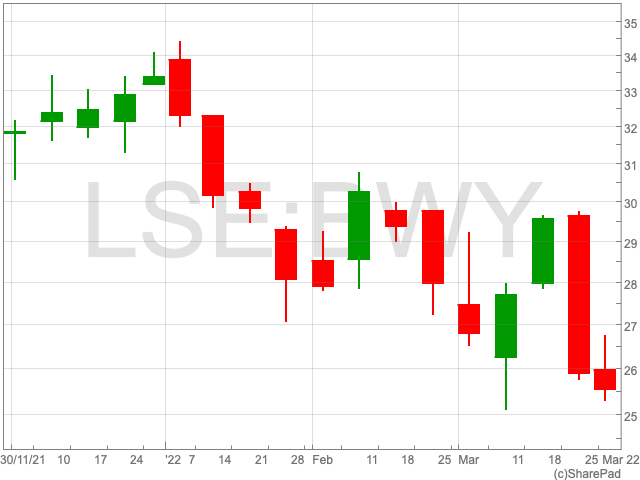
Barratt Developments, Persimmon, Berkeley Group and Taylor Wimpey were all down over 4%. Barratt Developments was the FTSE 100’s top faller, down 7%.

Unilever was one the FTSE best performers as activist investor Train Partners takes a stake in the group amid a takeover battle with GlaxoSmithKline.

How Vietnam’s millennials will shape the country’s consumer economy

Though 2021 was painful for Vietnam, its economy is expected to bounce back this year thanks to continued manufacturing growth and a more promising Covid-19 situation as a growing majority of the country’s citizens become fully vaccinated.

Accounting for roughly 35% of the country’s population, Vietnamese millennials – those aged 18 to 38 years – are playing an increasingly more influential role in the economy and Dynam Capital continues to closely monitor their telling consumption trends. 

As the first digital-native generation, they are driving widespread use of e-commerce platforms and other planks of the digital economy, and the pandemic has only accelerated this.

Interestingly, 60% of the participants in Dynam Capital’s recent survey on retail investors were in the 18-34 age group indicating further their prominent interest in investing. In addition, about a third of current millennial consumers are expectedto join the middle class by 2030. 

This means businesses will have to adapt to the demands of the millennial generation, which has much different needs and expectations than their predecessors.

“There is more sophisticated demand from millennials,” said Nguyen Hai Khoi, head of investment at Digiworld. “Instead of saying ‘I need a laptop,’ it is more common to hear ‘I need a gaming laptop’ or ‘I need a laptop for design purposes’.” 

The customer experience has also evolved in this respect, with millennial consumers shying away from products that cost less but have no after-sales service, or that have powerful specs but are hard to use. 

“Another aspect of the customer experience means that consumers want to try, touch and feel products before buying them,” Khoi added. “We have seen lots of millennial consumers visit Xiaomi and Huawei stores to try out our new products.” 

Hanh Tran wears two important hats on this issue. She is a millennial herself, and over the last 12 years she has worked on marketing campaigns for major brands such as Durex, Dutch Lady, Nivea and Samsung aimed directly at her generation.

“When we talk about young audiences, they’re all about trends and they’re ahead of the curve, and as marketers we have to be 10 steps ahead of them,” she explained. “We look at the time they spend on social media platforms, which tells you the quality of interaction, and we need to understand what would help us to capture their attention and move to action.”

Unsurprisingly, the rise of the millennial consumer has also spurred significant shifts in how companies advertise, with some moving completely away from traditional marketing channels, such as TV.

“Everything now centers around digital,” Hanh emphasises. “TV costs a huge amount of money, and companies are cutting that and moving to digital, where they can do so much more.”

The core relationship between brands and consumers continues to grow these trends. “It used to be that brands talked and consumers listened – a one-way pitch – but now it’s more about allowing the consumer to join a conversation,” she notes.

Hanh referred to the example of Coca-Cola allowing customers to print their name on Coke cans and how it allowed them to be part of a campaign. “You can’t do that with TV. Consumers feel like they identify with the brand, and they start interacting with it more.” 

One brand that has had to reimagine its relationship with millennial consumers is Biti’s, the Vietnamese footwear company established in 1982. Through the 2000s and 2010s, Biti’s fell out of favour with younger customers thanks to stiff competition from leading global brands.

According to Nguyen Phu Cuong, marketing director at Biti’s, five years ago the company created a sub-brand – Biti’s Hunter – directly aimed at the new generation of consumers.

“The ultimate goal was shifting the product’s perception of ‘durable, but outdated and cheap’ into ‘international-standard quality, cool, and value-for-money’,” he added. “Achieving that goal led us to a holistic change in our approach to young consumers.” 

Biti’s senior management discovered that these consumers are more pragmatic, prefer aspirational brands and have non-linear, multi-touchpoint shopping habits that demand fulfilling experiences. 

In an effort to transform their product, brand and system, Cuong and his colleagues took a number of major steps, such as borrowing ‘cool’ equity by partnering with icons of the millennial generation, for example, Marvel, superstar singer Son Tung M-TP, and top fashion designer Cong Tri. 

The company also emphasised its Vietnamese values, while also completely overhauling its retail operations to embrace e-commerce and provide more customised shopping experiences. 

These moves have paid off. Biti’s Hunter has released a number of hugely popular shoes and is now attracting a younger audience.

Stories like this will be the way forward as millennials take over Vietnam’s consumer economy.

“In 2022, after going through many changes due to the pandemic, millennials will pay more attention to health issues,” Khoi said. “This includes items that help improve the quality of a living space, exercise equipment, and equipment to help make food healthier.” 

“This is also the generation that lives with technology, and has the habit of shopping online,” he added. “In the coming years, this will continue to be developed.” 

Hercules PrimaryBid offer

Hercules Site Services hopes to raise up to £5.5m of new money through a placing and PrimaryBid offer in order to benefit from the growing infrastructure investment in the UK. Existing shareholders also want to raise £4.5m from share disposals.
Labour supply company Hercules Site Services was established in 2008 and it is currently owned by Hercules Real Estate Ltd, where chief executive Brusk Korkmaz and Nicola Korkmaz.
There is expected to be £650bn of infrastructure investment over the next decade and it can be difficult to obtain people with the right skills. Staff turnover is relatively l...

Ambitious targets for Goodbody Health

Broker Arden has initiated research on Aquis-quoted Goodbody Health (LON: GDBY) and set a 10p a share target price. The cannabis products and health testing supplier is expected to grow rapidly over the next two years.
Goodbody Health was previously known as Sativa Wellness Group, and it was set up in 2018. The initial CBD products supply business has been broadened into Covid testing clinics, that have in turn broadened the range of tests they offer. The strategy is to focus on independent pharmacies for testing business.
Currently 94% of testing revenues relate to Covid, but other blood test...

Lloyds share price set to be inflation winner in 2022

Lloyds share price is set to be a winner from soaring inflation in 2022 as the banking group enjoy the benefits of a hiking cycle in major global economies.

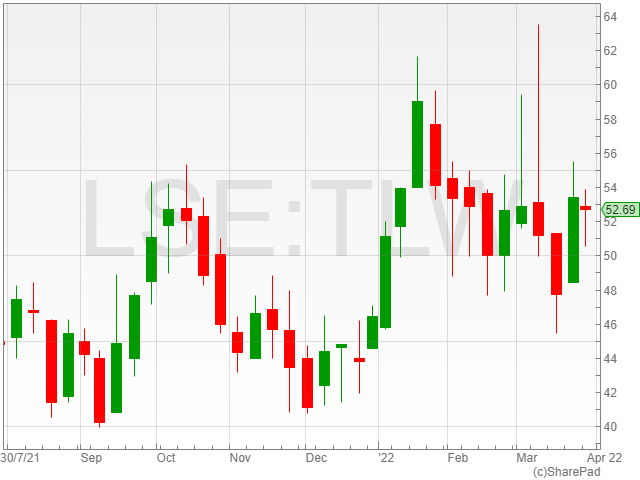
Lloyds shares have already had sterling start to 2022 adding 9% to trade at 51p. This is despite a significant retreat from the highest levels of the year for Lloyds share price.

There has been an ongoing and unavoidable discussion around inflation which started early last year. However, this is now starting to play out in markets with the threat of multiple interest rate hikes.

Concern has been most evident in the share prices of US technology stocks and the volatility in the tech-heavy NASDAQ index that counts the world’s largest tech companies as it’s constituents.

Fortunately for investors in Lloyds shares, the factors driving volatility in tech companies are the same factors helping Lloyds improve their profitability.

These are of course the associated benefits of higher interest rates on the Net Interest Margin of banks that thrive in higher interest rate environments.

Lloyds shares

Lloyds shares began their rally as soon as the Bank of England made a surprise interest hike in December and continue to reach intraday highs around 56p, before falling back.

With the debate raging whether the Federal Reserve will hike 3 or 4 times in 2022, it is almost certain the Bank of England will also embark on a series of rate hikes through 2022.

The tightening of monetary policy will have a deep impact on the economy as well as the positioning of investors.

Indeed, Lloyds shares may have the additional benefit investors rotating away from growth stocks to those that offer value in a dash for safety.

And Lloyds shares certainly fall into the category of being a value stock.

On both price-to-book and price-to-earnings multiples, Lloyds trades at a significant discount to the wider benchmark.

Notwithstanding the higher levels of profitability, the allure of relative value the company presents will certainly help support the Lloyds share price in 2022 and make it a winner during periods of high inflation.

Investor should note, however, a prolonged period of high inflation that damages household spending power and increases loan defaults – and possibly the housing market – will lead to negative outcomes for Lloyds shares.

FTSE 100 tumbles as UK retail sales decline and US tech sinks

The FTSE 100 dropped on Friday as the market digested a tranche of disappointing news including poor UK retail sales, falling oil prices and negative moves in US tech stocks.

The FTSE 100 was down 54 points or 0.7% at 7,530 in mid morning trade on Friday. The selling accelerated through the day and the FTSE 100 broke 7,500 to trade lower by over 1.4% as we approached the close.

Declines in London’s leading index were broad with most cyclical sectors falling. Mining companies, the Housebuilders and travel shares were among the top fallers on Friday.

UK economy

Concerns grew over the health of the UK economy following news retails sales were destroyed in the key December festive trading period by the Omicron variant.

Retail sales fell by 3.7% in December after consumers choose to do their shopping early and stay away from the high streets as Omicron spread. There were also concerns the drop in retail sales could be the first signs UK consumers were feeling the pinch of rising inflation.

“The decline in retail sales illustrated by today’s report continues to indicate rising prices and economic uncertainty as some of the key reasons for the slowing down of sales,” said Walid Koudmani, market analyst at financial brokerage XTB.

FTSE 100 shares

Given FTSE 100 shares largely earn their revenue overseas, the declines on Friday were driven predominantly driven by concerns the UK’s poor retail sales environment could be a signal inflation could be about to impact other global economies.

After having a strong start to 2022, BP and Shell were also among the losers as oil prices retreated.

Oil prices have also had a buoyant 2022 on hopes demand would recover as economies reopened.

UK housebuilders faced heavy selling as news of poor retail spending means home buyers could soon be facing a war on two fronts, with the prospect of rising interest rates increasing mortgage payments whilst consuming spending power declines.

Taylor Wimpey was 2.5% weaker and Persimmon gave up 1.7% at the time writing.

Netflix

Netflix shares declined 20% in the premarket after they missed expectations of subscriber numbers as people returned to normal life after the pandemic.

Although the news was devastating for Netflix investors, it also raised the question of market implications during the transition from the COVID economy to one that resembles life before the pandemic.

There are growing fear higher interest rates, a lack of government stimulus and support, and a shift in consumer behaviour will expose more cracks as 2022 progresses.

The drop in Netflix accentuated selling in other US tech stocks and the NASDAQ is now down around 10% in 2022.

The tech-heavy Scottish Mortgage Investment Trust was one of the top fallers on the FTSE 100.

Driver Group (AIM: DRV): Driving into the arms of a Swedish Suitor?

0

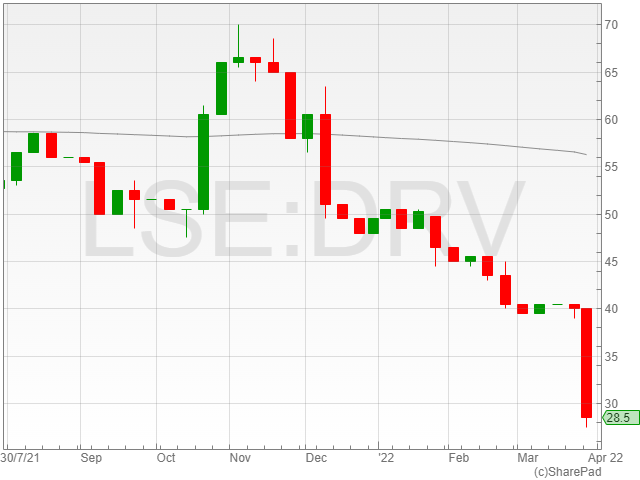
Driver Group (AIM: DRV) shares recovered to 50.5p (Mkt Cap £26m) after today’s brief news that the auditors have complete the finals for Y/E September which were due on 14th of December and will be reported on Monday 24th .

Driver Group is a global professional multi-disciplinary consultancy services for engineering and construction projects from ‘soup- to-nuts’, including claims, expert witness, and dispute resolution services it was founded in in 1978 and floated in 2005. There is a wide of sectors including transportation, Energy, Infrastructure building and marine. A new forensic accounting service is established, which compliments the construction-related, delay and technical expert services. It’s part of new strategy of focusing on higher margin business and upselling to existing clients and traction was being made in UK and Europe with weaker trading in the Middle East and Asia Pacific regions.

At the Covid infected Interims the Revenue was down 11% with an unchanged GP margin at 26% and an underlaying profit of £1,013k which is 19% lower, but the Interim Dividend was increased to 0.75p. The business development plans is to increase the proportion of sales represented by higher margin expert assignments, consequently, reducing the share of revenue derived from lower margin project services. The cost base was reduced by approximately 13% whilst maintaining the fee-earning capacity. DRV are inherently cash generative with a healthy net cash position of around £6.5m although growth has largely been organic.  It was looking good as a recovery play.

Then came the shock announcement of an audit delay due to DRV’s principals in Oman investigating projections from a significant customer. Sales momentum had been building although 2021 is profitable with a maintained dividend it is not a growth year. Due to these delayed finals expectations for the September 2022 year-end could be reset from the existing forecast of £3m for an EPS of 4.7p with a 1.75p dividend, which would be a prospective P/E 12.8x with a 2% yield.  Intriguingly supporting the recovery is AB Traction a Swedish Company which increased its stake last week from 19.56% to 20.5% and there are 41% of the shares  in public hands…… if 2022 expectations are crashed Driver could be  open to being taken-over.   The finals are now  due on Monday  but let’s wait and watch for a less risk buying opportunity.

Retail sales down in December

0

Retail sales in the UK were down 3.7% in December.

Footfall on the high street dramatically fell as people avoided shopping centres amid the Omicron variant around Christmas.

Sales at department stores, household goods stores and clothing retailers were hit. The ONS said: “Clothing stores and department stores reported a fall of 8.0% and 6.3% over the month and were 7.2% and 10.6% below levels in February 2020.”

“The volume of household goods stores sales fell by 3.2% in December and were 1.4% below their levels in February 2020.”

Food store sales were down by 1% and petrol and diesel sales fell by 4.7%.

Oliver Vernon-Harcourt, head of retail at Deloitte, commented: Continued rising inflation will put pressure on both consumer spending and confidence over the coming months. Rising household costs will also prompt some consumers to tighten purse strings, at a time when 72% of UK consumers are already concerned that prices for everyday purchases will go up.

Despite the adaptability shown by the industry throughout the pandemic, retailers will have to navigate not only inflation headwinds, but also manage continued supply chain disruptions and staff shortages.”

Netflix shares plunge as new subscribers slow down

0

Netflix has forecast a slowdown of subscribers as we emerge out of the lockdown and completion grows.

The streaming company expects to add 2.5 million subscribers in the first quarter of 2021, which is almost half of what was estimated by analysts. In the same period last year, subscribers grew by four million.

As a result, shares plunged almost 20%.

“While retention and engagement remain healthy, acquisition growth has not yet re-accelerated to pre-Covid levels,” said the group.

“Consumers have always had many choices when it comes to their entertainment time – competition that has only intensified over the last 24 months as entertainment companies all around the world develop their own streaming offering,”

“While this added competition may be affecting our marginal growth, we continue to grow in every country and region in which these new streaming alternatives have launched.”

Last year, Netflix added 18.2 million new subscribers. This is half the number it gained in 2020 amid the height of the pandemic.

“When Netflix released Don’t Look Up, was it trying to second guess what would happen when its fourth quarter numbers came out? The share price is doing exactly what was instructed by that film title – it’s looking down to the tune of a 20% decline in after-hours trading,” said Danni Hewson, financial analyst at AJ Bell.

“Fourth quarter earnings were well ahead of forecast and 8.3 million net new subscribers were better than the market consensus of 8.1 million, albeit less than the 8.5 million guided by Netflix.”

“Yet the big news was guidance for subscriber growth to slow massively, which therefore drags down earnings expectations and puts a question mark over Netflix’s goal to be cash flow positive every year from 2022.

Everyman shares rise on doubling of revenue

Everyman Media shares rose on Friday as the group released a 52-week trading update that revealed their revenue doubled from the year before.

Everyman reported a 101% rise in revenue to £48.7m in the 52 weeks to 30th December.

The group said they expected EDITDA to be ahead of current market forecast at approximately £8.3m.

Everyman benefited from the reopening and reduction of restrictions during a 33-week over the 52-weeks so one would expect revenue to further increase over the coming the period, if further restrictions are avoided.

The company current operates 36 venues and said they had plans to launch an additional 5 venues in the current financial year.

“Robust admissions seen across our estate in the second half of the year proves that demand for entertainment at Everyman remains strong,” said Alex Scrimgeour, Chief Executive Officer of Everyman Media Group.

“I would like to say a special thank you to our incredible team for making it happen in such exceptionally difficult circumstances. We are increasingly optimistic about 2022 performance and excited by our new opening pipeline. We are looking forward to a stimulating and diverse slate of films which will entertain our Everyman community.”