Brent crude has risen to around $70 per barrel after OPEC+ agreed to cut oil production
Aramco, the Saudi Arabian energy giant, saw its profits surge by nearly 300% thanks to an increase in the price of oil as demand recovers across the world.
The company, which is one of the biggest in the world, confirmed that vaccinations, the easing of restrictions, stimulus packages and the resurgence of economic activity have all played a part in its results.
Since the beginning of 2021, crude oil prices have risen by more than 30%, as Aramco’s net income rose by 288% to $25.5bn (£18.4bn) for Q2.
It surpassed analysts’ expectations of a net income of around $24.7bn for the quarter.
Brent crude has risen to around $70 per barrel after OPEC+ agreed to cut oil production.
The company’s chief executive also provided a positive outlook for the remainder of 2021.
“Our second quarter results reflect a strong rebound in worldwide energy demand and we are heading into the second half of 2021 more resilient and more flexible, as the global recovery gains momentum,” Amin Nasser said in a statement.
Saudi Aramco’s chief executive added that while the dividend could rise in the future, the company had identified an opportunity to increase its maximum output capacity.
Oil producers in the western world anticipate having to cut their production over the coming years, as pressure piles on from governments and investors to change to more renewable forms of energy.
“Seeing that there is a lot of under-investment in [oil] supply it’s a great opportunity for us. We are diligently working to increase capacity,” Nasser said.
Saudi Aramco’s largest shareholder is the Saudi Arabian government with 98% of its shares. It is the kingdom’s primary source of revenue.
Cinema operator Cineworld (LON: CINE) reports its interims on Thursday and this should provide an indication on how its takings are improving. Nearly all the cinemas are back up and running and attendances need to build up, so the group stops losing money.
Peter Rabbit 2 was apparently a success but the continued progress in attendances requires other successful films.
Interims
Cineworld will make a significant first half loss and its cinemas only started to open in April. The full year loss is expected to exceed $700m and much of that could be in the first half.
These figures in themselves ar...
The non-farm payroll data far exceeded economists’ expectations for 870,000 new jobs, the the Bureau of Labor Statistics revealed.
Policymakers are keeping a close eye in the numbers as it could influence future policies geared towards aiding the continuation of the US recovery from the Covid-19 pandemic.
Robert Alster, CIO at investment management firm Close Brothers Asset Management comments: : “Payrolls continue to paint a positive picture of the US jobs market, but the Fed will be keeping a close eye on the detail before making any decisions.”
“Companies are still struggling to hire, with job gains constrained by either not enough workers, the wrong workers in the wrong place, or the wrong jobs at the wrong salaries. Teen workers currently make up a higher proportion of the labour market than usual, and Powell’s dashboard reveals an uneven recovery in terms of diversity and inclusion.”
Some companies have increased wages, while others have offered other incentives.
The figures may be masking something a little more troubling for the US economy, suggests Hinesh Patel, portfolio manager at Quilter Investors:
“The recent surge in Delta cases will not be picked up by these numbers and as such employment figures will remain a little volatile and difficult to interpret. This could even be somewhat of a highpoint for US employment for some time. Furthermore, the Delta variant has shown how vulnerable the global economy is to new strains of the virus emerging and creating new waves.”
“But for now, the Fed will be hoping everyone returns to work and offices in September once the Delta surge has eased off, confidence resumes and vaccination rates improve. The biggest problem the Fed has is the fact that the participation rate remains at a near 40-year low and they seem to think they have influence over this. This pandemic has changed the way the economy works and ushered in new waves of automation. This is something that they will struggle to control over the longer-term and will mean fiscal support will need to step up even as the recovery continues,” Patel added.
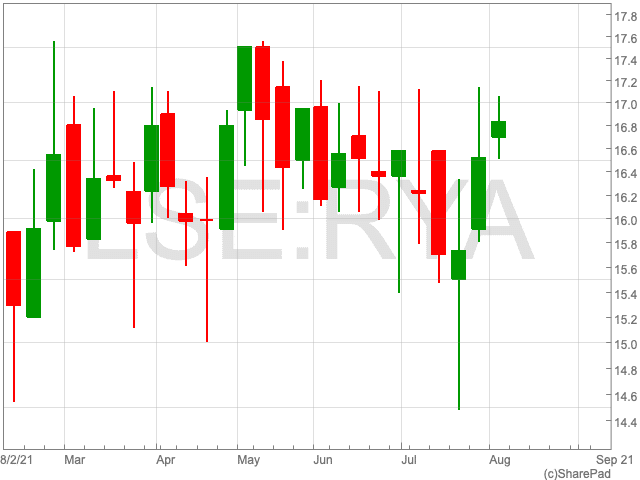
The Ryanair share price(LON:RYA), €16.82 at the time of writing, is set to close in the black for the third week in a row. The recent upwards move follows a positive set of results from the company and a brightening of the outlook of the airline industry more generally. However, while the Delta variant is hampering the global economic recovery, investors remain somewhat cautious about diving back into the stock which has had an up-and-down 2021 so far. This article will provide an update on the airline industry, as well as examining Ryanair’s position moving ahead.
Airline Industry
The mood around air travel has brightened over the past few weeks with passenger numbers climbing and destinations being opened up. However, any optimism is very much cautious as the sector was traumatised by its wort-ever crisis as a result of the pandemic.
It has been a long road, but gradually, the vaccine roll-out has allowed for the easing of some travel restrictions, with the path to full recovery becoming more achievable.
Willie Walsh, who runs global airline trade body Iata, told the Financial Times: “The recovery has definitely started in the second half, there are signs of things improving, restrictions being relaxed or removed, and we have to take positives from that.”
The number of planes in the air has risen to its highest level worldwide since the pandemic began, according to Citigroup.
However, the recovery across the world has been uneven. In addition, the Delta variant has threatened to throw a spanner in the works on a number of occasions in a variety of locations. The UK has significantly eased restrictions on travel for those who have been vaccinated.
Furthermore, people’s desire to go abroad remains very high. “What we are seeing empirically is there is nothing wrong with the consumer,” said Jozsef Varadi, chief executive of Hungary-based Wizz Air. “We think the desire to travel is totally intact.”
There are many reasons for investors curious about the Ryanair share price to be positive about the recovery. However, they must also be aware of the very real risks.
Ryanair
Ryanair confirmed a sharp rise in bookings at the end of last month while the low budget airline raised its forecast for passenger numbers over the coming year as travel restrictions are being eased across the continent.
However, the Irish company posted a €273m loss for the quarter between April and June, as lockdowns meant the majority of flights were cancelled amid ongoing caution.
The low budget airline said its mini-recovery was thanks to vaccinations, as well as the easing of isolation rules for travellers who have taken the vaccine, and the EU’s digital travel pass which the EU introduced at the beginning go July.
These factors have given Michael O’Leary, the chief executive of Ryanair, a degree of confidence over a sustained recovery for the industry, after the pandemic continued to test his company throughout the pandemic.
With a surge in bookings coming from continental Europe, Ryanair will increase its number of flights in operation during the end of summer.
While the airline is still facing challenging circumstances, it suggested that it will end the fiscal year “somewhere between a small loss and breakeven” as restrictions are there to stay for now.
Danni Hewson, financial analyst at AJ Bell, said:
“Could a last minute rush rescue Ryanair’s year? While the summer has been heavily affected by the continued strict restrictions on travel throughout Europe, the company is seeing notably higher bookings both for late summer holiday bookings and the winter,” Hewson said.
“This demonstrates how resilient demand for foreign holidays remains, particularly among the fully vaccinated cohort which now have a little more freedom to travel.”
“If people are booking now given all the uncertainty and hassle involved in flying then you could imagine a more rapid ascent when, hopefully, we finally emerge from the pandemic.”
Price Forecast
Davy, the wealth management company, recently retained its ‘outperform’ rating for Ryanair. The group said its medium-term outlook is “stellar”, and therefore the Ryanair share price is the only one with an outperform rating.
The stockbroker has a target of €18 for the Ryanair share price.
It is the largest rises in energy bills in over a decade
Energy bills for as many as 15m homes will increase by at least 15% from October as record-high gas costs mean the price cap will be lifted.
Ofgem, the gas and electricity markets regulator, said that 11m households on standard tariffs will see a 12% increase to £139 per year, while an additional four million will be faced with a 13% increase to £153.
It is the largest rise in energy bills over the last ten years which could squeeze families across the country, as the furlough scheme comes to an end.
Ofgem said the increase was the result of “a rise of over 50 per cent in energy costs over the last six months with gas prices hitting a record high as the world emerges from lockdown”.
“Gas prices have risen to a record high in Europe due to a recovery in global demand and tighter supplies. This is increasing the cost of heating homes and pushing up electricity prices,” the regulator added.
Ofgem chief executive Jonathan Brearley told the BBC that customers should shop around for the best possible deal, as there are opportunities to make significant savings.
“You don’t have to live with this tariff. The price cap is a backstop. We’d encourage any customer, particularly those struggling to pay their bills, to contact their supplier, and get access to a wide-range of help and support,” he added.
“Millions of household budgets are already stretched to the limit and this massive increase could not be coming at a worse time.”
The new rate will come into effect on October 1 for customers on their supplier’s default tariffs.
Domestic energy bills are directly linked to wholesale prices, the price at which energy businesses have to pay for gas and electricity.
After gas prices soared to a record high as the world economy recovered from the pandemic, wholesale prices jumped too, as there was a surge in demand for energy.
“A confluence of factors occurring at the same time has caused the recent bull run with record low gas storage, outages, continual/prolonged production issues and active Asian buying,” said Nick Campbell, a director at consultancy Inspired Energy.
Ten years from now, the world might look back on Covid as our ‘great reset’ moment, similar to how Americans describe their “Pearl Harbor moment” in the 40s, which marked a moment in US history which saw dire adversity, and it sparked innovation to address the era’s biggest problems.
At the time of Pearl Harbor, artilleries were mainly horse drawn – 80% of the German military depended on horses and the majority of the US artillery was horse drawn. Take a moment to let this sink in: In 1941, major artilleries depended on horses. Yet, by the end of the war, the world had entered the atomic age. The continued threat of ever evolving weapons, and increasing tension like the cold war, which is similar in its continuity to the threats pandemics and climate change pose to us now, gave way to an incredible period of innovation and economic growth. ‘History doesn’t repeat itself, but it often rhymes’, as Mark Twain put it, and the electric car industry could be one of the more interesting horses to place bets on this decade.
Riding the EV trend into 2035
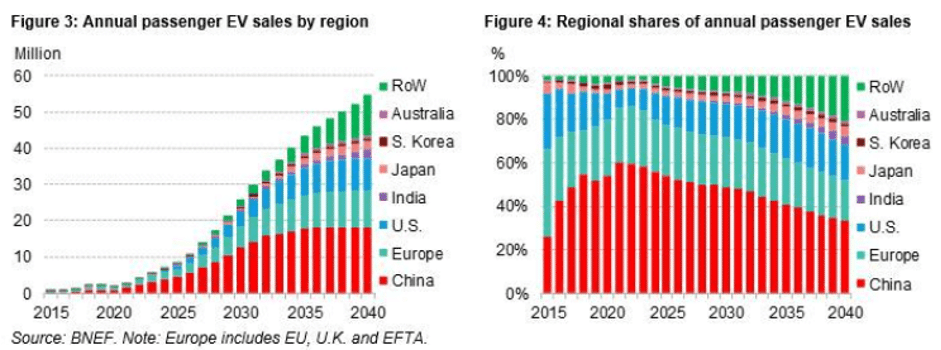
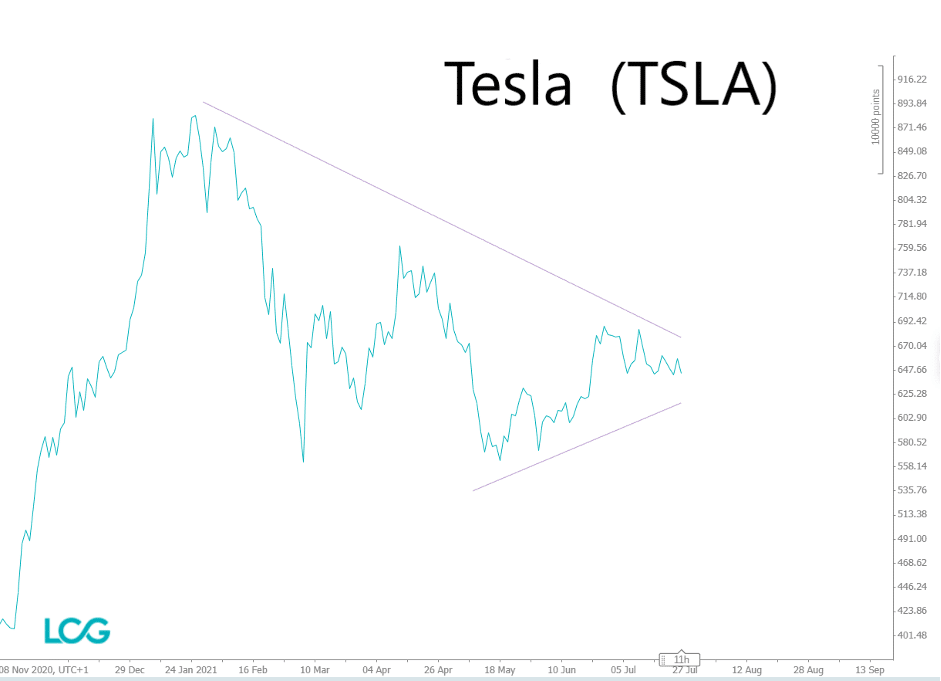
One of the most outspoken and iconic ‘problem solvers’ Elon Musk, is looking to make us a multi planet species, deploying rockets to Mars, and, most notably to traders, his company ‘Tesla’ had a meteoric rise in 2020. As per the BNEF 2020 forecast below, the trend of electric vehicles becoming the first choice for transport is deemed to continue this decade, however, please bear in mind, past performance is not indicative of current of future performance as investments can go down as well as up.
The BBC recently published an article that highlighted the infrastructure inversion that is currently happening in relation to charging cars. The narrative went from ‘you will never be able to charge your car with electricity anywhere’ to ‘you might not be able to fill your car with petrol or diesel by 2035’. The 2020s have been hauled as the great reset, and the electric vehicle industry is one industry to watch.
The next step: Battery stocks
Electric car stocks are those of companies that focus primarily on manufacturing electric cars. However, companies that manufacture the components used in electric cars — like batteries – are also part of the wider electric vehicle industry and could outpace the car manufacturers this year. Question is, how are the prices related, and are we in a super cycle rotation right now?
Bullish catalysts for battery stocks
1 Installation of charging station at home
You can have a charging station installed in your garage at home for your electric vehicle, which can usually be done within 8 hours. So, you can leave your car plugged in and wake up in the morning to have it ready.
2 Long battery lifespan
Research has shown that the average electric vehicle battery will retain at least 90% of its battery life after six years and six months of usage. Most electric vehicle manufacturers offer a service warranty of 8 years to 10 years for their batteries.
3 Battery swap technology
Tesla and other car manufacturers offer battery swap technology that allows one to swap batteries in less than 2 minutes. That way, you do not have to spend extra time charging your battery.
4 Regenerative Braking
Some electric vehicles have regenerative braking, whereby the car brakes by converting its kinetic energy to another form of energy that can be stored until when it is needed. This reduces friction on the tires, elongates the lifespan of the braking system, and makes for energy efficiency.
5 Battery price
The batteries of electric vehicles are expensive. Battery price amounts to about 25% of the cost price of an electric vehicle.
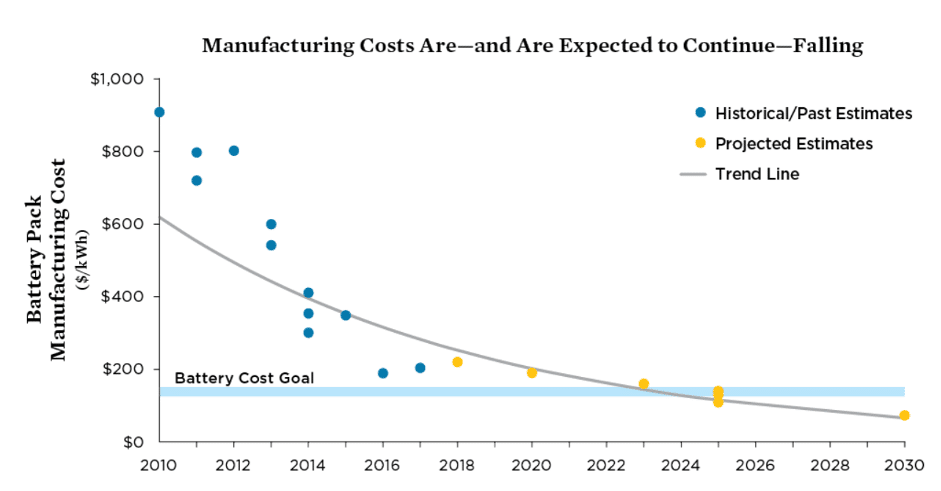
Yet, private and government researchers are working on reducing the prices of these vehicles. A lot of progress has been made on this. According to IHS Markets, the average price of batteries dropped 82% from 2012 to 2020. Based on its data, by 2023, when batteries are expected to cost less than $100/kWh, the drop will be 86% in a decade. Mass production of batteries and improvements in battery technology will drop the costs further.
6 Reusable batteries
Electric vehicle batteries can be reused for home energy storage, backup for large buildings, electric bikes, electric scooters, backup power for data centres, backup power for telecommunication base stations, etc.
The residual capacity of these batteries is still very valuable.
7 Recyclable batteries
Old batteries from electric vehicles can be recycled. The batteries could also be reduced to constituent metals and elements for usage elsewhere.
Potential risks for battery bulls
1 Global chip shortage
The global semiconductor chip shortage that has hit automakers around the world and constrained vehicle production will easily drag into next year, the chief executive of the world’s No. 4 automaker, Stellantis warned, which could hamper production and profitability of electric vehicle makers.
2 Cost and environmental impact of raw materials
Materials for battery production are of finite supply. The chemicals and processes used in mining lithium create air, water, and soil pollution; Less than 5% of lithium-ion batteries are recycled. If thrown in landfills, EV batteries can leach chemicals into the ground and into water, potentially causing serious environmental damage, or even cause toxic chemical fires.
As for with most emerging industries, there is a risk of betting on a company that will lose out to the competition.
5 Risk/reward ratio
When stocks have risen quickly, there is always a risk of pullback, and battery stocks are no exception to this.
6 Competition pressure on prices
Prices for batteries are expected to keep falling, which will be good for profit margins. However, there could also be increased pressure to offer batteries cheaply, which would decrease profit margins for the battery stock firms.
3 battery stocks that are worth a look
Tesla
Tesla is not only producing cars but is also heavily invested in the production of batteries. The Q2 earnings report revealed that, in short, Tesla managed to get some progress done, yet they still have more work to do before achieving any volume production on their batteries.
Past performance is not an indicator of current or future performance
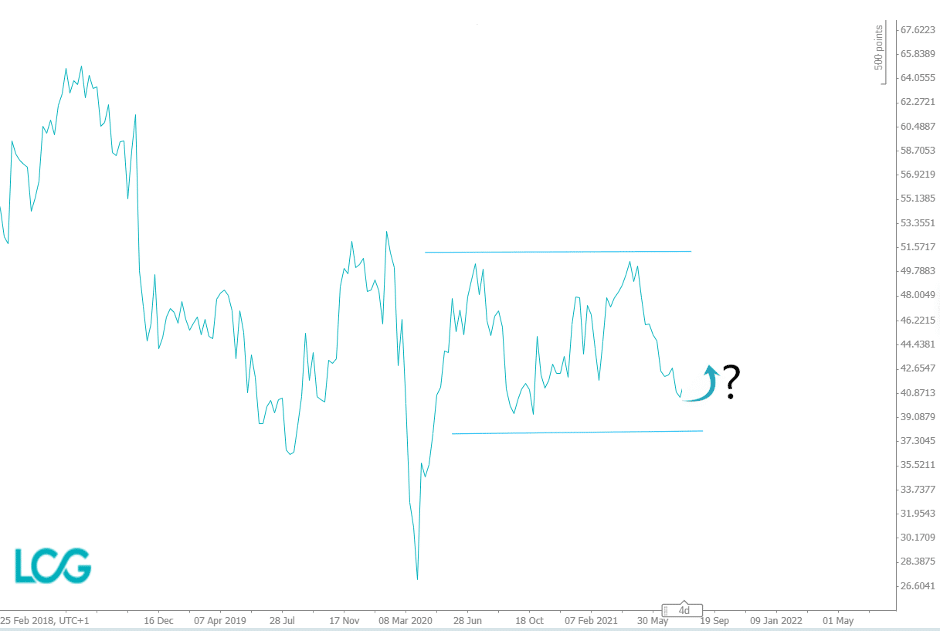
ENR is a leading manufacturer of batteries and automotive care products globally and produces lithium-ion batteries. Is the share price increasing or decreasing amid the effect of Tesla’s earning call?
Past performance is not an indicator of current or future performance
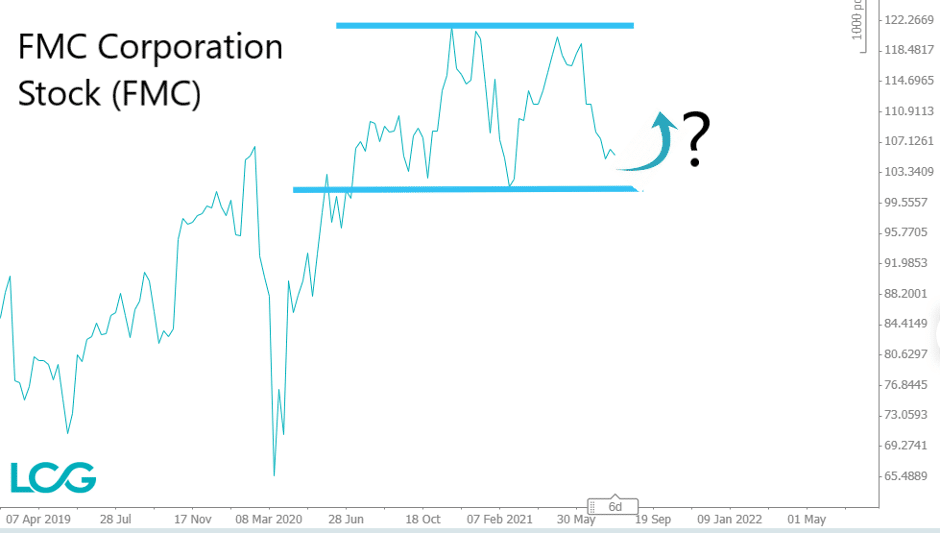
Similarly, the chemical company FMC Corporation, which is involed in the production of Lithium for batteries, has been cycling for around one year. The , questionsis whetherthe support lines as indicated below hold despite the global chip shortage, and whether we will then see another leg up as per the previous months?.
Past performance is not an indicator of current or future performance
The world is changing at an ever-faster pace, and while it is impossible to predict which technologies will rise the most, electric car batteries continue to be worth watching.
Spread betting and CFD trading carry a high level of risk to your capital and can result in loss of your deposits. CFDs are complex instruments and come with a high risk of losing money rapidly due to leverage. Please note that 68% of our retail investor accounts lose money when trading CFDs. You should consider whether you understand how CFDs work and whether you can afford to take the high risk of losing money.
The information provided within this communication has been prepared by London Capital Group Limited (LCG) and is intended for informative purposes only. It is not intended for investment, or commercial advice or an offer or solicitation for the purchase or sale of any financial instrument. Any opinions, news, research, analysis, prices, other information, or links to third-party contained within this communication is provided as general market commentary and does not constitute investment advice and is not intended for any form of commercial use. LCG shall not accept liability for any loss, damage including, but without limitation, to any loss or profit which may arise directly or indirectly from use of or reliance on such information.
The information in this article is not directed at residents of EU as well as Australia, Belgium, Canada, New Zealand, Singapore or the United States, and is not intended for distribution to, or use by, any person in any country or jurisdiction where such distribution or use would be contrary to local law or regulation.
London Capital Group (LCG) is a company registered in England and Wales under registered number: 3218125. LCG is authorised and regulated by the Financial Conduct Authority (FCA) under the firm reference number of: 182110. The registered address for LCG is: 80 Cheapside
A number of key markets in Europe and Asia were quiet on Friday, with the FTSE 100 slipping 0.0056% to 7,120 and Asian stocks gave away ground.
“US non-farm payroll figures could put a bit of life in the markets later today, with forecasts for 925,000 jobs to have been added in July and unemployment at 5.6%. A worse than expected figure might trigger a positive market reaction as it would suggest the economy is not overheating,” says Russ Mould, investment director at AJ Bell.
“Conversely a better-than-expected figure might trouble investors if it suggests the economy is racing ahead, which would stoke fears of interest rate hikes happening sooner than currently guided by the US Federal Reserve.”
With the markets now entering the quiet summer period, investors will be looking back over their year-to-date performance and creating a strategy for the autumn onwards.
US stocks continue to be the place to be for many, with the S&P 500 index up 19.7% year to date, closely followed by the Dow Jones which has advanced 16%.
“Joe Biden’s $1 trillion infrastructure plan will provide impetus, together with the fact that businesses and consumers are busy spending, all creating a tailwind for economic growth. Equally there is also a headwind in the form of inflationary pressures which is starting to eat into corporate profit margins. For now, investors seem happy to stick with the US market in the search for investment returns,” said Mould.
The UK market has also done well, especially compared to its performance over the past decade.
“The FTSE 250 has been the star performer, up 14.1% so far this year, helped by a swathe of takeover activity as private equity and overseas trade buyers start to capitalise on the value still to be found among UK stocks,” Mould said.
“The FTSE 100 has lagged the UK’s mid cap index, but still delivered an 8.2% gain year-to-date. That’s slightly better than the historical annual returns seen from the market and we still have the best of five months to go.”
Asia has been the laggard, with a regulatory clampdown in China putting investors off the region. Hong Kong’s Hang Seng index has fallen 4.6% so far this year, and China’s SSE index is down 1.3%.
“Japan’s Nikkei 225 index has bucked the negative trend in Asia with a 2.1% gain since the start of January, but hardly a reason to celebrate. The IMF recently downgraded its 2021 economic forecast for Japan as it struggles to deal with Covid. It now expects 2.8% growth this year, the weakest of all the advanced economies.”
Changes to the stamp duty holiday came into effect last month
Average UK house prices rose in July by 7.6% compared to the year before, however, the rate of growth has slowed down.
This is according to Halifax, the mortgage lender, which said that the average property price is now at £261,221.
The July figure is 0.4% higher than the month before when the annual growth rate was higher at 8.7%.
Changes to the stamp duty holiday came into effect last month as buyers will now get less favourable terms.
However, a shortage of homes is likely to continue to support house prices, according to Halifax.
At 7.6%, the growth in house prices is still easily exceeding wage growth, as has been the case for the majority of the past decade.
There are a number of factors that appear to have caused the dramatic rise in house prices even in the face of the pandemic. Firstly, the cost of borrowing is historically low. Secondly, there is pent-up demand following a temporary slowdown. Lockdowns have created a desire among people to have more space. Finally, sizeable government subsidies have played their part.
Russell Galley, a managing director at Halifax, said
“Recent months have been characterised by historically high volumes of buyer activity, with June the busiest month for mortgage completions since 2008. This has been fueled both by the ‘race for space’ and the time-limited stamp duty break. With the latter now entering its final stages, buyer activity should continue to ease over the coming months, and a steadier period for the market may lie ahead,” said Galley.
“Latest industry figures show instructions for sale are falling and estate agents are experiencing a drop in their available stock. This general lack of supply should help to support prices in the near-term, as will the exceptionally low cost of borrowing and continued strong customer demand.”
CyanConnode has signed a number of important partnerships
CyanConnode (LON:CYAN), the IoT technology innovator, confirmed on Friday that its operating loss for the financial year to March 2021 narrowed by 57% to £2.7m.
However, CyanConnode’s revenue jumped to £6.4m from £2.5m a year prior.
The board of the company remains optimistic regarding its outlook approaching the remainder of 2022.
CyanConnode signed a number of important partnerships, as well as winning two new orders since the beginning of the year.
The AIM-listed firm also confirmed the appointment of a new senior management team in India, where a number of projects will begin following the easing of restrictions.
“We look forward to further order announcements during this financial year, and to delivering the backlog of orders won in previous periods,” CyanConnode said.
The CyanConnode share price is down by 2.13% during the morning session on Friday following its results.
“The market in India is picking up again after its second lockdown during April and May 2021, and we were pleased to receive a contract from Schneider in August 2021 for 152,000 Omnimesh modules and associated gateways, services, Head End Software and support and maintenance services. This further increases the backlog we are delivering in India,” said John Cronin, Executive Chairman of CyanConnode.
“Along with the orders received for Thailand in July 2021 and an African deployment in August 2021, we look forward to an even more successful financial year ahead.”
Earlier this week CyanConnode confirmed it received a contract for a smart metering deployment in Africa.
The firm said it would supply 100,000 ‘Omnimesh’ modules together with advanced metering infrastructure, services, Omnimesh head-end software, a perpetual licence, and an annual maintenance contract.
Investors are also unclear about China’s policies in dealing with the pandemic
Asian stocks gave away ground on Friday due to the spread of the Delta variant of the coronavirus raising concerns over the country’s economic recovery.
The move came as US stocks posted strong gains.
Investors are also unclear about China’s policies in dealing with the pandemic, creating a sense of hesitancy, especially after the CCP came down on the technology sector.
The MSCI Asia ex Japan index is down by 0.19% on Friday, while the CSI 300 index (Chinese blue chips) and KOSPI 200 Index (Korea) have lost 0.55% and 0.33% respectively.
“There are two main drivers of volatility in the market this week, firstly everything surrounding the Chinese regulatory drive…and secondly the severity of Delta outbreaks around the region,” Carlos Casanova, senior economist Asia at UBP, told Reuters.
“International investors are still wrapping their head around what happened in the education sector (in China). I expect that will continue to drive sentiment. The regulatory drive is not over yet, it should continue to be a factor in the next three to six months or so,” he said.
China today reported 124 confirmed new cases for 5 August, the country’s highest daily count for new cases in the recent outbreak.
Additionally, Malaysia and Thailand reported record daily cases on Thursday.
The MSCI world shares index is just short of an all-time-high as stock markets from other parts of the world take the load off of Asia.
Following a flurry of robust earnings announcements, the Nasdaq and S&P 500 closed at record levels yesterday, as eyes will now turn to the upcoming jobs report.
“Asian and emerging markets have gone from strength to strength,” says Kate Marshall, senior investment analyst at Hargreaves Lansdown. “Rapid industrialisation, growing populations, and a desire to succeed have helped transform developing countries into economic superpowers. Domestic consumption is set to be a key driver of growth over the coming years, helped by a young and growing population, and rising wealth.”
“These countries have also become hotbeds of innovation. Some countries are at the forefront of technology and many companies located there are overtaking Western competitors,” Marshall added.