Georgina Energy faces wait for environmental permit

Georgina Energy’s subsidiary Westmarket Oil & Gas has received preliminary approval for its Well Management Plan at the Hussar site from Western Australia’s Department of Mines, Petroleum and Exploration.

However, the London-listed company cannot begin site preparation or drilling until it secures final approval for expanded environmental management plans under state regulations.

The environmental hurdle represents the remaining barrier before drilling can commence at the Hussar-2 well.

Once environmental approval is granted, Georgina Energy will repair the Hussar airstrip and access roads, construct drilling and camp facilities, and install water wells ahead of operations.

“Georgina’s operations team has worked on all the required obligations for the Hussar drilling permit approval in cooperation with the indigenous community representatives,” said Anthony Hamilton, Chief Executive Officer of Georgina Energy. “We await approval for our extended environmental plan, and look forward to receiving the final drilling approval once all obligations and approvals have been obtained.”

Georgina Energy shares were flat at the time of writing.

The company completed a reverse takeover in 2024, raising £5m at 12.5p during the height of London’s helium hysteria. Georgina Energy shares are down 50% to 6.6p since the reverse takeover was completed.

Filtronic announces fresh contract win, shares rise

Filtronic plc, the RF solutions designer and manufacturer, has won a £13.4m contract to supply high-performance modules for an electronic sensor system to a defence prime contractor.

Today’s deal is the latest in a string of high-value contract wins by Filtronic, which have helped push the stock to all-time highs this year.

Filtronic shares were 3% higher at the time of writing.

The contract’s delivery is scheduled to begin in mid-2026, with production taking place at Filtronic’s secure automated hybrid microelectronics facility in Sedgefield, County Durham.

“We are proud to continue strengthening our defence portfolio, which highlights the market’s ongoing confidence in our ability to execute complex programmes to the highest standards,” said Nat Edington, Chief Executive Officer.

“Aerospace and defence remains a key sector in our growth strategy, and this latest order reflects Filtronic’s proven track record of successful project delivery, collaborative partnerships, and manufacturing excellence.”

AIM weekly movers: Eneraqua Technologies gets into financial difficulties

4

Premier African Minerals (LON: PREM) says that the Zulu lithium plant was restarted on 6 July and optimisation of the processing will happen in the coming weeks. The share price rebounded 103% to 0.0245p.

Futura Medical (LON: FUM) is replacing James Bader as chief executive after disappointing sales o of its main erectile dysfunction product Eroxon. Jeff Needham is also leaving the board. Alex Duggan will become interim chief executive. The share price recovered 51% to 11.85p.

Conroy Gold and Natural Resources (LON: CGNR) has discovered anomalies along the Skullmartin gold trend. This trend is more than 30km long. The share price I 50% higher at 6.75p.

David Johns-Powell has increased his stake in Haydale Graphene (LON: HAYD) from 3.49% to 4.52%. The original stake was revealed last November. The share price improved 38.5% to 0.9p.

FALLERS

Petro Matad (LON: MATD) has raised £2.84m at 0.8p/share – more than expected – and could raise a further £500,000 from a retail offer. The cash will be invested in lower cost power generation. The share price dipped 38.1% to 0.82p.

Water and energy efficiency technology services provide Eneraqua Technologies (LON: ETP) says revenues will be lower than expected for the year to January 2025, but pre-tax profit will be in line with forecasts. Revenues of £81m were forecast but the outcome is going to be £63m. A £7m project substantially completed last year is recognised as accrued revenues. There have been delays in the receipt of payments and further deferral of projects in the current year. This has led to the requirement for additional funding. The disposal of a non-core business should raise £1m. Subsidiary Cenergist has been placed in administration due to an adverse adjudication. Trading in the shares has been suspended because of the financial uncertainty, but prior to that the share price slumped 34.5% to 19p.

Active Energy Group (LON: AEG) has closed a substantially oversubscribed placing raising £346,180. The biomass-based renewable energy technology developer will use the cash for working capital. The company is evaluating a digital assets strategy for its treasury management. A proportion of the fundraising is likely to be invested in Bitcoin and other digital assets. The share price fell 30% to 0.21p.

IT training company Northcoders (LON: CODE) warns that there is limited visibility on government funding of regional training. Some regions have not even launched tenders for the training. Northcoders has a good reputation but cannot guarantee how much business it will win. This makes revenues unpredictable for the full year and Zeus has withdrawn its forecasts. Fixed costs are being reduced. The share price slipped 27.7% to 36.5p.

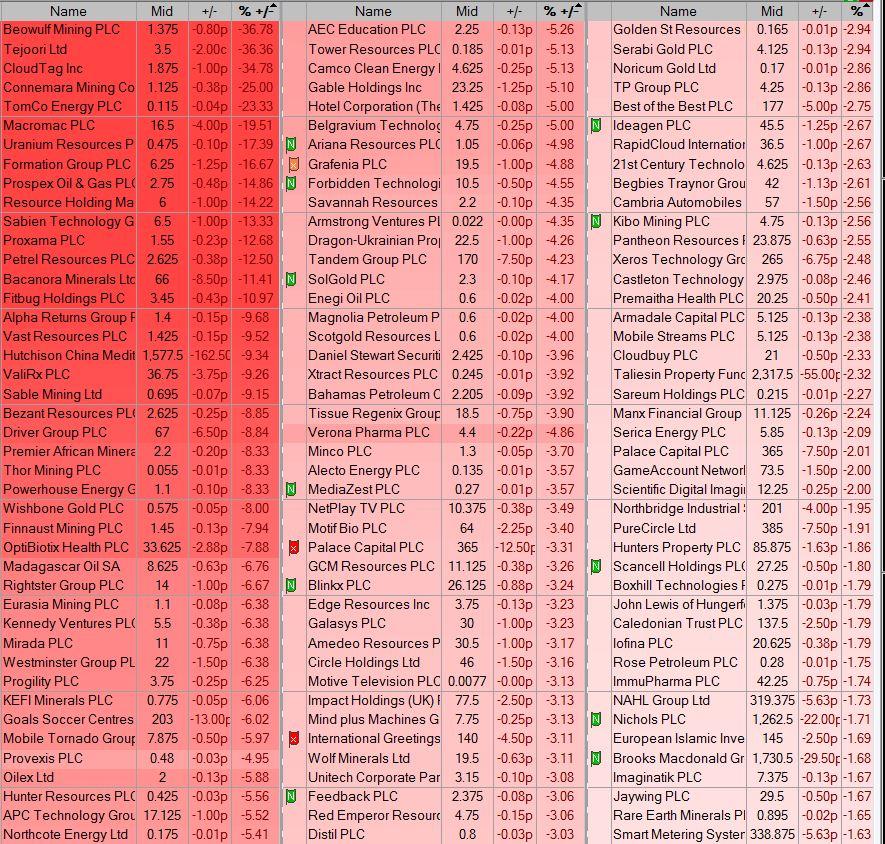
Aquis weekly movers: TechFinancials reveals potential Kenyan iron project purchase

Wishbone Gold (LON: WSBN) has applied for 12 exploration tenements near to the Red Setter gold dome project. They are also close to the Telfer gold mine operated by Greatland Resources (LON: GGP). The share price jumped 94.4% to 0.7p.

TechFinancials (LON: TECH) has entered into an agreement to potentially acquire a 60% stake in the Dilotiko high-grade iron ore project in Kenya. The mining permit application is going through final evaluation. There has been historical exploration. This could be an open pit mine with a 20 year life. TechFinancials is issuing 20 million shares at a deemed share price of 0.25p for an option to acquire 60% of Dikotiko. Then, within 60 days 80 million shares, depending on the price will be issued to acquire 25% of project owner Dilotiko Ltd. Further shares will be issued to take the stake in the project to 60%. The deal was introduced by Gathoni Muchai Investment Company, which can appoint two directors to the TechFinancials board following the formal acquisition. The firm will also underwrite a placing to raise £250,000 at 0.25p/share.  The share price rebounded 75.7% to 0.325p.

Coinsilium (LON: COIN) ay that its Forza! subsidiary holds 86.67 Bitcoin. Shareholder agreement to the issue of new shares will enable further investment. Trading activity in the shares has increased. The share price rose 54.3% to 27p.

The Smarter Web Company (SWC) raised a further £10.3m at 325p/share, which follows the previous placing raising £22.9m at 327p/share earlier in the week. The company currently owns 1,275 Bitcoin at a total cost of £100.1m. There is £31m left to be invested. In the past 30 days there has been a Bitcoin yield of 497% on its treasury holding. The share price improved 21.7% to 392.5p.

FALLERS

Shares in prize draw operator Good Life Plus (LON: GDLF) fell a further 32% to 0.425p following the previous week’s announcement that it plans to ask shareholders for approval to leave Aquis because it says there is limited liquidity, and it is getting funding outside of the market.

Vaultz Capital (LON: V3TC) director Neil Ritson has left the board. The company has submitted an application to commence share trading on the OTCQB Venture Market in the US. Bryan Reid has built up a near-11% stake. The share price dipped 28.1% to 16.625p.

Hot Rocks Investments (LON: HRIP) increased the size of its fundraising from £375,000 to £450,000, still at 1.125p/share. The share price declined 14.1% to 1.375p.

Broker VSA Capital (LON: VSA) returned to profit in the year to March 2025 as revenues roe from £1.89m to £2.78m. A small loss was reported, but that was due to the amortisation charge of £330,000. Underlying pre-tax profit was £323,000. There was £537,000 in the bank at the end of March 2025. The number of retained clients increased from 27 to 30. The share price slipped 2% to 4.9p.

AIM movers: Weak visitor numbers hit accesso Technology

4

Rockfire Resources (LON: ROCK) announced more positive news for the Plateau project in Queensland from farm-in, joint venture partner Sunshine Metals. ACAM LP has a 16.3% stake in Rockfire. The share price rose 15.8% to 0.11p.

Sundae Bar (LON: SBAR) has begun the acquisition of Bitcoin. The TAO Strategies partnership delivered subnet emissions increasing from τ9 TAO daily at the end of June 2025 to τ15 TAO daily (equivalent to approximately $5,490 daily). The share price improved 7.32% to 11p.

FALLERS

Petro Matad (LON: MATD) has raised £2.84m at 0.8p/share – more than expected – and could raise a further £500,000 from a retail offer. The cash will be invested in lower cost power generation. The share price slumped by one-quarter to 0.825p.

Ticketing technology provider accesso Technology (LON: ACSO) says that the full year revenues will be at the lower end of guidance. Weak attendance levels for customers reduced transaction revenues. This is the most important trading period. Cash EBITDA margin I still expected to be 15%. A customer says that it will not be renewing one of its agreements and that will reduce 2026 gross profit by $6m. There are new contract wins. The share price dived 23.7% to 363p.

Allergy Therapeutics (LON: AGY) has issued 250.7 million warrants exercisable at 4p each. This is related to the £50m loan facility. There are 25 warrants issued for every £1 drawn down. The share price fell 4.55% to 7.875p.

URU Metals (LON: URU) reports assay results for the two hole drilling programme at Zeb nickel project in Limpopo, South Africa. This confirmed mineralisation of an untested area and there are also thicker, higher-grade intervals beneath the historic resource. The share price declined 2.06% to 4.75p.

Premier Miton (LON: PMI) reported a small decline in assets under management to £10.5bn at the end of June 2025. There was a positive performance over the latest quarter and outflows were lower. After the period end there was a new $50m mandate after the period end. The share price dipped 4.9% to 68p.

Is Vietnam the biggest winner in this round of tariff negotiations? 

Vietnam appears to be emerging as a regional winner in the latest round of revisions to US President Donald Trump’s “liberation day” tariffs.  

As Mr Trump drip-feeds new tariff rates in posts on social media, clear and significant differences are emerging between markets in Southeast Asia. The new tariff rates could intensify competition between the region’s major economies, as each tries to maintain a competitive advantage over its neighbours. 

For the moment, it appears that Vietnam might have an edge. After intense lobbying by the Vietnamese government, the US has now slashed tariffs to 20%, down from 46%.  

Vietnam’s neighbours have not been as successful in rolling back Mr Trump’s tariffs.  

For Thailand, the tariffs have been set at 36%. For Malaysia it’s 25%. For Indonesia, it’s 32%. Even close US allies like Japan and Korea will face 25% tariffs. Laos and Myanmar will each face 40% tariffs, while Cambodia’s tariffs have been revised down from 49% to 36%.  

The Philippines also has tariff rates of 20% (interestingly, that’s higher than the initial rate set in April). But its economy has a greater emphasis on services, and it arguably doesn’t compete as directly with Vietnam as other major Southeast Asian economies.  

Foreign direct investment has been a key growth driver in Vietnam in recent years. It remained strong in the first quarter 2025, driven by the manufacturing and processing industries. Tariffs certainly aren’t the only thing that investors look at, but higher tariffs in Thailand and Indonesia might prompt some businesses to look at Vietnam more closely, especially if they plan on exporting to the US. 

The original tariffs, announced in April, could have caused a contraction of 2% of GDP or more, depending on which analyst you believe. The impact will clearly be much smaller now that the US has relented.  

The markets seem optimistic. Nike and Lululemon — which are both exposed to US-Vietnam trade — posted gains after Mr Trump announced the deal. The effect on Vietnamese equities was minimal. The local stock exchange is not hugely exposed to international trade. Furthermore, it is very retail driven, and any movements probably reflect sentiment. It’s likely that investors have already priced in the effects of tariffs.  

Even so, a number of Vietnamese businesses who are more dependent on the US market will probably be breathing a sigh of relief.  

Still, it wouldn’t be entirely accurate to call the latest tariffs a triumph. The tariff rates are roughly double what they were at the start of the year and they are still higher than those imposed on some close US allies such as Australia (10%). Also, the Trump administration is looking at a range of tariffs that apply to products rather than countries. It’s not entirely clear how they will affect Vietnam yet.   

Furthermore, the rollout of these tariffs has been erratic, and it seems likely that there will be further movement. Between now and August 1, when they are supposed to take effect, every government in the region will be engaged in furious lobbying aimed at driving the tariffs lower.  

Indonesia is offering a raft of concessions in an effort to secure a lower tariff rate. Malaysia is continuing to negotiate, although it has expressed less willingness to compromise. Thailand has offered to reduce the surplus, slash tariffs on several categories of agricultural goods, and increase imports of natural gas and aircraft.  

Singapore’s situation is slightly different. It currently faces a tariff of 10%, and only runs a small surplus with the US. Mr Trump’s new ambassador recently faced a grilling in the US Senate over the trade relationship.  

It’s entirely possible that the situation will look very different in three weeks, and based on past experience it would not be surprising if the Trump administration kicked the can down the road again, offering some kind of temporary reprieve while more negotiations take place.     

Also, there is a caveat to Vietnam’s new rate: there will be a tariff of 40% on goods that are transshipped from China. The US has long had concerns that Chinese manufacturers are escaping tariffs by shipping through Vietnam, where the product is minimally altered (or not altered at all) before being shipped to the US. 

Estimates of the scale of transshipment vary significantly, so it’s difficult to say with any real certainty how much impact this might have. It’s also not yet clear what the US will deem to be a transshipped product and what will count as local.  

However, the Vietnamese government is serious about addressing the problem.  

Given its goal is to move up the value chain, there’s little incentive for Vietnam to encourage transshipment, which does little to benefit the Vietnam’s economy or deliver the benefits of manufacturing to its people. Listed Vietnamese companies have almost no exposure to the transshipment trade.  

Arguably, once there is a clearer picture of what counts as local and what counts as transhipment, some businesses with operations that hover near the legal boundary might even be inclined to bring more of the manufacturing value chain to Vietnam.  

Despite the lingering possibility of future adjustments, Vietnam’s success in negotiating lower tariffs is a significant positive step, potentially enhancing its appeal as a manufacturing hub and reinforcing its strategic position as a driver of growth in Southeast Asia.   

FTSE 100 slips as Trump fires off more trade threats and UK economy contracts

After a storming session yesterday that took the FTSE 100 to within touching distance of the 9,000 milestone, Donald Trump’s latest trade threats and a dismal UK GDP reading gave investors a reason to unwind positions going into the weekend.

The volley of new considerations for investors curtailed demand for FTSE 100 shares and sent the pound down sharply against the dollar.

London’s leading index was trading down 0.3% at the time of writing, following news that Trump planned to slap a 35% tariff on Canada and UK GDP shrank 0.1% in May.

Donald Trump really put the TACO trade to the test overnight by saying on a phone call with NBC News that he plans to impose blanket tariffs of 15%-20% across most countries – considerably higher than the 10% he’s previously touted.

“Amid higher trade tensions, the latest growth snapshot for the UK may act as a bit of a drag on confidence. The economy contracted in May by 0.1%, with a drop in production the main culprit for the contraction,” explained Susannah Streeter, head of money and markets, Hargreaves Lansdown.

Streeter added that although there was a raft of bad news for investors to digest on Friday, the FTSE 100’s losses were relatively contained, with the index well-positioned for any trade disappointment.

“There remain hopes that despite the trade bluster from Trump, the tariffs won’t weigh on the global economy as much as had been feared, especially as new trading relationships are being forged,” Streeter said. “The defensive nature of the FTSE 100 is also well-positioned for any rotation out of the US, as investors look to diversify and insulate their portfolios against Trump induced turmoil and potential volatility among the tech mega-caps.”

Most FTSE 100 shares were down at the time of writing, with 67 of the 100 constituents trading in the red.

BP was the FTSE 100’s top gainer after saying ‘upstream production in the second quarter is now expected to be higher compared to the prior quarter’. This helped offset disappointment about oil prices falling during the period.

The news took BP shares back above 400p for the first time since Trump’s tariff announcement in April.

“A big slump in the oil price following Trump’s Liberation Day tariff plan has done no favours to BP. It has flagged up to $1.5 billion of potential asset impairments, despite ramping up production in the second quarter, explained Dan Coatsworth, investment analyst at AJ Bell.

“The market doesn’t seem too fussed, instead focusing on good news from its oil trading business and higher refining margins.

“BP is in a new era of focusing more on oil and gas and less on renewables, so it needs to prove to the market that the business is doing the best it can.”

WPP was the top faller as the media giant resumed its downward trajectory, taking shares to the lowest levels since the financial crisis.

UK economy shrinks for second month in a row

The UK economy shrank for the second consecutive month in May, as construction and production output tumbled amid Labour’s tax increases, the cost-of-living crisis and concerns about Donald Trump’s tariffs.

The 0.1% contraction in May will rightly pile pressure on the Labour government, which has talked the economy down and manufactured a slowdown in activity through increases to National Insurance.

Businesses are dialling back hiring plans, and it’s hitting the economy.

Services showed slight resilience with a minor 0.1% expansion in activity, but a 0.9% contraction in production output and a 0.6% fall in construction dragged the UK economy lower.

Economists had expected a 0.1% increase in GDP in May, so the second straight monthly GDP contraction caught the market off guard and sent the pound 0.3% lower against the dollar.

One would hope that if Rachel Reeves is crying into her cornflakes this morning, she’s also thinking about a credible plan to undo the damage her Labour government has done to the economy.

“Some strength in the IT and professional services sectors mean services growth as a whole scraped into positive territory for the month. However, that was not enough to offset contractions in manufacturing and construction sectors, meaning the UK economy shrank unexpectedly in May,” said Nicholas Hyett, Investment Manager at Wealth Club.

“Higher US tariffs seem to be causing some of the UK’s woes, especially in car manufacturing  – which faced the full brunt of tariffs early on. Changes to stamp duty have also weighed on the construction sector. 

“An optimist might argue these are one off headwinds – US tariffs on UK cars have already been softened, and the housing market will get moving again once its had time to adjust. The problem is that it’s difficult to see what turns things around.”

Should I buy Lloyds shares now?

The Lloyds share price has drifted from recent highs but is within touching distance of the highest levels in over a decade. The company has enjoyed the higher interest rate environment, and key profitability metrics remain strong.

Lloyds’ rally in 2025 has been remarkable. Shares have shrugged off concerns about motor financing redress and powered higher despite a sluggish UK economy.

Many that were selling at 55p – the top of the range between 2022 and 2024 – will be kicking themselves. Lloyds results have proved to be strong, and worries about the UK economy haven’t wormed their way into the share price.

The company’s first quarter results revealed rising net income due to higher net interest margins of 3.03% – an 8 bps increase year on year. The resilience of Lloyds’ net income will have played a major part in the stock’s rally this year, and with interest rates remaining elevated, the party will likely continue, at least for the next quarter or two.

We get our latest insight into Lloyds’ financial performance when it reports half-year results on 24th July, and many will be asking: Should I buy Lloyds shares now?

From a technical perspective, Lloyds is forming a bullish flag, which suggests the stock has further to run. Technical analysts would argue the golden cross formed in February this year puts the bulls firmly in the driving seat.

However, there are some considerations on the valuation front. For years, Lloyds and other FTSE 100 banks traded at a discount to book value. Lloyds shares traded at around half of book value for a prolonged period.

Thankfully for long-term holders, Lloyds is now trading pretty much on par with its book value following a storming rally this year. But the higher price-to-book valuation may leave the stock vulnerable to any disappointment in upcoming results.

A trader may see an opportunity for Lloyds to attack recent highs in the run-up to results and enter a position with a tight stop loss. Long-term investors may find better value elsewhere.

The 4.2% dividend yield is an attraction, but it’s not as high as it has been and is on the verge of not being worth the risk of the stock pulling back.

AIM movers: Northcoders hit by tender delays for IT training and ex-dividends

0

Executive search firm Norman Broadbent (LON: NBB) reports interim net fee income up by one-third to £6m. This is helped by the rise in the average fee per mandate. Underlying EBITDA is more than £750,000. The company has moved into a net cash position of £200,000. Third quarter contracted revenues have increased. The share price jumped 19% to 172.5p.

Dekel Agri-Vision (LON: DKL) says that the number of cashew nuts processed in the first half was 269% higher. Improved production meant that the number of cashews produced was 353% ahead. Cashew prices have risen, as have crude palm oil price. First half palm oil revenues were one-fifth higher. Zeus has maintained its 2025 pre-tax profit forecast at €1.5m, but net debt is slightly higher at €25.5m. The share price increased 13% to 0.65p.

CML Microsystems (LON: CML) has secured a 12-year design and supply agreement with a leading manufacturer of industrial Global Navigation Satellite System equipment. This deal will be worth more than $30m. Shore Capital is still not providing forecasts for this year because of the underlying uncertainty. The share price rose 10% to 308p.

Cybersecurity services provider Shearwater (LON: SWG) continues to benefit from yesterday’s positive trading statement. The pre-tax profit forecast was raised from £400,000 to £600,000 and the 2025-26 figure is maintained at £1.1m. The share price moved up a further 8.47% to 64p.

Bernberg has raised its share price target for Everplay (LON: EVPL) from 380p to 400p. Barclays has increased its share price target from 310p to 435p. The share price improved 3.61% to 373p.

FALLERS

IT training company Northcoders (LON: CODE) warns that there is limited visibility on government funding of regional training. Some regions have not even launched tenders for the training. Northcoders has a good reputation but cannot guarantee how much business it will win. This makes revenues unpredictable for the full year and Zeus has withdrawn its forecasts. Fixed costs are being reduced. The share price dived 23% to 38.5p.

Central Asia Metals (LON: CAML) reports first half copper production at Kounrad of 6,218 tonnes, plus 8,692 tonnes of zinc-in-concentrate and 12,613 tonnes of lead-in-concentrate produced at Sasa. Exploration is underway in Scotland and Kazakhstan. Net cash was £42.9m at the end of June 2025. The company recently increased its offer for New World Resources to A$0.062/share. The share price dipped 8.01% to 148.1p.

Johnson Services Group (LON: JSG) says interim revenues were just over 5% ahead at £257.6m with growth from hotel and catering and workwear divisions. Organic growth was 1%. The hotel and catering operations started the summer more slowly than anticipated because of the weak hospitality market, although there are signs of improvement. Workwear volumes are stable. Net debt was £99m at the end of June 2025. The interim will be announced on 2 September.  JSG expects to move to the Main Market on 1 August. The share price declined 7.82% to 141.4p.

Ex-dividends

Anpario (LON: ANP) is paying a final dividend of 8p/share and the share price slipped 10p to 420p.

Character Group (LON: CCT) is paying an interim dividend of 3p/share and the share price is unchanged at 270p.

Heavitree Brewery (LON: HVT) is paying an interim dividend of 2.75p/share and the share price is unchanged at 215p.

Kitwave (LON: KITW) is paying an interim dividend of 4p/share and the share price declined 8.5p to 245.5p.

Marks Electrical (LON: MRK) is paying a final dividend of 0.66p/share and the share price dipped 0.5p to 61p.

Polar Capital (LON: POLR) is paying a final dividend of 32p/share and the share price fell 20p to 467.5p.

Sanderson Design Group (LON: SDG) is paying a final dividend of 1p/share and the share price rose 1p to 52.5p.