Sareum Holdings Share Price jumps as company raises more funds

0

Sareum Holdings Share Price

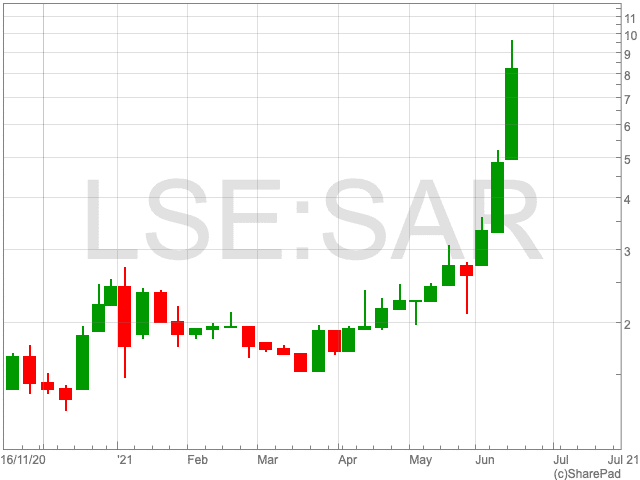
The Sareum Holdings share price (LON:SAR) is flying in June as the drugs company made successive announcements over recent weeks. Today, in the aftermath of another announcement by the company, its share price is up by 9.43% to 7.66p. Over the past month it is up by an astonishing 157.05% causing the AIM-listed company to enter Hargreaves and Lansdown list of ‘most viewed shares’. Investors will be curious to know what is behind the recent surge and if there is more to come.
Bull-Run

There are a number of factors that can help to explain Sareum’s recent bull-run. Firstly, the pharmaceutical company confirmed that it raised £900,000 via a subscription by a high net worth individual at the end of May. The money, the company said, will be allocated to finding new coronavirus treatments. This is on top of funding received from the government months before. The Sareum Holdings share price rallied again on Tuesday as the company said it raised £1.47m before expenses via a subscription for 30m new ordinary shares priced at 4.9p each.

The drug developer also informed investors of encouraging results on its progress with a number of treatments. Included was small molecule therapeutics to improve cancer treatments and auto-immune diseases, in addition to is Covid treatment project. Sareum has previously stated that its project could bring “potentially ground-breaking Covid-19 treatments”.

Risks

While its ability to raise funds is impressive, as well as the potential upside of its coronavirus research, there are still risks to consider. Covid-19 research is highly competitive, especially when Sareum goes up against major pharmaceutical companies, including constituents of the FTSE 100. Nonetheless, the rise of the Sareum Holdings share price is noteworthy, and could be worth investors’ attention going forward.


Coca-Cola share price tumbles as Ronaldo removes drinks from press conference

0

Coca-Cola share price remains up 5% since the beginning of the year

Cristiano Ronaldo removed two bottles of Coca-Cola during a press conference on Tuesday, causing the drinks company’s share price to fall in value by $4bn.

The Portugal captain who scored two goals to help his country to victory against Hungary yesterday made his feelings about the soft drink clear.

The talisman moved the two bottles out of sight, appearing to say “agua”, the Portuguese word for water, in an effort to encourage people to make better health decisions.

https://twitter.com/SkyNews/status/1404805896107143188?s=20

Following Ronaldo’s gesture, the Coca-Cola share price fell by over 1.5%, a drop of $4bn, bringing its market cap to $238bn.

Coca-Cola, one of the official sponsors of Euro 2020, put out a brief statement in response saying “everyone is entitled to their drink preferences” with different “tastes and needs”.

The drinks company has seen its share price perform pretty well in 2021, up 5.02% since the beginning of the year. Over the past 12 months it is up 18.41%.

The resulting share price move has similarities with Tesla CEO Elon Musk’s ability to influence crypto markets, much to the chagrin of investors.

FTSE 100 pushes on despite strong pound being an issue for companies earning overseas

0

The FTSE 100 moved forward despite a stronger pound being a headwind for its multitude of overseas earners.

A 0.14% rise to 7,183 was driven by NatWest as banks should benefit from a stronger UK economy thanks to increased appetite from consumers and businesses to borrow money.

In addition, the index saw gains from B&Q owner Kingfisher which is riding the DIY boom.

“Sterling rallied on Wednesday after a pick-up in UK CPI inflation, which jumped to 2.1% in May from 1.5% in April and which was driven by the cost of fuel and clothing. The British currency advanced 0.3% against both the US dollar to $1.4119 and the euro at €1.1638,” says Russ Mould, investment director at AJ Bell.

“The currency gains helped to drive the domestic-facing FTSE 250 0.5% higher, with housebuilders Bellway and Vistry, building materials group Travis Perkins and property group Unite were among the top risers. The economy is picking up thanks to strong consumer spending and anything related to the buoyant property market has also been fired up.”

“It’s worth remembering that the FTSE 100’s constituents are more representative of the global economy rather than simply the UK. Names like Diageo and Unilever were in demand from investors as they should benefit from greater consumer spending around the world, and increased economic activity bodes well for oil consumption which is pushing up shares in Royal Dutch Shell.”

With coronavirus increasingly being put in the rear-view mirror and life getting back to normal, we’re getting more lockdown winners seeing their purple patch fade away. 

FTSE 100 Top Movers

Bunzl (1.54%), Reckitt Benckiser (1.4%) and B&M (1.36%) are heading up the FTSE 100 during the morning session on Wednesday.

While trailing the pack is Glencore (-2.4%), Anglo American (-2.24%) and Associated British Foods (-1.42%).

40% of high earners do not have an ISA

0

Only one in five of those earning over £100,000 used their full ISA allowance in 2018/19

40% high earners do not have an ISA, according to data collected by HMRC.

This figure is despite ISAs providing protection from tax rates up to 60% for those who very possibly have cash available to save.

Figures that have emerged for the 2018/19 tax year, published by HMRC last week, revealed that 60% of people with an income above £100,000 have an ISA.

While only one in five of those earning over £100,000 used their full ISA allowance in 2018/19.

“Of course that’s still the majority, but when you consider how attractive an ISA is for those paying the top rates of tax, and their high level of discretionary income, it’s pretty astonishing that 40% don’t have an ISA at all,” said Laith Khalaf, financial analyst at AJ Bell.

A greater proportion of high earners have an ISA than those with income under £50,000 a year, 60% compared to around 50%, “but it’s not as big a gap as you would expect given the additional protection afforded by the ISA if you’re facing high rates of tax on dividends and interest,” Khalaf added.

This is especially true for those earning just over £100,000, as tax rates can be as high as 60% because their personal allowance starts to be withdrawn once their yearly income reaches six figures.

“It’s possible that high earners are choosing to divert their savings into a pension instead, given the high rates of tax relief they can get on contributions. But there’s still an annual contribution limit of £40,000 a year, including employer payments, which are likely to be quite generous for high earners. There’s also the Lifetime Allowance to consider, which is now frozen at £1,073,100 until 2026. Paying into a pension also doesn’t properly explain why so many high earners don’t have any ISA savings whatsoever, seeing as they work well alongside pensions as a more accessible tax shelter which you can draw on before retirement.”

Research also suggests that Britons are now more interested in bitcoin and other cryptocurrencies than stocks and shares ISAs.

A survey carried out by AJ Bell suggests 7% of Britons bought into cryptocurrencies over the last year. That compares to 5% who have invested in a stocks and shares ISA.

Bitcoin held by 10% of richest addresses makes up 99% of supply

Investors prefer to keep their bitcoin holdings in hot wallets instead of cold storage despite the risks

Despite the decentralised purpose of bitcoin, it seems that only a few addresses hold a major share of the digital currency’s total supply. This is according to data collected by crypto trading simulator Crypto Parrot.

As of June 14 2021, bitcoin held by the 10% richest addresses equated to over 18.5m.

This amount of bitcoin represents more than 99% of the entire circulating bitcoin supply as many coins have not yet been mined.

Counting the digital currency’s eventual maximum supply of 21m, the amount held by one tenth of the addresses would equal 88.37%.

While bitcoin’s anonymous nature makes it difficult to determine the identity of the holders, it is likely they are high net worth individuals and entities. Exchanges and institutions fall into this category.

With exchanges ranking in this category, the report highlights the implications of the scenario. According to the research report: “This is an indicator that investors prefer to keep their bitcoin holdings in hot wallets instead of cold storage despite the apparent risks. Besides exchanges, other large bitcoin holders are likely to be funds, custodians, and other high net worth individuals.”

Therefore it would appear that the bitcoin whales still account for a massive influence on the asset’s price movement.

Earlier this week bitcoin closed in on $40,000 as El Salvador announced that the cryptocurrency is now legal tender in the central American country.

A number of south and central American nations have hinted at being willing to follow El Salvador’s lead, while more recently, Tanzania’s leader Samia Suluhu Hassan has urged the country’s central bank to prepare for the digital currency.

India may soon classify bitcoin as an asset class, according to a report, after it initially took an unwelcoming view of the digital currency.

Industry sources have suggested, according to a report from The New Indian Express, that the government will make moves soon while the Securities and Exchange Board of India (SEBI) will oversee regulations as the classification for bitcoin is changed. 

The report added that India’s crypto experts have held talks with the finance ministry over the construction of new regulations.

BP, Inflation and Diamond exploration with Alan Green

We once more welcome Alan Green back to the UK Investor Magazine Podcast for our weekly exploration of UK equities and global markets.

UK inflation was today’s topic of discussion before we drilled down into BP (LON:BP), Blue Prism (LON:PRSM) and Karelian Diamonds (LON:KDR).

UK inflation rose to 2.1% in May as fuel, recreational goods and clothing helped prices higher as the economy reopened. A reading of 2.1% is marginally above the Bank of England’s target rate of 2% but with signs prices could elevated, there may be concerns in some corners of the market that it will force the BoE to hike rates in an economy not fully recovered from the pandemic.

As a gauge of the market’s feeling around potentially higher rates in the future, GBP/USD spiked higher by 40 points to GBP/USD 1.4120 in immediate reaction, before falling back.

Fuel prices rose 17% year-on-year, the biggest jump since 2017 as oil prices continued their march higher.

ScS to resume dividends as Brits continue to improve their homes

0

ScS could see sales of around £314m say analysts

ScS (LON:SCS), the sofa seller, has hailed its trading levels since its shops reopened following the easing of restrictions.

As a result, ScS will resume its dividend payments to shareholders, starting with an interim payout of 3p per share.

An update released by the firm on Wednesday said its full year results would surpass expectations. Analysts have suggested it could see sales of around £314m, while profits before tax could come in at £11.8m.

Due to the ability to save more, a number of people have used the prolonged lockdowns as an opportunity to improve their homes.

As at June 12, ScS’s order book, at £116.6m, far exceeded the £39m recorded at the same point one year ago.

Russ Mould, investment director at AJ Bell, was not surprised by ScS’s improved sales figures during the pandemic.

“We didn’t necessarily all become couch potatoes during lockdown but we certainly learned the value of a good sofa as most of our evenings were spent sat in front of the TV,” Mould said.

“While it is possible to buy your new suite online, many of us would feel more comfortable going out and sampling its comfort factor for ourselves. This created pent-up demand which has now been unleashed in full force.”

“It’s unsurprising that ScS has seen a big improvement in trading as physical shops were able to reopen, particularly given there is a cohort of consumers who have saved up cash during the pandemic through reduced outgoings on things like commuting and socialising.”

As lockdowns ease and the economic outlook looks uncertain, ScS could see fluctuations in demand.

“The scale of the improvement may still have caught some off guard though and that is reflected in the shares pushing to fresh all-time highs as analysts hastily upgrade forecasts. ScS also deserves credit for its ability to meet this surge in demand, particularly at a time when there is a shortage of some raw materials,” Mould said.

“ScS needs to be prepared for fluctuations in demand as pent-up demand eases and with the economic outlook and recovery from Covid still fairly uncertain. The company at least has the buffer of a strong balance sheet to fall back on.”

Blackstone in talks over £1.2bn takeover of property developer St Modwen

Blackstone now has over $196bn of property assets under management

Blackstone, the private equity company, is nearing a £1.2bn to takeover of UK property investment company St Modwen.

The deal, first announced in May, will see Blackstone fork out 542p per share for the developer, a 21% premium on its closing price on May 6.

It follows a string of property investments by Blackstone, which now owns Sage Housing and Bourne Leisure.

The private equity firm now has over $196bn of property assets under management.

The offer was initially opposed by JO Hambro Capital Management, one of the FTSE 250 developer’s largest shareholders with a 9% stake. It believed that the price was too low.

A spokesman for JO Hambro said at the time: “We feel it would be a shame for stock market investors to lose the long-term optionality within the group’s businesses and land bank, built up over many years, particularly for the small premium being offered.”

UK inflation climbs to 2.1%

0

UK inflation surpasses Bank of England target of 2% by the end of the year

UK inflation rose again in May, surpassing forecasts by economists and the Bank of England target.

As the country has gone through its stages of reopening, prices for clothes, fuel and meals in restaurants have been pushed up.

The Office for National Statistics revealed on Wednesday that the price of consumer goods rose by 2.1% for the year to May. This was up from 1.5% in April.

The inflation figure was expected to come in at 1.8%.

ONS chief economist Grant Fitzner said: “The rate of inflation rose again in May and is now above 2% for the first time since the summer of 2019.

“This month’s rise was led by fuel prices, which fell this time last year but have jumped this year, thanks to rising crude prices. Clothing prices also added upward pressure as the amount of discounting fell in May.”

Inflation is now at its highest point since before the pandemic which could lead to calls for interest rates to go up.

Paul Craig, portfolio manager at Quilter Investors commented on the implications of today’s inflation figure.

“Inflation is on the up, breaching the Bank of England’s 2% target, yet it remains hesitant to respond by reducing the stimulus it has provided and the quantitative easing that has become so addictive for markets. For now, this is likely the correct decision as we still expect much of the inflation feeding through to be transitory. Wage increases do appear to be coming through, but again this data is so distorted by the furlough scheme that it can’t be seen as a reliable indicator,” said Craig.

Craig added that current levels of inflation are affecting poorer households the most.

“Unfortunately, much of the inflation that is coming through is bad inflation and hitting lower income households in the pocket. How long these price rises continue remains to be seen. Will inflationary pressures be self-defeating or resolved as pent-up demand dissipates or is met with increasing supply. But should it become sustained then it risks making the recovery even more uneven than it already is and thus, it will ultimately fall to government to pull the fiscal levers as it continues in its levelling up agenda.”

Toyota vehicle production at lowest point since 2012

0

The car industry saw a massive downturn as Covid-19 caused the world economy to grind to a halt

Toyota (LON:TYT) produced its lowest number of vehicles in nearly a decade, at 7.55m units, for the year ending in March 2021. This is according to data presented by TradingPlatforms.com.

The car industry saw a massive downturn as Covid-19 caused the world economy to grind to a halt during 2020.

It is the lowest number of vehicles produced by the Japanese car company since 2012, when it made 7.44m vehicles.

Rex Pascual, editor at TradingPlatforms.com, commented:

“Toyota’s production downturn in FY 2021 is in line with industry trends, as the pandemic stifled demand significantly across the board. But Toyota’s status as one of Japan’s most iconic brands ensures a bright post-pandemic future for the car manufacturer. Its emergence as market leaders in hybrid electric vehicles as well as hydrogen fuel-cell vehicles shows the historic brand’s willingness to adapt to more modern trends.”

Toyota’s most lucrative market is North America, where it sold 2.7m vehicles during 2020. However, this figure dropped to 2.31m, a fall of 14.74% for the year ending in 2021.

In the Asia market, which excludes Japan, Toyota saw a sizeable contraction of 23.63% in sales for the year ended in March 2021 to 1.22m vehicles. This compares to 1.6m vehicles sales during the full year ending in 2020.

As of July 2014, Toyota was the largest listed company from Japan based on market capitalization, a ranking it still holds as of writing. Toyota was also listed by Forbes as the 42nd largest company in the world based on market cap.