Boohoo sales jump by 32% as lockdown restrictions are eased

0

Boohoo also benefitted from integrating the fashion brands it acquired earlier in the year

Boohoo (LON:BOO), the online fast-fashion brand, confirmed a 32% increase in sales during the previous quarter as the company saw demand rise as lockdown restrictions eased.

The Manchester-based company’s revenue reached £486.1m during the three months up to the end of May. This compared to £367.8m for the same period of time one year ago.

The fashion firm performed particularly well in Britain and the US where its sales rose by 95% and 157% respectively.

Boohoo also benefitted from integrating the fashion brands it acquired earlier in the year.

The AIM-listed company purchased Debenhams, in addition to Dorothy Perkins, Wallis and Burton, from the brink of administration.

Boohoo keeps its guidance for full year 2021/2022 revenue growth of around 25%, along with an overall core earnings (EBITDA) margin of 9.5-10%.

CEO of Boohoo John Lyttle commented: “I am delighted with our performance in the first quarter, particularly as it was always going to be challenging to produce strong growth rates on last year, when lockdowns around the globe drove such high traffic to online retailers. The two year CAGR of 38% highlights the Group’s continued phenomenal growth, with revenues having increased 91% over the last two years, with particularly strong performance in key markets such as the UK and US, where sales have more than doubled.”

“This quarter we have integrated and relaunched our newly-acquired brands, Dorothy Perkins, Wallis and Burton, and we have also relaunched Debenhams for fashion, beauty and homeware, adding ranges, with an exciting pipeline of brands for our digital department store.”

“We continue to make great progress on our Agenda for Change programme, with this morning’s latest report from Sir Brian Leveson outlining the seriousness with which the Group is determined to develop and demonstrate a gold standard in our supply chain.”
Glencore share price could depend on the price of copper and zinc in the coming months

0

Glencore Share Price

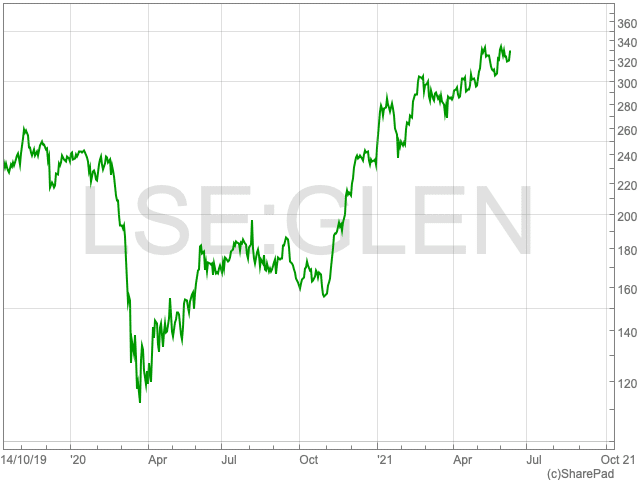
The Glencore share price (LON:GLEN) has performed well since the turn of the year and going back further, on the back of a global commodities boom. The FTSE 100 company has seen demand for its produce soar as the world economy comes back to life. Having spent large parts of May range bound, the Glencore share price is up by 33% to 327.65p since the turn of the year. Going back further, it is up by 951.14% over the past 12 months.

Rising demand for metals, particularly copper and zinc, has aided Glencore’s profits throughout the past 12 months. However, there are reasons for this which may not bode so well for the future. For example, the constant concern around inflationary pressures which could push the price of Glencore’s commodities higher. Additionally, as demand grows, Glencore may have its work cut out to keep up.

Metal Prices

The immediate future of the Glencore share price is dependent to some extent on metals prices. Furthermore, during Q1 of 2021, Glencore sourced 301,200 tonnes of copper and 282,600 tonnes of zinc. The mining giant is most heavily weighted towards these metals therefore Glencore’s revenues will likely follow their paths. When the Glencore share price dipped during the beginning of June, copper prices dropped below $10,000, while gold saw big falls too.

Zinc

Up until March 2021, zinc production production across the world rose by 6.2%, while the usage of the metal soared by 10.3%. For the entire year, zinc production is estimated to increase by 4.5% to 13.8m tons.

This means, according to Dr. Heinz-Jürgen Büchner, director Industrials & Automotive, IKB Deutsche Industriebank AG, that the zinc price will reach $2,900 per ton, with a fluctuation range of +$500, by the end of Q3 2021. Its current level is just above $3,000.

Copper

Regarding the red metal, a copper agency based in Chile called Cochilco, has raised its price forecast for 2021 as it anticipates a deficit in the global market for the near-term.

Cochilco upgraded its average copper price projection to $4.30/lb for this year, a dollar more than its original forecast made in January.

Its estimation for the average price of copper for 2022 has also been upgraded to $3.95/lb, up from $3/lb.

Cochilco executive vice-president Marco Riveros said: “The macroeconomic scenario [for the rest of 2021] of the main copper-consuming economies is positive for the demand of the metal. The depreciation of the US dollar consolidates downwards after the rise in unemployment in the US during March and fiscal policies and expansive monetary policies,” Riveros said.

“On the other hand, the global supply of concentrates of copper remains low, which has led to treatment charges and refining to minimal levels. While China would continue to drive the demand, the growth of refined copper imports would tend to be moderate during 2021.”

Both copper and zinc will play a significant role in the global economy’s recovery from the pandemic and their price targets look strong for the coming months. This looks good for the the Glencore share price going forward. However, risks, such as not being able to meet demand, and high inflation, remain.

Unilever share price could pick up as life returns to normal

0

Unilever Share Price

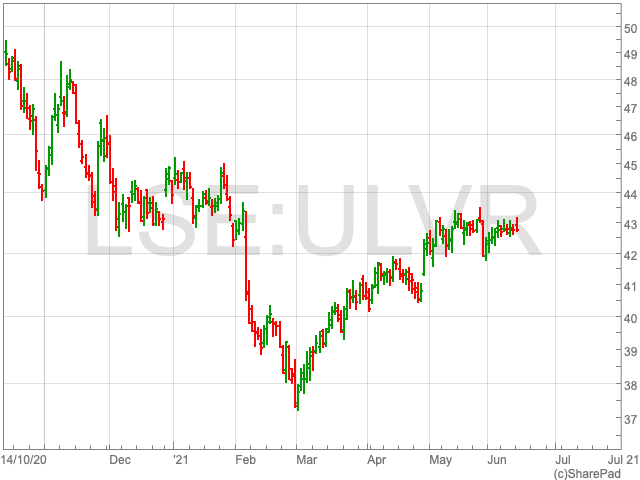
The Unilever share price (LON:ULVR) dropped dramatically in March 2020 to 3,854,5p as lockdowns came into effect. However, demand for consumer goods held steady throughout the pandemic, allowing the FTSE 100 company to surpass its pre-pandemic level, getting as high as 4,450p. Despite some volatile movements over the past 12 months, the Unilever share price is pretty unchanged overall, down 0.41%.

Since the turn of the year, the company has lost 4.23% in the value of its shares. With restaurants, cafes and shops reopening, Unilever is likely to see its revenues grow, and as people head out to socialise, demand will rise again for beauty and personal care products. Therefore investors may be tempted by the staple consumer goods company heading into the summer and beyond.

‘A’ Rating

Firstly, Fitch, the ratings agency, said that Unilever’s competitiveness became more robust in 2020, and expects the company’s sales growth to pick up as life returns to normal.

Fitch asserted Unilever’s Long-Term Issuer Default Ratings (IDRs) and senior unsecured ratings at ‘A’. The rating demonstrates the consumer goods company’s “strong business profile”, as “one of the largest and most diversified” consumer goods and food companies (FMCG) in the world.

“The Stable Outlook reflects our expectation that potential asset divestments are unlikely to reduce leverage as we assume that proceeds will be used for bolt-on M&A or returned to shareholders through share buybacks,” Fitch said.

Meat-Free Market

While Unilever has a vast product line, the company is still expiring new areas to diversify into. The latest is its proposal to bring plant-based meat products to market. The consumer goods giant recently announced a partnership with Enough, a food-tech company, to use a fermentation process to grow a high-quality protein.

The non-meat sector is seeing massive growth across the world as more people consider the environmental impact of meat eating, as well as health implications. It has been estimated that the industry will be worth $290 billion in 2035.

It follows Unilver’s investment of €85m in Hive, a facility for food innovation in the Netherlands, in an effort to support the development of plant-based foods.

Carla Hilhorst, executive vice-president of R&D for foods and refreshment at Unilever, said: “Plant-based foods is one of Unilever’s fastest growing segments and we’re delighted to partner with Enough to develop more sustainable protein products that are delicious, nutritious, and a force for good.

“We’re excited by the potential that this technology has for future innovations across our portfolio, and we can’t wait to launch more plant-based foods that help people cut down on meat, without compromising on taste.”

Director dealing: Sportingbet founder tops up online gaming holding

Mark Blandford, founder of one of the early online betting firms Sportingbet, has bought more shares in an AIM online gaming company where he is currently a non-executive director at a cost of nearly £102,000. The prospects for online gaming in the US are the attraction of this company.
Sportingbet floated on Ofex, now Aquis Stock Exchange, in the nineties and subsequently graduated to AIM and then the Main Market. Formerly AIM-quoted online gambling company GVC Holdings, now Entain (LON: ENT), in association with William Hill, acquired Sportingbet in a cash and shares bid that in 2013 valued ...

Crude oil prices reach highest point in nearly 3 years on strong demand in US

Analysts at Goldman Sachs believe that Brent crude oil could reach $80

The price of Crude oil has made further gains into this week, reaching its highest point in 32 months.

With Brent crude oil at $71.47 per barrel in the early afternoon on Monday, the energy market is being supported by speedy roll-outs of vaccines worldwide, as well a coherent plan by OPEC+ to control supply levels.

Similarly West Texas Intermediate is at $71.70, its highest level in nearly three years, carrying on its recent bull run.

The run comes as more and more Americans are venturing outdoors and getting back to a normal mode of life.

New cases of coronavirus are falling in the US to the lowest levels in over 12 months, while over 50% of Americans have been vaccinated.

Daily air travellers in the USA went past 2m for the first time since before the pandemic, confirming strong demand for fuel as the summer season nears.

Demand for oil is expected to surpass pre-pandemic levels before the end of 2022, according to the International Energy Agency (IEA).

Analysts at Goldman Sachs believe that Brent crude oil could reach $80 per barrel this summer.

Bitcoin closing in on $40,000 as Musk and president of Tanzania have their say

A number of south and central American nations have hinted at being willing to follow El Salvador’s lead

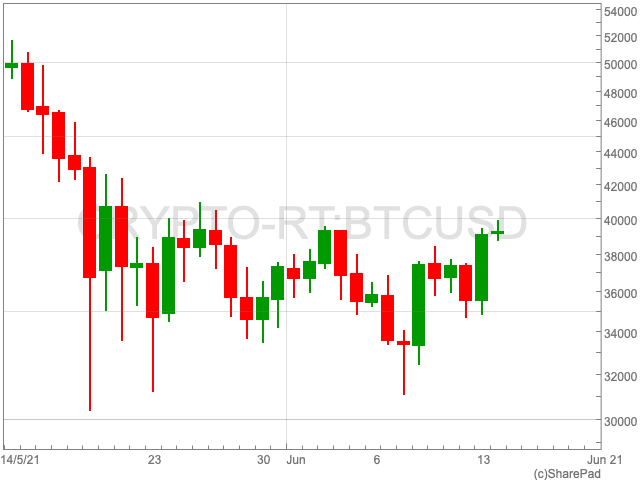
Bitcoin appeared revitalised on Sunday evening and into Monday as the digital currency is now up by 8.94% in the past 24 hours to $38,179.

There are a number of factors which appear to have encouraged the move on the back of El Salvador’s announcement that bitcoin is now legal tender in the central American country.

A number of south and central American nations have hinted at being willing to follow El Salvador’s lead, while more recently, Tanzania’s leader Samia Suluhu Hassan has urged the country’s central bank to prepare for the digital currency.

Hassan drew attention to the development of crypto in the region. “Throughout the region, including Tanzania, they have not accepted or started using these routes,” she said.

“My call to the Central Bank is that you should start working on that development. The Central Bank should be ready for the changes and not be caught unprepared.”

Furthermore, Elon Musk has waded back in, saying that Tesla will again accept bitcoin payments when bitcoin is more weighted to renewable energy sources.

“When there’s confirmation of reasonable (~50%) clean energy usage by miners with positive future trend, Tesla will resume allowing bitcoin transactions,” Musk said in a tweet yesterday.

Less than a week ago bitcoin threatened to go below $30,000 for the first time this year.

Along with the news from Tanzania, Musk’s words have been able to push the cryptocurrency towards $40,000, after it spent most of the weekend below $35,000.

As bitcoin regains momentum following dramatic falls during May and into June, investors which be keenly watching the digital currency to see if it could continue into the week.

Oriole Resources shares tumble on results from project in Cameroon

0

Oriole Resources says remaining results will not be released until end of second quarter

Oriole Resources (LON:ORR) has announced further results from the recently finished 3,118 metre maiden diamond drilling programme at its Bibemi gold project in Cameroon.

The gold miner also said the remaining results will not be released until the end of the second quarter.

The results are from the 5.3km-long Bakassi Zone 1 prospect, and include best intersections of 2.45 metres grading 2.96 grammes per tonnes, 3.6 metres grading 1.75 grammes and 12.4 metres grading 0.71 grammes.

The findings have confirmed more than 100 metres vertical continuity from surface to the system, which remains open at depth.

They also include best intersections of 2.45 m grading 2.96 g/t Au, 3.60m grading 1.75 g/t Au and 12.40m grading 0.71 g/t Au.

Oriole Resources CEO, Tim Livesey, said: We are very pleased to share these early results from the Bakassi Zone 1 prospect, a significant strike length of mineralisation within the more extensive Bibemi gold system. These results prove that our preliminary exploration model for mineralisation is correct and that the orogenic-style mineralisation we had previously identified at surface does indeed continue vertically along the mapped shear / vein systems.

“These results prove that our preliminary exploration model for mineralisation is correct and that the orogenic-style mineralisation we had previously identified at surface does indeed continue vertically along the mapped shear/vein systems. The structural logging, mapping and interpretation work carried out by our geological team, in addition to the recent support of a specialist structural geologist from SRK, has further strengthened our understanding of the area. Each of the four prospect areas at Bibemi shows subtly different host geology and dynamic structural regimes and we are looking forward to developing our geological models further once the remaining results are returned later this month.”

The Oriol Resources share price fell by over 13% on Monday morning.

FTSE 100 unfazed by rumours of lockdown extension

1

Widespread speculation that England will delay lockdown easing hasn’t troubled markets, with the FTSE 100 up 0.39% to 7,167.

“That puts the UK index at its highest level since February 2020, but there is still some way to go to hit the 7,400 levels seen before Covid triggered a global market crash,” says Russ Mould, investment director at AJ Bell.

“Many other major stock markets in the world have already recovered all of their Covid crash losses and since rallied to considerably greater heights, including the S&P in the US and the Nikkei 225 in Japan.”

Driving the UK market on Monday were oil stocks, consumer goods firms, overseas-focused banks and pharmaceutical companies, with Unilever the largest driver for the index in points terms.

“These movements would suggest that investors are focusing on companies that do business beyond the UK, taking a positive view on the global economy,” said Mould.

“Gold fell back 1.1% to $1,858 as some investors lost interest in safe-haven assets, pulling down shares in precious metal miners Polymetal and Fresnillo.”

Leisure companies could be worst affected by any delay to lockdown easing in England as it will require a continuation of the social distancing rules, meaning pubs and restaurants can’t operate at full capacity.

“However, investors don’t seem too bothered by the risk, perhaps because speculation points to a mere four-week delay, albeit during a seasonally busy time. Pubs group Marston’s slipped 0.5% while Restaurant Group was unmoved,” Mould said.

“Airlines fared worse as any cautious tone by the Government doesn’t bode well for relaxing guidance on foreign travel. The travel sector is waiting with bated breath to start taking more passengers overseas, but hopes are fading for widespread flying this summer. International Consolidated Airlines fell 2.3% while EasyJet dropped 1.8%.”

FTSE 100 Top Movers

BT (2.55%), Halma (2.12%) and Just Eat (2.06%) are leading the way early on Monday.

While at the bottom end of the FTSE 100 is Rolls-Royce (-3.18%), IAG (-2.62%) and Polymetal International (-1.62%).

VietNam Holding records impressive growth on digitisation of Vietnam

0

Vietnam Holding saw its share price soar by 60% this year

Vietnam Holding (LON:VNH) released a statement on Monday that said Vietnam was the best performing stock market in the world during May, while the investment firm’s performance surpassed the national benchmark.

The trust’s largest holding, FPT, saw its share price soar by 60% during this year, according to a report issued this month by Dynam Capital, the manager of the trust.

Dynam said that its recent success in Vietnam can be put down to the spread of the internet, which reached 69% of the population in 2020, which rose to 73% in 2021.

“For FPT, fast internet means customers can stream content over their rapidly growing Pay TV business …[and] contribute greatly to economic growth,” Dynam said.

“Considering Vietnam’s software engineers on average cost one third of the level of those in India and China, the opportunity for a Vietnamese company, such as FPT, to be internationally competitive is also immense. FPT already serves many Japanese and US companies, which are trying to move their activities to the cloud and upgrade their technologies to adapt to new customer usage patterns.”

The digitisation of the country has benefitted other industries too, as banks propped up the country’s economy as they have been more able to connect with customers online.

Dynam said that banks in its portfolio have risen in value following strategic decisions by the management team.

“Other drivers in the digitalisation momentum currently taking place in Vietnam include education and government regulations… The government is also pushing hard for digital technologies as a way to scale Vietnam’s development as a modernising industrial nation and is planning to promote e-payment and e-government.”

“Soft infrastructure is as important as hard infrastructure, and both can have a multiplier effect on economic growth, in our view.”

“Digitalisation is helping Vietnam stay on course to reach its 30-year track record of 6.5% growth.”

Vietnam Holding presented at the UK Investor Magazine Virtual Conference on 23 March.

Average age of US vehicles reached record 12.1 years in 2020

0

According to IHS Markit, vehicle miles in the US fell by over 13% during 2020

The average age of cars in America jumped to a record 12.1 years during 2020 according to IHS Markit.

It happened as Americans drove less and scrapped more cars throughout the pandemic.

However, as lockdown restrictions are easing, IHS Markit said the data may not last long sales of both new and used cars are starting to pick up again.

According to IHS Markit, vehicle miles in the US fell by over 13% during 2020, while more than 15m vehicles were scrapped. That amounts to 5.6% of the Toal vehicle population.

High scrap rates generally accompany a decline in the average age of a vehicle, IHS Markit said.

However, a fall in car sales during the pandemic as people travelled fewer miles, saw the average age increase by 2 months from 11.9 years in 2019.

Another cause of a fall in vehicle production, according to IHS Markit, was an ongoing shortage of semiconductors, which led to inflated prices and a subsequent increase in used vehicle prices.