US GDP grows at a rate of 6.4% during Q1

0

GDP comes in slightly lower than consensus estimates

US GDP (Gross Domestic Product) rose at a rate of 6.4% during the first quarter of 2021, the US Bureau of Economic Analysis revealed on Thursday.

The figure is a percentage point below market expectations of 6.5%.

Looking into the future, economists have put forward estimates of a GDP growth rate of 8.2% during the second quarter of the year.

The S&P 500 opened up by 0.3%, while the Nasdaq composite held steady. The Down Jones Industrial Average rose by 0.7%

The wider stock market has held steady this week amid fears over oncoming inflation as the Federal Reserve hinted that talks over altering the rate of asset purchases in the near-term may soon commence.

Commenting on US GDP and pandemic-low jobless figures, Ali Jaffari, head of North American Capital Markets at Validus Risk Management, said: “US initial jobless claims and QoQ GDP came in slightly lower than consensus estimates at 406K and 6.4% respectively. Employment data remains a key focus for the Fed and a continued convergence to pre-pandemic levels will certainly drive the thinking on tapering discussions.”

“The jobless claims print has been on a declining trend and this week’s figures mark a pandemic low. As the US economy progresses with its vaccination program and reopening measures, employment and labor force participation are expected to pick up in the coming months. While US Treasuries declined on the release, equity futures continue to be range bound.”

“Looking ahead, although this GDP and jobless claims print may not be sufficient to change the Fed’s thinking, a continued trend will certainly place pressure on the Fed to initiate talks on the reduction in its pace of asset purchases.”

UK investor confidence buoyed by vaccine roll-out and lockdown easing

0

The vaccine roll-out and the easing of lockdown restrictions is increasing optimism among UK investors.

That is according to an independent survey, commissioned by HYCM (Henyep Capital Markets), of 735 participants.

The survey found that 41% of investors in the UK had confidence that vaccine roll-out would be beneficial to their investment portfolios.

The same number of people believe the relaxing of social distancing rules will have a similarly beneficial impact on their investments.

More people (22%) think Joe Biden’s presidency will have a favourable impact on investments than those (8%) who believe his tenure harmful.

The most popular asset class for UK investors is cash, with 33% of those surveyed planning to invest more into their savings over the coming 12 months.

Stocks and shares (22%) and property (14%) are the next most popular options.

Giles Coghlan, chief currency analyst, HYCM, said: “The success of the vaccine rollout is clearly having a significant influence on investors’ mindsets. In allowing lockdown rules to be lifted and the UK economy to spark back into life, the speed of the vaccine programme should also mean that investors – like consumers – become more active in the months to come.”

“Meanwhile, it is interesting to see that many investors remain wary of how Brexit could affect their savings and investments. While a no-deal outcome was avoided, a large number of investors still fear a tail risk to their assets. It will likely take time for these concerns to subside.”

“In terms of asset classes, UK investors can clearly see the property bubble forming, not just in the UK but around the world – property prices globally have been spurred on by low interest rates. It makes sense that cash savings remain popular given the uncertainty that still lingers overhead, while bonds are evidently also being considered by many. If central banks start tapering, bond yields will become more attractive, and this should see some UK investors moving into bonds from equities.”

The trading broker commissioned an independent survey of 735 UK-based investors, all of whom have investments in excess of £20,000, excluding their property, savings and workplace pensions. It found that 41% are confident the vaccine rollout will benefit their investment portfolios.

Bitcoin is here to stay & BitcoinPoint will accelerate its adoption

Sponsored by BitcoinPoint

  • Bitcoin is still up 260% and its trajectory in the mid long-term won’t change
  • Inflation is the impact of the recent correction but will paradoxically be good for Bitcoin
  • Central Banks embracing blockchain with their own digital currencies and the DeFi sector will ultimately be good for Bitcoin
  • BitcoinPoint’s vision is to accelerate the adoption by providing inclusive access

BITCOIN IS -NOT!- DEAD

Bitcoin has already died over 414 times in the media, and each time there’s a correction articles against it are flourishing, and last week was of course no exception.

An asset trending upwards by 260% since May 2020 and that has increased by 200% per annum over the last 12 months is hardly a bubble or one that will fade into obscurity.

The truth is that it’s a classic FUD (Fear, Uncertainty and Doubt) in Bitcoin’s cycle, and long-term and experienced holders are not selling according to data from Coin Metrics compiled by Portfolio Insider.

DON’T BE DISTRACTED BY THE NOISE

While media are focusing on news about Elon Musk and China (reaffirming a statement from 2017), regulation is not presently a concern as it’s mostly trying to enforce taxation like other asset classes.

THE TRUE WORRIES ARE INFLATION

25% of existing US Dollar didn’t exist a year ago, what’s the impact on this excess of monetary stimulus? 

Early this year, house prices have skyrocketed with the fastest year-on-year growth in the past two decades in wealthier countries (source OECD Analytical House Price Database). However, last month Commodity prices had increased by alarming rates, and two weeks ago the CPI (Consumer Price Index) had the sharpest rise since September 2008 in the US. This latest news took the market by surprise and led to a jump in the Long-Term Bond Yields and a fall in the Stock and Crypto market (which have been correlated for the past year). Then on May 13th the PPI (Production Price Index) was up by 6.2% which was the highest jump since tracking began in 2010.

The problem with inflation above target is that it can led to further inflation when companies start increasing their prices. Not only individuals are impacted, companies with cash on their balance sheets see a depreciation of their asset which is a destruction of shareholder value. 

So, what’s a good hedge against inflation?

Gold is supposed to have limited supply but if we look at the performance over the past year it has increased by just 10% and we are currently not at an all-time-high level.

While Bitcoin has a limited supply of 21 million units it also has a decreasing emission schedule, and its inflation rate is falling to reach nearly zero by 2035 where 99% of Bitcoin will be mined. The billionaire Paul Tudor Jones, one of the most successful macro Hedge Fund managers, sees Bitcoin as “the firstcrypto, first-mover… it has that historical integrity within digital currencies that it will always have … and because of its finite supply, that might be the precious crypto” he added.

One thing Jones is certain of is the digitization of money in the future, especially as more central banks move toward their own digital currencies.

CBDCs

Indeed, Central Banks are now actively looking at CBDCs (central bank digital currency), a concept is inspired by Bitcoin with blockchain based technology. 

UK Chancellor Rishi Sunak made the announcement of its potential benefit. While a digital transformation could make payment more resilient and avoid a situation where 90% of payments are controlled by US companies (Mastercard also owns the company running Faster Payments and BACS). CBDCs also hope to compete with existing cryptocurrencies.


However, whilst at the macro-level CBDCs could serve as a powerful tool to monitor flows and inject cash faster without the needs of commercial banks, the ultimate benefit of consumers using contactless payment or similar approaches is questionable.

Likewise, any digital currency created a by a state or issued by private companies replicating fiat currencies like the US Dollar (commonly called ‘stablecoin’), would simplify the access to Bitcoin as commercial banks – still the main ‘on-ramp’ access for Bitcoin – would no longer be required.

Moreover,  ‘state’ cryptocurrencies would be easier to convert with the interoperability of blockchains. As an example, USDC, the second largest stablecoin replicating the US dollar, is now available on four blockchain rails.

But while Central Banks could succeed their digital transformation. These CBDCs are an antithesis of Bitcoin if they lead to mass surveillance by implementing digital identity. Bitcoin was created to become a digital version of cash to keep transactions private.

SUPERIORITY OF BITCOIN 

Bitcoin is a scarce asset and its momentum will not be reproduced: it’s not controlled by any central entity, a state or a company like Facebook, and has no identified founding team or leader, like Vitalik Buterin the man behind Ethereum.

Bitcoin, with its global presence and encouraging adoption, is the gate for the DeFi (Decentralised Finance) sector.

BitcoinPoint a service to accelerate the adoption

The story began early 2017 when its cofounder struggled to open an account on a cryptocurrency exchange and found Bitcoin ATMs too expensive. A few months later, the company released an app with an online Bitcoin wallet that charged zero network fees for purchases in-store to buy at a network of agents, and BitcoinPoint became two years later a platform supported by 25 agents ranking in the top bitcoin ATM services in London. By mid-2020, the app also allowed the customers to instantly buy through Open Banking technology from anywhere, creating a unique bitcoin exchange with non-custodial solutions on both cryptocurrency and fiat, removing the credit risk for the users.

Six months ago, the company began allowing users to sell bitcoin and withdraw cash through 16,000 ATMs across the U.K., making the largest ATM network in the country an off-ramp service for Bitcoin. And last month, it signed an agreement to connect to 320,000 in 20 countries. Starting with the UK with 20,000 Point of Sale (POS)!

FUTURE PLANS

This new partner, bringing in POS locations in Europe, Latin America, Asia and Africa, will be a game changer by allowing us to scale-up their activities faster. The company is  also in discussions with banking and retail partners in different countries to build a remittance service to allow cross-border instant transfers.

After a successful integration into U.K. Faster Payment Service, the company wants to become a fiat gateway to Bitcoin and DeFi by connecting to global payment service providers and facilitate online payment processing solutions in emerging countries for people who don’t have access to the financial system.

FUNDRAISING

While, the company has successfully hit a fundraising goal to expand its services a few hours after being live, the campaign will last for another two weeks as the more funding they can gather, the quicker they can realize their global expansion.

Visit BitcoinPoint’s crowdfunding page on Crowdcube.

Find out more about their services on their website here.

Aviva Share Price: plenty to absorb for investors after strong Q1 results

0

Aviva Share Price

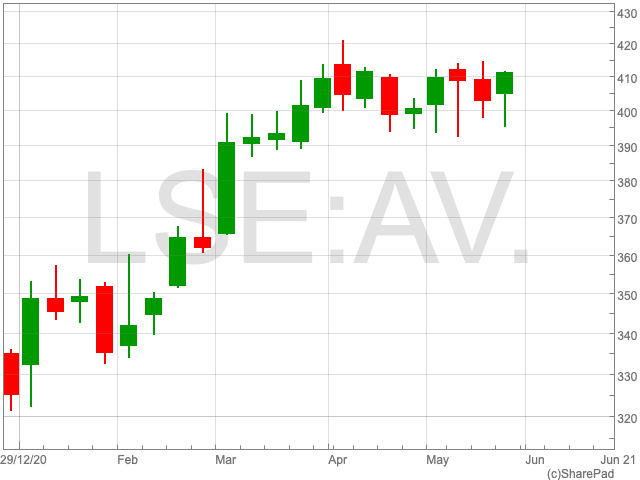
The Aviva share price (LON:AV), at 410.90p per share, has now reached its pre-pandemic level. This is despite moving sideways for the last two months. Since the beginning of the year, the Aviva share price is up by 26.4%. As the FTSE 100 insurance company released its Q1 results today, this article will analyse Aviva’s ability to maintain its bullish run moving forward.

Results

Aviva announced solid sales figures from its life insurance business, at £8.3bn, as well as a 4% increase in general insurance on Thursday.

Aviva also sold eight businesses, amounting to £7.5bn over the past year, in order to focus on its priority markets, the UK, Ireland and Canada. The British insurance company reaffirmed its pledge to give cash to shareholders. However, this could happen as late as 2022, according to chief financial officer Jason Windsor.

“Combined operating ratios in the General Insurance business, which illustrates the proportion of premiums that are paid out either as claims or in operating costs, improved dramatically – falling 28.1 percentage points to 90.6%,” said Nicholas Hyett, equity analyst at Hargreaves and Lansdown.

“The group expects conditions to get tougher as the year goes on, especially as motor claims increase when lockdown ends, but expects the combined operating ratio to remain below 95% this year,” Hyett added.

Analysts at JP Morgan described the Q1 update as “strong”, and restated an “overweight” rating for the company.

“Aviva put on a good show following its strong Q1 results that contained plenty of meaty headlines for investors to absorb,” Chris Beauchamp, chief market analyst at IG.

Focus on Sustainability

Aviva has also refocused towards strategies around sustainability. This was one of the reasons for their decision to sell some of their assets across the world.

Amanda Blanc, chief executive of Aviva, recently outlined the group’s efforts to clean up their investments, saying Aviva will only invest “where [they] are sure it delivers sufficient returns’ for stakeholders. Blanc added that ‘where [they] see a valuable opportunity to invest in growth, [they] will take it”.

This follows Aviva’s commitment to becoming the first major insurance company in the world to slash its emissions to net-zero by 2040.

With strong results and a clear strategy on environmental issues, the Aviva share price looks like a solid proposition for investors.

Uber to allow drivers to join union in historic deal

0

Uber (NYSE:UBER) confirmed on Thursday that it will officially recognise a trade union in a landmark deal that could benefit gig economy employees.

The GMB union has been given the power to represent UK drivers in discussions on a number of issues, including earnings and wellbeing.

Mick Rix, national officer at GMB, commented on the ruling:

Rix said it could be “the first step to a fairer working life for millions of people”.

“When tech private hire companies and unions work together like this, everyone benefits – bringing dignified, secure employment back to the world of work.

“We now call on all other operators to follow suit.”

The deal arrived three months after a Supreme Court ruling stated that Uber should not be allowed to classify its drivers as independent contractors, who would forego employee rights.

Subsequently, Uber confirmed in March that it would consider its UK drivers as “workers”. This would entitle them to a minimum wage, enrolment into a pension plan and holiday pay.

GMB and Uber will now gather once every three months to talk about driver related issues.

Jamie Heywood, Uber’s regional general manager for Northern and Eastern Europe, acknowledged the company’s increasing reliance on unions.

“Whilst Uber and GMB may not seem like obvious allies, we’ve always agreed that drivers must come first, and today we have struck this important deal to improve workers’ protections,” Mr Heywood said.

“This historic agreement means that Uber will be the first in the industry to ensure that its drivers also have full union representation.”

Earlier this month, Arrival, the British electric vehicle manufacturer, recently listed on the New York Stock Exchange, entered a partnership with Uber to develop electric taxis.

The deal will involve Uber drivers having an input into the design of the cars which are scheduled to move into production next year. 

It is part of a wider plan by Uber to transition its 45,000 London-based drivers to electric vehicles by 2025, while the remainder of UK drivers will do the same by 2030.

Nissan asking for taxpayer funding to build gigafactory in Sunderland

0

Nissan says the plant could produce batteries for up to 200,000 cars per year

Nissan (TYO:7201) is hoping to secure support from the UK government to build a “gigafactory” in Sunderland in order to manufacture batteries for electric vehicles.

The Japanese company is in the later stages of talks to construct a plant that could produce batteries for up to 200,000 cars per annum, creating thousands of jobs in the process.

Nissan’s plan comes ahead of the government’s oncoming ban of petrol and diesel cars in the UK, which is expected to create a dramatic rise in the sale of electric vehicles.

The Faraday Institution, a research organisation with a focus on batteries for cars, estimates that the UK will need eight gigafactories by 2040 in order to meet demand, The Times reported.

Nissan said: “Having established [electric vehicle and] battery production in the UK in 2013 for the Nissan Leaf, our Sunderland plant has played a pioneering role in developing the electric vehicle market.”

“As previously announced, we will continue to electrify our line-up as part of our global journey towards carbon neutrality. However, we have no further plans to announce at this time.”

A spokesman for the Department for Business, Energy & Industrial Strategy, commented: “We are dedicated to securing gigafactories and continue to work closely with investors and vehicle manufacturers to progress plans to mass produce batteries in the UK.”

Ofgem, the UK energy market regulator, outlined on Monday its plan to invest £300m in over 200m infrastructure projects to ready the UK for the future of electric transport.

The plans will come into action over the next two years and is part of a wider £40bn project to move the UK to a system that uses low-carbon transport and heating. 

Boris Johnson has previously confirmed plans to forbid the sale of petrol and diesel cars from 2030 in order to reduce its emissions to net-zero by 2050. However, the country may well need to upgrade its infrastructure significantly to support the future influx of electric vehicles.

Trident Royalties Presentation at the UK Investor Magazine Virtual Conference 25th May

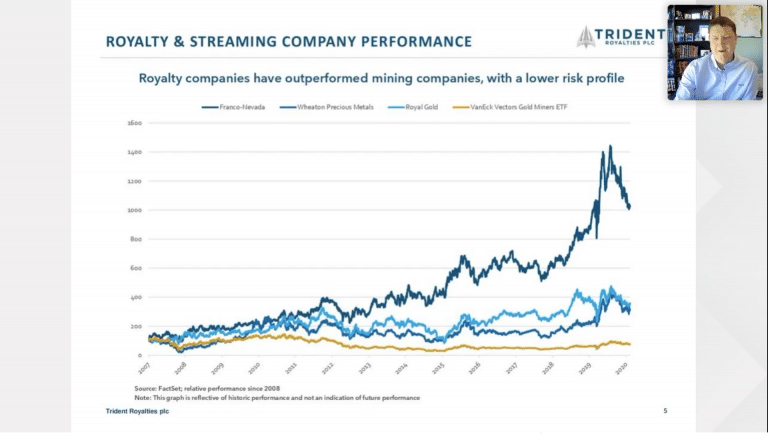
Trident Royalties are mining royalties and streaming company with a diverse range of royalties covering precious, base and battery metals.

Having presented at the December UK Investor Magazine Virtual Investor Conference, Trident Royalties returned to update investors of recent progress at the company.

Trident Royalties are on a path achieving critical mass with robust pipeline of deals having already acquired 12 mining royalties.

CEO Adam Davidson provides a detailed comparison of investing in mining royalties versus investing directly in mining companies.

There is also discussion around a commodities super cycle and how Trident Royalties can benefit from higher metals prices.

Challenger Energy Group Presentation at the UK Investor Magazine Virtual Conference 25th May

Challenger Energy Group presents at the May UK Investor Magazine Virtual Conference.

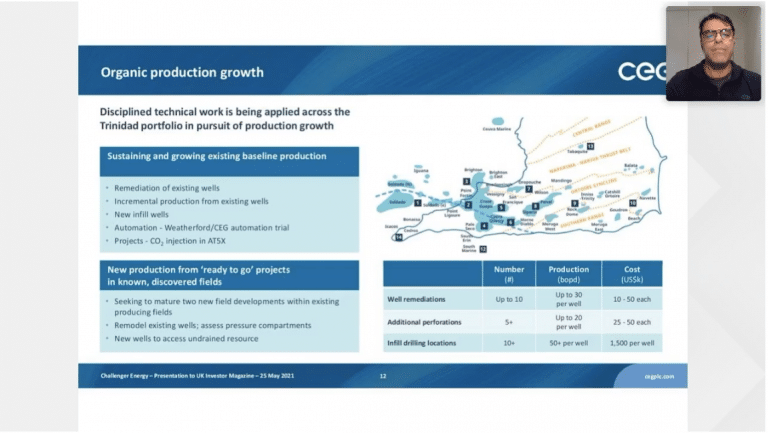
Challenger Energy Group are a Caribbean and South American focused oil producer and explorer with a range of assets across the region.

Incoming CEO Eytan Uliel outlines key progress at their flagship projects and updates investors on corporate changes.

Challenger Energy Group in the midst of a drilling campaign at their Saffron project and Mr Uliel highlighted the nature of their development programme and what investors can expect in terms of news flow in the future.

There is also discussion around funding options and a number of specific questions from the audience.

FTSE 100 lacking direction with US GDP figures on the horizon

0

Another day with more lethargy on the FTSE 100, as the index is up by 6.93 points to 7,033.86 just over an hour into the day.

“The FTSE 100 seems to be on a road to nowhere at the moment,” says AJ Bell investment director Russ Mould. “Fears about inflation have subsided for the time being and even some volatility in Asian markets wasn’t enough to wake the index from its slumber.”

“There is a relative dearth of economic data which could push markets in any particular direction in the coming days, although a second estimate of first quarter US GDP later on Thursday could renew focus on inflationary pressures, particularly if the already elevated number is revised upwards.”

Metal prices are also creeping higher again. “This could put yet more focus on the risks of the global economy overheating but has at least given the UK mining sector a bit of a lift this morning,” says Mould

FTSE 100 Top Movers

Melrose Industries (3.2%), Rolls-Royce (3.16%) and Aviva (2.73%) are the biggest risers on the FTSE 100 early on Thursday.

While making up the bottom three are Severn Trent (-3.07%), Johnson Matthey (-2.84%) and Taylor Wimpey (-2.24%).

Johnson Matthey

Johnson Matthey (LON:JMAT), the chemicals manufacturer, forecast low-to-mid teens growth for this year on strong demand for its autocatalytic converters and stricter pollution rules in Asia. The FTSE 100 company also posted a fall in its yearly profit.

Johnson and Matthey recorded an underlying profit of £504m for the year up to the end of March, down from £539m a year before.

Pets at Home sets £1bn sales record as lockdown caused surge in demand for pets

0

Pets at Home expects to continue growing market share

Pets at Home (LON:PETS) recorded sales in excess of £1bn for the first time as demand for pets soared while people were locked in their homes.

The FTSE 250 company estimates that the number of pets in the UK has grown by 8% over the past year.

The animal retailer even said the boom caused a shortage in pet food.

Peter Pritchard, chief executive of Pets at Home, commented:

“Covid-19 has structurally changed the dynamics of the pet care market. We estimate that the rising level of pet ownership, combined with structural demand drivers such as premiumisation and humanisation, has increased the outlook for growth across our addressable market, and in conjunction with our expectations of continuing to take market share, provides a tailwind to the £600m customer revenue opportunity we see across our business over the medium term.”

Pets at Home saw its revenue levels grow by 7.9% to £1.1bn during the year ending in March, a record in the company’s history which spans over three decades.

Profits rose to £116m despite £30m coronavirus-induced costs, while underlying profits remained steady having accounted for the £30m sale of five pet hospitals.

Pets at Home is expecting a continuation of this trend, and suggests it can further increase its sales, due to raised ownership as well as owners splashing out more on their animals.

Susannah Streeter, senior investment and markets analyst at Hargreaves and Lansdown, commented:

“The tail is wagging happily at Pets At Home with retail sales reaching £1 billion for the first time.”

“The company has clawed opportunity from the soaring popularity for pets during the pandemic, with ownership estimated to be up 8% over the year. Lockdowns proved an ideal opportunity for people to settle in a new member of the household. It’s the demand for array of goods and services to keep them fed, watered and entertained which have returned a big stick of revenue to the group,” Streeter added.