The pound flourishes on a positive day for UK jobs

UK unemployment rate between January and March of 2021 fell to 4.8%

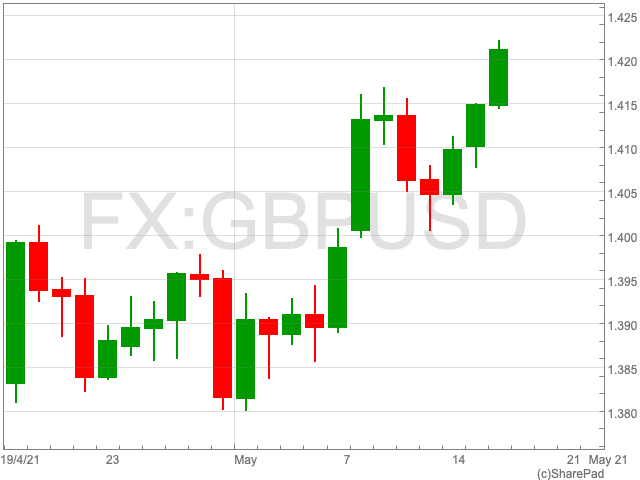
The Pound rose substantially on Tuesday, with Cable up 0.47% to 1.42, its highest level since February.

Until now the Pound has been somewhat rangebound, as England entered the third stage of easing lockdown rules.
The move comes as the UK jobs market showed signs of a recovery following the battering it took from the pandemic.

The UK unemployment rate between January and March of 2021 fell to 4.8%. The figure is roughly 0.8% higher than the same period in 2020.

The ONS announced that payrolls increased by 97,000 between March and April, in what was the fifth consecutive month of growth.

“With the latest lockdown restrictions being eased and further easing on the 21st of June, one can only presume this number will soon return to pre-covid rates or better,” says Hugh Shields, financial trader at Spreadex.

“However, the Pound’s surge today is not solely in connection with the UK’s job bliss. Cable’s surge is also down to a weak dollar,” Shields adds.

This is in light of rumours that, despite rising inflation rates, the Fed plans to keep its stimulus programme.

“This, in conjunction with US housing starts coming in below forecasts at 1.569M in April, suggest why the Dollar is struggling to match against the Pound,” says Shields.


Even with a weaker Dollar, US markets haven’t been majorly affected on the open. The Dow is down only 3.68 points, and the S&P 500 down 3.87.

The Euro has also taken advantage of the weaker Dollar, with EUR/USD up 0.55% on the day to 1.2215.

European markets have continued yesterday’s stability. The FTSE, having seen the Pound rise, is slightly up on the day, rising 11 points to 7044. On the other hand, the DAX and CAC are down 0.13% and 0.14% respectively.

Strong investment to support Vodafone share price through the recovery

0

Vodafone Share Price

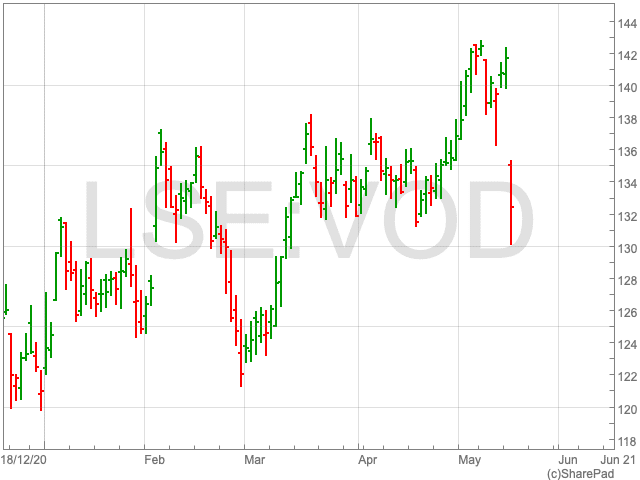
The Vodafone share price (LON:VOD) is down by over 6% on Tuesday. This move happened because the FTSE 100 company’s annual profits came in below expectations. Year-to-date the stock remains up by 10%, having made solid gains so far. Going further back to this time last year, it is up by around 5%, after a mini-resurgence following the coronavirus-induced crash. Investors will want to know if today’s fall marks the end of its bull-run in 2021, or if it presents an opportunity for value.

Results

Vodafone saw its revenue drop last year as its roaming and visitor numbers fell due to the pandemic. The FTSE 100 telecommunications company recorded a fall in its adjusted earnings by 1.2% to €14.4bn for the year to March. The company’s savings totalling €500m acted as a buffer.

It was at the bottom of its guidance range and was lower than the €14.5bn expected by analysts. Vodafone’s revenue fell by 2.6% to €43.8bn, while its net debt rose to €40.5bn.

These numbers are what caused the Vodafone share price to plummet today by 6%.

Vodafone’s guidance on Tuesday is for a minimum dividend of 9 eurocents per share. However, there was no hint at increasing the payout. At 5.8%, Vodafone’s current dividend yield is well above average.

There may be some concern that the company may struggle to maintain a dividend which it cut significantly in 2019.

Looking Ahead

Vodafone committed to spending money to upgrade its existing networks. The company will provide hundreds of millions of euros into its telecoms networks in an effort to secure a competitive advantage.

Over the past year Vodafone said it increased its capital expenditure by €500m. It also committed to going further. The telecommunications giant noted that 70% of the EU’s €750bn pandemic recovery fund, aimed at giving loans and grants to encourage investment, will be focused on markets where Vodafone operates.

A commitment to spending in order to bring about growth, along with the continued UK recovery, could be crucial in securing the Vodafone share price over the coming months.

Tesla Share Price could come under threat from intense competition in EV market

1

Tesla Share Price

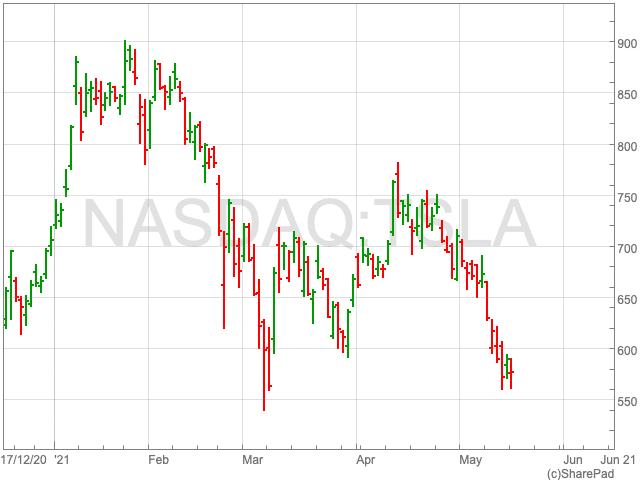
After a positive start to 2021, the Tesla share price (NASDAQ:TSLA) has collapsed in recent months. Having closed yesterday at $576.83, down by 2.19%, it is around 35% down from its all-time-high in January. Having said that, the Tesla share price remains up by 548% since the middle of March 2020. Many investors have been monitoring the stock looking for an opportune moment to buy. However, they will be cautious about what the dip represents for the stock’s prospects. Also, whether or not it has further to fall. While Tesla’s Q1 results were encouraging, there are areas of concern for investors looking forward.

Competition

Competition is heating up in the electric vehicle market. Traditional car manufacturers are pushing forward plans to get their electric vehicles onto the road by 2030. The date the UK looks set to ban the sale of cars with internal combustion engines.

Volkswagen is one company that could threaten Tesla’s status. The German car maker set itself a target for 70% of the cars it sells in Europe to be fully electric by 2030. Over the past five years the company put aside $86bn of investment for developing electric vehicles.

The Volkswagen board also revealed the company will be opening six battery cell production plants across Europe by 2030. It said that it plans to transition to a new technology that would slash the cost of electric car batteries by up to 50% from as early as 2023.

Reducing the cost of batteries would drive down the cost of cars, and that would not be ideal for the Tesla share price. Susannah Streeter, a senior investment and markets analyst at Hargreaves Lansdown, told The Times that “Volkswagen is in pole position in the race to steal Tesla’s crown with a pledge to increase electric vehicle sales 27-fold by 2025.”

She added: “It is also researching solid-state batteries, which are considered less harmful to the environment, are easier to assemble and allow for faster charging compared with the lithium-ion batteries that Tesla relies on. These could help Volkswagen to gain the edge over Elon Musk’s empire.”

Meanwhile Daimler, owner of Mercedes-Benz, recently unveiled its ‘EQS’, while Ford and General Motors have stepped up their efforts in the EV market too. In short, remaining as the industry leader may be easier said than done for Tesla.

Michael Burry Bets Against Tesla Share Price

Another area of concern is the news that Big Short investor Michael Burry’s investment vehicle has disclosed a $534m bet against Tesla’s share price. It was revealed on Tuesday that Scion Asset Management, Mr Burry’s family office, revealed that it “put” options on 800,100 shares in the electric vehicle manufacturer,

This means that Burry’s company could be able to sell shares in Tesla at a specific price in the future. The options could also become more valuable as the Tesla share price decreases.

In February, Mr Burry tweeted about the latest Tesla share price surge: “Enjoy it while it lasts.”

How working from home affects people’s mental health in a pandemic

0

88% say working from home during the pandemic hasn’t negatively influenced their mental health

A quarter of UK office workers believe a return to the physical workplace could negatively influence their mental health, according to research by Ezra, a leading provider of digital coaching.

As lockdown restrictions begin to ease, it is still uncertain as to what extent remote working will still be a part of everyday life.

Remote working does appear as though it’s here to stay, as Google became the latest major company to reveal their plans to create a hybrid workplace.

For the majority of people, 88%, Ezra suggests that working from home during the pandemic hasn’t negatively influenced their mental health. 29% have even said that remote working has been good for their mental health.

When asked about the impact of a return to work on mental health, 24% said that they believed it would impact their mental health negatively, while 21% thought it would have a positive impact.

A quarter of those surveyed said less family time would be the biggest factor that would impact their mental health. While for 22% the prospect of commuting into work was their biggest concern.

Founder of Ezra, Nick Goldberg, commented:

“Despite lockdown forcing a drastically different way of life upon us, the silver lining for many has been more time spent at home with loved ones and a far better work-life balance.”

“For some, this means that working from home has actually been beneficial for our mental health and it comes as no surprise that replacing this family time with commuting and the pressures of the workplace are the biggest concerns about returning to the physical workplace.”

“However, we’re all dealing with the current landscape differently and it’s clear that remote working doesn’t work for everyone. While it certainly feels like we’ve been under some form of lockdown restrictions forever, there’s also no real indication as to how remote working could impact us on an ongoing, long-term basis.”

“As we move forward, it’s important that businesses consider how they adapt to meet the needs of all their employees and this will no doubt take the form of a hybrid workplace, allowing for some flexibility on working from home, but also maintaining the physical workplace on a full-time basis for those that need it.”

FTSE 100 picks up in ‘risk-on’ day for UK stocks

0

After last week’s inflation-inspired global markets sell-off, equities are racing to claw back lost territory with gains seen across Europe and Asia on Tuesday. The FTSE 100 advanced 0.35% to 7,058, while gains in the region of 0.9% were seen across mainland Europe

“It looked like a risk-on day for UK stocks, with investors bidding up shares in energy, mining and consumer cyclicals. That would suggest new-found optimism towards global economic growth and that investors are trying to look beyond short-term issues around the Indian Covid variant,” said Russ Mould, investment director at AJ Bell.

“A lot of faith is being put in a strong vaccine rollout and therefore there is confidence that companies will enjoy strong earnings growth this year. Earnings growth is a key driver for share price growth.”

Walmart and Home Depot will report earnings later today, which could give some indication of consumer spending confidence in the US.

FTSE 100 Top Movers

IAG (3.06%), JD Sports (2.47%) and Evraz (2.4%) are the top risers on the FTSE 100 during the morning session on Tuesday.

Vodafone (-6.50%), Hargreaves and Lansdown (-1.15%) and Fresnillo (-0.88%) saw the biggest falls early on in the day.

Vodafone

Vodafone saw its revenue drop last year as its roaming and visitor numbers fell due to the pandemic. The FTSE 100 telecommunications company recorded a fall in its adjusted earnings by 1.2% to €14.4bn for the year to March, as its savings totalling €500m acted as a buffer.

This fall towards the bottom of its guidance range and was lower than the €14.5bn expected by analysts, The Times reported. Vodafone’s revenue fell by 2.6% to €43.8bn, while its net debt rose to €40.5bn, an increase of 3.6%.

UK Employment

Unemployment dropped during the first three months of 2021 despite continued lockdowns as the jobs market recovered. A number of companies are hiring more staff, while some are retaining employees ahead of an expected reopening, according to official data.

The Office for National Statistics announced that payrolls increased by 97,000 between March and April, in what was the fifth month of growth in a row. The official UK employment rate grew for the first time since the pandemic begun last year

Employment on the up as UK continues reopening

0

UK unemployment rate falls to 4.8% for the first three months to March

Unemployment dropped during the first three months of 2021 despite continued lockdowns as the jobs market recovered.

A number of companies are hiring more staff, while some are retaining employees ahead of an expected reopening, according to official data.

The Office for National Statistics announced that payrolls increased by 97,000 between March and April, in what was the fifth month of growth in a row.

The official UK employment rate grew for the first time since the pandemic begun last year.

The unemployment rate falling to 4.8% for the first three months to March put to bed fears of mass unemployment akin to that seen during the 1980s.

“The latest figures suggest that the jobs market has been broadly stable in recent months, with some early signs of recovery,” the ONS said.

Rishi Sunak, the chancellor, said: “While sadly not every job can be saved, nearly two million fewer people are now expected to be out of work than initially expected – showing our Plan for Jobs is working.”

The amount of people in employment rose by 84,000 in the first quarter to 32.5m, above predictions of a 50,000 rise. It is the first time since the coronavirus emerged that the number of people employed rose on the ONS’s labour force survey.

The employment, up for the first time in a year, is now at 75.2%.

Commenting on UK unemployment falling to 4.8% in March Ian Warwick, Managing Partner at Deepbridge Capital, said: “While today’s data marks just a slight fall in the UK unemployment rate it follows positive GDP data last week to be yet further evidence that the economy is moving in the right direction at a significant pace.”

“As we focus on economic recovery, it remains critically important that scale-up businesses, particularly in high-growth sectors such as digital technologies and life sciences are supported; as they will be at the very heart of economic growth as we create an economy fit for the twenty-first century.”

Vodafone hints at increased investment as earnings fall

0

Vodafone’s revenue fell by 2.6% to €43.8bn

Vodafone (LON:VOD) saw its revenue drop last year as its roaming and visitor numbers fell due to the pandemic.

The FTSE 100 telecommunications company recorded a fall in its adjusted earnings by 1.2% to €14.4bn for the year to March, as its savings totalling €500m acted as a buffer.

This fall towards the bottom of its guidance range and was lower than the €14.5bn expected by analysts, The Times reported.

Vodafone’s revenue fell by 2.6% to €43.8bn, while its net debt rose to €40.5bn, an increase of 3.6%.

The group saw its share price tumble during the morning session to 132.14p per share, down by 6.75%.

Vodafone also confirmed it will be raising its investment levels so it can target the EU’s €750bn pile of post-coronavirus recovery grants aimed at projects to upgrade the continent’s digital infrastructure.

Russ Mould, investment director at AJ Bell, gave his view on the Vodafone results.

“Who’d have thought it, people being less ‘mobile’ in general is bad news for mobile telecoms groups like Vodafone, which saw its revenue and earnings hit by lower roaming charges as individuals were unable to travel thanks to the pandemic.

“Handset sales have also slumped, suggesting we’re not so bothered about having the latest, fancy new phone when we’re stuck at home.

Nick Read, Group Chief Executive, commented on the year gone, as well as looking ahead to life beyond the pandemic.

“We have delivered on the first phase of our strategy to reshape Vodafone as a stronger connectivity provider – including the simplification of the group to Europe and Africa, the successful IPO of Vantage Towers (€13.2 billion market capitalisation), the fast roll out of our next generation mobile and fixed networks, share gain in broadband subscriptions and continued reduction in customer churn. Our digital transformation initiatives have generated savings of €0.5 billion over the year and the integration of the assets acquired from Liberty Global is well ahead of plan,” Read said.

“The world has changed. The pandemic has shown how critical connectivity and digital services are to society. Vodafone is strongly positioned and through increased investment, we are taking action now to ensure we play a leadership role and capture the opportunities that these changes create. The increased demand for our services supports our ambition to grow revenues and cash flow over the medium-term. We remain fully focused on driving shareholder returns through deleveraging, improving our return on capital, and a firm commitment to our dividend.”

JLEN completes acquisition of a 16.8 MW Energy-from-Waste plant in Italy

0

Completion of this acquisition by JLEN is subject to a number of conditions

JLEN (LON:JLEN), the listed environmental infrastructure fund, announced on Tuesday its acquisition of a 45% equity stake in Energie Tecnologie Ambiente (ETA).

ETA is a 16.8MW energy-from-waste power (EfW) plant which processes refuse derived fuel, located in the municipality of Manfredonia in the Apulia region of southern Italy.

The €26.75m investment has been made alongside Foresight Energy Infrastructure Partners, which will also acquire a 45% equity stake.

Completion of this acquisition, according to JLEN, is subject to a number of conditions which are expected to be finalised by the end of May 2021.

The EfW Plant, which utilises proven technology, has been fully operational since 2012.

It earns revenues from gate fees paid by RDF suppliers to ETA, incentives related to producing electricity from renewable energy and the sale of electricity to the market.

Richard Morse, chairman of JLEN, commented on his company’s investment.

“We are happy to announce JLEN’s investment into this energy-from-waste plant which leverages the
knowledge and experience gained in owning a number of bioenergy assets already. This is JLEN’s first
investment in Italy and we look forward to co-owning this locally important asset alongside FEIP and
the Seller,” said Morse.

“We believe that assets such as these provide a vital outlet for non-recyclable waste that would
otherwise be sent to landfill, and which can be used to generate baseload power to the grid. The plant
has a strong operational track record and we look forward to working with the existing operations
team as a new co-owner.”

This acquisition is JLEN’s first investment in Italy, further diversifying its portfolio, geographic
exposure and revenue base.

The company’s investment adviser’s Italian team was “instrumental in the execution of the acquisition and will remain closely involved in the management of the asset”.

Aquis Stock Exchange granted equivalence for dual quotations with the Frankfurt Stock Exchange

0

Frankfurt Stock Exchange is one of the largest exchanges in the world

Aquis Stock Exchange (AQSE), the primary and secondary trading business of exchange service group Aquis Exchange (LON:AQX), confirmed on Tuesday that it has been granted equivalence status by the Frankfurt Stock Exchange’s Open Market.

Companies with a quotation on AQSE will be able to seek a dual quotation on the Frankfurt stock Exchange.

The Frankfurt Stock Exchange is one of the largest exchanges in the world, as well as being continental Europe’s largest.

At present, 44,366 international securities are tradable in the open market.

Among the advantages for companies seeking a dual listing for AQSE security on the Frankfurt Stock Exchange is “better access to the German-speaking financial community, which has Europe’s largest retail investor community, while stocks become accessible to certain German funds that only allow investment in companies with a domestic listing”, a statement by the company read.

Commenting on the development, Aquis Exchange CEO, Alasdair Haynes, said:

“We are very pleased to have reached this agreement with our German counterparts to allow AQSE-quoted stocks to list in Frankfurt and thus gain simpler access to investors beyond the UK.”

“In return, we look forward to having German stocks come to us to benefit from AQSE’s unique liquidity pool, narrow spreads and institutional support base. The strategy at Aquis is to constantly innovate to improve our offering for the sake of issuers, investors, be they institutions or private individuals, and the economy overall.”

AJ Bell, a leading UK investment platform, confirmed last month that it has added Aquis Stock Exchange to its online trading platform.

The Aquis Stock Exchange became directly available to AJ Bell‘s retail customers, providing access to approximately 90 listed growth companies.

Cerillion soars on back of contract wins

There has been a steady flow of new contracts won by telecoms billing software provider Cerillion (LON:CER) this yearand the interims only show some of the benefits from these contract wins.
New orders worth £23.6m were secured in the six months to March 2021, while sales to new customers contributed £18.1m of that figure. These order values cover more than one year, but they do underpin the second half prospects.
The order book was worth £42.1m at the end of March 2021 and three-quarters of those revenues will be recognised over the next 12 months. Cerillion is preferred supplier on £19.7m of...