GenIP Plc has secured its first technology park partnership, collaborating with Pelotas Science Park in Brazil to deliver GenAI commercialisation services.
The park—a “quadruple helix” innovation hub uniting government, academia, industry, and civil society—houses 63 enterprises, 23 partner institutions, and the Candy Valley startup network. GenIP will guide tenant companies and incubated startups through technology investment and commercialisation decisions.
The partnership accelerates GenIP’s strategic goal to diversify its client base to include more corporates. The company has so far been very active with university research departments, so today’s news looks to be the first step into what could be a more lucrative market.
By tapping into the tech park’s concentrated ecosystem of corporate entities and startups, GenIP gains direct access to multiple commercial clients through a single relationship. One tech park. Multiple clients.
The Brazil deal looks to establish a blueprint. More park alliances could follow.
“Our collaboration with Pelotas Science Park represents an important milestone for GenIP as we expand our reach beyond universities to support entire innovation ecosystems,” said Melissa Cruz, CEO of GenIP.
“Science parks play a vital role in Technology Transfer by connecting researchers, startups, and industry partners, and we’re proud to provide the analytical foundation that helps their tenant companies identify commercially viable technologies and attract investment. This partnership reflects our broader strategy to deepen engagement with industry and startup communities, bringing us closer to our goal of achieving 45% industry participation.”
The UK Investor Magazine was delighted to welcome Brendan Callan, CEO of Tradu, back to the podcast to explore what zero commission trading means for individual traders and the market as a whole.
Zero-commission trading is breaking down barriers for retail investors and making financial markets more accessible to everyone seeking to secure their financial futures.
We explore the pros and cons of zero-commission and the practices investors should be aware of.
Brendan discusses Tradu’s approach to zero-commission trading and the values that guide their offering for traders and investors.
Hargreaves Lansdown investors have piled into US and technology funds amid the market recovery from the tariff-induced sell-off, according to the latest data released by the platform this week.
Funds that focus on US equities were clear favourites among HL investors who clearly saw a bargain in the world’s largest companies in the third quarter. That bet has paid off with the S&P 500 adding more than 30% since its April low.
“The risk-on sentiment following the Liberation Day losses back in April has continued, with US tariff uncertainty reducing over Q3, providing a tailwind for US and Global stock markets, many of which have hit new all-time highs over the quarter. The AI theme also continues to dominate market returns, with share prices of the big tech players in this space rising further,” said Joseph Hill, senior investment analyst, Hargreaves Lansdown.
“In this environment, it’s no surprise that Q3 saw HL investors return to old favourites, with funds with a global, US or technology focus dominating the most popular choices across different ISA accounts.”
Hill also highlighted that HL investors had a propensity to opt for passive options with just one fund of the top ten bought funds being actively managed.
“The trend towards passive investing also continued, with 9 of the top 10 funds bought by HL clients in Stocks & Shares ISAs, Junior ISAs and Lifetime ISAs being passive. The low fees associated with passive funds continue to prove attractive to retail investors purely looking for broad market returns,” Hill said.
“Artemis Global Income was the sole active fund to feature in the most popular funds with HL clients in Q3 across the different types of ISA accounts.”
Most bought funds, HL Stocks and Shares ISA, Q3 (net buys)
Following the news from Norcros (LON:NXR) that it had received clearance from the UK Competition and Markets Authority, the group this week has completed the £46m acquisition of Fibo Holdings, a major wall panel supplier in Norway.
That deal adds another market-leading brand into the group, that is the number one bathroom products business in the UK and Ireland, helping to create a leading presence in waterproof wall coverings markets across the UK&I, Scandinavia and Central Europe.
Waterproof decorative wall panels are an attractive, high-growth market segment and the ac...
Oxford Metrics is valued at just a little over its cash balance despite the firm returning to year-on-year revenue growth for the financial year ending 30 September 2025.
In a trading statement released on Wednesday, the smart sensing and software company said it expects revenue and adjusted EBIT to be in line with market forecasts of around £46.2m and £2.3m, respectively.
Oxford Metrics has around 10,000 clients across 70 countries.
The firm’s flagship Vicon motion capture division showed resilience despite US academic funding challenges, supported by stronger performance in other regions and markets.
Oxford Metrics’ smart manufacturing segment performed well. Both IVS and Sempre delivered robust organic and inorganic growth through improved management execution.
Notably for investors, the group closed the year with £37.0 million in cash – only just below its market cap of around £45 million. This was after £5.4 million in acquisition costs, £4.2 million in dividends, and £8.3 million allocated to share buybacks.
The company has very little debt.
“FY25 was a year of strong strategic progress for Oxford Metrics,” said Imogen O’Connor, CEO of Oxford Metrics.
“Continued innovation, including the launch of new products, further strengthens our position across diversified, high-value niches and aligned to market trends. With a healthy balance sheet and a clear strategic direction, we enter the new financial year well placed to pursue the exciting growth opportunities ahead.”
Podcasting platform Audioboom Group has enjoyed a record third quarter as the impact of acquisitions and higher engagement helped boost revenue and profits, but revenue growth is falling
The company posted Q3 adjusted EBITDA of $1.2 million, up 18% from $1.0 million in the prior-year quarter. Revenue climbed 9% to $20.4 million from $18.8 million.
However, the third-quarter EBITDA growth was slower than the year-to-date pace, and revenue growth wasn’t anything to write home about.
Adjusted EBITDA profit for the nine months ended September 30 surged 127% to $3.0 million, compared with $1.3 million in the same period last year.
Worryingly for investors, revenue growth is slowing. Revenue so far this year is $55.5 million, up just 5%. Revenue grew 13% in the 2024 full-year period.
“Audioboom’s positive performance has continued through the third quarter of the year and alongside record Q3 revenue, gross profit, and adjusted EBITDA, the third quarter of 2025 marked a turning point in the Company’s story with the successful acquisition and integration of Adelicious, highlighting the long-term value our platform business can deliver through accelerated expansion,” said Stuart Last, CEO of Audioboom.
The July acquisition of Adelicious Limited significantly boosted operational metrics. Average monthly distribution soared 40% to 135 million downloads and video views from 96 million in Q3 2024. The deal created the UK’s second-largest podcast network and was fully integrated by September 1—two weeks ahead of schedule.
However, the Adelicious acquisition temporarily pressured margins. Q3 revenue per thousand downloads fell to $51.92 from $66.06 due to lower-yield UK inventory, though management views this as an opportunity for medium-term value creation in the British market.
Audioboom Group shares were down 6% at the time of writing.
It is nearly five years since Nick Purves and I had the honour to be appointed as the new portfolio managers of the Temple Bar Investment Trust, and whilst we believe that the expression ‘pride comes before a fall’ is probably more true in asset management than almost any other walk of life, we think we can look back at what we have achieved with a sense of tempered satisfaction.
Some notable highlights since we were appointed at the end of October 2020:
A total share price return of 211%[1]
Number one in the UK Equity Income Sector per Citywire over 1, 2, 3 and 5 years[2]
Progressive dividend growth driven by both increasing revenues and the recent change of policy to supplement the dividend from capital
Discount closed over the period of our management to now trade at a modest premium
Market cap of £1bn reached for the first time on 23 September 2025[3]
Past performance is not a guide to the future. The price of investments and the income from them may fall as well as rise and investors may not get back the full amount invested. No investment strategy or risk management technique can guarantee returns or eliminate risks in any market environment.
In this letter to our shareholders, therefore, we would like to look back at the last five years and highlight what we see as some of the most important lessons.
1. Value investing isn’t dead
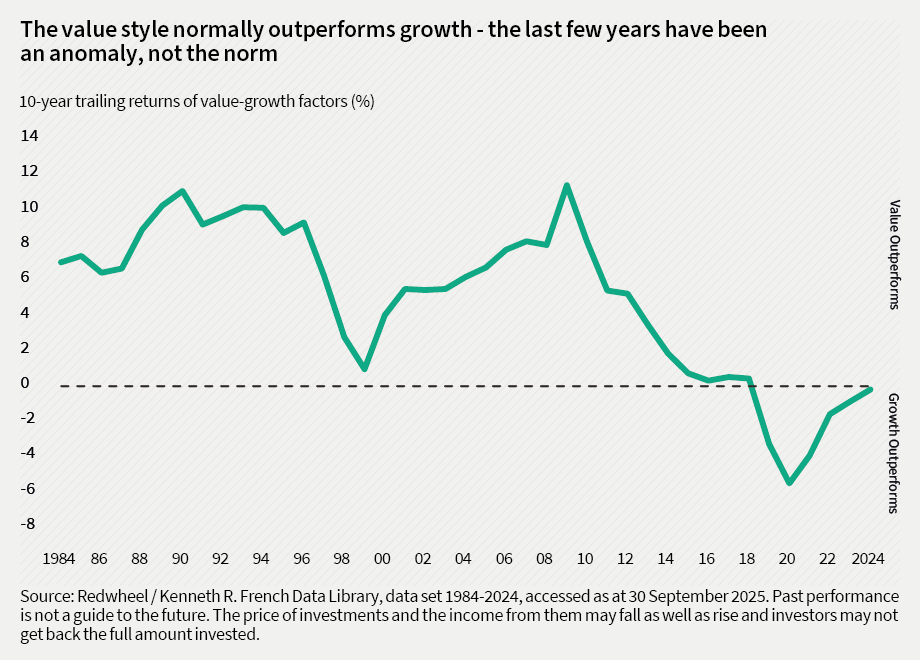
2020 was the end of a very unusual decade in which growth investing as a style had produced better returns than value. The chart below demonstrates just how rare this is.
This prompted some commentators to claim that value investing was dead. To us, this seemed an odd conclusion to draw. If you define value investing as an investment approach that seeks to buy businesses for significantly less than they are worth, how could that ever be dead?
“All intelligent investing is value investing — acquiring more than you are paying for. You must value the business in order to value the stock.” Charlie Munger
“We think the very term ‘value investing’ is redundant. What is ‘investing’ if it is not the act of seeking value at least sufficient to justify the amount paid?” Warren Buffett
2. Active fund management can add value
In recent years, active fund managers have had a tough time in general. Those focused on US equities have found it especially hard, with the index being powered upwards by the so-called Magnificent Seven stocks. This was seized upon by cheerleaders of passive investing as evidence that active investing no longer worked. Whilst, on average, this is perhaps a fair assessment, one should always be wary of conclusions based around averages – as the six-foot tall man who drowned crossing a river that was five feet deep on average found out to his cost. Our experience, and that of Temple Bar’s shareholders, suggests that the disciplined application of a value investment strategy can still produce returns in excess of the wider market in the long run.
3. You can make good returns in UK equities
The UK equity market was written off for not having enough exposure to exciting technology stocks and, latterly, because of the anti-business, anti-growth economic policies of the current government. And yet, the 211% total return from Temple Bar over the period of our management has been significantly in excess of the 112% from the US stock market despite the fact the latter benefited from the returns of the Magnificent Seven stocks[4]. It is always worth remembering that a country’s economy is not the same as its stock market. Encouragingly for Temple Bar shareholders, the UK market continues to languish at one of the lowest valuations seen over the last fifty years whilst the US is, on some measures, more expensive than it has ever been.
4. It is the volatility that creates the opportunities…
Without a shadow of a doubt, the strong returns that Temple Bar shareholders have enjoyed over the last five years are a function of the start point. It is easy to forget the level of fear that existed at the start of the pandemic, but this is perhaps best illustrated by the fact that the share price of NatWest in 2020 was at the same level as in the depths of the Global Financial Crisis in 2008, when the government nationalised its predecessor Royal Bank of Scotland[5]. It is this extreme level of fear that sometimes causes investors to make emotional, possibly irrational decisions, but provides opportunities for those able to tame their emotions, go contrary to the crowd and think long term.
“It is largely the fluctuations which throw up the bargains and the uncertainty due to the fluctuations which prevents other people from taking advantage of them.” John Maynard Keynes
5. No company is so good that it can’t be turned into a bad investment by paying too high a price for it
In the years following the Global Financial Crisis, it is fair to say that there were some very high-quality companies trading at valuations which did not adequately reflect their strengths. Investors in our open-ended funds will know that we owned shares in Microsoft in 2010 because it was an unpopular business at that time and hence could be bought for eight times its earnings, which seemed to represent good value to us. Ten years later, however, many businesses like Microsoft had rerated to valuations which were so high that they virtually guaranteed poor returns.
“There’s no such thing as a good idea or bad idea in the investment world. It’s a good idea at a price, it’s a bad idea at a price. Whenever we consider an investment, we think just as much or more about what can go wrong as about what can go right, and we put the avoidance of losses on a high pedestal.” Howard Marks
6. It is foolish to put a line through a sector and declare it ‘uninvestable’
One of the key contributors to the returns Temple Bar shareholders have enjoyed has been its investments in the UK, with perhaps NatWest being the standout performer having risen by 440% in the last five years[6]. One of the reasons returns have been so good is that the fundamentals have been very strong with earnings per share going from 25p in 2021 to an estimated 61p in 2025[7]. The key factor, however, was that the sector was utterly loathed five years ago with some investors declaring it ‘uninvestable at any valuation’. Thus, you were being offered the opportunity to buy businesses at very low valuations just at a time that their fundamentals were set to dramatically improve – almost the perfect investment opportunity.
7. We benefit from the increasing number of investors for whom valuation is irrelevant
We continue to believe that starting valuation is one of the best guides to long-term returns and that if you buy a stock at a significant discount to intrinsic value, not only do you have a margin of safety built in to your investment, but over time you should gain an excess return as the controversy declines and the share price moves towards intrinsic value. Interestingly, however, fewer and fewer investors seem to use valuation as part of their investment process. According to some estimates, passive funds now account for almost half of the equity market and obviously take no account of valuation (arguably they allocate more of their money to the larger, often more expensive stocks in the index)[8]. The growth of multi-strategy funds (or pod shops) has had a similar effect since these ‘investors’ are very short term and have no regard for valuation. We believe that, in the long term, this puts investors like us, for whom valuation is the cornerstone of a disciplined process, at an advantage, since it should lead to more securities being mispriced in the stock market.
8. Don’t be too quick to take a profit
Temple Bar’s shareholders would not have enjoyed such strong returns if we had been too quick to take a profit. As time has gone on, we are increasingly convinced that inactivity is a blessing and that you should run your winners. When a struggling business begins to improve, the effect will often last for years and investors are often repeatedly surprised at how positive operational gearing feeds through to profit growth. As a share price responds to an improving trend in profits, momentum investors who wouldn’t look at the company when it was available at, say, five times earnings may feel compelled to invest in it at a much higher valuation. Hence, the share price often goes far further than we may have initially thought. Both NatWest and Marks and Spencer, for example, have exceeded our initial expectations in recent years in terms of earnings growth and multiple expansion – we have allowed both positions to run higher in the portfolio, keen not to take a profit too early.
9. The investment trust structure is a good one especially for the retail investor
Temple Bar is nearly one hundred years old and there are those who argue that the investment trust structure is antiquated and no longer fit for purpose. Our experience of the last five years would suggest exactly the opposite. Whilst liquidity means that the largest wealth managers cannot move around the market using investment trusts as vehicles, for the smaller shareholder, they have significant advantages. Truly independent and strong Boards such as Temple Bar’s work in the best interests of their shareholders, as evidenced recently with the enhancement of the dividend using the capital account to reflect the shift by UK companies from paying dividends towards share buybacks. Finally, returns have been enhanced through the disciplined use of gearing.
10. Boards have the ability to add (or destroy) significant value particularly at inflection points
None of this would have happened if the board had capitulated to the wisdom of the crowds in 2020 and proposed to switch the style of the trust from value to growth. With the benefit of hindsight this seems an obvious decision, but the board did not have this benefit and moreover several other trusts switched style at exactly that time. Shareholders owe an enormous debt of gratitude to the current and former board members who took the brave decision to stick with value investing when many others were throwing in the towel.
Looking forward
In closing, we would note that the stock market is always intriguing, but the events of the last five years have perhaps made this period one of the most fascinating of our careers. We would like to thank the board for their support throughout this period and you, our shareholders, for putting your faith in us. What excites us both as we reflect on our five years as portfolio managers for Temple Bar is that we strongly believe that this journey is far from over. On many measures, today’s Temple Bar portfolio looks as attractive as it has done throughout our tenure, and for that reason, we look forward to the next five years… at least!
[1] Source: Bloomberg from 30 October 2020 to 30 September 2025 on a share price total return basis in UK sterling.
[2] Source: Citywire to 30 September 2025 on a NAV total return basis in UK sterling
[3] Source: Bloomberg as at 23 September 2025
[4] Source: Bloomberg from 30 October 2020 to 30 September 2025 on a total return basis in UK sterling
[5] Source: Bloomberg
[6] Source: Bloomberg from 30 October 2020 to 30 September 2025 on a total return basis in UK sterling
[7] Source: Bloomberg as at 10 October 2025
[8] Source: Morningstar, March 2025
Past performance is not a guide to the future. The price of investments and the income from them may fall as well as rise and investors may not get back the full amount invested. Forecasts and estimates are based upon subjective assumptions about circumstances and events that may not yet have taken place and may never do so.
No investment strategy or risk management technique can guarantee returns or eliminate risks in any market environment. Nothing in this document should be construed as advice and is therefore not a recommendation to buy or sell shares. Information contained in this document should not be viewed as indicative of future results. The value of investments can go down as well as up.
This article is issued by RWC Asset Management LLP (Redwheel), in its capacity as the appointed portfolio manager to the Temple Bar Investment Trust Plc. Redwheel is authorised and regulated by the UK Financial Conduct Authority and the US Securities and Exchange Commission.
The statements and opinions expressed in this article are those of the author as of the date of publication.
Redwheel may act as investment manager or adviser, or otherwise provide services, to more than one product pursuing a similar investment strategy or focus to the product detailed in this document. Redwheel seeks to minimise any conflicts of interest, and endeavours to act at all times in accordance with its legal and regulatory obligations as well as its own policies and codes of conduct.
This document is directed only at professional, institutional, wholesale or qualified investors. The services provided by Redwheel are available only to such persons. It is not intended for distribution to and should not be relied on by any person who would qualify as a retail or individual investor in any jurisdiction or for distribution to, or use by, any person or entity in any jurisdiction where such distribution or use would be contrary to local law or regulation.
The information contained herein does not constitute: (i) a binding legal agreement; (ii) legal, regulatory, tax, accounting or other advice; (iii) an offer, recommendation or solicitation to buy or sell shares in any fund, security, commodity, financial instrument or derivative linked to, or otherwise included in a portfolio managed or advised by Redwheel; or (iv) an offer to enter into any other transaction whatsoever (each a Transaction). No representations and/or warranties are made that the information contained herein is either up to date and/or accurate and is not intended to be used or relied upon by any counterparty, investor or any other third party. Redwheel bears no responsibility for your investment research and/or investment decisions and you should consult your own lawyer, accountant, tax adviser or other professional adviser before entering into any Transaction.
The FTSE 100 was lower on Tuesday as tariff concerns rumbled on after US Treasury Secretary Bessent said China ‘wants to drag everybody else down’, suggesting the relationship wasn’t as rosy as Trump’s social media posts over the weekend would lead us to believe.
London’s leading index was 0.3% lower at the time of writing.
“UK stocks opened lower this morning, tracking declines across Europe as trade tensions creep back into focus,” said Matt Britzman, senior equity analyst, Hargreaves Lansdown
“After a stretch of relative calm, headline risk is making conditions jumpy again and markets are back in the web of reacting to social media posts. But with earnings season kicking off, both at home and across the pond, there are more traditional catalysts on the horizon.”
US earnings season kicks off today with banks releasing earnings, providing investors with insight into how companies are faring in the current climate.
Earnings from the first firms to report were encouraging. Goldman Sachs fell in the US premarket despite earnings coming in ahead of estimates, while JP Morgan was flat as profits rose on higher trading activity. Citigroup also beat estimates and rose in the premarket.
BP was the headline FTSE 100 earnings story on Tuesday, with shares falling 2.4% after the group revealed slow oil trading activity.
“BP’s trading arm has become a thorn in its side. Having warned in April of weak gas trading, the same problem has now been reported with its oil trading arm,” said Russ Mould, investment director at AJ Bell.
“The company might argue that fluctuations with the trading business are par the course, and that its key focus is production. Yet the trading arm is far from insignificant as it can provide a nice sweetener to group earnings.
“Volatile energy prices are generally good for trading, and we’ve certainly seen fluctuations in oil and gas prices over the past year. Questions will now be asked of BP as to why the trading arm isn’t riding high.”
Easyjet was the top riser amid reports shipping firm MSC was eyeing the airline for either a full takeover or significant investment.
Miners were the biggest drag on the FTSE 100 with Anglo American, and Antofagasta and Glencore among the top fallers.
Bellway has delivered surprisingly strong full-year results for the period ending 31 July 2025, with total housing completions rising 14.3% to 8,749 homes at an average selling price of £316,412.
The company’s underlying operating profit increased 27.5% to £303.5m, achieving an operating margin of 10.9%, up from 10.0% in the prior year.
Underlying profit before taxation grew 27.9% to £289.1m.
Bellway shares rose by more than 5% after the housebuilder released results that will please investors concerned about the state of the UK property market. They are also materially better than some of their peers have released recently.
Encouragingly, private reservation rates improved to 0.57 per outlet per week, representing an 11.8% increase year-on-year, though momentum softened in the final quarter following solid spring demand.
The company’s sales performance showed marked improvement in the second half, with the private reservation rate reaching 0.62 compared to 0.51 in the first half.
Setting the group up for the eventual pick up in the housing market, Bellway maintained a decent land bank totaling 95,704 plots at year-end, marginally up from 95,292 plots in 2024.
Perhaps the biggest positive for investors is Bellway’s decision to reward shareholders with a share buyback.
“Bellway’s new capital allocation policy had been well flagged by management, but investors are warming to it all the same, as the housebuilder both increases its annual dividend and launches a £150 million share buyback scheme for the coming year,” says AJ Bell investment director Russ Mould.
“A strong balance sheet supports this largesse, whereby the buyback and forecast dividends for the year to July 2026 equate to nearly 8% of the company’s stock market capitalisation, and increased profits would help, too.”
Analysts see the share buyback as a potential foundation for the share price to recover, despite the company, like all housebuilders, noting stuttering activity in recent months.
“While Bellway has seen a slow start to the year, its share buyback and improved cashflow point towards underlying strength in the business and a confidence in the months to come. The shares managed to find a short-term low in September, and these results seem to provide the groundwork for a further recovery in the price.”
Eco Buildings Group (LON: ECOB) has set up a new subsidiary with Socotra Real Estate Development and Investment Company to offer modular housing in Sudan. The Khartoum-based partner will invest €5m to fund two production lines and receive 50% of any net profit. The share price jumped 41.5% to 7.5p.
Marechale Capital (LON: MAC) has raised £202,500 at 1.5p/share. Experienced City investment banker Nick Wells invested £50,000 giving him a 2.8% stake. He is expected to bring potential deals to the company. The cash will be used for investment and co-investment opportunities. The share price increased 12.9% to 1.75p.
Pulsar Helium Inc (LON: PLSR) has mobilised a drill rig at the Topaz project in Minnesota. This will be part of a programme to confirm the scale of helium potential that will move commercial development closer. Up to ten wells will be drilled with the first starting this week. The share price rose 9.52% to 46p.
Another positive trading statement from music instruments retailer Gear4Music (LON: G4M) has led to a further forecast upgrade. Revenues grew 31% to £49.6m in the six months to September 2025. EBITDA expectations have been raised from £12m to £13.7m. Market conditions are improving and marketing has been stepped up. There has also been investment in improving availability of products. The share price is 10.3% to 311p.
Future Metals NV (LON: FME) shares have rebounded 6.78% to 1.575p ahead of leaving AIM on 5 November and concentrating on the ASX listing. Depositary Interest holders will have an opportunity to become registered shareholders.
Brazilian gold miner Serabi Gold (LON: SRB) achieved record quarterly production of 12,090 ounces of gold at Coringa and the Palito Complex in the third quarter of 2025. In the previous quarter production was 10.532 ounces. Full year product is expected to be between 44,000-47,000 ounces of gold. Net cash is $33m. The share price improved 6.59% to 275p.
Online womenswear retailer Sosandar (LON: SOS) grew interim revenues by 15% to £18.7m, despite disruption from Marks & Spencer’s cyber incident, and net cash improved from £7.3m to £7.7m at the end of September 2025. That was despite an increased loss of £1.1m, up from £700,000. A full year pre-tax profit of £400,000 is forecast. Initial homeware sales through NEXT have been good. The share price recovered 4.76% to 5.5p.
FALLERS
MyHealthChecked (LON: MHC) is selling its loss-making trading subsidiary Concepta Diagnostics to Boots UK for £2.375m. The company will become a shell with £5.7m of cash after the costs of the disposal, including an exit bonus to chief executive Penelope McCormick who is leaving with the subsidiary. The share price fell by one-quarter to 7.5p.
SpaceandPeople (LON: SAL) chief executive Nancy Cullen sold 27,500 shares at an average price of 244p/share. That leaves her with 3.52%. The share price declined 12.2% to 215p.
Synthetic binders developer Aptamer (LON: APTA) has increased full year revenues by two-fifths to £1.2m and there is already visibility of £1m in revenues in the year to June 2026. The potential pipeline is worth £3.4m. The June 2025 cash of £1.06m has subsequently been supplemented by a £1.8m fundraising and at the end of July cash was £2.7m. The share price dipped 11.6% to 0.875p, but it is still 136% higher this year.