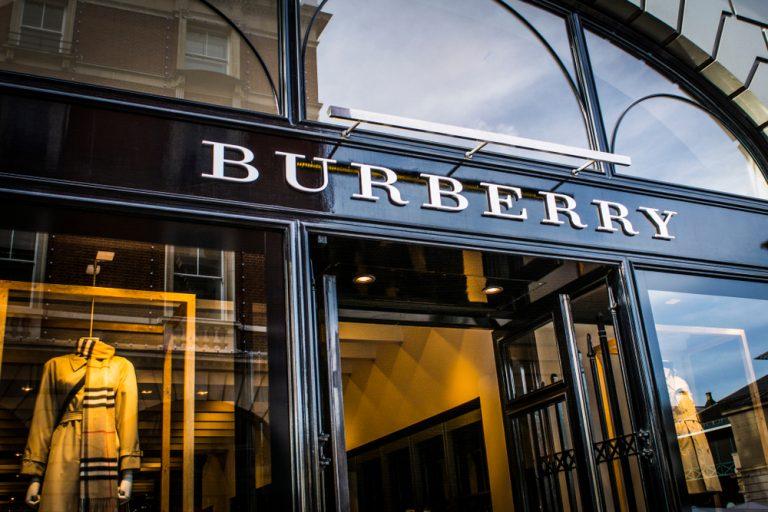
Burberry reinstates dividend after annual profit jumps on strong Q4

0

Burberry revealed that it made an adjusted operating profit of £396m

Burberry (LON:BRBY) announced on Thursday that it will payout a dividend that matches pre-pandemic levels as the fashion brand said it has made a strong recovery from the downturn.

Having cancelled its payout for 2020, Burberry will now offer shareholders a full-year dividend of 42.5p, equal to its payment in 2019, following the FTSE 100 company’s “strong cash generation”.

The fashion brand confirmed a 10% fall in sales for the year to March 27, as it felt the effects of store closures as well as fewer tourists.

While it also said its Q4 sales rose by 32% compared to the same period a year before, although around 16% remained closed on average.

Burberry revealed that it made an adjusted operating profit of £396m, surpassing analysts’ expectation by £18m, while it was short of the £433m made the year before.

Marco Gobbetti, chief executive of Burberry, commented on the company’s position and looked ahead to its future.

“In the last three years we have transformed our business and built a new Burberry, anchored firmly in luxury. We have revitalised our brand image, renewed our product offer and elevated our customer experience while making further progress on our ambitious social and environmental agenda.”

“In spite of COVID-19, we achieved our objectives for the period and delivered a strong set of results in FY21, ending the year with good full-price sales growth. In this next chapter, supported by these foundations and the strength of our teams, we will accelerate our growth and deliver value creation while continuing to build a more inclusive and sustainable future.”

The chief operating officer of Burberry said the company was happy with its performance in China after it was asked about any backlash to Western accusations of abuses in Xinjiang.

In March Burberry received backlash from China over disputes around human rights abuses of Uighur muslims in Xinjiang.

FTSE 100 hit by sharp reversal of commodity stocks

0

Though Europe was able to avoid succumbing to Wednesday’s inflation fears, ballooning losses overnight in the US, and a tough session in Asia, weakened the region’s defences come the opening bell.

The FTSE 100, which was yesterday’s frontrunner thanks to the UK’s better then forecast GDP numbers, was hit by a sharp reversal from its commodity stocks. That sent the index 1.4% lower, leaving it teetering on the precipice of 6,900 and at its worst price in three weeks.

The Dow Jones was really dealt a hammering yesterday evening, closing 1.99%, or 681 points, lower to post its worst performance since January. This following an unexpected-yet-unsurprising surge in inflation in April, to 4.2% at the annualised rate – more than double the Fed’s target.

And with the index set to drop a further 80 points this afternoon, the Dow is soon to find itself back at 33,500, mere days after crossing 35,000 for the first time.

“Data-wise there is little on the agenda to raise spirits, though extra scrutiny may be paid to this afternoon’s weekly jobless claims reading following last Friday’s nonfarm disappointment. Analysts are expecting another week-on-week drop, from 498,000 to 487,000 – however, these estimates are notoriously inaccurate, so there could be a lot of movement around that number,” said Connor Campbell, financial analyst at Spreadex.

FTSE 100 Top Movers

The biggest risers on the FTSE 100 so far are Intertek Group (1.03%), SSE (1.11%) and Spirax-Sarco Engineering (0.53%).

Burberry (-7.93%), Hargreaves and Lansdown (-5.11%) and Rio Tinto (-3.57%) are the biggest fallers in the opening hour of the index’s Thursday morning session.

Rolls-Royce

Rolls-Royce confirmed on Thursday that it will turn free cash flow positive at some point during the second half of 2021 as the vaccine roll-out continues and air travel makes a return.

The FTSE 100 engineering company said its performance since the turn of the year has met expectations after what proved to be a brutal period during 2020.

Rolls-Royce keeps 2021 guidance ahead of AGM

0

Rolls-Royce says flying hours of its large engines reached 40% of their levels so far in 2021

Rolls-Royce (LON:RR) confirmed on Thursday that it will turn free cash flow positive at some point during the second half of 2021 as the vaccine roll-out continues and air travel makes a return.

The FTSE 100 engineering company said its performance since the turn of the year has met expectations after what proved to be a brutal period during 2020.

Because Rolls-Royce charges airlines for the amount of time in which they use the engines, its income plummeted when travel restrictions came into place.

The company has taken measures, including taking on debt and raising equity in order to remain afloat.

During the first four months of 2021, Rolls-Royce said that the flying hours of its large engines had reached 40% of their levels from before the pandemic.

Rolls-Royce Holdings plc is holding its Annual General Meeting (AGM) today. In his address to shareholders, chief executive Warren East will commented: “We faced unprecedented challenges in 2020 with events that were beyond our control. We acted quickly and decisively by putting in place the measures necessary to protect our people and our business. I would like to thank our colleagues for the dedication and hard work this year and all our stakeholders for their engagement and support.”

Jack Winchester, Analyst at Third Bridge, commented on Rolls-Royce’s update and outlook:

“As Rolls Royce holds its AGM today, it will be looking back on a first few months which seemingly have not been a great surprise. Flying hours logged by the company’s engines – and the metric by which Rolls Royce collects cash from customers – was at just 40% of 2019 levels and is expected to reach 45-55% for the full year.”

“Rolls Royce is trapped in a costly holding pattern until long-haul travel recovers, and that isn’t forecast to happen until at least 2024, according to many of our experts. The company’s focus on the wide-body engine market means that until more long-distance commercial jets are back in the air again Rolls Royce is going to continue losing money.”

Vertu Motors overcomes lockdown challenge

Motor dealer Vertu Motors (LON: VTU) performed admirably in the past year, given that it was not able to open its showrooms for an extended period of time. AIM-quoted Vertu Motors has prospered because of its online offering and customer service. Trading in the first two months of this year has been impressive even though the dealerships did not open until the last three weeks of the period.
Deals can be done purely online but most involve telephone contact. Potential buyers have the option to reserve a vehicle by paying a deposit of £99 and most do end up buying.
Vertu Motors has a strong, as...

Eurasia Mining slips out late announcement

Eurasia Mining (LON: EUA) has ended its formal sale process and it has a potential acquiror of substantially all its Russian mining assets. How much they might be willing to pay is uncertain.
The announcement was made at 6.08pm. There is no certainty that the deal will go ahead, though.
The formal sale process and strategic review has been going on for more than ten months. In recent weeks, it has focused on potential bidders.
A potential acquiror of the company’s assets (rather than bidder for the company) has come to the fore. That deal will turn the business into a shell if it happens.
The ...

US inflation jumps by highest rate since 2008

0

Inflation

US consumer prices surpassed economists’ expectations, rising by 4.2% in April, above their level 12 months ago.

The news could further concerns around the possibility of oncoming inflation.

The 4.2% is particularly drawing the attention of investors, economists and analysts as high demand brought about through the vaccine roll-out and other factors could lead to a surge in prices.

It is the highest level of inflation since 2008 and well above March’s figure of 2.6%.

“What we are seeing is a perfect storm of supply and demand side factors, from monetary and fiscal stimulus boosting consumer spending, to supply bottlenecks related to the pandemic which are increasing costs,” said Kevin Lester, CEO of Validus.

It poses new challenges to Joe Biden, as well as the Fed, as they have been trying to inject life into the US economy following the coronavirus pandemic.

US stocks

The US markets suffered in the aftermath, with the Dow Jones falling 0.6%. And though that may sound relatively measured, at its current girth that equates to a 200-point collapse, sending the Dow under 34,100 for the first time in 9 days.

“The markets have been hovering around all times highs with a lot of the reopening trade already priced in. So it’s not out of the question that the outsized inflation read could bring us back down to earth a bit,” said Mike Loewengart, managing director of investment strategy at E-Trade, told CNBC.

“Keep in mind the Fed has made it clear that it won’t let inflation increases necessarily sway it from its easy money policies and further any jumps like this could be transitory. So is this a trend? That remains to be seen,” Loewengart said.

Tech shares in particular, have come under pressure in recent weeks and months.

Dollar

The dollar went in the other direction to the Dow, adding 0.4% against the pound and 0.5% against the euro.

“The greenback’s gains help explain why Europe didn’t follow the US markets lower, instead strengthening their own hand as the session went on,” said Connor Campbell, financial analyst at Spreadex.

A Sniff of Better Figures

Kromek (LSE:KMK) 15.85p (15p-16p) Mkt Cap: £68m
Trading update ahead of Finals to April 2021 to be announced in July 
Yesterday’s trading for finals to be reported in July, stated that momentum had continued with new orders inline with expectations for its radiation detection product D3S. These are  deployed in over 20 countries and help keep critical infrastructure and public spaces safe and demand for D3S family of products continues to increase and follow on orders likely in the US, Asia and Europe. It has won contracts with the Canadian Nuc...

Natwest share price: long road ahead as government looks to shift shares by 2025

0

Natwest Share Price

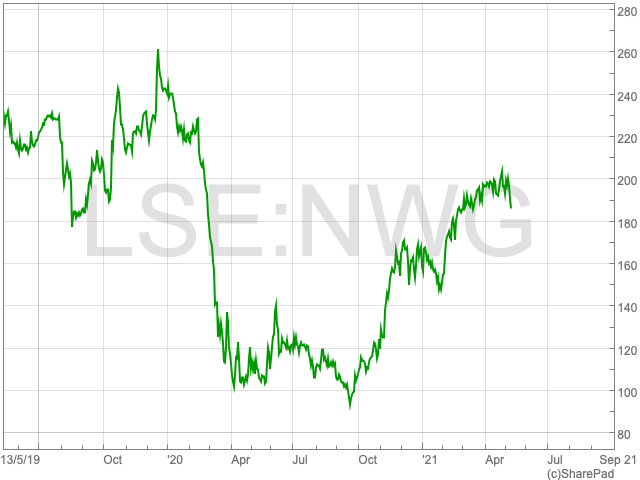
The Natwest share price has fallen for three consecutive days, down to 185.83p per share. The dip, which has come as the UK government announced that it is aiming to secure a buyer for shares in Natwest worth up to £1.1bn, follows a bull-run which lasted since September. Since the beginning of the year, the Natwest share price up by 12.4%, while it is up by over 100% since September 2020. While it seems the FTSE 100 bank is on the comeback in the aftermath of the pandemic, there remains an element of uncertainty over its outlook for the remainder of 2021.

UK Government to Sell-off Natwest Shares

NatWest saw the Government sell £1.1 billion worth of shares to reduce its holding to 54.8%. In this case the bank will likely be pleased as it marks another step in the long rehabilitation of the group from the financial crisis.

580m shares in the FTSE 100 bank were being offered to institutional investors as part of a placing that would bring the government’s holding down to 54.8%.

Analysts are expecting NatWest to be fully returned to private ownership by 2025, almost 20 years after its effective nationalisation.

Ian Gordon, an analyst at Investec, told The Times that the timing of the move was understandable due to the market price being at its highest point in over 12 months. However, he added that there was a long road ahead as the government still has some way to go to shift the remainder of its holding in the bank.

Risks

While it may seem minimal, there remains a risk that the UK’s seemingly smooth economy could unravel. In addition, interests remain on the floor which could limit Natwest’s growth for the foreseeable future.

However, according to Nicholas Hyett, equity analyst at Hargreaves and Lansdown, “investing is a long-term game, and a balance sheet awash with capital should allow NatWest to weather a spell of poor results. The bank that emerges will be both smaller and duller than what went before, but ultimately that may be no bad thing”.

Exports to EU return to pre-Brexit levels

0

Goods exported to the EU increased by 8.6% in March to £12.7bn

The UK’s exports to the European Union are close to making a recovery after they dropped by 40% at the begging of the year, according to data released by the Office for National Statistics (ONS).

Goods exported to the trading bloc increased by 8.6% to £12.7bn in March, it was revealed on Wednesday.

It is £1bn shy of the level recorded in December, prior to the UK’s exit from the EU, which resulted in exports plummeting by over 43% the following month.

The figures hint at a recovery in trade levels both in Britain and on the continent following the upheaval caused by the vote. It also has taken some time for countries to adapt to the new rules of trading.

Ruth Gregory, economist at Capital Economics, told The Times: “March’s trade figures showed that the UK’s goods export values to the EU have now almost reversed January’s 43.2 per cent plunge after the Brexit transition period ended. However, imports from the EU have continued to lag behind.”

The FTSE 100 received an early helping hand thanks to a better than forecast Q1 GDP reading, while European markets, including the DAX and the CAC have both made gains.

According to a forecast released on Wednesday by the EU’s executive commission, the trading bloc is expected to grow by 4.2% this year, an increase of 0.5% from a forecast made in February.

“Recovery is no longer a mirage. It is under way,” said EU Commissioner Paolo Gentiloni “After a weak start to the year, we project strong growth in both 2021 and 2022.”

Diageo share price lifts on surprise announcement by CEO

0

Diageo Share Price

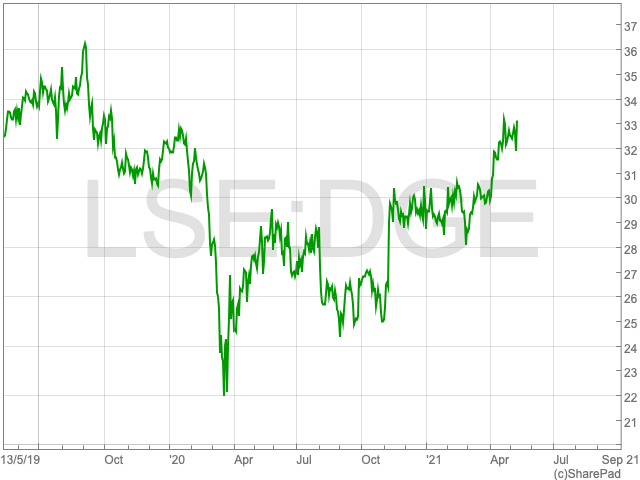
The Diageo share price (LON:DGE) jumped during the morning session on Wednesday, up by 3.8% at the time of writing, as the drinks company made a pledge to buy back shares or provide a special dividend. The company’s share price reached 3,317p per share, now less than 10% below its all-time-high of 3,640p, as it looks to be closing in on the marker last reached in September 2019.

Diageo Pledge to Shareholders

Shareholders in Diageo are set for billions worth of share buybacks or special dividends. The news came on Wednesday as the company said it had made a strong recovery from the coronavirus-induced downturn, allowing the company to return cash to its investors.

Going back to April, Menezes, chief executive of Diageo, paused the return of capital (ROC) scheme last April. The FTSE 100 drinks giant had returned £1.25bn to investors out of the £4.5bn scheduled to be returned over the longer-term.

As the company as seen growth in its profits that has exceeded expectations, it made the announcement, which came as a surprise to many.

AJ Bell investment director, Russ Mould, commented on what the news could mean for shareholders looking ahead:

“Like several businesses, Diageo hoarded cash during the pandemic to help get it through, now profit is expected to bounce back quicker than expected it can afford to be more generous,” Mould said.

“With its on-trade sales in bars, clubs and restaurants virtually disappearing for large parts of 2020 and the beginning of 2021 the company did a good realignment job – focusing its marketing on the off-trade as people enjoyed their Guinness or Johnnie Walker at home instead.”

Now things are reopening Diageo is likely to see hospitality-linked sales recover with the only area still severely impacted being sales in airports and other travel hubs.

“The company’s main focus is on the manufacture of spirits and this industry has some winning attributes for a market leader like Diageo as consumption is increasing in both developed and emerging markets, the relative costs of making it are low and yet brand power allows it to be sold at a premium price,” Mould added.