Bank of England holds UK interest rates at a record low 0.1%

0

The Bank of England voted across the board to keep borrowing rates the same

The Bank of England held its main interest rate at 0.1% on Thursday, a record low, despite the central bank warning of inflation pressures as the UK economy continues its recovery.

Susannah Streeter, senior investment and markets analyst Hargreaves Lansdown, commented on the bank’s decision:

“The Bank of England isn’t ripping up the party rule book yet, content to let the economy feast on record-low rates and ultra-loose monetary policy. It is on alert, ready to change the game if the inflationary guest starts acting up, but right now it’s not changing the mood music,” said Streeter.

The monetary policy committee retained an upbeat outlook around the UK economy. As restrictions on economic activity have eased, the Bank of England has revised its Q2 estimate for growth by 1.5%. The central bank expects output for this month to be a mere 2.5% below its level in Q4 of 2019, just prior to the beginning of the pandemic.

“The UK economy is still dancing to the tune of consumer confidence, helped by a bouncy castle of a housing market and the jump in activity since the re-opening of shops, pubs and restaurants in April hasn’t lost much energy. Current economic activity is even stronger than in May, with supply bottlenecks pushing up prices at a time of strong demand for goods,” Streeter added.

While the recovery continues, inflation is expected to blow past the BoE’s target, exceeding 3%. However, it is then expected to retreat, “with the balloon of higher prices losing air”, said Streeter.

“Already there are party pooper signs. Companies are having to reduce services, due to the lack of staff. The Bank of England identifies that there are now recruitment difficulties across sectors and regions, and this could be a drag on growth,” Streeter said.

“The Bank of England knows that the sugar rush of cheap money needs to be withdrawn. But right now it’s judging that the guests at the party aren’t yet robust enough to cope with their treats being taken away.”

A significant portion of the UK economy, which shrank by 10% during 2020, is now open although social distancing requirements are still being enforced.

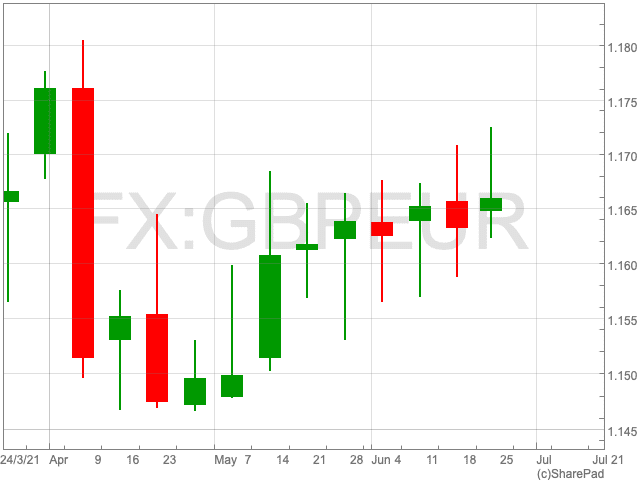
Sterling falls as BoE expects inflation to pass 3%

The FTSE 100, which features companies that benefit from a weaker pound, is up by 0.47%

Sterling fell on Thursday, down from its strongest position against the euro in over two months, as the Bank of England predicted inflation would exceed 3%.

The central bank’s forecast of inflation is above its target for a “temporary period”.

GBP, having traded at €1.17 prior to the Bank of England meeting on Thursday, fell by 0.5% against the euro to €1.165. Cable fell by the same amount to $1.3894.

The news has not motivated the BoE to urgently act by tightening its policy.

“The economy will experience a temporary period of strong GDP growth and above-target CPI inflation, after which growth and inflation will fall back,” the monetary policy committee said.

The FTSE 100, which features a number of companies that export goods and services that could benefit from a weaker pound, is up by 0.47%.

Commenting on sterling falling as the Bank of England expects inflation in excess of 3%, Olivier Konzeoue, FX Sales Trader at Saxo Markets, said: “The BoE chose to maintain accommodative measures in place, keeping the Benchmark Interest Rate at 0.1% and holding government asset purchases at GBP 875Bln, whilst outgoing chief economist Haldane was the only dissenter voting against keeping the bond-buying program unchanged (8-1 split on the topic).”

“The MPC used similar rhetoric to that used by the US Fed of late, describing an expected peak in inflation in excess of 3% (versus 2.47% previously) as likely temporary in nature and flagged the uncertainty around the labor market outlook with close to 1.5 Million people still receiving wages through the furlough scheme. This justifies pushing back a potential 15Bps rate hike to August 2022, instead of June 2022, in order to avoid undermining recovery by a “premature tightening in monetary conditions.”

“GBP fell to session lows around 1.3906 after the announcement and hovers around the 1.3920 mark, whilst UK 10-year yields dropped 3Bps to 0.75% from 0.78%.”

Central banks increase pressure on cryptocurrencies

The Bank for International Settlements says cryptos ‘all tend to work against the public good’

Central banks are increasing the pressure on cryptocurrencies, warning that they are not in the public interest, as they continue to strive to be the future of finance.

Cryptocurrencies established within the private sector “all tend to work against the public good,” according to the Bank for International Settlements (BIS), the Switzerland-based bank for the world’s central banks.

The BIS made bitcoin the target of its criticism, suggesting its carbon footprint is wasteful, and that it is a highly speculative asset used to facilitate crime.

The comments come as bitcoin has made recent leaps to establishing its future as an alternative means of payment for goods and services, including becoming legal tender in El Salvador, despite its market price crashing in recent months.

The price of bitcoin fell to below $30,000 earlier this week for the first time since January but then bounced back a bit. In April it peaked at over $63,000.

In the UK, the Bank of England is still looking at lunching its own digital currency. The governor, Andrew Bailey, said earlier in June that it would be a step to move the country into a new era.

China has been developing a digital yuan, while the US Treasury secretary, Janet Yellen, has expressed support for a digital dollar.

Starlink to go public once cash flow is more predictable Musk says

0

Elon Musk confirmed on Wednesday that he intends to list Starlink once its cash flow becomes more predictable.

“Going public sooner than that would be very painful,” Musk said in a tweet. “Will do my best to give long-term Tesla shareholders preference.”

The idea of separating Starlink from SpaceX for an initial public offering was first touted last year by Gwynne Shotwell, president of SpaceX.

Starlink’s mission is to offer high speed internet across the world, using a network of thousands of satelites in low-earth orbit.

Tesla chief Musk believes that Starlink will play an important role in getting resources for his grander plans of bringing consumer passengers to the moon and colonising Mars.

Over 5m people became millionaires during pandemic

0

More than 1% of adults globally were millionaires in 2020

Over five million people entered millionaire status worldwide during 2020 as the world reeled from the coronavirus pandemic.

The number of millionaires across the world grew by 5.2m to 56.1m , while many people became poorer, according to research by Credit Suisse.

For the first time ever, more than 1% of adults globally were millionaires in 2020.

As stock markets recovered and house prices rose, owners of said assets do the same.

Low interest rates and government programmes resulted in a massive transfer of wealth from the public sector to homeowners.

This brought about a rise in household saving, reducing household debts and “inflated household financial assets”.

“The contrast between what has happened to household wealth and what is happening in the wider economy can never have been more stark,” the Credit Suisse report said.

The combined with of people worth at least $1m had increased fourfold since 2000 to $191.6tn, as their share of global wealth increased from 35% to 46%.

Value of Crown Estate supported by offshore wind farms

0

Crown Estate’s marine portfolio rises to £4.1bn

The Crown Estate, the Queen’s property company, has seen its value jump by 7.5% to £14.4bn on the construction of offshore wind farms.

This happened despite revenues from high street properties falling as the pandemic took its toll.

Some of the world’s major energy companies made huge bids to lease seabeds in February, causing the value of the Crown Estate’s marine portfolio to rise to £4.1bn, The Times Reported.

On the other hand, the Crown Estate saw its on land property portfolio fall by £1.1bn, as the occupiers of its commercial property units found themselves unable to pay rent as a result of the pandemic.

The profits of the company which operates on behalf of the Queen fell by 22% during the 2020/21 financial year to £269.3m for this reason.

The Crown Estate gives its profits to the Treasury. The Treasury then gives a portion of this amount to the Royal Family in what is referred to as a “sovereign grant”.

The Crown Estate is anticipating a substantial increase in its income over the coming years as energy companies will begin paying in the region of £879 million a year to build wind farms.

Dan Labbad, chief executive of The Crown Estate, told The Times: “All things being equal we will see healthy income coming out of offshore wind in the upcoming years.”

“We’re not out of the woods yet. We’re still operating under lockdown, we don’t know how footfall will recover,” he said. “What the pandemic has thrown into sharp relief is that challenge and uncertainty are the new normal and there is no doubt we will face another difficult year ahead, but with the progress of the vaccination programme and our collective resilience as a society, there is reason to be cautiously optimistic,” he added.

New strategy outlined for Dignity

The new management team has outlined its strategy for Dignity (LON: DTY) at the funerals and crematoria operator’s AGM. Selling a stake in the crematoria business is mentioned, but it is not the focus of the new strategy. Management says that Dignity needs to remain vertically integrated.
The argument is that the previous management policy of increasing prices led to a decline in market share and there were problems with telephone sales of prepaid funerals, where there were high levels of cancellations.
The telephony sales contracts have been cancelled and Dignity will no longer sell 10 year p...

Specialist Fund Segment admission: Literacy Capital

Literacy Capital is joining the Specialist Fund Segment of the Main Market on 25 June, but no new money is being raised. The company is chaired by Capita founder Paul Pindar.
The focus is long-term capital growth through investment in unquoted investments and the provision of donations to charities. Literacy Capital makes an annual charitable donation of 0.9% of its NAV.
The company was formed in September 2017 and the investment manager is Literacy Capital Management LLP. Paul Pindar and his son Richard run the investment manager. The management fee is one-quarter of 0.9% of NAV. The director...

Victoria acquisition adds online expertise

Acquiring hard flooring distributor Cali Bamboo Holdings Inc not only provides a North American base for floorcoverings and tiles manufacturer Victoria (LON: VCP) it also provides other opportunities.
Victoria is paying $76.1m (£55.1m) for Cali and repaying $27.8m (£20.1m) of debt. In the year to April 2021, revenues were $171.6m (£124.3m) and EBITDA of $13.8m (£10m). Revenues have been growing at 17% a year over the past five years. Margins are lower than for the group because Cali is not a manufacturer.
This is the latest in a raft of acquisitions in recent months. Victoria has spent more th...

Supply issues and staff shortages set the tone ahead of tomorrow’s Bank of England meeting

0

The IHS Markit flash UK composite output index came in at 71.7

Inflationary pressure on UK businesses hit record highs this month, while growth narrowed a bit from May’s all-time high, as Covid restrictions were eased.

This is according to the IHS Markit/CIPS UK Composite Purchasing Managers’ Index (PMI), which showed one of the most robust month-on-month increases in business activity in over 20 years.

The IHS Markit flash UK composite output index came in at 71.7, 1.2 shy of a record May.

IHS Markit said businesses have hired staff at “an unprecedent rate” in response to rapidly increasing workloads.

The survey also drew attention to the fact that input and output costs have reached new highs on supply-chain disruptions.

Chris Williamson, chief business economist at IHS Markit, said: “Businesses are reporting an ongoing surge in demand in June as the economy reopens, led by the hospitality sector, meaning the second quarter looks to have seen economic growth rebound sharply from the first quarter’s decline.”

“There are some signs that the rate of expansion appears to have peaked, as both output and new order growth cooled slightly from May’s record performance, but full order books and a further loosening of virus-fighting restrictions should nevertheless help ensure growth remains strong as we head through the summer.”

Danni Hewson, AJ Bell financial analyst comments on today’s Flash PMI figures, added:

“The latest flash PMI figures set the tone ahead of tomorrow’s interest rate decision by the Bank of England. Supply chains are still fraught, some materials are still hard to come by and delays are pushing some companies to try and buy ahead, at a premium. All those cost pressures will work their way through and signal an uncomfortably bumpy period where inflation will continue on its upward trajectory.”

“Add in staffing shortages being felt by industries like hospitality and you have a recipe which will require businesses to weigh up whether it’s better to slim down provision or scale up wages. Of course, the end of the furlough scheme could solve that issue. No one really knows how many of those still being cushioned will return to their substantive posts or be looking for new ones.”