With the Dow Jones back under 34,000 after concerns out at the thought of a Biden tax hike, the European markets were slow out of the gates on Friday morning. As the flash manufacturing and services PMIs for April continue to roll out, the FTSE 100 barely moved, dipping 0.15% to 6,927.66 at mid-morning trading.
“Following a rough few sessions, the pound, on the other hand, tried to pick itself up. Against the dollar it rose 0.4%, pushing back towards $1.389 – remember, at one point this week, cable crossed $1.40. Sterling benefited from a far better than forecast UK retail sales figure, the number hitting a 9-month peak of 5.4%,” said Connor Campbell, financial analyst at Spreadex.
“The UK is hoping for improvements in both its manufacturing and services readings. The former is set to sneak 0.1 higher to 59.0, while the latter is expected to see a slightly more robust rise thanks to the country’s spring-time re-opening, from 56.3 to 58.9 month-on-month,” Campbell added.
The Eurozone indices echoed the slow start of the FTSE 100. With a rise in the German manufacturing PMI, but a dip in its services equivalent, the DAX was down 0.2%. The CAC, meanwhile, was flat, despite both French flash PMIs surpassing estimates.
“Looking to this afternoon and the Dow Jones is straining to get back to 33,900, though is set to fall short with a 0.2% increase. As for the US PMIs, the manufacturing reading is expected to jump from 59.1 to 60.9, with the services figure climbing from 60.4 to 61.6,” Campbell said.
FTSE 100 Top Movers
Evraz (1.19%), Glencore (1.15%) and Intertek (1.14%) are the top movers on the FTSE 100 on Friday morning having made modest gains so far.
The biggest fallers on the UK index are IAG (-2.11%), Next (-1.65%) and Land Securities Group (-1.40%).
UK Retail Sales
Retail sales continued moving up in March with a rise of 5.4% as Covid restrictions are increasingly being eased. The rise surpassed economists’ expectations of a monthly increase of 1.5%, according to data released by the ONS on Friday.
Sales were 1.6% higher than in February, before the pandemic impacted the UK economy.
The bitcoin price has tumbled in recent days soon after reaching a record high.
Since nearly getting to $65,000 on 14 April, following the Coinbase IPO, bitcoin is now down to $48,000. It represents a drop of 35% in the value of the pre-eminent crypto currency.
The news come in the wake of reports that Joe Biden will put forward a plan to raise taxes on America’s wealthiest people, including the largest-ever rise on taxes on investment gains.
Other reports have suggested the dramatic price move in recent days could be a consequence of a major power cut in China.
The price crash coincided with the largest daily drop in bitcoin’s hash rate in nearly four years, which could be attributed to power outages in the Chinese region of Xinjiang.
“We just saw the single largest one day drop in mining hash rate since November 2017,” said cryptocurrency analyst and forecaster Willy Woo.
“The hash rate on the network essentially halved, causing mayhem in bitcoin’s price as it crashed.”
Analysts at JP Morgan have warned that if bitcoin’s price does not come back and get above $60,000 soon, its momentum signals could collapse.
“Over the past few days bitcoin futures markets experienced a steep liquidation in a similar fashion to the middle of last February, middle of last January or the end of last November,” JPMorgan strategists led by Nikolaos Panigirtzoglou wrote in a note to clients that was first reported by Bloomberg. “Momentum signals will naturally decay from here for several months, given their still elevated level.”
Bitcoin has failed to hold its upward momentum following the Coinbase listing said according to Pankaj Balani, the chief executive of the Singapore-based Delta bitcoin and cryptocurrency. “Only a move above $60,000, which is a key resistance for any bull-trap rally, will help restore confidence that the bull trend is intact,” he added.
Biden move is part of an overhaul of the US tax system
President Joe Biden will put forward a plan to raise taxes on America’s wealthiest people, including the largest-ever rise on taxes on investment gains.
The proposal is aimed at funding $1trn in childcare, universal pre-kindergarten education and paid leave for workers, Reuters reported.
The move is a part of a wider overhaul on the US tax system, aimed at getting more tax revenues out of the country’s wealthiest people and largest companies.
Reporters reported that the proposal is calling for the top marginal income tax rate to be increased to 39.6% from 37%. In addition, the plan would double taxes on capital gains to 39.6% for those earning in excess of $1m.
It would be the highest rate of tax on investment gains since the 1920s. Since the aftermath of World War Two, the rate has not gone above 33.8%.
Stocks on Wall Street retreated on Thursday as reports emerged that Biden would propose hiking taxes on the wealthy, including capital gains taxes.
Such a policy will need to pass through Congress, where Biden’s Democrats have narrow majorities, and could struggle to get support from the Republicans.
“If it had a chance of passing, we’d be down 2,000 points,” said Thomas Hayes, chairman and managing member at hedge fund Great Hill Capital LLC, referring to stock market indexes.
Further information is expected to be announced next week ahead of Biden addressing Congress on Wednesday.
White House press secretary Jen Psaki said the president would discuss his “American Families Plan” during his speech to Congress but declined to comment on any details.
“His view is that that should be on the backs … of the wealthiest Americans who can afford it and corporations and businesses who can afford it,” Psaki said.
Retail sales continued moving up in March with a rise of 5.4% as Covid restrictions are increasingly being eased.
The rise surpassed economists’ expectations of a monthly increase of 1.5%, according to data released by the ONS on Friday.
Sales were 1.6% higher than in February, before the pandemic impacted the UK economy.
The ONS said the data reflected “the effect of the easing of coronavirus restrictions on consumer spending.”
Additional figures released by the ons revealed that the UK government borrowed in excess of £303.1bnover the last financial year. That represents an increase in £246bn compared to the previous year.
UK borrowing came in at 14.5% of GDP, the highest since 1946, when it was at 15.2%.
The figures are a result of the increase in public spending, as well as tax cuts, aimed at managing the negative impact of the pandemic.
Commenting on the new ONS data, Jon Hudson, fund manager of the Premier Miton UK Growth Fund, said: “Despite the country being in lockdown during March, the 5.4 per cent growth in retail sales volumes were surprisingly strong.
“Clothing stores in particular saw an impressive jump of 17.5 per cent as consumers spent their forced savings accumulated over the past year and readied their wardrobes for a more normal summer.”
Mobile phone and technology recycler and reseller musicMagpie has built up a substantial UK market position in the sale of pre-used goods. This is a market estimated to be growing at 10% a year. There is still a lot more to go for in the US, which is an underdeveloped market.
Management believes it can do a lot more with the customer data musicMagpie has collected and it has launched new initiatives to enhance growth. The new smartphone rental operation could reduce short-term revenues but the recurring revenues over the term of the contract will be more profitable.
The new financial year has ...
The UK Investor Magazine was delighted to be joined by David Lawrence, CEO of AIM-Listed Wealth Manager Kingswood Group (LON:KWG).
Kingswood Group have made a number of acquisitions in the past twelve months as the company seeks to expand in the UK Wealth Management and Financial Advice sector. More recently, Kingswood have made an exciting acquisition in the United States as they set out to target a new market that has regulatory and cultural similarities.
We discuss with David the landscape for financial advice in the UK and highlight some of the problems Kingswood see as opportunities for further growth. In particular, we touch on the digitalisation of wealth management of the financial advice gap that still exists here in the UK.
Rates remain on hold as ECB chiefs anticipate easing of lockdowns
The European Central Bank (ECB) has restated its desire to minimise borrowing costs across the eurozone, suggesting it will continue its increased rate of bond buying until the EU is well on the road to recovery.
The bank confirmed on Thursday via a press conference that it has “decided to reconfirm its very accommodative monetary policy stance”. The ECB’s to policymakers said in a statement after the conference that “incoming information confirmed the joint assessment of financing conditions and the inflation outlook carried out at the March monetary policy meeting”.
Therefore, “the governing council expects purchases under the [pandemic emergency purchase programme] over the current quarter to continue to be conducted at a significantly higher pace than during the first months of the year”, the statement said.
The deposit rate held steady at -0.5% as the ECB reaffirmed its position that €1.85tn emergency bond-buying programme could be expanded or not fully utilised. Its decision would depend on the progress of its efforts to support a recovery in output and inflation.
Containment Measures
The bloc is hurting as EU countries deploy measures to stifle the high rate of infections. However, the rate of vaccinations is moving more quickly in a number of countries. So much so that economists are anticipating the possibility of a strong recovery if restrictions are eased next month.
Speaking at a press conference after the announcement, ECB president Christine Lagarde said: “While the recovery in global demand and sizeable fiscal stimulus are supporting global and euro area activity, the near-term economic outlook remains clouded by uncertainty about the pandemic.”
“The progress with vaccination campaigns, which should allow for a gradual relaxation of containment measures, should pave the way for a firm rebound in economic activity in the course of 2021,” Lagarde said.
Downside Risk
While the risks surrounding the euro area growth outlook over the near term continue to be on the downside, according to Lagarde, medium-term risks remain more balanced. The president of the ECB also said that the prospects for global demand were better – bolstered by the sizeable fiscal stimulus – and that the progress with the vaccination roll-outs are encouraging.
“On the other hand, the ongoing pandemic, including the spread of virus mutations, and its implications for economic and financial conditions continue to be sources of downside risk,” Lagarde added.
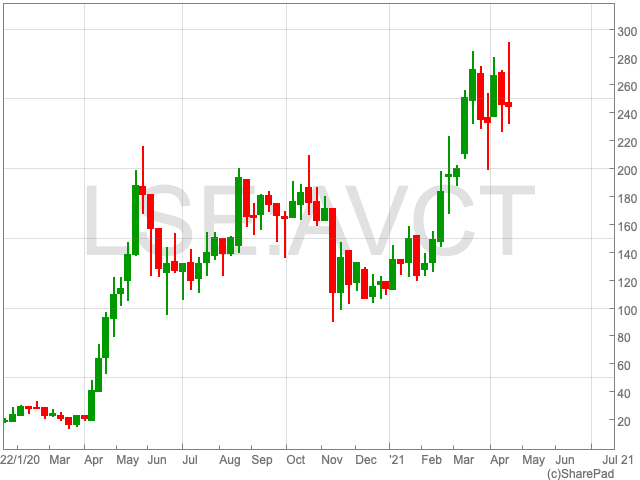
Having made outstanding gains since the beginning of April, the Avacta Group share price (LON:AVCT) continued to push on into 2021. Since the turn of the year the company is up by 115%, while in the last 12 months it is up by 360%. Avacta recorded £3.9m during 2020, while its sales for the full year of 2021 are expected to reach £6.25m. The question now is whether, after its impressive resurgence in the face of the pandemic, it is a viable stock for the long-term.
Rapid Antigen Lateral Flow Test
Avacta’s share price shot up in March and the key factor was positive results from its rapid antigen lateral flow test. The therapy and diagnostics developer said that it is now able to detect dominant new variants of the coronavirus, such as the B117 and D614G, in addition the original strain of Covid-19.
The SARS-CoV-2 antigen lateral flow test was clinically evaluated in Europe and identified 96 out of 98 positive patients correctly with a 20 minute read time and 101 out of 102 negative samples.
Chief executive Dr Alastair Smith said: “I am delighted with the clinical data from this larger clinical study, which has robustly evaluated the AffiDX antigen test … The results are very impressive and mark a major step in obtaining a CE mark for professional use.
“We are completing the necessary assessment of the product from our manufacturing partner Global Access Diagnostics, including stability testing that will complete the technical file for CE marking, which we expect will happen in early May.
Avacta said it is looking to provide a commercial update as soon as possible on the commercial roll-out of the AffiDX test in the coming months.
Long-term
Moving forward there is always the possibility that Avacta’s trials will be unsuccessful. This is a risk any investor takes when it comes to biotechnology, which could negatively impact the company’s share price. Alternatively, as seen over the course of the past 12 months, it can be the cause of sharp rises.
Another hazard of the industry is research and development costs, which as well as being substantial, are ongoing. This means Avacta has to pump money in which has at times come from a dilution of the company’s share price. Avacta is also an AIM-listed stock, and so there is less liquidity than in, for example, the FTSE 100. This means there can be a great deal of volatility, which presents a risk for investors who want quick access to their money.
For many years, the word “millennial” has been synonymous with “the young” – and yet, millennials today (defined as those born between 1981 and 1996) are now in their late twenties and thirties. The oldest are hitting their forties.
They’re not just coming of age, they areof age: working harder, acting smarter, facing vastly different challenges than other generations. What’s more, they are increasingly of stature in politics, culture and across professions – they’re CEOs and rising artists, leading teams and driving change across business and society.
For banks and wealth management firms alike, the rise of the millennial represents a crucial opportunity.
Not only digitally native and forming the majority of today’s workforce, there is a growing cohort within the millennial generation who are not only affluent in their own right, but are about to become the beneficiaries of one of the greatest wealth transfer in history. According to Simon Kucher & Partners, by 2046 baby boomers (those born between 1946 and 1964) will have transferred USD30 trillion of their wealth to the next generation.
There are already over 2.4 millionyoung but affluent millennials in the UK – but that number is increasing. As they enter their prime earning, inheriting, and spending years, these millennials – the young affluents – are the future clients that banks and wealth managers must work hard to not just attract, but retain. And that means addressing a swathe of currently unmet expectations.
Underserviced and overlooked
Despite the size and potential of the young affluent audience, the financial sector in its current guise is not meeting their expectations.
When it comes to wealth, incumbents and challengers alike favour a one-size-fits-all approach, meaning that there are a growing number of young and affluent people who are currently overlooked by banks.
Research backs this up, with data showing that 56% of high-net-work millennials in the UK are dissatisfied with the wealth management tools on offer to them. They seek a financial solution which is personal, accessible, high-tech and high-touch – but they’re not finding a service that meets these needs amongst the current market offering.
Unsurprisingly, this dissatisfaction shapes their behaviour; 60% of millennials say they’re not loyal to their current wealth management service.
So where’s the disconnect?
Crucially, young affluents recognise how important their relationship with money is. Unlike previous generations, they approach their wealth as an act of self-care, rather than avarice, which makes them both more financially conscious and financially cautious.
With this in mind, there are a number of consequences that shape young affluents’ requirements from a bank.
Firstly, they want to approach their personal finances and savings goals from a place of mindfulness and intention, with accumulation no longer the sole focus. Accenture’s ‘Millennials & Money’report found that 59% of millennials want to become savvier with cash flow management and budgeting, as well as planning for specific events.
Secondly, young affluents want their wealth to meet their sense of purpose. They believe – as I do – that your money should help you achieve your goals, not be the point of stress that it all-too-often becomes.
That’s where ikigai comes in
At ikigai, we’re on a mission to help this under-serviced but increasingly powerful audience, by building a financial platform for the future of wealth.
We want to redefine the way young affluent people bank and invest by approaching personal finance from a personal place – an approach to money that, as explored here, we believe escapes incumbents and challengers alike.
As for why we’re taking this challenge so seriously?
With ikigai, we believe there is a clear opportunity to redesign banking and wealth management from the ground up. We’ve created a product where our clients’ wealth meets their sense of purpose. And we’re inviting you to join us on our mission.
If what I’ve shared here resonates with you, and you’d like to join us on our journey to redefine the way young affluent people bank and invest, I’m pleased to offer you the chance to become part of our community.
ikigai’s crowdfunding is now open with exclusive early access.
To invest in us on Crowdcube, and to find out more, head here.
Investments of this nature carry risk to your capital and should be invested in as part of a diversified portfolio. Please Invest aware.
Aggreko will now turn focus to second largest shareholder
The takeover of Aggreko(LON:AGK), the temporary power supplier, seems more unlikely now as the FTSE 250 company’s largest shareholder hinted its intention to thwart the deal worth billions of pounds.
Sky News has reported that Liontrust Asset Management, whose stake in Aggreko amounts to 12%, will vote against the £2.3m deal.
If they do then the company’s 880p-a-share acquisition by a consortium comprising TDR Capital, the private equity firm, and Squared Capital, an infrastructure investor, could come in to doubt.
Aggreko supplies its equipment across industrial sectors, notably to large-scale events, including the World Cup, the Super Bowl and Glastonbury.
The Scottish-based company recently reported a yearly profit before tax of £102m on its revenue of £1.4bn. Eyes will now turn to the plans of Sprucegrove, whose stake amounts to 8%, meaning it is the second-largest shareholder. As of yesterday, its voting intention is unclear.
Aggreko confirmed last month that it would recommend the deal to shareholders, with Ken Hanna, chairman, insisting that the price reflected its future growth prospects.