Small pharma companies tend to have one product or technology that could make them a highly successful investment. In some cases, there is a well advanced second treatment using different life sciences technology.
This pharma company has a treatment to prevent serious infections that has already had highly positive phase 2b clinical study results. The next step will be the design of a phase 3 clinical study.
There is also a second, acquired technology that could move to a phase 3 clinical study next year. This is another antimicrobial drug to prevent serious infections.
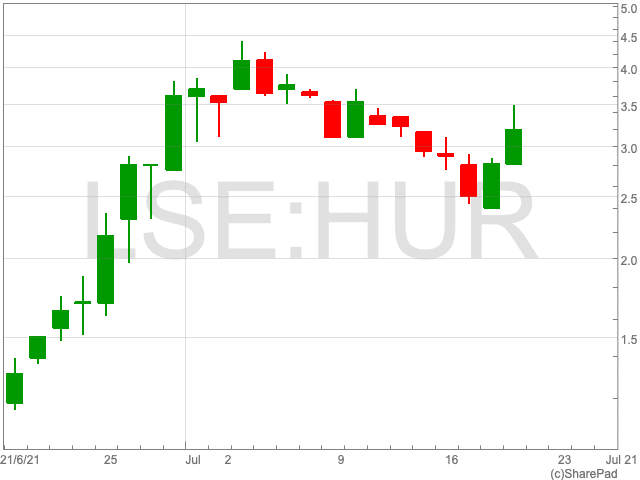
The share price did ris...
US nonfarm payroll below expectations despite adding 559,000 jobs in May
America labour market strengthens amid shortage of workers
Nonfarm payrolls in America jumped by 559,000 in May, the US Bureau of Labor Statistics revealed on Friday.
The reading fell short of the market’s expectation of 650,000.
The figures are well up from the 278,000 recorded in April, which was revised from 266,000.
The rate of unemployment in America fell from 6.1% to 5.8% over the same time period.
The figures suggest the labor market has strengthened despite fears that a shortage of workers were keeping the economy held back.
US nonfarm payrolls were announced as the US economy appears to be rebounding strongly as restrictions are eased. Additionally, concerns remain over the possibility of inflation.
Robert Alster, CIO at investment management firm Close Brothers Asset Management comments: “The Fed and market alike have been waiting for this nonfarm print with bated breath. April’s figures were a shock, coming in at a quarter of the expected increase despite stellar economic growth and otherwise-positive employment data. Now we are seemingly back on track, and signals are pointing towards a bright future for the US.”
“But there are still some key questions to be answered. There are vacancies in the US job market, and as people return to the workforce it’s unclear why those vacancies are not being filled. At best, it’s simply a matter of time. At worst, there’s a mismatch between the labour needed and the labour available.”
“As firms like McDonalds and Walmart increase wages to tempt workers back faster, it adds fuel to the US’ inflationary fire. While a rise in disposable income and consumer spending would be positive, if wage growth prompts a persistent increase in inflation then the Fed may be forced to step in with a monetary fire extinguisher, risking dampening the recovery before it’s really begun.”
Many businesses have been struggling to find employees as demand picks up with many offering higher wages in an effort to lure workers in.
Jobs figures in March came in below expectations, leading to concerns over labour shortages and the subsequent impact on the US economy’s recovery.
The May report from US Bureau of Labor Statistics comes as the Fed will again put its spotlight on its monetary policy, where it may consider easing some of stimulus measures since the beginning of the pandemic.
Construction sees biggest rise for seven years amid housing boom
IHS Markit’s Construction PMI reaches 64.2% in May, above economists’ expectations
The construction sector grew at its quickest rate in close to seven years last month as the easing of lockdown restrictions caused a surge in new orders.
The IHS Markit’s Construction Purchasing Managers’ Index expanded by 0.6% to 64.2% in May, reaching its highest point since September 2014.
It also surpassed economists’ expectations of 62.3. Any recording higher than 50 is a sign of growth.
Growth was particularly strong in housebuilding, as house prices soared by more than 10% during May on an annual basis.
Housebuilding was followed by commercial jobs which saw its strongest level of growth since August 2007.
“UK construction companies reported another month of rapidoutput growth amid a surge in residential work and the fastest rise in commercial building since August 2007,” Tim Moore, economics director at IHS Markit, said.
Pressure on costs also intensified for construction firms at the fastest pace since records began, following a jump in supplier delivery times.
“Despite severe challenges with materials availability, construction firms remain highly upbeat about their near-term growth prospect,” Moore said.
Additional data is showing that Britain is on a path for a strong rebound in growth. Other surveys for the manufacturing and services sectors are suggesting that the UK economy is now partaking in broad-based growth.
The all-sector PMI, a combination of the PMI surveys for construction, manufacturing and services, jumped by 2.2% in May, its highest ever recording.
Employment growth in the construction industry remains at its highest level since 2014, as demand for staff reached record highs in May.
On the other hand, Howard Archer, chief economic advisor to the EY ITEM Club, gave a warning about what the data could mean: “Stretched supply chains and rises in raw material prices led to input prices rising at the fastest rate in the survey’s history of just over 24 years.”
“This will undoubtedly add to mounting inflationary concerns.”
New car sales on the rise but remain 15% down on pre-pandemic levels
Hybrid earned nearly 13.8% of this year’s new car market
Demand for new cars fell by 14.7% in May compared to the same month in 2019.
The Society of Motor Manufacturers and Traders (SMMT) revealed that 156,737 cars were registered in the UK last month.
The figures show an increase of nearly 675% from May 2020 when showrooms were forced to shut down as the first lockdown came into effect.
Since the beginning of the year total registrations are still down by 29.1% compared to the average between 2010 and 2019.
SMMT chief executive Mike Hawes said: “With dealerships back open and a brighter, sunnier economic outlook, May’s registrations are as good as could reasonably be expected.
“Increased business confidence is driving the recovery, something that needs to be maintained and translated in private consumer demand as the economy emerges from pandemic support measures.
“Demand for electrified vehicles is helping encourage people into showrooms, but for these technologies to surpass their fossil-fuelled equivalents, a long-term strategy for market transition and infrastructure investment is required.”
Hybrid vehicles are making up ground, earning 13.8% of this year’s new car market, an increase of 6.6% from the same point a year ago.
“But for these technologies to surpass their fossil-fuelled equivalents a long-term strategy for market transition and infrastructure investment is required,” Hawes said.
James Fairclough, chief executive of AA Cars, told The Times: “The new car market has burst back into life and sales in May were up substantially on April’s figures as buyers once again flocked to showrooms across the UK. With lockdown restrictions set to be eased even further in late June many prospective buyers will be keen to choose a vehicle that will enable them to enjoy a summer staycation in the UK, or just to travel to see family and friends across the country.”
“It may take some time for sales of new cars to return to their pre-pandemic levels, as many drivers continue to be drawn primarily to the used market, which offers affordable price points and plenty of choice,” Fairclough added.
The battery electric vehicle market saw a fall from 12% last May to 8.4% in 2021.
Rio Tinto appoints first Aboriginal director after sacred cave destruction
Rio is striving to improve its perception across the world after it blew up the Juukan George rock in Western Australia last year
Rio Tinto, the FTSE 100 mining group, has appointed its first ever indigenous Australian to its board as it deals with the aftermath of its destruction of a nearly 50,000-year-old sacred site in 2020.
The iron ore-focused miner said on Friday that Ben Wyatt, the former Australian minister of Aboriginal Affairs, would bring about expertise in public policy, regulation and trade upon joining the company on the first day of September.
“I was deeply saddened and disappointed by the events at Juukan Gorge but I am convinced that Rio Tinto is committed to changing its approach to cultural heritage issues and restoring its reputation,” Wyatt said.
Rio is striving to improve its perception across the world after it blew up the Juukan George rock in Western Australia last year, leading to investors and board members to variously express their disapproval.
Rio Tinto’s chairman Simon Thompson said: “With family links to the Pilbara and an impressive track record in public life, Ben’s knowledge of public policy, finance, international trade and Indigenous affairs will significantly add to the depth of knowledge on the board at a time when we are seeking to strengthen relationships with key stakeholders in Australia and around the world.”
Approximately 90% of the mining company’s profits come from its iron ore production in the Pilbara.
Prior to entering state parliament in 2006, Wyatt has worked as a solicitor and a barrister.
The Rio Tinto share price (LON:RIO) moved sideways on Friday and is currently valued at 6,166.00p.