Eurozone manufacturing sector surges at record rate in March

0

PMI measure soared to 62.5, up from February’s level of 57.9

Manufacturing in the eurozone performed robustly during March, as operating conditions improved by the highest level in 24 years of records.

The PMI figure, a measure of the prevailing direction of economic trends in manufacturing, soared to 62.5, up from February’s level of 57.9, indicating a substantial improvement in the sector’s performance.

The index has now registered above 50.0, the level which reflects no changes in output, for nine months in a row.

Germany66.6 (flash: 66.6)record high
Netherlands64.7record high
Austria63.439-month high
Italy59.8252-month high
France59.3 (flash: 58.8)246-month high
Ireland57.18-month high
Spain56.9171-month high
Greece51.813-month high
Countries ranked by Manufacturing PMI: March

Growth was broad-based across the region, with Germany and the Netherlands leading the way. Both nations recorded their highest ever PMI levels in March.

Greece, in contrast, recorded only modest growth, despite enjoying its best PMI reading for over a year.

The further strengthening of trade, orders and production placed further strain on already stretched supply chains.

According to the latest data, average lead times for the delivery of inputs lengthened at an unprecedented rate as challenges in sourcing inputs due to product shortages, stronger global demand and ongoing logistical challenges linked to COVID-19 continued in March.

According to the latest data, the rate of increase in buying was the strongest ever recorded by the survey, although with continued delays in delivery, firms sought to utilise their existing stocks wherever possible. Whilst falling at a slightly slower rate, input stocks declined in March for a twenty-sixth successive month.

Commenting on the final Manufacturing PMI data, Chris Williamson, Chief Business Economist at IHS Markit said:

“Eurozone manufacturing is booming, with production and order books growing at rates unprecedented in nearly 24 years of PMI survey history during March,” Williamson said.

“Although centred on Germany, which saw a particularly strong record expansion during the month, the improving trend is broad based across the region as factories benefit from rising domestic demand and resurgent export growth.”

“Driving the upturn has been a marked improvement in business confidence in recent months, with expectations of growth in the year ahead running at record highs in February and March. This has not only boosted spending but has also led to rising investment and restocking, as firms prepare for even stronger demand following the vaccine roll-out.”


FTSE 100 off to positive start ahead off holiday weekend

0

Climbing 0.6%, the FTSE 100 found its way back above 6,755 after the bell. The index spent the final week or so of March repeatedly hitting its head on 6,775 before retreating, even with the confidence boost of Monday’s re-opening.

“The biggest contributors to the FTSE 100 in index point terms were miners Glencore and Rio Tinto as plays on stronger commodities demand and positive read-across from US President Joe Biden’s plan to invest heavily in infrastructure,” said Russ Mould, investment director at AJ Bell.

““In backing these companies, investors are effectively looking past any short-term noise and potential setbacks to getting the pandemic under control, and instead looking well into the future and taking the view that earnings will not just start to recover in 2021 but also keep improving thereafter,” Mould added.

Despite the Dow Jones failing to finish March at an all-time high, the European indices had a spring in their step on the first day of April.

“Though the DAX was only slightly ahead of the FTSE with a 0.6% increase, given their relative levels that means something very different for the German index. It is now at a fresh record peak of 15,090 and will be keen to stretch its neck to 15,100 before the day is over,” Campbell added.

FTSE 100 Top Movers

Melrose (4.54%), IAG (3.56%) and Aveva Group (3.32%) were the top risers on the FTSE 100 during the morning session on Thursday.

Phoenix Group Holdings (-2.47%), Smith & Nephew (-0.94%) and AstraZeneca (-0.92%) have not fared so well, seeing the biggest falls so far.

Next

Next navigated the coronavirus pandemic by growing the scope of its online business which accounted for nearly 50% of the company’s revenue.

The fashion retailer confirmed that its online sales have exceed estimates during the first eight weeks of the year, up 60% compared to two years ago. Subsequently the FTSE 100 company is raising its profit guidance by £30m to £700m.

“That its pre-tax profit was still so strong is to be applauded. The high street staple has been able to shield itself from the full impact of lockdown thanks to its online store, with Lord Wolfson also pointing out the fortune of its strongest growth areas being those with a low return rate,” Campbell said.

“Adding an extra layer of shine to the FTSE 100’s open, Next itself rose 2.8% to a 2 and a half month high of £80.86 per share.”

Argo Blockchain appoints Guidehouse as climate strategy advisor

0

Guidehouse will provide the crypto miner with a full climate action plan

Argo Blockchain (LON:ARB) confirmed on Thursday that the company has hired Guidehouse, the consultancy firm, to research and advise on its long-term goal of being carbon neutral via science-based solutions.

Guidehouse will provide the crypto miner with a full climate action plan to assists in its target of becoming a net-zero greenhouse gas (GHG) company.

Argo Blockchain is trying to set an example to others in the industry and is actively researching “numerous strategies to be a climate friendly cryptocurrency miner”.

The AIM-listed firm said that Guidehouse is best positioned to provide strategic recommendations to become net-zero based on its depth of expertise as a global sustainability leader and its extensive experience providing advisory services to the technology industry.

Argo said Guidehouse would not inhibit its mining operations and would allow the company to continue to prosper an an ever-changing sector.

Argo chief executive Peter Wall expressed his delight at the new partnership with Guidehouse:

“We are delighted to be working with Guidehouse to assess the options available in order to achieve our goal of becoming net-zero and a climate friendly cryptocurrency miner,” Wall said.

“At Argo, we pride ourselves on being pioneers within this hugely exciting sector, and we aim to become the gold standard for other miners to ensure we are doing everything we can to secure a sustainable future for generations to come”, he added.

Argo Blockchain confirmed earlier this month that it had finalised a fund-raising to allow the company to complete an investment in Pluto Digital Assets.

In addition, Argo intends to pursue strategic opportunities in crypto mining, capital investment, decentralised finance (DeFi) and Web 3.0 initiatives.

Guidehouse is a leading global provider of consulting services to the public and commercial markets with broad capabilities in management, technology, and risk consulting.

Equiniti swings to loss amid ‘challenging macro environment’

0

Equiniti makes pre-tax loss of £6.6m

Equiniti (LON:EQN) said 2020 had been a challenging year as the firm announced a fall in revenue, EBITDA and profit.

The payments and technology company saw its turnover fall by 15% in 2020 to £471.8m, while its underlying EBITDA was down 32.6% to £91.7m.

Equiniti announced a pre-tax loss of £6.6m, a swing from a profit of £40m in 2020.

The FTSE All-Share company also confirmed it would not be offering a dividend during 2020, having done the same in 2019.

Cheryl Millington, chief executive of Equiniti, outlined the impact of the pandemic on the business:

“Our financial results for 2020 have been significantly impacted by the challenging macro environment. However, the fundamental strengths of our business model remain and EQ is well positioned for an improvement in market conditions and economic and capital market recovery,” said Millington.

“While uncertainty continues, the outlook for capital market activity in 2021 is encouraging and we have started the year well with a number of important new business wins. Our focus is on driving performance and market share, while reducing the Group’s debt and delivering on our cost initiatives to offset reduced interest income in a low interest rate environment.”

“We look forward to welcoming Paul Lynam as CEO from 1 April. I would also like to thank all of my colleagues for their ongoing commitment in continuing to deliver a seamless service to our clients throughout the COVID-19 crisis.  As CEO I have witnessed the consistency and quality of the service that EQ delivers, which has been so critical in these challenging times. The depth of our client relationships provides me with confidence as we look to the future.”

Next raises profit guidance as online sales sees it through pandemic

0

Next grew its online customer base by 40% to 8.4m last year

Next (LON:NXT) navigated the coronavirus pandemic by growing the scope of its online business which accounted for nearly 50% of the company’s revenue.

The fashion retailer confirmed that its online sales have exceed estimates during the first eight weeks of the year, up 60% compared to two years ago. Subsequently the FTSE 100 company is raising its profit guidance by £30m to £700m.

Next also said it grew its online customer base by 40% to 8.4m last year, thanks to online sales which amounted to nearly 50% of the company’s turnover.

Pre-tax profit was recorder at £342m, matching a trading update by the company in January, while brand full price sales for the year fell by 15% and total sales were down by 17% from the year before.

Despite shops remaining closed for most of the year Next cut its net debt by £502m to £610m. In addition, the company said it will further reduce its net debt to £435m by generating £175m of surplus cash.

Next said it would not pay a final dividend for the year “given the continuing uncertainty” after suspending payouts last April.

Michael Roney, chairman of Next, commented on the company’s ability to weather the storm caused by the pandemic, as well as outlining future trends for the industry.

“In last year’s Full Year Results, published just as the UK went into lockdown, we stated that our sector was facing a crisis unprecedented in living memory. We also stated that our strong balance sheet and profit margins would allow us to weather the storm,” Roney said.

“We expect the shift in consumer behaviour towards Online sales to continue for some time and one of our priorities during the year has been to continue the development of our Online platform. We accelerated part of our planned capital expenditure in the Online business, spending £121m on warehousing and systems.”

“Rather than proposing a dividend at this time, the directors consider it sensible to wait and see how the business performs once the current lockdown comes to an end and COVID restrictions are lifted.”

Sumo growth covered by contracts

Demand for the expertise of video games services provider Sumo Group (LON: SUMO) remains high with the current year forecast practically underpinned by work that is already contracted.
The UK games market is worth £7bn a year, up 30% in 2020, and there is increasing need for creative talent. The global games market is expected to be valued at $196bn this year.
2020
In 2020, revenues increased from £49m to £68.9m, while underlying pre-tax profit improved from £12.6m to £14.8m. There were contributions from acquisitions, but there was also organic revenue growth of 24%.
Sumo’s development teams ...

ONS: Economy expanded by 16.9% and 1.3% in Q3 and Q4 of 2020

0

2020 UK economy’s worst performance in over 300 years

The recovery of the UK economy has been stronger than expected, according to data released by the Office for National Statistics (ONS), demonstrating higher household savings than figures previously suggested.

The ONS said the British economy grew by 16.9% in Q3 of 2020 and 1.3% in Q4%, up from its initial forecasts of 16.1% and 1%.

Analysts are saying that the stronger than expected recovery is a signal that the UK could grow more during the current year.

However, while the ONS described a strong second half of 2020, it also said the recession during the first half of the year was more substantial than previously thought.

GDP fell by 19.5% in the second quarter of 2020, more than the initial forecast of 19%.

Over the course of the year, the UK economy shrank by 9.8%, 0.1% lower than expected by the ONS, but still the UK’s worst performance for over 300 years.

Disposable incomes held steady in 2020, up by only 0.1%, having been adjusted for inflation. The lack of opportunities to spend money due to lockdowns meant that many homes gathered savings that exceeded the ONS’s initial estimates.

Cash saved as a proportion of disposable income, otherwise known as the savings rate, rose from 14.3% in Q3 of 2020 to 16.1% in Q4.

Philip Shaw, an economist at the investment firm Investec, commented: “Our estimate of excess or pent-up savings now stands at £121bn, equivalent to close to 10% of total household consumption in cash terms last year.”

This could mean that households spending will surge from its position as the weakest sector of the economy to the strongest.

Shaw told The Guardian that he expects the third lockdown to push down GDP by 1.8% in Q1 of 2021, to be followed by a rebound that would push GDP 7.3% higher in 2021 as a whole.

The UK economy recorded among the largest contractions of all the large countries in the Organisation for Economic Cooperation and Development, with only Spain and Argentina reporting steeper falls.

Arrival Share Price: the future of electric commercial vehicles?

0

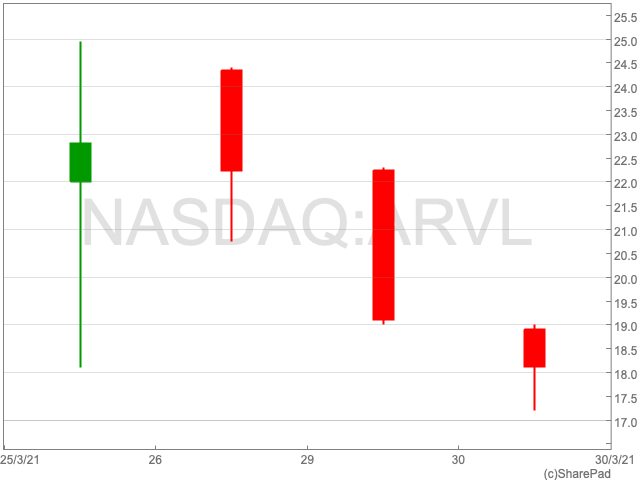
Arrival Share Price

Arrival (NASDAQ:ARVL), a British manufacturer of electric commercial vehicles, made its stock market debut at $22 per share on 25 March, raising around $660m, which valued the company at $13.6bn (£9.5bn). Since then it has come down to $18.12 per share. This followed Arrival completing its merger with SPAC company CIIG on Thursday 25 March. Arrival has said its listing is the biggest by a UK tech company in history.

Outlook

Arrival is expecting to record $1bn in revenue in 2022, increasing to $14billion by 2024, while aiming to become profitable in 2023. While the electric vehicles company has not met all of its pre-orders, it has established $1.2 billion worth of orders from United Parcel Service.

In order to meet the orders, Arrival confirmed it is constructing an additional micro-factory in Charlotte, North Carolina. President of Arrival, Avinash Rugoobur, said that the vertically integrated micro-factories would require less space and investment than traditional manufacturing bases, thereby lowering the company’s long-term cost base.

Electric Vehicles

Founder and chief executive Denis Sverdlov – a former deputy telecoms minister of Russia – said: “We believe that all vehicles will soon be electric, because it is better for people, the planet and business.”

“Arrival’s invention of a unique new method to design and produce vehicles using local Microfactories makes it possible to build highly desirable yet affordable electric vehicles – designed for your city and made in your city,” Sverdlov added.

In February Arrival began trials of its zero-emission Bus with First Bus, one of the UK’s largest transport operators. The trials, which will see Arrival buses navigating existing First Bus routes in the UK, will begin this Autumn. The new partnership comes just seven months after First Bus announced their commitment to purchase no diesel buses after 2022 and to operate a fully zero- emission fleet by 2035.

In addition, earlier in March the company unveiled specs, images and video of the next phase in the development of its electric van which will be starting public road trials with key customers this summer. Arrival believes it has set a new standard for commercial vehicles by introducing a fully electric van that excels across both payload (1975kg) and cargo volume (2.4m3 per metre in length) at a price comparable with fossil fuel vehicles, and with a substantially lower Total Cost of Ownership (TCO).

While the company is clearly making inroads in the growing industry of electric commercial vehicles, it has been ambitiously priced. Therefore investors may be more bullish if the stock comes down a bit more.

“If it comes down below $17.50, you can buy it hand over fist, because this one has the best claim to be the son of Tesla — or daughter, to break the tyranny of that awful cliche,” said Jim Cramer, host of CNBC’s Mad Money.

“We’re still in the early innings of this story, but it’s much more compelling than some of these other small-time electric-vehicle start-ups,” Cramer added.

Wetherspoon sets out plans for £145m post-lockdown investment

0

Wetherspoon chairman criticises possible vaccine passport

JD Wetherspoon (LON:JDW) has disclosed plans for a £145m investment aimed at expanding and upgrading its pubs – providing there is not another lockdown.

The FTSE 250 company has confirmed that the 75 projects would take over a year to complete and provide 2,000 new jobs. Over the coming decade the group is looking at investing an additional £750m, which would create a further 20,000 jobs.

The initial funding, set to begin this summer, will see 18 new pubs as well as 57 “significant” upgrades and extensions to existing sites.

Tim Martin, the Wetherspoon founder and chairman, said: “Our immediate investment will provide work for architects, contractors and builders as well as resulting in 2,000 new jobs for staff in our pubs.”

Martin reaffirmed his commitment to its long-term investment programme over the coming years but warned it is not a certainty.

“The investment is conditional on the UK opening back up again on a long-term basis, with no further lockdowns or the constant changing of rules,” Martin said.

“Since the great majority of our capital expenditure has always been funded by free cash flow, it would be reckless to proceed with major investment without a firm pledge that the lockdown and restrictions era is over. Excluding any capital expenditure whatsoever, the pub industry had a negative cash flow in the last year — investment without cashflow is Goodnight, Irene.”

The Wetherspoon also raised concerns over the possible introduction of coronavirus health certificates as England’s lockdown is eased in a Telegraph column.

The chairman of the pub chain said: “For many pubs, hanging on for dear life and devastated by G-force changes of direction, a complex and controversial passport scheme would be the last straw.

“It would inevitably put pub staff in the frontline of a bitter civil liberties war, with some customers unwilling to be vaccinated or unable to have a jab for medical reasons.”

Parsley Box off to slow start on AIM

0

Parsley Box directors now control around 31.2% of company

Parsley Box, provider of long-life ready meals to older customers, is down by 10.7% per share on its opening day of trading to 187.5p per share. This followed an early rise to 211.8p from a flotation price of 200p as the company made its debut on AIM.

Russell Pointon, Edison Group director of consumer and media, shared a positive outlook for the company after its promising start on the London stock market:

“It has a differentiated product offer (the only D2C ready meal provider offering easy to prepare meals that require no cold storage) and high level of customer service (next day delivery and no subscription required) that are geared to maximising customer convenience,” Pointon said.

“It has a clear opportunity to grow its customer base and their level of spend with the company in structural growth markets. The structural growth drivers include exposure to the fastest growing age demographic, which is currently underserved by other providers, and the ongoing shift of spend on food to e-commerce.”

Parsley Box raised total gross proceeds of £17m (£5m for the company and £12m for selling shareholders) giving an implied market of £83.8m.

Pointon further outlined the next steps fo the company as it seeks to expand its customer base.

“Management plans to scale the business, which is capital light, through increasing the frequency of purchases and AOVs from repeat customers while increasing the new customer base,” said Pointon.

“To facilitate this there will further range extensions (eg more price segmentation and special dietary foods) and broader categories (eg vitamins and functional foods). In addition, management is considering geographic expansion to countries with similar age and meal choice characteristics.”

Gordon and Adrienne MacAuley, a husband and wife team, started the venture in 2017. Kevin Dorren, 52, the Scottish entrepreneur who is involved in businesses such as Diet Chef, TVSquared and Machine Labs, moved from chairman to become chief executive in 2019.

The directors of the company will now control around 32.1% as trading has begun.