Bahamas Petroleum outlines opportunities in Trinidad and Suriname update

0

BPC core production portfolio at 450 to 500 barrels of oil per day

Bahamas Petroleum Company (LON:BPC) drew attention to a number of value drivers as the company provided an update ahead of its drilling programmes in Trinidad and Suriname.

First on the list is the Saffron #2 appraisal, which will be mobilised in April ahead of an anticipated start-date around the middle of May.

Assuming the appraisal is successful, Saffron #2 will deliver around 200 to 300 barrels of oil a day.

Between five to nine more follow up wells will be readied for drilling in H2 of 2021 to complement a field development which will eventually include approximately 30 wells.

The opening programme of wells is forecasted to produce between 1,000 and 1,500 barrels of oil before the end of 2021, which would generate around $8-12m of cash, at $60 per barrel.

An additional positive note from the company comes from Suriname, within the Weg Naar Zee production sharing contract (PSC) area, where drilling is due to start in July after a minor Covid-19 related delay.

Going back to Trinidad Bahamas Petroleum Company’s core production portfolio has steadied between 450 to 500 barrels of oil per day.

Simon Potter, chief executive of British Petroleum Company commented on the update:

“Since we acquired our Trinidad and Tobago and Suriname licenses, the team have worked tirelessly to fully understand their significant potential. This has progressed such that we are now looking at multiple value drivers via appraisal, infill and well testing campaigns across our portfolio during 2021.”

“Our immediate focus turns to the upcoming drilling of the Saffron #2 appraisal well, which we anticipate beginning 17 May 2021. Saffron #2 will further our understanding of the field and, in a success case, can quickly be put into production at extremely low cost, potentially adding 200-300 bopd.”

“It is our intention that through these actions we can continue to increase production to more than 2,500 bopd across our portfolio which, with a conservative oil price estimate, can generate significant cash flow.”
Kazera Global provides positive update on diamond production

0

Kazera Global share price jumps by 43%

Kazera Global shares (LON:KZG) soared on Thursday following the company releasing a positive update on its diamond production, as well as a proposed funding package.

The mining company confirmed its final tally of sorted diamonds had risen to 242 from the 220 carats expected the month before.

On the assumption that the price per carat is $200, the company will cover the cost of its South African operation. Kazera Global added that it expects its diamond production to be “materially profitable” in a trading update.

Dennis Edmonds, Kazera Executive Director managing the South African projects, commented:

“The latest diamond results mean that our South African operation is now covering its own overheads. The additional revenues from the gravel stockpile and the two new areas of operation indicate that this project should be a major cash generator for the Company in the near future.”

The company confirmed a €9,130,000 investment package from a Namibian investor is close to completion, with relevant due diligence set to be completed.

Upon the news being release the Kazera Global share price jumped up by 43% to 1.75p per share.

Larry Johnson, Kazera Chief Executive Officer, commented: 

“The proposed investment will be transformational in allowing us to build the water pipeline, construct the tailings dam that will enable us to recover water whilst facilitating waste storage in an environmentally sound manner, and to bring the processing plant back on line. It will also allow us to continue to explore the vast property with a third phase core drilling program, so adding further valuable resource to our world class tantalum and lithium assets. “

“We will also be able to continue exploring other opportunities available to us and to accelerate progress on our recent investments in South Africa.”

“The process has taken longer than anyone expected but reflects the structured and disciplined way in which Namibia approaches foreign investment, ensuring strict global compliance is met through rigorous documentation and KYC.”

Ocado sales up 39% as lockdown boosts demand for home deliveries

0

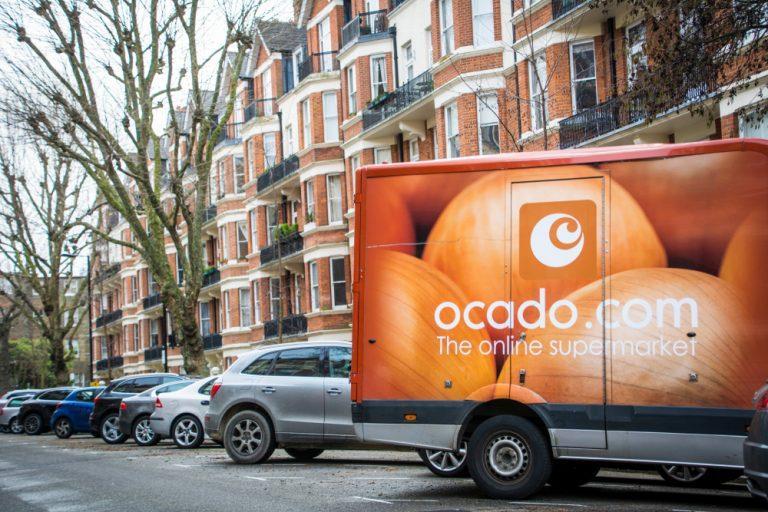
Ocado and Marks and Spencer dispatched 329,000 orders per week in Q4

Ocado (LON:OCDO) confirmed on Thursday that its sales surged by 39% in Q4, as the current lockdown buoyed demand for food at home.

The company anticipates a return to its normal results but offered no profit guidance for the coming year.

The size of an average order was recorded at £147 as families that remained in their homes purchased more goods. As a result, sales went up by two-fifths from the quarter the year before which was unaffected by the pandemic.

The partnership between Ocado and Marks and Spencer dispatched 329,000 orders per week during the 13 weeks to the end of February. The number was a small rise on the year before which displayed the limits of its automated picking capacity.

AJ Bell investment director, Russ Mould, commented on the performance of the group’s partnership with Marks & Spencer, as well as the continued trend of online shopping.

“Ocado’s latest update focuses on its joint venture with Marks & Spencer rather than the whole group, which means we don’t get the news people really want to hear – namely if it has managed to sign up any new grocery customers for its technology platform,” said Mould.

“The venture with Marks & Spencer is doing well, so there is reason to be cheerful when looking at Ocado’s performance. Revenue has been soaring which reflects how the country continues to flock to the online channel to buy food and drink. Ocado is increasing capacity for order volumes via new mini fulfilment centres.”

Melanie Smith, Ocado Retail’s chief executive, also commented on the update:

“Over the past year, large numbers of UK consumers have made a permanent shift to online grocery shopping. Ocado Retail is best placed to serve these customers as we continue to improve the customer experience through the joint venture with M&S, adding new products, offering greater value, and maintaining high customer service levels,” Smith said.

“We opened one mini Customer Fulfilment Centre in Bristol last month, which gives us capacity to serve more customers and with the opening of Purfleet and re-opening of Andover, both later this year, we ultimately expect to ramp our overall capacity by 40% with these sites.”

FTSE 100 steps back to digest news from US

0

FTSE 100 opened up 10 points, or 0.17% at 6773 points, following yesterday’s announcement by the US Federal Reserve and in anticipation of the latest update by the Bank of England.

“After an early gain the FTSE 100 took a step back on Thursday as investors tried to decipher the latest meeting of the US Federal Reserve,” says AJ Bell investment director Russ Mould.

“In some ways Fed chair Jay Powell and his colleagues delivered what the market wanted which was a commitment to keep interest rates low. However, it is now a question of the credibility of this argument,” Mould added.

Connor Campbell, financial analyst at Spreadex, commented on the FTSE’s move on and looked ahead to the Bank of England’s announcement later in the day.

“Once again the black sheep of the Western markets, the FTSE fell 0.2% in anticipation of the Bank of England’s Thursday get-together,” said Campbell.

“Like the Fed, Andrew Bailey and the MPC will be walking a tightrope, needing to celebrate the vaccine-led economic recovery in the UK, reassure about the impact of rising inflation on interest rates, and soothe concerns that the central bank will be turning off the taps any time soon.”

FTSE 100 Top Movers

Informa (3.22%), Rightmove (2.46%) and Standard Life Aberdeen (2.16%) lead up the index as the day’s top movers so far.

At the other end, the biggest fallers on the FTSE 100 are M&G (-4.62%), Ocado (-2.38%) and Rolls-Royce (-1.87%).

US Federal Reserve

The Federal Reserve is anticipating stronger than previously forecasted growth this year, as the vaccination roll-out continues apace and the government’s stimulus efforts start having an impact. The US central bank has forecasted growth of around 6.5% this year, an increase of its initial expectation of 4.2% in December. 

The Fed also confirmed a brighter outlook for the jobs market on Wednesday. However, the central bank decided against raising interest rates, with most members expecting to keep borrowing costs close to zero until after 2023.

Federal Reserve to keep interest rates at zero and raises US GDP forecast

0

Federal Reserve Chair Jerome Powell says ‘no one should be complacent’ about US recovery

The Federal Reserve is anticipating stronger than previously forecasted growth this year, as the vaccination roll-out continues apace and the government’s stimulus efforts start having an impact.

The US central bank has forecasted growth of around 6.5% this year, an increase of its initial expectation of 4.2% in December.

The Fed also confirmed a brighter outlook for the jobs market on Wednesday.

However, the central bank decided against raising interest rates, with most members expecting to keep borrowing costs close to zero until after 2023.

Chair of the Federal Reserve Jerome Powell said he wanted to see a more full recovery before changing policies which are aimed at stimulating the economy.

Jerome Powell stated that ‘no one should be complacent’ about the US recovery.

Commenting on the Fed keeping a zero-rate outlook, Olivier Konzeoue, fx sales trader at Saxo Markets, said:

“A cautious Fed decided to keep rates near zero and to maintain the pace of its monthly assets purchase at $120Bn but upgraded its economic outlook resulting in a change in the dot plot with seven out of 18 fed officials seeing a rate hike in 2023,” Konzeoue said.

“The Fed therefore deems it important to maintain accommodative financial conditions and is happy to see inflation run hot for some time in order to return to full employment by 2023.”

Powell described any rise above the 2% target as ‘transitory’, and that such an increase would not meet the standard required for a shift in monetary policy.

Connor Campbell, financial analyst at Spreadex, commented on the Chair’s remarks:

“In other words, an increase in interest rates is still off the table until at least 2024, even if 4 members of the FOMC would seek a hike in 2022, and 7 in 2023.”

The Dow reacted accordingly, closing nearly 190 points high to stick its foot across 33,000 for the first time in its history.

With the EU regulator set to announce its decision on the safety of the AstraZeneca vaccine, and automakers up in the aftermath of the Fed decision, the DAX easily outstripped its peers. Climbing 1%, the German index crossed 14,740 for the first time. The CAC, by contrast, added 0.1%, leaving it at a 13-month peak.

Fever-Tree expects strong growth in 2021 as bars set to reopen

0

Fever-Tree sees strong growth in America

Fever-Tree (LON:FEVR) announced on Thursday that it expects its revenues to rebound this year past pre-pandemic levels.

The company expects a lift by increased at-home drinking as well as the gradual easing of lockdown restrictions increasing its sales at bars and restaurants.

The producer of tonics and other mixers also confirmed its preliminary sales numbers during 2020 showed a 3% fall to £252.1m. The company anticipates revenue growth of between 12% and 16% in the coming year, while its adjusted core profit dropped by 26%.

Robust growth in America, where people are having drinks at home, has offset a 22% dip in UK sales.

In a show of confidence Fever-Tree proposed a full-year dividend of 15.68p per share, an increase of 4% from the year before.

Tim Warrillow, Co-Founder and CEO of Fever-Tree, commented on Fever-Tree’s performance throughout the pandemic:

“Our performance in the Off-Trade was especially strong, exceeding our expectations across all our regions. Numerous periods of lockdown during the year encouraged increased consumer interest in premium spirits and stimulated excitement about mixing drinks at home, attracting more households and new consumers to the Fever-Tree brand than ever before. Consequently, we have increased our penetration in the UK, driven value share gains in the US, and Europe, and gained real traction in Canada and Australia.”

“Despite the restrictions and closures that impacted the On-Trade for a large proportion of the year we didn’t furlough any of our team enabling us to support our customers across the On-Trade and Off-Trade, strengthening our relationships and securing new contracts.”

“Our resilient performance can also be attributed to the proactive and rapid actions taken by the business to respond to the evolving consumption and purchasing habits that emerged during the pandemic. Crucially, we did this while remaining focused on the longer-term opportunity. We expanded our team across all our regions, as well as acquiring our sales agent in Germany, and began local production in the US for the first time. We also launched new products with our Premium Soda range in the UK targeting the significant vodka category and Pink Grapefruit in the US targeting the fast-growing tequila category. Both launches were very encouraging, delivering an excellent rate of sale growth as well as attracting new consumers to the brand.”

National Express swings to a £381m loss

0

National Express cancels dividend payment for 2020

National Express (LON:NEX) reported a £381.4m operating loss on Thursday as the pandemic brought the company to a standstill during 2020.

The firm saw an 80% fall in passenger numbers as lockdowns first came into effect, causing its profit and revenue to plummet.

Having made an operating profit of £242m during 2019, National Express posted a loss of £326.7m.

Revenue also declined from £2.7bn in 2019 to £1.94bn the following year.

The company confirmed it would not be paying out a dividend in 2020 as a result of a tough year.

Ignacio Garat, chief executive of National Express Group, commented on the group’s performance during the pandemic.

“I am immensely proud of the performance of the National Express team in tackling the challenges faced in the past year and I have been impressed by the professionalism and dedication of my colleagues across the Group, who have done an outstanding job in delivering safe and reliable services for our customers during the most testing of times,” Garat said.

“I am also grateful for the support we have received from both customers and authorities, which demonstrates not only the essential nature of our services but also the strength of the relationships that we have built and the extent to which we are perceived as a trusted partner. This partnership approach, and the non-discretionary nature of the majority of our services positions us well for a strong recovery as travel restrictions are lifted in the months ahead. This is boosted by the sustainable cost savings made, and new contracts won during the period.”

“As a business we have an important role to play in modern society and I want us to continue to be at the forefront of the debate on climate change and the role we can play in social mobility. We have a strong and diverse international transport platform that has demonstrated its resilience in recent months. We have a clear set of priorities to ensure we will return to growth in a prudent and safe manner. We will be competing to win”

The Gym Group swings to loss as centres closed due to pandemic

0

The Gym Group retained a high number of customers since the turn of the year

The Gym Group (LON:GYM) announced on Thursday that it was in a position recover from a tough year as the organisation suffered a heavy loss during 2020.

The company recorded a before tax loss of £46.52m, a swing from a £14m profit during 2019.

The Gym Group‘s revenue fell by 47.4% from 2019 to £80.47m.

As a result of the pandemic unfolding during 2020, the firm had to shut down its centres for 45% of trading days in the year.

The Gym Group did retain a a high proportion of its members during the recent lockdown, with levels at 547,000 at the end of February 2021, compared to 578,000 at the beginning of the year.

Gyms are expected to re-open for individual exercise on 12 April, as a part of the government’s roadmap out of the current lockdown.

97% of the current members anticipate returning to the gym as soon as it re-opens, while 75% have said their fitness has become more of a priority since the pandemic began.

The company will open three new centres in April and one in May, with an additional four starting on-site imminently.

Richard Darwin, chief executive of the Gym Group, commented on his company’s resilience and the planned rebuild as lockdown measures ease.

“During 2020 we demonstrated the resilience of our business and its culture even in the most challenging of times,” Darwin said.

“By freezing subscriptions when closed and by providing an excellent COVID-secure environment in our gyms when open, we have retained most of our members; by supporting colleagues with topped-up furlough pay, honest communications and a comprehensive wellbeing plan we have high levels of staff retention and engagement; and by managing cash carefully we will emerge from the crisis with manageable levels of debt.”

“We are ready to start rebuilding our memberships levels and growing our estate from 12 April, extending affordable fitness at a time when health and fitness has never been more important.”

Antofagasta Share Price: boosted by strong production guidance

0

Antofagasta Share Price

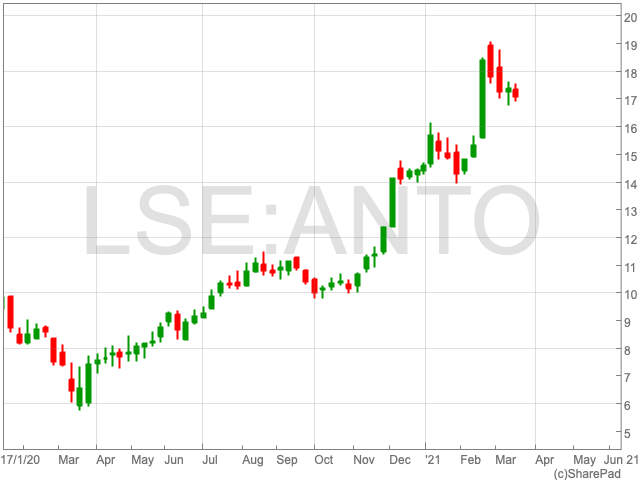
Over the past 12 months the Antofagasta (LON:ANTO) share price has risen by 175%, and since the turn of the year, the mining giant is up by 18.6%. The company’s strong performance coincided with the surge in the price of copper during 2020.

Antofagasta Share Price

Results

Antofagasta confirmed a 6% rise in its net profit during 2020 as well as raising its dividend, while mining giant’s net profit reached $893.9m, up from $843.1m in 2019. Lower costs and stronger prices more than offset a fall in copper production levels.

Antofagasta’s EBITDA increased by 12% to $2.74bn ahead of analysts’ expectations of $2.7bn. The copper miner also announced a final dividend of 48.5 cents per share, bringing the full-year number to 54.7 cents, and up from 50.9 cents in 2019.

Production

The London-based Chilean miner said its copper production had fallen 5% last year to 733,900 tonnes because of lower grades of copper, but would pick up in 2020 to between 730,000 and 760,000 tonnes.

“The year has been challenging, but we have successfully kept our people safe and healthy, achieved our production and exceeded our cost targets,” chief executive Iván Arriagada commented.

“Full year copper production was 733,900 tonnes and net cash costs were $1.14/lb, reflecting the company’s agility in changing operating conditions,” Arrigada added.

Copper

The red metal makes up a significant portion of Antofagasta’s revenue and has made a robust start to 2021, now valued at just below $9,000 per tonne. This bodes well for Antofagasta’s prospects. The question will be if copper can keep the momentum that was established in 2020 amid talk of a supercycle.

CRU director of base metals research and strategy, Vanessa Davidson, believes the copper price will peak in H1 of 2021, with the prices beginning to tail off towards the end of the year.

“Our expectation is that prices will drop next year. We see a peak in copper prices in the second quarter of this year, and then we expect to see prices coming off a little bit,” she said. “The supply from the new products will start hitting the market from the second half of the year.”

CRU is forecasting a 5.2% rebound in global copper consumption in 2021, with China increasing by 3.5% and the rest of the world increasing by 7.1%. “In order to get that recovery of 5.2% in global refined copper demand, we need the rest of the world to recover by 7.1%,” Davidson explained.

While the price of copper may not soar, providing the world economy recovers, demand will remain firm, and Antofagasta will be well positioned to capitalise.

BHP Share Price: mining sites offer advantage over Rio Tinto

0

BHP Share price

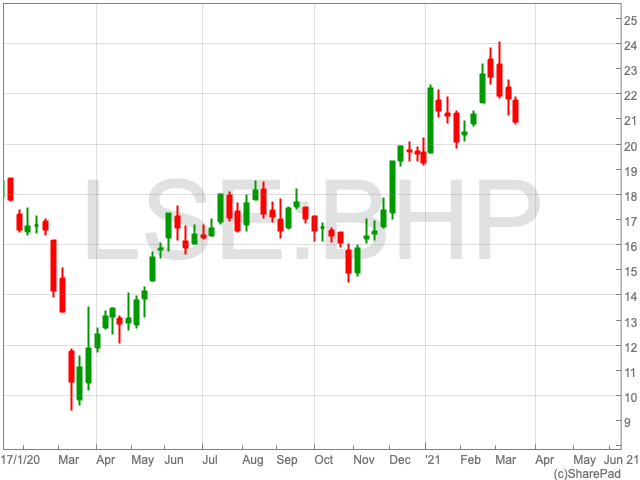
BHP (LON:BHP) performed well during the pandemic on account of the soaring price of iron ore. Additionally, BHP Group saw record output at its Western Australia Iron Ore (WAIO) operations, the company reported in its results. Over the past 12 months BHP is up over 100%, while year-to-date the share price is up by 8.16% despite a recent retreat.

Results

BHP posted strong results in February with robust margins and a record interim dividend payment.

The company revealed in February underlying EBITDA at $14.7 billion at a margin of 59%. While the mining giant’s underlying profit increased to $6.04bn from $5.19bn in the first half of 2020.

BHP’s operating cash flow is $9.4bn, while its free cash flow was confirmed at $5.2bn. The mining firm also recently announced its dividend at $1.01 per share for H1 2021, up from $0.65 the year before.

Production

BHP could be a preferable option for investors based on its advantages with its own mining sites. Goldman Sachs research suggests BHP’s mine sites and mining hubs could bring its capital intensity in Pilbara to average U$7 per tonne over the next five years, compared to Rio Tinto at around U$11 per tonne. The investment bank feels that Rio Tinto will have more mines to replace, requiring more capital expenditure, in addition to the ongoing fall-out from the Juukan George incident.

Iron Ore

Iron ore’s price thrived throughout 2020 as the company produced 280m tonnes of the commodity. BHP’s outlook will depend on whether or not the iron ore can continue its rise into 2021.

However, a recent pollution crackdown by China began to suppress the price of iron ore. There are now question marks over the future prospects of the commodity, which could in turn lead to concerns over the FTSE 100 company’s future prospects.

Having risen from $80 per tonne in March 2020 to nearly $180 per tonne a year later, the commodity has retreated following China’s new policies. 

Nicholas Snowdon, analyst at Goldman Sachs, predicts the Chinese government will increasingly look to limit emissions which will cap the production of iron ore, causing downward pressure on the price of the commodity. 

“We now see iron ore prices turning lower in the coming months,” said Snowdon, who has set a 12-month price target of $100 a tonne. “This reflects mounting evidence that supply is shifting toward a sustained recovery and also that China’s environmental policies will reinforce a peak in iron ore imports.”