ASOS set for FTSE 250 demotion and shares could fall even further

ASOS is set to drop out of the FTSE 250 after a prolonged period of poor share price performance amid falling revenues and deep losses.

Once the shining light of London’s technology sector, ASOS shares are down 30% so far in 2025 and are worth less than 5% what they were at their peak.

“Fast fashion group ASOS looks set to be kicked out of the FTSE 250 in the latest blow to the company’s reputation,” said AJ Bell investment analyst Dan Coatsworth.

“ASOS moved from AIM to the Main Market in February 2022 with the aim of enhancing its corporate profile and recognition, as well as attracting a broader group of institutional shareholders.

“At the time, it had an ambitious growth strategy and was determined to bounce back from a post-pandemic hangover which saw a big slowdown in sales growth across the retail sector. Unfortunately, its struggles have got worse and the shares have limped along. Competition has remained fierce, consumer trends have shifted, and ASOS has been left behind.”

ASOS reported a 13% drop in adjusted group revenue for the interim 26-week period to 2nd March. Gross margins did improve slightly to 45% but the group still reported a £70m loss before tax.

The worrying thing for investors is that ASOS has thrown the kitchen sink at trying to improve efficiencies and return to profitability, but it doesn’t seem to be working for them.

ASOS have even started banning customers who make too many returns. This isn’t an action taken by a company confident in its growth prospects.

One has to look at the £360m market and wonder how much further it could fall.
FTSE 100 in holding pattern ahead of Jackson Hole

The FTSE 100 was trading in a holding pattern on Friday as markets geared up for the Jackson Hole Symposium and a speech by the Fed Chair that could move the dial for stocks.

Friday’s steady session followed another record high for the FTSE 100 yesterday, achieved with the help of London’s defensive sectors.

“The FTSE 100 notched its third consecutive record close yesterday, edging up 0.2% as healthcare and mining stocks led the charge,” said Matt Britzman, senior equity analyst, Hargreaves Lansdown.

“A strong UK manufacturing PMI print added to the upbeat tone, signalling the best month for services in a year. The early US trade deal and relatively inexpensive valuation for UK companies relative to global peers have made for an attractive backdrop for UK stocks that have performed well all year.”

There was further good news on the economic front on Friday as GfK’s UK Consumer Confidence Index rose two points as the BoE’s interest rate cut helped lift the mood.

“The biggest changes in August are in confidence in personal finances, with the scores looking back and ahead a year each up by three points,” explained Neil Bellamy, Consumer Insights Director at GfK.

“This is likely due to the Bank of England’s August 7th cut in interest rates, delivering the lowest cost of borrowing for more than two years. The improved sentiment on personal finances is welcome, but there are many clouds on the horizon in the form of inflation – the highest since January 2024 – and rising unemployment.”

Standard Chartered was the top riser after reports of a favourable development in their long-running case with US courts. Standard Chartered shares were 3.2% higher at the time of writing.

Airtel Africa enjoyed a 2% gain as the stock retested all-time highs just above 220p

Gains were offset by losses for Rightmove, Coca-Cola HBC and Prudential.

Oil prices steady after two-day rally

The oil price was steady on Friday after a two-day rally for Brent and WTI, driven by disappointment about Trump’s failure to advance the Ukraine peace process.

WTI was trading up 0.3% at $63.75 at the time of writing, while Brent was 0.2% higher at $67.86.

“The lack of progress on a Putin-Zelenskiy summit and on security guarantees reinforced expectations of prolonged conflict and potentially tougher US sanctions, adding a risk premium that could reverse part of the recent weeks’ decline,” said Frank Walbaum Market Analyst at Naga.

“Meanwhile, the market could continue to find support after US inventory data showed large drawdowns. API crude inventories fell by 2.4 million barrels in the week ending August 15, reversing the prior week’s build, while EIA declined by 6 million barrels, suggesting stronger demand. The market is also awaiting the OPEC+ meeting on September 7 for guidance on production by the organisation’s members.”

The next catalyst for the oil price will be today’s Jackson Hole Symposium and any hints of changes to interest rates to support US growth.

Revolution Beauty ends sale process to return to founder-led business

Revolution Beauty has ended its sale process and is returning to being a founder-led business after failing to find a buyer.

To support the renewed strategy, Revolution Beauty has announced plans to raise approximately £15 million through an equity placing, marking a potential reset for the embattled cosmetics company.

The multi-channel beauty brand will issue up to 500 million new ordinary shares at 3p each – a 14% discount to the prior closing price of 3.5p. The placing represents a massive 156.5% of existing shares, significantly diluting current shareholders.

Revolution Beauty investors Debenhams and the founders, who hold 7.6% of existing shares, have committed to participate in the placing. The company will also launch a separate £1.5 million retail offer for UK shareholders.

To lead the business forward, Co-founder Tom Allsworth will return as chief executive. His fellow founder, Adam Minto, will rejoin in a consultancy role. The duo previously grew Revolution Beauty to nearly £190 million in revenue, delivering 99% compound annual growth between 2014 and 2019.

Shareholders should be mildly optimistic about their return.

Strategic overhaul

The return of the founders follows a torrid period for Revolution Beauty. Revenue plunged 26% to £141.6 million in the last financial year as management discontinued over 6,000 product lines. Trading in early 2025 proved “softer than planned” due to weakness in digital retail channels.

The founders have outlined a three-pronged strategy: refined product development and pricing, streamlined operations, and optimised marketing spend.

With shares losing 98% of their value over five years, investors will hope the new strategy works.

FTSE 100 eases back from record high

The FTSE 100 touched fresh intraday record highs on Thursday before easing back as London’s defensive attributes attracted investors amid a US tech sell-off.

London’s leading index was trading down 0.3% at the time of writing after hitting an intraday record of 9,301 earlier in the session. 

The FTSE 100’s more defensive-oriented stocks were among the leaders that helped keep losses contained on Thursday, with BAE Systems, Fresnillo and Whitbread having a solid session.

Much of the downside for the FTSE 100 on Thursday was a result of stocks trading ex-dividend. Legal & General and Imperial Brands were among those losing the right to upcoming dividends.

For years, the absence of major technology firms has meant the FTSE 100 lagged global peers such as the S&P 500, but 2025 has seen a significant outperformance of the FTSE 100 due to its weighting to sectors such as defence, pharma, and utilities.

This was again the case this week, with the FTSE 100 touching fresh highs as US stocks faltered after the release of Federal Reserve minutes.

“It’s not too often that the FTSE 100’s lack of technology exposure is a virtue but it has been this week,” says AJ Bell investment analyst Dan Coatsworth.

“Amid selling in Europe and the US, the UK’s flagship index tested new highs above 9,300. Old world economy stocks like banks, energy companies and insurers have been to the fore – with their generous dividends in demand with investors.

“In the US overnight, tech names trimmed heavier losses seen earlier in the trading session.”

Although names such as Babcock, BAE and Weir helped provide support for the index, losses for Mondi, Legal and General, and Coca Cola HBC weighed.

All eyes will now be on Jackson Hole and the Fed Chair for further hints on the trajectory of interest rates.

AIM movers: boohoo financial restructuring and ex-dividends

1

Versarien (LON: VRS) says the acquisition of its graphene IP by a potential joint venture with a Chinese business has been blocked by the UK government. A strategic investment is still possible. The share price rebounded 64% to 0.0164p.

Wishbone Gold (LON: WSBN) says drilling at the Red Setter gold dome project in Western Australia has reached 777 metres and the breccia pipe is 152 metres long. Drill core is being transported to be assayed. The share price improved 12.2% to 1.06p.

Online retailer boohoo (LON: DEBS) has completed a refinancing that provides up to £175m over three years. This replaces a £125m facility. The share price recovered 7.03% to 14.92p.

Andrada Mining (LON: ATM) has completed construction of a second processing plant at the Uis tin mine within budget. Tin output should significantly increase. The share price rose 6.9% to 3.1p.

FALLERS

Pulsar Helium Inc (LON: PLSR) has raised £3.72m at 23p/share and Universal Bancorp has raised its stake to 4.99%. The cash will be invested in developing the Topaz helium project in Minnesota. There are plans for ten appraisal wells. There will also be a preliminary economic assessment and resource update. The share price fell back 19% to 23.5p.

Image Scan (LON: IGE) is being hampered by further delays to a major defence contract and difficulties securing components. That will hit second half revenues. There was £771,000 in the bank at the end of July 2025. Zeus has withdrawn forecasts. The share price declined 10.3% to 1.3p.

Packaging manufacturer Robinson (LON: RBN) increased interim operating profit by one-quarter to £2.04m on a 2% increase in revenues to £27.6m. Additional working capital increased net debt to £8.5m, but the second half should be a strong cash generator. The share price has been on an upward trend because of property disposals and profit upgrade. There was some profit-taking and the share price slipped 4.84% to 147.5p.

Eurasia Mining (LON: EUA) says share trading has commenced on the AIX, and the currency is US dollars. The share price fell 4.17% to 4.6p.

Ex-dividends

Cohort (LON: CHRT) is paying a final dividend of 11.05p/share and the share price is 12p lower at 1210p.

Samuel Heath & Sons (LON: HSM) is paying a final dividend of 8.56p/share and the share price is unchanged at 335p.

Supreme (LON: SUP) is paying a final dividend of 3.4p/share and the share price decreased 3.5p to 178.5p.

Convatec Group: after recent Interims FTSE-100 group’s shares on the upward move again 

In the last day or so the shares of the ConvaTec Group (LON:CTEC) has been one of the standout performers, climbing nearly 6% following the medical products company announcing a chunky share buyback programme of up to $300m. 
ConvaTec operates in four chronic care categories, which have market growth rates varying between 4-8% p.a.  
It sells over 900m high-quality consumable products annually for a diverse range of chronic conditions and are among a small number of leaders in the categories in which we operate. 
The group expects to consistently grow revenues faster than each m...

Cloudbreak Discovery shares soar on ‘encouraging’ gold sampling results

Cloudbreak Discovery shares rocketed higher on Thursday after announcing early results from gold exploration activities in Western Australia.

Cloudbreak Discovery has reported what it calls ‘very encouraging results’ from its inaugural gold sampling programme at the Darlot West Gold Project.

Shares in the company were over 150% higher after Cloudbreak said maiden exploration work had yielded gold grades significantly above expectations.

Surface rock chip sampling across four distinct prospect areas has returned multiple significant results, with the highest grade reaching 28.62 grammes per tonne of gold. A repeat assay of this sample confirmed the exceptional nature of the find, returning an even higher grade of 34.15g/t Au.

Other notable results from the programme include grades of 4.50g/t, 2.62g/t, and 1.30g/t gold. These findings demonstrate consistent mineralisation across multiple areas within the project.

The Darlot West project sits just 10 kilometres southwest of the renowned Darlot Gold Mine, which has produced 2.8 million ounces of gold to date.

“These gold results from our initial field trip and the investigation, carried out as part of the Company’s due diligence on the tenement, are exceptionally good. Getting results approaching an ounce of gold per tonne are not common and are much better than we had expected,” said Tom Evans, Cloudbreak’s MD.

“An exploration programme is being planned to further understand the extent of gold mineralisation and the areas gold ounce potential. We look forward to providing further updates with respect to additional exploration to be completed.”

WH Smith slashes profit expectations amid accounting irregularities

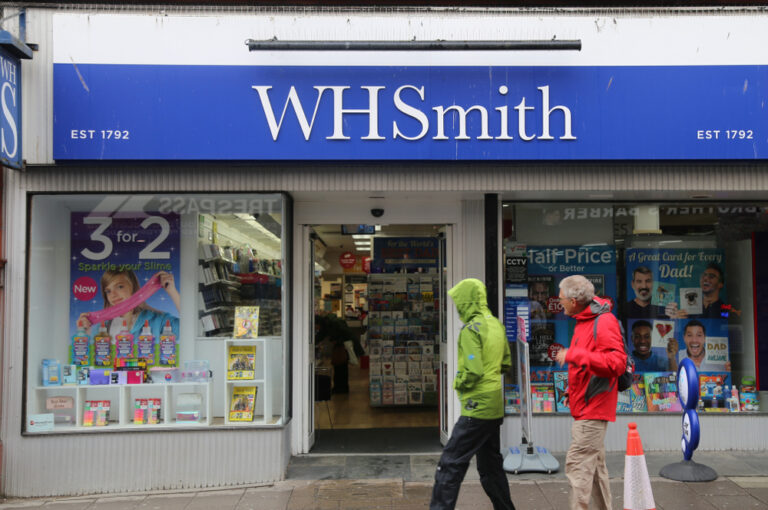
WH Smith shares were down 30% in early trading on Thursday after the group announced a sharp reduction in group full-year profit expectations.

WH Smith has slashed its profit expectations for North America by £30m following a financial review that uncovered accounting irregularities.

The travel retailer now expects headline trading profit from its North America division to reach approximately £25m for the year ending 31 August 2025. This represents a dramatic fall from previous market expectations of around £55m.

The overstatement stems largely from the premature recognition of supplier income within the North America operation. WH Smith’s board has commissioned Deloitte to conduct an independent review of the issues.

The revision means the group’s full-year headline profit before tax will be around £110m. Further details will be provided when WH Smith announces its preliminary results.

WH Smith reported £160m headline profit before tax for the year ended August 2024, and investors are bitterly disappointed they are staring down the barrel of PBT coming in a third less in 2025.

The fact that the profit warning is largely down to an own goal will make the news even more painful.

WH Smith shares are now trading at less than half of their 2023 high.

Inheritance tax receipts rise again

Inheritance tax receipts have continued their upward trajectory as asset prices rise and major estates are dragged into paying the tax.

Income tax receipts surged dramatically in July, driven by a combination of the self-assessment deadline and the ongoing freeze on tax thresholds.

Inheritance tax receipts for the period from April 2025 to July 2025 reached £3.1 billion, representing an increase of £200 million compared to the same period last year.

“Inheritance tax receipts continue their unrelenting rise, hitting £3.1bn for the year so far. We are only part of the way through the year, but it already looks likely we are in for another record year for this most unpopular of taxes,” said Helen Morrissey, head of retirement analysis, Hargreaves Lansdown.

“The decision to include pensions for inheritance tax purposes has garnered a lot of attention and has put the tax firmly on people’s radar. This means that those who think they may be affected can start putting a strategy in place to try and mitigate it.”

Morrissey suggested there are quick and easy methods to reduce the IHT bill, such as gifting, although this won’t make a dent in the bills that larger estates have to pay.

“There are various gifting allowances such as the £3,000 annual allowance as well as gifting out of surplus income that will prove useful. However, it is hugely important that someone does not gift away too much too early to loved ones and potentially leave themselves short in their haste to avoid this tax,” Morrissey said.