EasyJet share price: all set to capitalise on a return to travel

0

EasyJet Share Price

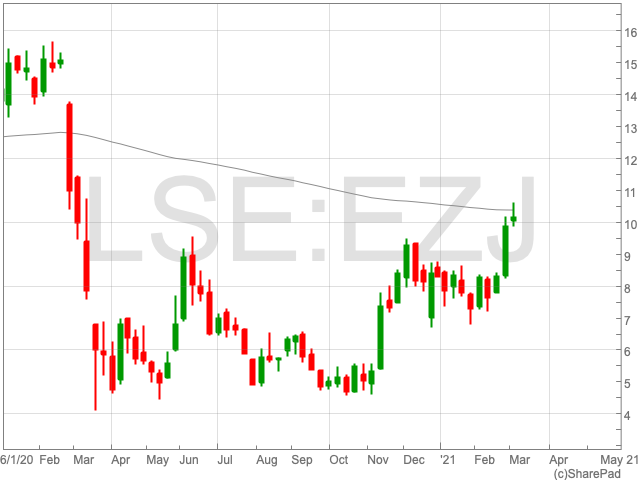
EasyJet’s share price sat at 1,508.50p in February 2019 before news of global travel restrictions caused a fall to 475p per share at the beginning of April. However, the airline has gained ground since, climbing back up to 1,014.50p per share, particularly in recent weeks, as the government outlined plans to lift restrictions. Since the beginning of 2021 EasyJet’s share price is up by 32%.
EasyJet share price

Potential for Growth

In February, the Prime Minister announced a four-stage plan for easing lockdown measures in the UK, with a return to international travel proposed for 17 May. The date, just before the beginning of the summer holiday season, unleashed a surge of pent-up demand, as EasyJet reported a dramatic rise in the number of holiday bookings.

Chief executive of easyJet, John Lundgren, commented on the figures: “We have consistently seen that there is pent-up demand for travel and this surge in bookings shows the signal from the government that it plans to reopen travel has been what UK consumers have been waiting for.”

In addition, the UK airline raised €1.2bn worth of seven-year bonds at the end of February at a yield of 1.875%.

“Monday’s announcement was incredibly helpful but, this was opportunistic on the back of recent market conditions irrespective of [the] announcement,” said Mark Lynagh, co-head of Emea debt markets at BNP Paribas, who worked on the deal. He added that this “plays into the optimism around the recovery that we’re going to see and there is a view that low-cost carriers like easyJet are well placed to benefit from that”.

Risks

EasyJet reported a £1.3bn loss towards the end of 2020, down from a £430m profit the year before. Even if the airline industry does recover, it could be a long road back for EasyJet, as many of its costs have remained constant throughout the pandemic.

Otherwise, there is the question of if and when travel can return to normal. Even once most people have received a vaccine jab, if the disease lingers, then international travel could be restricted beyond May 17.

“The challenge is to find a way to live with it without keeping huge restrictions in place,” says Azra Ghani, professor of infectious disease epidemiology at Imperial College London.

ESG trend lifts global ETF industry to $8trn

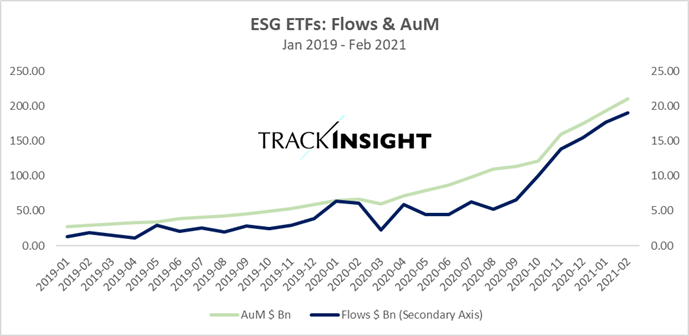
ESG ETFs see new high of $210bn assets under management

ETFs (Exchange-Traded Funds) have reached a record high of $8trn assets under management (AuM) as investors scour the market for options that meet ESG (environmental, social and governance) standards.

This is according to data collected in February by trackInsight, a global Exchange-Traded Funds analysis platform.

Funds listed in North America saw over $95bn flow in last month, nearly a 50% increase month-on-month. 3,200 ETFs are now listed on North American exchanges with $5.9bn in AuM.

February was the single large month in history for ESG funds, which saw $19bn coming in, to reach a new high of $210bn.

ESG ETFs: Flows and AuM

Bitcoin ETFs also reached record highs in February with nearly $0.25bn flowing in. Bitcoin is tracked via ETFS by $4.5bn worth of assets, a small but increasing portion of its $1trn market cap.

In contrast, Gold funds lost their lustre over February as flows went negative, losing $5 Billion for a total of $186 Billion of AuM. However, Cannabis ETFs made up seven of the top ten best-performing funds this year.

Anaelle Ubaldino, head of research and investment advisory at TrackInsight, commented on the company’s findings:

“The flexibility of the ETF wrapper means that an ever-increasing range of ideas, from actively managed strategies to ESG and thematic investments like disruptive tech and Bitcoin, are now easily available to all investors, and many are taking the opportunity to gain exposure to asset classes and strategies that were previously unavailable to them.”

“However, the proliferation of choices, not just in areas like ESG or Bitcoin, but across ETFs in general means investors are faced with a paradox of choice. So investors must do their homework and look beyond the headlines and media hype when picking an ETF as products that are similar on the surface may be very different when you look under the hood.”

FTSE 100 in the red as rising bond yields provide continued cause for concern

0

FTSE 100 could benefit again from rising oil prices

FTSE 100 is down 0.53%, by 35 points, during morning trading on Friday. The index is down to 6,615.82 points as a knock-on effect of a sell-off in America brought about by a rise in US bond yields.

“After Fed chair Jay Powell’s comments last night, that the Fed was focussed on its dual mandate of unemployment and inflation, and that the central bank was a long way from meeting either, would under normal circumstances, have been enough to assuage market concerns about a premature tightening of policy,” commented Michael Hewson at CMC Markets.

“By not specifically referencing or expressing concern over the recent move higher in longer term US yields, and looking to hold the markets hand, it was perhaps not surprising that the bond sell-off continued, however whether the sell-off is sustained is a different matter entirely.”

FTSE 100 Top Movers

The Asia focused banks, Standard Chartered (2.84%) and HSBC (1.75%) and supermarket giant Sainsbury (1.48%) led up the index during the morning session.

London Stock Exchange Group (-5.87%), Scottish Mortgage Investment Trust (-5.15%) and Admiral Group (-3.17%) are the biggest fallers on the FTSE 100 so far.

ConvaTec

ConvaTec, the medical technology company, confirmed a rise in full-year revenue along with a fall in earnings during 2020. For the year ending in December 2020, ConvaTec’s revenue increased by 4% to $1.89bn, while pre-tax earnings fell by 1.1% to $350m. 

According to a statement by the FTSE 100 company, ConvaTec’s performance during 2020 was driven by strong growth in the Infusion Care and Continence & Critical Care businesses, offsetting limited growth in Ostomy Care and a decline in Advanced Wound Care.

Triple Point Social Housing REIT

Triple Point Social Housing REIT recorded an operating profit in 2020 of £30.2 million, up from £26.9 million the year before.

The profit came in addition to the company acquiring 58 properties (400 units) during the year at a total investment cost of £78.9 million. The trust’s total investment portfolio now stands at 445 properties.

Oil Prices

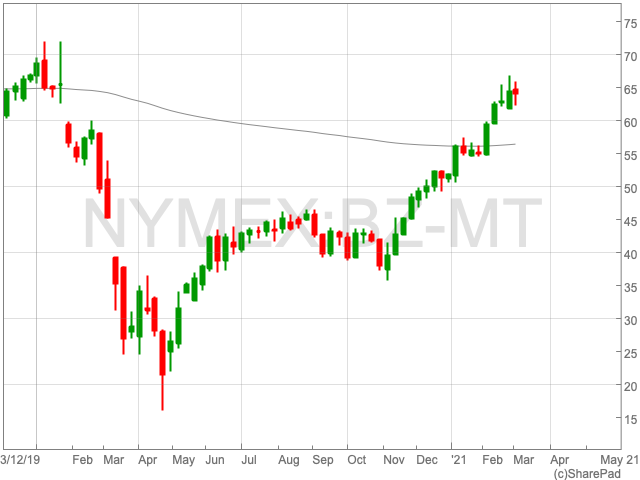
Oil prices have climbed to a 14-month high as Brent crude oil reached $67.85 per barrel today, its highest level since January 2020. West Texas Intermediate is up to $64.8 per barrel on Friday morning.

In the UK, the FTSE 100 has benefited from strong performances from oil companies in recent weeks, in addition to mining firms, relying on both sectors for gains. 

Oil prices climb to 14-month high

Opec and allies to restrict oil supply during April

Oil prices have climbed to a 14-month high as Brent crude oil reached $67.85 per barrel today, its highest level since January 2020.

West Texas Intermediate is up to $64.8 per barrel on Friday morning.

Brent crude oil price

The news came as Opec and its allies made the decision to restrict supply during April amid uncertainty around the economic recovery from the pandemic.

Prince Abdulaziz bin Salman, the Saudi Arabia’s oil minister and son of King Salman, warned against complacency over the commodity’s recovery.

“Let us be certain that the glimmer we see ahead is not the headlight of an oncoming express train,” he said, as a meeting of oil ministers began. “The right course of action now is to keep our powder dry, and to have contingencies in reserve to ensure against any unforeseen outcomes.”

bin Salman stated that he favoured a more cautious approach moving forward.

“When you have this unpredictability and uncertainty [I believe in] taking things in a more precautionary way.”

The news has prompted analysts to raise their price forecasts for the commodity. Goldman Sachs raised its forecast to $75 per barrel, up $5 per barrel, for Q2 of 2021, and $80 in Q3.

Having reached an all-time low in April 2020 due to worldwide lockdowns, oil has climbed back to its pre-pandemic level.

The price of oil is looked to as a barometer of activity as the world economy continues to cope with the ongoing coronavirus pandemic.

After worldwide lockdowns first came into effect in early 2020, oil prices plummeted into negative territory. Producers who did not have adequate storage capacity, were paying buyers to take the commodity off their hands. 

In the UK, the FTSE 100 has benefited from strong performances from oil companies in recent weeks, in addition to mining firms, relying on both sectors for recent gains.

“Between them they provide a fifth of the index’s market capitalisation and are forecast to provide 31% of total profits and 28% of aggregate dividends in 2021,” according to Russ Mould, investment director at AJ Bell. 

ConvaTec revenue up despite fall in sales during pandemic

0

ConvaTec full-year dividend up to 5.7 cents per share

ConvaTec (LON:CTEC), the medical technology company, confirmed a rise in full-year revenue along with a fall in earnings during 2020.

For the year ending in December 2020, ConvaTec’s revenue increased by 4% to $1.89bn, while pre-tax earnings fell by 1.1% to $350m.

According to a statement by the FTSE 100 company, ConvaTec’s performance during 2020 was driven by strong growth in the Infusion Care and Continence & Critical Care businesses, offsetting limited growth in Ostomy Care and a decline in Advanced Wound Care.

ConvaTec announced a dividend of 3.983 cents per share to take the full-year dividend for 2020 up to 5.7 cents. This was in line with the previous year’s figure.

ConvaTec is forecasting organic revenue growth of between 3-4.5% during 2021 and a constant currency adjusted EBIT margin of 18-19.5%.

The company’s share price rose by 2.33% to 193.2p in early morning trading upon the release of its financial results.

Karim Bitar, chief executive at ConvaTec, commented on the results:

“I am pleased with our strategic progress and how the business performed in 2020.  Against the backdrop of COVID-19 we set our new strategic direction of travel, responded well to the needs of our customers and improved our operational performance.  In addition our ongoing strategic transformation remains firmly on track.”

“The outlook for 2021 is positive although uncertainty surrounding COVID-19 persists.  We expect to see 2021 organic4revenue growth of between 3-4.5% and a constant currency adjusted EBIT margin of 18-19.5% as we continue to invest in our transformation, some of which was deferred from 2020, and as COVID-suppressed costs begin to normalise.”

“There is still further work ahead for the Group as we continue to strengthen our foundations and begin to pivot to sustainable and profitable growth, but I am confident in the inherent attractiveness of the markets we serve and in ConvaTec’s growth prospects.”

Triple Point Social Housing REIT acquires 58 new properties as profits rise

0

Triple Point Social Housing REIT will pay a dividend 5.18p per share

Triple Point Social Housing REIT (LON:SOHO) recorded an operating profit in 2020 of £30.2 million, up from £26.9 million the year before.

The profit came in addition to the company acquiring 58 properties (400 units) during the year at a total investment cost of £78.9 million. The trust’s total investment portfolio now stands at 445 properties.

The organisation’s portfolio was independently valued at £571.5 million on an IFRS basis, up from £471.6 million in 2019. This represents a valuation uplift of 7.7% against total invested funds of £530.7 million, according to the company’s financial statement released on Friday.

100% of rental income due and payable for the period ended 31 December 2020, and due and payable at 28 February 2021 has been collected.

Triple Point Social Housing REIT will pay a dividend on 26 March 2021 of 5.18p per share. This is around the same level as the previous two years.

On early morning trading the REIT’s share price is up by 0.47% to 107.5p per share

Max Shenkman, head of investment at Triple Point Social Housing REIT, commented on the results:

“Despite the challenges of 2020, Triple Point Social Housing REIT had another year of strong performance, demonstrating that investments that have a positive social impact are often the most resilient – especially in times of difficulty. Our stakeholders rose to the challenge to continue the delivery of high-quality housing, the need for which is as great – if not greater – than ever before.”

“The fundamentals of our sector remain strong, and we look forward to what we can achieve in 2021 by working hard to deliver the housing that is so desperately needed across the length and breadth of our country.”

The trust was one of three organisations that presented investment opportunities at February’s UK Investor Magazine Virtual Investor Conference

The REIT’s aim is to allow investors to get a solid long-term return while having a positive impact on society. Their mission is geared towards addressing the ongoing housing crisis by investing in the UK social housing sector.

Metal Tiger encouraged by progress at the Kitlanya East copper-silver project

Metal Tiger CEO looking forward to providing details of KML’s follow-on drilling activities

Metal Tiger (LON:MTL) gave an update on Thursday morning on “encouraging progress” at the Kitlanya East copper-silver project in Botswana, operated by Kalahari Metals Ltd (KML).

Airborne geophysics survey and soil sampling results highlight the potential for the South Fold target to host copper-silver mineralisation in a similar setting to Sandfire Resources’ neighbouring T3 and A4 deposits.

Michael McNeilly, chief executive of Metal Tiger, commented on the results:

“The processed results from the Q4 2020 airborne geophysics survey and soil sampling programme highlight the potential for the South Fold Target to host Cu-Ag mineralisation in a similar setting to the neighbouring Sandfire Resources T3 and A4 deposits as corroborated by a recently commissioned independent structural assessment.”

“With these encouraging results, in the heart of the rapidly developing Kalahari Copper Belt, we look forward to providing details of KML’s follow-on drilling activities planned for the Kitlanya East Project.”

Metal Tiger‘s share price closed 2.22% down at 22p.

Deliveroo aiming for $10bn valuation in London IPO

0

Deliveroo committed to making London its “long-term home”

Deliveroo has its sights set on a $10bn valuation ahead of its initial public offering, which would be the highest valued new listing in London for a number of years.

The food delivery business, which saw demand rocket during the pandemic, is looking to benefit from new rules making it easier for companies to list in the UK’s capital city.

Deliveroo, which operates internationally, also committed to making London its “long-term home”.

Will Shu, who founded Deliveroo in London eight years ago, said the city was “a great place to live, work, do business and eat. I’m so proud and excited about a potential listing here”.

If Deliveroo is able to float at the level of its target range, the food delivery company will have a market cap in excess of £7bn.

Following a private financing in early 2021, Deliveroo was valued at $7bn, a figure that since Amazon led up an investment round n 2019.

In a private financing in January Deliveroo was valued at about $7bn, a figure that had already doubled since an Amazon-led investment in 2019.

Professor John Colley, Associate Dean of Warwick Business School and an expert on tech firm IPOs, commented on the prospective valuation.

“This valuation of Deliveroo seems excessive for a business which is still many years from profit, especially given that some hold significant doubt whether the home takeaway delivery model can become profitable outside of London.”

“Indeed, the sole basis for this valuation appears to be the immense amounts of cash looking for growth technology stocks.”

Colley also outlined difficulties in making profit in an already squeezed industry.

“Ultimately Deliveroo will have to charge customers and restaurants far more to make a profit, but that brings its own difficulties. For restaurants, margins are already narrow. And at what price do customers simply decide to collect their own meals?”

Revolution Bars is anticipating a surge in demand as it prepares to reopen

0

Revolution Bars expecting “significant pent-up demand” following the easing of restrictions

Revolution Bars (LON: RBG) confirmed today that it will be opening 20 of its locations when hospitality companies are allowed to serve customers outdoors in April.

The AIM-listed company, which owns 66 sites in total, is expecting “significant pent-up demand” following the easing of restrictions.

While the company would liked to have resumed business sooner, the roadmap out of lockdown has enabled it to prepare properly ahead of reopening, according to a Covid-19 update released today.

Revolution Bars has been getting through around £400,000 to £450,000 per week, according to the statement, which also stated that the company has £9.8m of liquidity.

The company’s share price soared today by 15.55% to 3,270p per share following its announcement. Year-to-date, Rovolution Bars’ share price is up from 2,100p.

Rishi Sunak confirmed yesterday during his budget announcement that retail and hospitality businesses will receive a special “restart” grant to help them reopen in April.

Rob Pitcher, chief executive of Revolution Bars Group, commented on the company’s outlook for thee remainder of the year and beyond.

“With the encouraging progress of the vaccination programme, clarity in the timetable to reopening, and the additional financial support measures announced by the Chancellor, the light at the end of the tunnel is getting brighter.”

“Notwithstanding that good news, our industry remains on the critical list and the continued support announced by the Government is required to ensure that we can be in a position to return to growth and be a driver of national job creation once again particularly for young people who are the lifeblood of our industry and who have been severely impacted over the last year.”

“We are excited at the prospect of welcoming back our colleagues and guests and providing fun and memorable experiences for them as lockdown restrictions ease.”

Construction sector rebounded in February on increase in commercial activity

0

IHS Markit/CIPS UK Construction Total Activity Index was at 53.3 in February

Following a setback at the beginning of the year, UK construction companies delivered a robust return to growth in February, according to survey compiled by IHS Markit.

PMI data also revealed that new orders had regained momentum, as well as more projects beginning, amid economic optimism.

The seasonally adjusted IHS Markit/CIPS UK Construction Total Activity Index was at 53.3 in February, up from 49.2 the month before. Any measure above 50 signals a an increase on overall construction output.

Despite lockdowns, the index has registered above the 50.0 no-change mark in eight of the past nine months.

Residential work remained the strongest area of growth, although the speed of recovery eased slightly since January.

FTSE 100 construction companies, including Persimmon and Taylor Wimpey, have propped up London’s blue-chip index in recent months, as other sectors have struggled through the pandemic.

The industry received a boost yesterday as the Chancellor pledged to “stand behind home buyers” during his budget speech in the House of Commons.

Tim Moore, Economics Director at IHS Markit, commented on the survey’s findings:

“Construction work regained its position as the fastest-growing major category of UK private sector output in February. The rebound was supported by the largest rise in commercial development activity since last September as the successful vaccine rollout spurred contract awards on projects that had been delayed at an earlier stage of the pandemic,” Moore said.

“House building is still the engine of recovery for the construction sector, although there was a loss of momentum since January as adverse weather and longer wait times for materials contributed to some temporary delays on site.”

“Stretched supply chains and sharply rising transport costs were the main areas of concern for construction companies in February. Reports of delivery delays remain more widespread than at any time in the 20 years prior to the pandemic, reflecting a mixture of strong global demand for raw materials and shortages of international shipping availability. Subsequently, an imbalance of demand and supply contributed to the fastest increase in purchasing costs across the construction sector since August 2008.”