


Private investors now hold more than a quarter of all investment company shares, with their share climbing to 27%, worth £57 billion, according to a new report from the Association of Investment Companies (AIC).
That’s up from 26% and £55 billion the year before, a measured but meaningful increase in the ownership of investment trusts by private individuals.
One pound in every six of investment company shares is now held through just three platforms: Hargreaves Lansdown, interactive investor and AJ Bell. Hargreaves Lansdown alone accounts for £14.5 billion, with interactive investor close behind at £13.7 billion and AJ Bell at £5.1 billion.
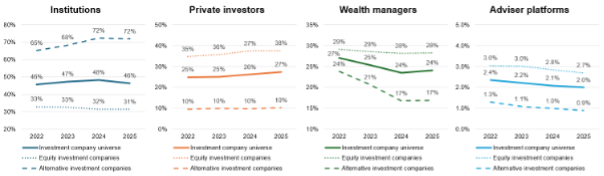
Wealth manager shares, meanwhile, has stablised. After two years of declining share, wealth firms including Rathbones, Evelyn Partners and Brewin Dolphin held steady at 24% of investment trust shares at the end of 2025, with holdings worth £50 billion.
Rathbones is now the single largest wealth management holder at 4.9% of all investment company shares by value, bolstered by its merger with Investec.
Institutional investors still command the biggest slice of the pie at 46%, though their share has fallen. Adviser platforms hold a modest 2%.
Richard Stone, Chief Executive of the AIC said: “During a tumultuous time for investment companies, it is good to see that wealth managers’ share of the industry has held steady and that private investors have continued increasing their share. We are not quite at the point where every headwind is turning into a tailwind, but there are some positive signs, such as the narrowing of the discount from 19% in 2023 to 11% today, and the partial resolution of the cost disclosure issue that has been a cloud over the sector for some years.”
The AIC’s report, based on analysis of £187 billion in holdings, roughly 90% of the sector’s £208 billion market capitalisation, also reveals an interesting insight into international participation. UK investors hold 74% of investment company shares overall, but that drops sharply to just 58% for trusts investing in alternative assets. US investors pick up much of the difference, holding 23% of alternatives-focused trusts compared to 13% of the broader sector.